- The paper presents a counter-free methodology that isolates kernel-level performance by fixing operator, model, and dataset factors in cloud environments.
- It compares four CUDA kernel variants—naive, global-memory-coalesced, cache-blocked, and warp-tiled—demonstrating up to a 3.26× runtime reduction and increased effective memory bandwidth.
- The study reveals that data movement is the key performance bottleneck in memory-bound operations, emphasizing the need for kernel designs that maximize intra-block data reuse.
Operator-Level CUDA Kernel Optimization for Depthwise Convolution in Cloud Environments
Introduction and Motivation
The paper "CUDA Kernel Optimization and Counter-Free Performance Analysis for Depthwise Convolution in Cloud Environments" (2604.25422) offers a rigorous operator-level study of CUDA kernel optimization for depthwise convolution within Structured State Space Models (S4ConvD). The central objective is to decouple algorithmic performance from library-level or model-level confounds by strictly fixing the operator, model, dataset, and training parameters, and varying solely the CUDA implementation. The study is aligned to address performance analysis in cloud environments, where hardware counters and privileged profiling tools (e.g., NVIDIA Nsight Compute) are generally inaccessible. Thereafter, the paper introduces a methodology for counter-free performance analysis, combining CUDA-event timing, kernel-path-aware decomposition, analytic memory traffic estimation, bandwidth measurement, and roofline modeling. This allows architectural insight without reliance on non-portable profiling infrastructure.
Experimental Design and CUDA Kernel Variants
The experimental protocol is structured for maximal control:
- Operator-level invariance: The S4ConvD operator, model configuration, and ASHRAE Great Energy Predictor III dataset characteristics are immutable across experiments, guaranteeing isolation of kernel-level performance factors.
- Kernel-path specificity: Forward, input-gradient, and weight-gradient execution paths are implemented and timed separately to identify bottlenecks per path.
- CUDA kernel variants: Four implementations are realized:
- Naive baseline: One output per thread, no inter-thread cooperation or explicit locality.
- Global-memory-coalesced: Linear mapping for contiguous access, improving global memory transactions but not eliminating access redundancy.
- Shared-memory cache-blocked: On-chip staging of temporal work tiles, enabling intra-block reuse.
- Warp-tiled: Assignment of single warps to (b,h) pairs, with full shared-memory data residence and no inter-warp communication or divergence.
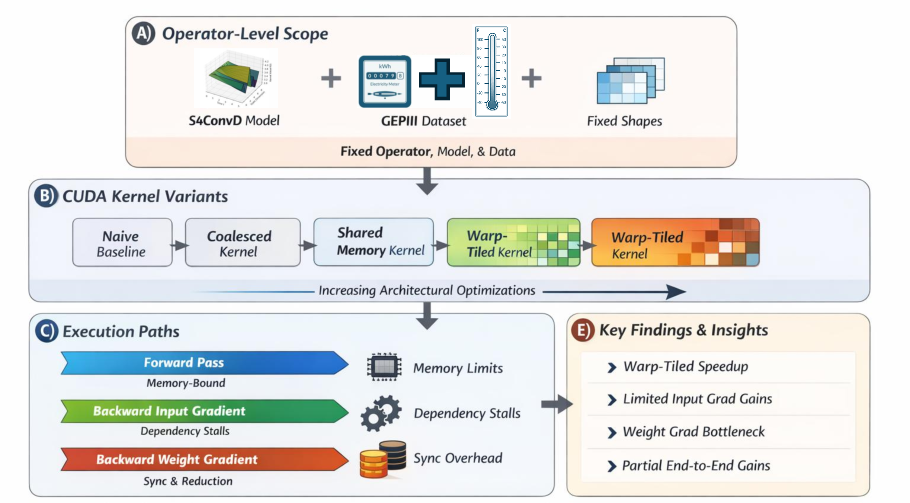
Figure 1: Conceptual overview of the study design, highlighting the operator invariance, evaluated kernel variants, execution paths, and resultant architectural bottlenecks.
Supporting these variants are detailed mappings to thread-block configuration, explicit tiling strategy, and analytical modeling of problem dimensions. The simplified NVIDIA Tesla P100 memory hierarchy (Figure 2) and CUDA execution hierarchy (Figure 3) are both considered to ensure appropriate memory and thread model reasoning.
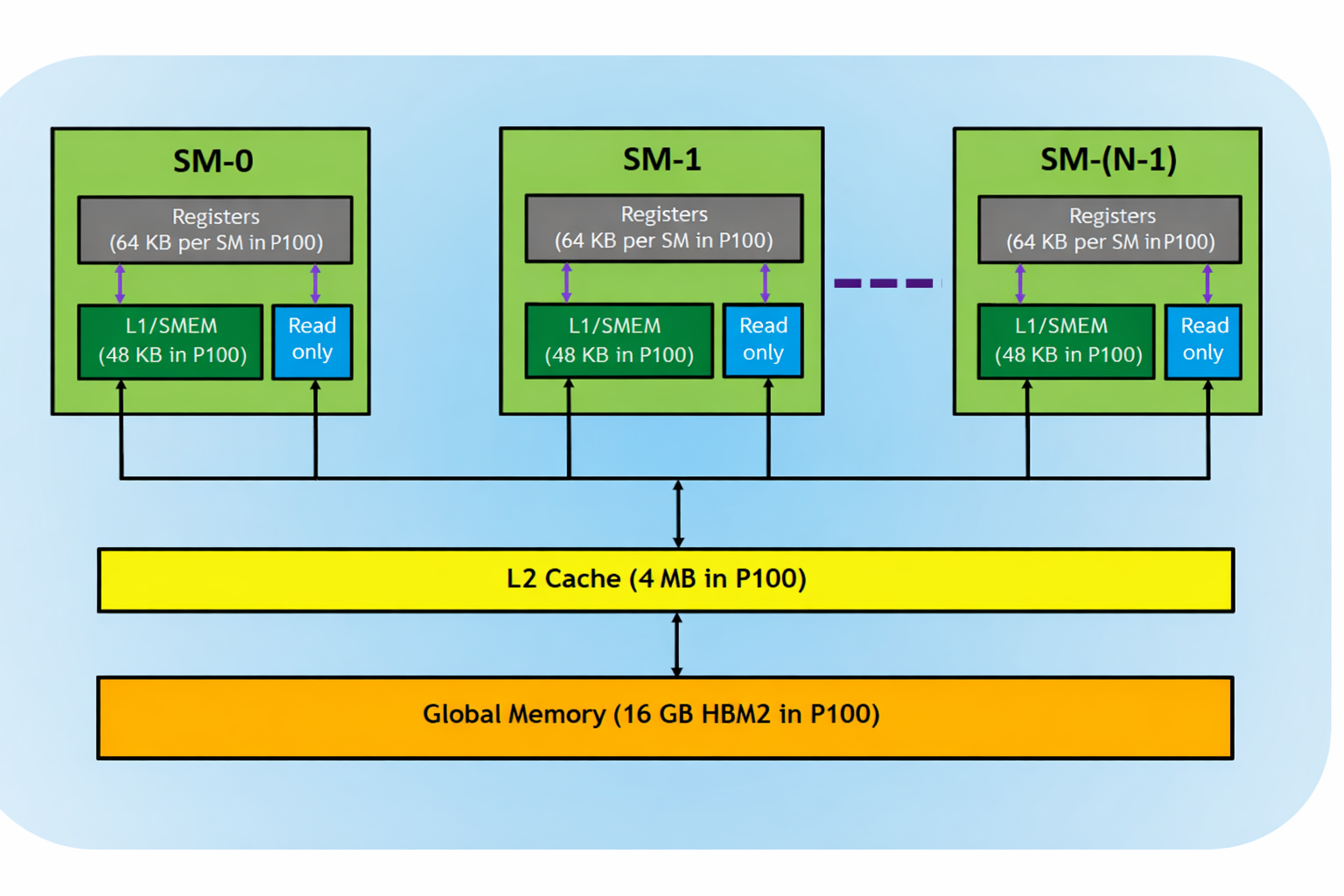
Figure 2: Simplified memory hierarchy of the NVIDIA Tesla P100, showing DRAM, L2, shared memory, and register layers.
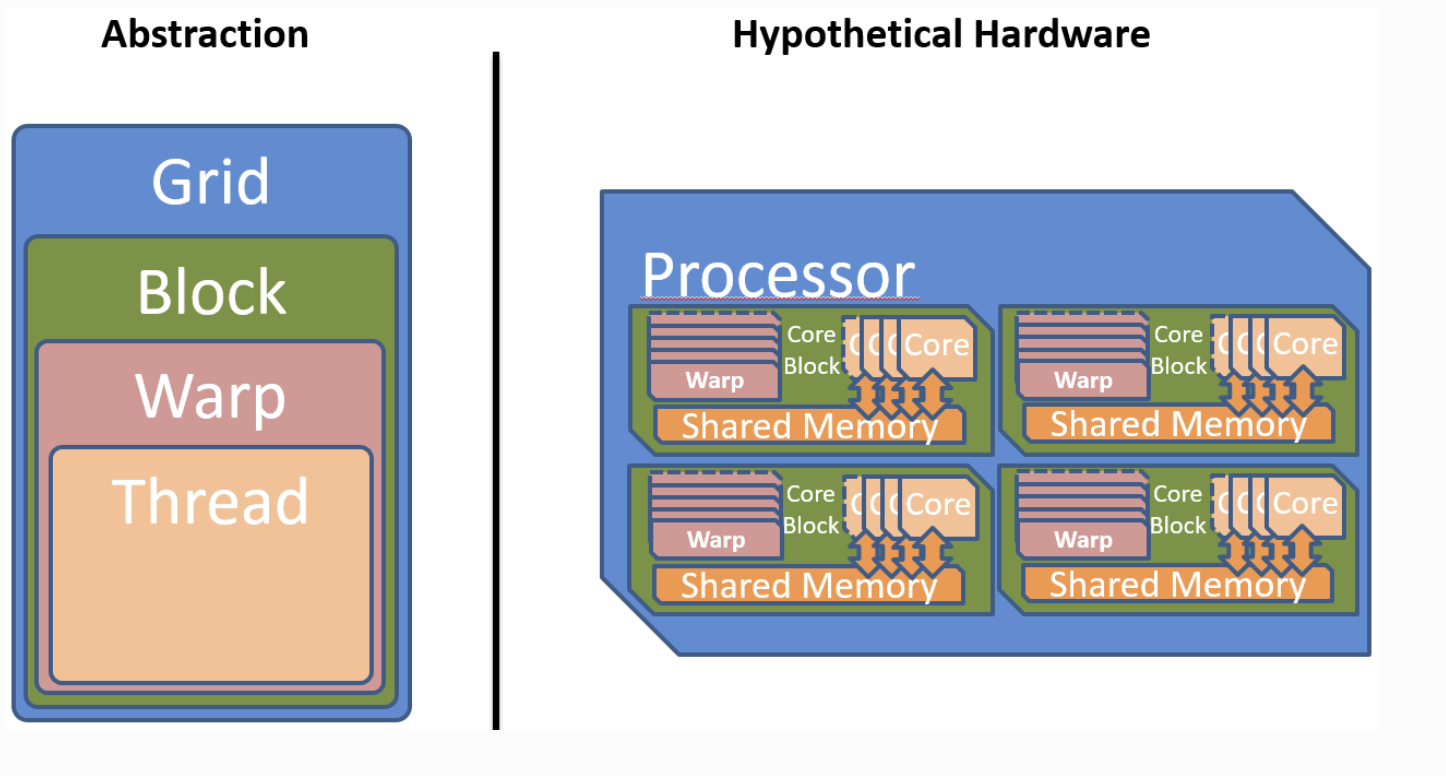
Figure 3: Schematic of the CUDA SW/HW execution hierarchy; thread blocks map to streaming multiprocessors, with warps sharing on-chip resources.
Path-Aware Execution and Memory Access Characterization
The study systematically separates the effects of execution mapping on three paths:
- Forward and input-gradient: Throughput-oriented, each kernel can exploit pronounced data reuse in the temporal domain, provided explicit tiling and staging are implemented.
- Weight-gradient: Dominated by reductions across batch and time, the kernel is structurally bottlenecked by synchronization and accumulation constraints even under full data locality, a fact validated analytically and empirically.
The naive implementation (Figure 4) exemplifies the baseline without locality; all threads redundantly fetch overlapping input slices.
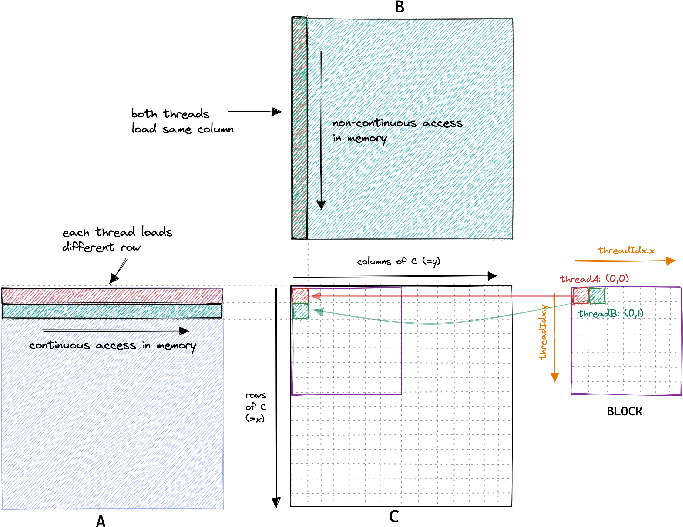
Figure 4: Naive CUDA parallelization—each thread processes a single output, yielding high redundant access in convolution windows.
Moving to warp-level coalescing (Figure 5), temporal accesses are aligned for contiguous access, reducing memory transaction overhead but not overall data movement.
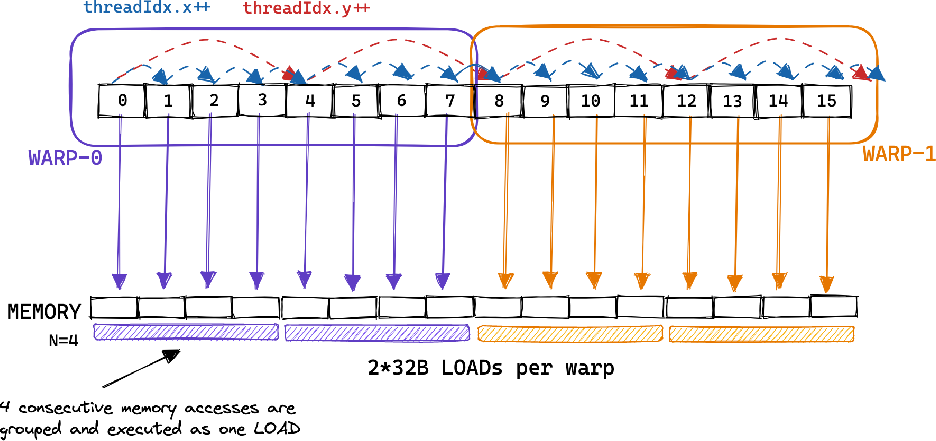
Figure 5: Warp-level coalesced accesses—contiguous thread mapping in t, yielding reduction in transaction count but not in memory redundancy.
Full elimination of redundant data movement is achieved only at the cache-blocked and final warp-tiled stages, the latter bringing data reuse to its theoretical maximum by aligning computation to the warp and staging all necessary input/output for a (b,h) pair.
Profiling relies exclusively on portable CUDA-event-based measurement, with explicit path-level timing instrumentation. Analytical memory traffic is calculated from tensor sizes and access structure, with effective-bandwidth derived as the quotient of traffic and measured runtime. The roofline model is constructed contra classical recipes, using analytic operation count for FLOPs and estimated bytes moved, with the NVIDIA P100 memory and compute peaks.
Key numerical results:
- Warp-tiled kernel achieves a 3.26× runtime reduction for the convolution operator relative to the naive CUDA baseline.
- End-to-end training speedup is 1.29×, confirming the nonlinearity between operator-level and global application performance.
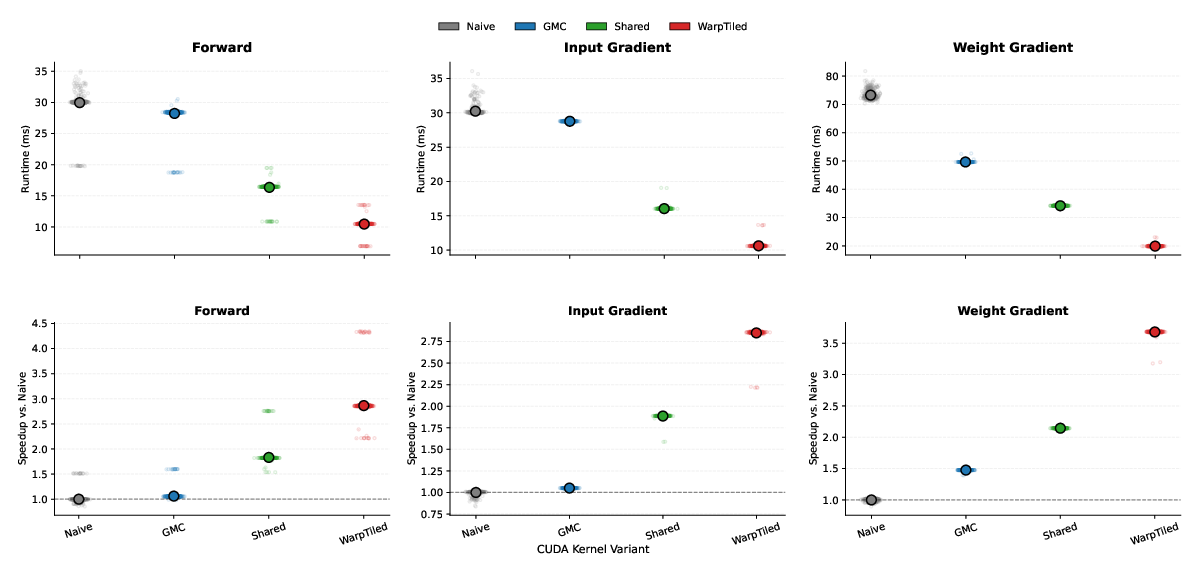
Figure 6: Kernel runtime and speedup across paths—substantial gains for forward/input gradients, with persistent reduction-limited bottlenecks on the weight-gradient.
- Effective memory bandwidth improves from ≈42 GB/s (coalesced) to ≈115 GB/s (warp-tiled), with the theoretical peak at 732 GB/s remaining out of reach due to memory-bound regime and workload arithmetic intensity.
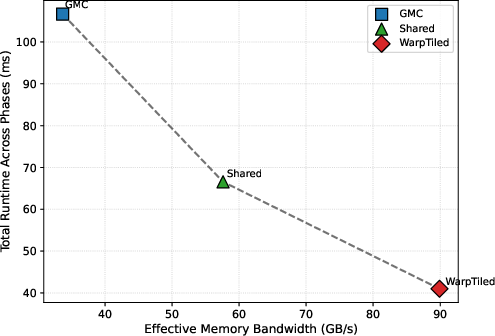
Figure 7: Effective bandwidth versus runtime for optimized kernels—reducing data movement rather than just transaction alignment is critical for performance.
Roofline positioning further emphasizes that all kernels remain far from the compute roof, solidifying that memory system effects, not arithmetic throughput, are rate-limiting.
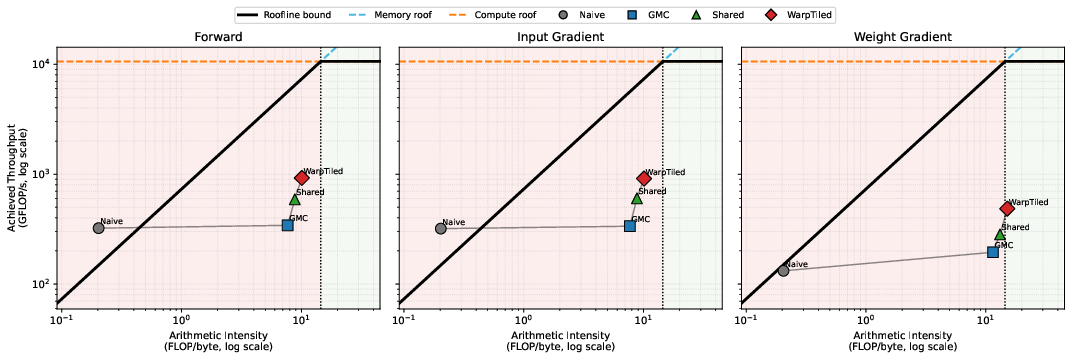
Figure 8: Roofline analysis—forward/input-gradient kernels move upward (higher arithmetic intensity) with improved data locality, but all remain bandwidth-bound.
Numerical Validation and Algorithmic Integrity
Correctness is shown by alignment to PyTorch reference implementation; forward/output and input gradients exhibit errors at the machine epsilon, while weight-gradient shows small, expected floating-point accumulation order deviations at scale (<5×10⁻⁴ in absolute error for the largest configuration, still O(10−6) relative error).
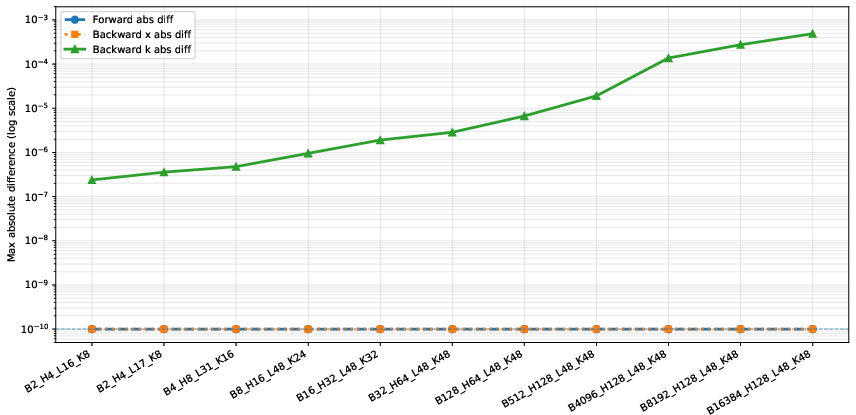
Figure 9: Maximum absolute error versus problem size; only weight-gradient error increases (as expected in parallel reductions).
Theoretical and Practical Implications
The findings accentuate that for memory-bound GPU kernels typical of depthwise convolution and structured operator scenarios, data movement dominates, not arithmetic throughput or occupancy. Only explicit kernel tuning for data reuse (cache-blocked/warp-tiled) can realize large speedups, while strategies only targeting access alignment (coalescing) provide marginal benefit.
A persistent architectural limit is demonstrated for reduction-dominated kernels, where synchronization and accumulation cannot be parallelized away by memory optimization alone. This is particularly consequential for large-batch, deep convolutional or state-space models, indicating future research should focus on algorithmic (e.g., hierarchical reductions, kernel fusion), not only mapping-level, changes to overcome these effects.
The methodology itself reframes the restricted nature of cloud environments from a liability to an opportunity for reproducibility and portability. Analytical, counter-free techniques are shown to recover architectural inference—identifying both memory redundancy bottlenecks and reduction limits—without needing hardware-event observation.
Future Directions
The kernel-level optimization and counter-free analysis paradigm can be generalized to more complex operators, structured pipelines, and automated model-to-kernel mapping systems. Further operator fusion, block-level or cluster-level reduction scheme innovations, and generalized cloud-executable analysis workflows form a compelling agenda for performance research in machine learning systems and high-performance deep learning.
Conclusion
The paper solidifies that data movement is the principal performance bottleneck for cloud-constrained, memory-sensitive GPU workloads such as depthwise convolution in modern sequence models. Warp-aware kernel design and explicit intra-block data reuse—rather than naive occupancy maximization or access coalescing alone—are prerequisites for efficient utilization of GPU resources. Reduction-heavy backward paths will remain bottlenecked barring new algorithmic schemes. The counter-free, operator-level evaluation workflow established here provides a reproducible and portable foundation for future cloud-scale system performance research.
Reference: "CUDA Kernel Optimization and Counter-Free Performance Analysis for Depthwise Convolution in Cloud Environments" (2604.25422).