- The paper's main contribution is the LEDF-GNN model, which integrates a dual-topology strategy and deep nonlinear embedding fusion to resolve heterophilic misaggregation and over-smoothing in GNNs.
- It introduces a Dual-Topology Parallel Strategy (DTPS) and a novel Layer Embedding Deep Fusion operator, significantly enhancing node classification accuracy across both homophilic and heterophilic datasets.
- Empirical evaluations and ablation studies demonstrate that LEDF-GNN outperforms traditional fusion methods, offering robust performance improvements even in deep propagation scenarios.
Layer Embedding Deep Fusion Graph Neural Network: Addressing Heterophily and Deep Propagation Degradation in GNNs
Introduction and Motivation
Graph Neural Networks (GNNs) operate under the implicit assumption of label consistency—nodes connected by edges are likely to share the same class. This homophily prior, while effective for many real-world tasks, results in the degradation of representational capacity in settings where graphs are heterophilic, i.e., where connected nodes frequently belong to different classes. Additionally, as the message-passing depth increases, GNNs suffer from over-smoothing: node embeddings become indistinguishable, particularly in heterophilic graphs where structural and semantic alignment is absent. The "Layer Embedding Deep Fusion Graph Neural Network" (LEDF-GNN) seeks to resolve these two prominent bottlenecks—structural heterophily and deep propagation degradation—by introducing two orthogonal yet synergistic enhancements: deep nonlinear inter-layer fusion and adaptive, dual-topology learning (2604.23324).
Theoretical Analysis of Over-Smoothing and Misaggregation
LEDF-GNN's theoretical motivation is grounded in an analysis of the message-passing process. Over-smoothing can be decomposed into intra-class and inter-class effects. In homophilic graphs, increased propagation depth leads to feature convergence within classes without affecting overall class separability. In heterophilic cases, however, early layers already incur significant performance loss due to structural misalignment, resulting in rapid inter-class smoothing and loss of discriminability. This is empirically substantiated by the rapid decline in classification accuracy with propagation depth in heterophilic datasets compared to the more gradual degradation in homophilic ones.
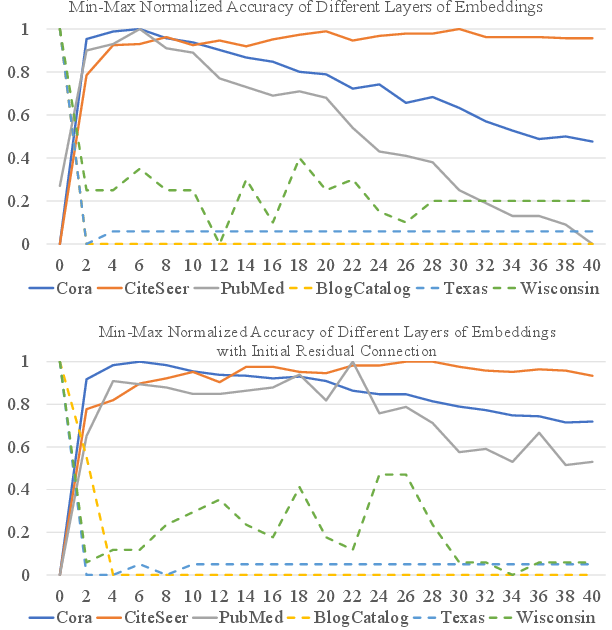
Figure 1: Min-Max normalized classification accuracy over propagation rounds, highlighting earlier and more severe degradation in heterophilic graphs.
Residual connections, a common remedy for over-smoothing, are shown to be inadequate for heterophilic graphs. The core issue is not feature collapse but the intrinsic misaggregation stemming from the graph topology. In the absence of homophily, message passing propagates noise rather than semantically relevant signals.
Architecture of LEDF-GNN
The LEDF-GNN framework is comprised of two primary innovations:
1. Dual-Topology Parallel Strategy (DTPS):
This component generates two parallel propagation streams: one on the original topology and one on a logically reconstructed topology. The latter is derived using the Logical Similarity Coefficient (LSC), which quantifies feature-wise overlap and suppresses dissimilarity through bitwise logical operations. Node features are discretized prior to LSC computation to ensure compatibility. The reconstructed topology enhances effective homophily, mitigating edge-induced misaggregation.
2. Layer Embedding Deep Fusion (LEDF) Operator:
A multi-layer nonlinear fusion network stacks embeddings from all message-passing rounds into a tensor and applies a sequence of fully connected layers. Unlike convex or attention-based linear fusion, this operator is capable of modeling complex, high-order inter-layer dependencies. The fusion process is adaptive and backpropagation-driven, allowing the network to capture layer-wise complementarities and dynamically alleviate over-reliance on noisy depths prevalent in heterophilic scenarios.
The two streams are fused at the representation level via trainable, node-wise attention, producing a unified output embedding.
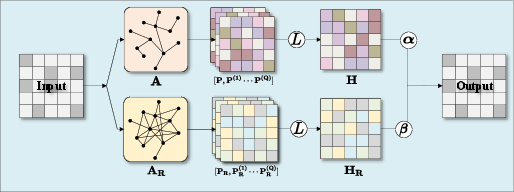
Figure 2: Pipeline overview of LEDF-GNN, detailing the dual-topology mechanism and the deep nonlinear fusion operator.
Empirical Evaluation
Node Classification
LEDF-GNN demonstrates consistent improvement over existing architectures—including both the backbone variants (MLP, GCN, GAT, GIN, APPNP) and recent SOTA plug-in modules (BORF, ComFy, AGMixup)—on thirteen benchmark datasets spanning homophilic and heterophilic regimes. Classification accuracy gains are statistically significant across both graph types, with particularly strong improvements in settings where classical methods fail, notably on heterophilic benchmarks BlogCatalog, Texas, Wisconsin, Chameleon, and Squirrel.
Component Ablation
Ablation analyses confirm the necessity and complementarity of the DTPS and LEDF modules. Removing either topology path or reverting to single-layer embedding leads to pronounced performance drops, especially in heterophilic graphs.
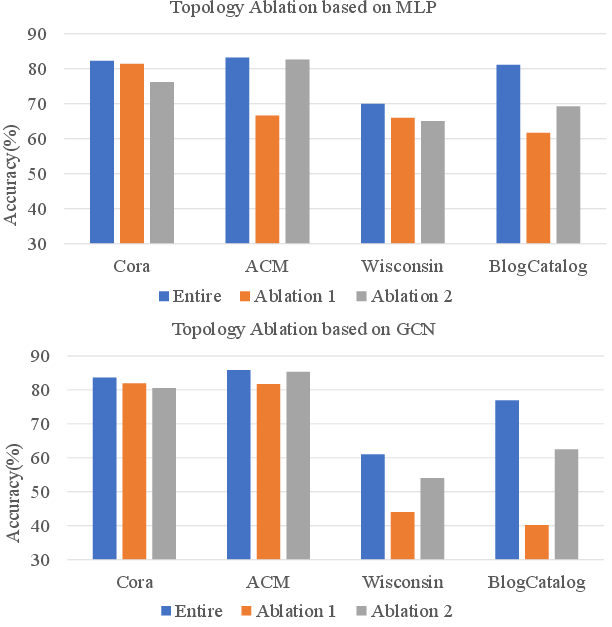
Figure 3: Accuracy contrast between LEDF-GNN and DTPS ablation variants on representative homophilic and heterophilic datasets.
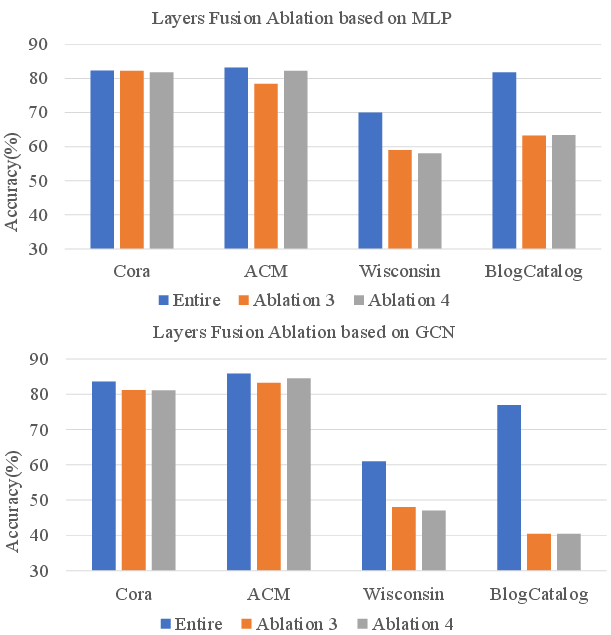
Figure 4: LEDF ablation results showing deeper embedding fusion is critical, with performance sharply declining when fusion is disabled.
Fusion Method Comparison
LEDF fusion distinctly outperforms mean pooling, max pooling, and classical attention-based summation across all datasets, with the performance gap widening under strong heterophily. Analysis of attention distributions reveals that attention-based fusion collapses onto shallow layers in heterophilic graphs, confirming the inadequacy of convex fusion schemes.
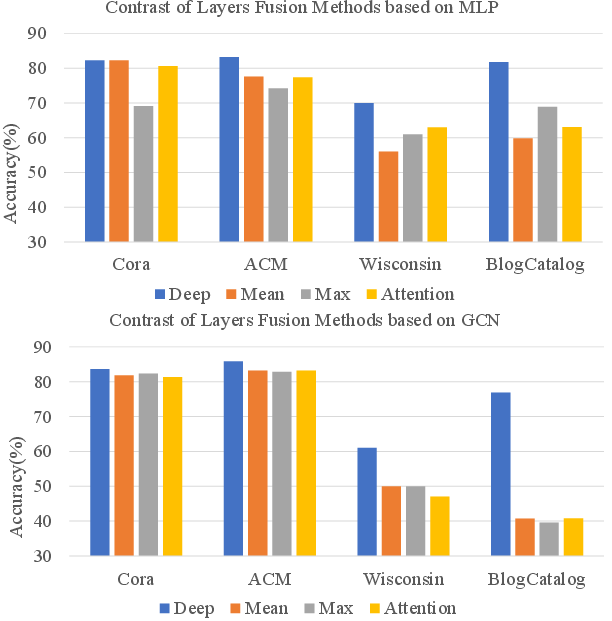
Figure 5: Validation comparison of LEDF fusion with other aggregation strategies, highlighting superior robustness of the proposed nonlinear operator.
Visualization and Robustness
Qualitative embedding visualizations on Cora, ACM, BlogCatalog, and Wisconsin validate that LEDF-GNN produces more structured and separable clustering compared to baselines, for both MLP and GCN backbones.
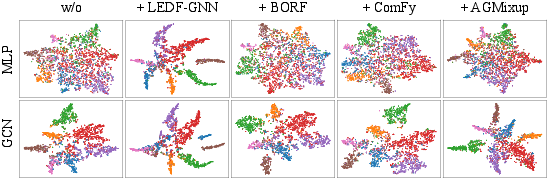
Figure 6: Visualization on Cora: LEDF-GNN preserves inter-class margins compared to baseline and prior re-wiring methods.
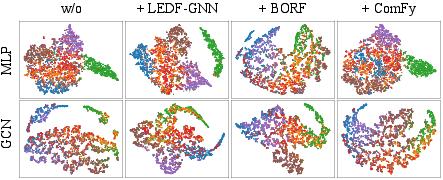
Figure 7: Visualization on BlogCatalog: Backbones with LEDF-GNN yield higher cluster purity under strong heterophily.
Sensitivity analysis on hyperparameters (propagation depth Q, reconstruction parameter K) confirms model robustness without laborious tuning in diverse regimes.
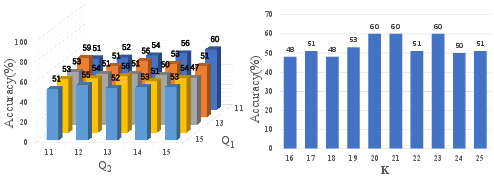
Figure 8: Sensitivity of classification accuracy to Q and K on Wisconsin, exemplifying stable behavior.
Implications and Future Directions
The LEDF-GNN addresses a central limitation of the message-passing paradigm: the entanglement of topological and semantic cues. By decoupling the modeling of structural similarity from semantic similarity, and by replacing brittle linear inter-layer aggregation with nonlinear, learnable fusion, LEDF-GNN establishes a more generalizable and robust approach for graph representation learning. The model’s plug-in design ensures compatibility with a broad range of graph backbones, making it amenable to future variants (e.g., spectral GNNs, transformer-based graph models).
A notable implication is for the development of adaptive GNNs capable of automatic topology selection and dynamic fusion, advancing towards models that require less prior knowledge of homophily/heterophily in practical deployment. Furthermore, the LSC-based logical topology construction suggests exciting new pathways for discrete, interpretable graph rewiring. Extending LEDF-GNN principles to temporal graphs, attributed hypergraphs, and large-scale web graphs presents clear avenues for future investigation.
Conclusion
LEDF-GNN presents a cohesive, theoretically motivated, and empirically validated framework for graph neural network learning in heterogeneous and deep propagation environments. By integrating dual-topology representation and deep nonlinear embedding fusion, the architecture achieves state-of-the-art accuracy and robustness under both homophilic and heterophilic conditions. These advances offer strong foundational insights for addressing topology–semantic misalignment, setting a precedent for future GNN development (2604.23324).

