- The paper demonstrates that measurement-only circuits exhibit distinct volume-law and sub-volume-law entanglement transitions controlled by measurement range and density.
- It employs a replica mapping to an emergent statistical mechanics model, revealing a direct link between circuit parameters and an effective power-law XX Hamiltonian.
- The study shows that dense, single-basis circuits enable rapid purification and resource state generation with suppressed scrambling, offering promising routes for quantum architectures.
Introduction and Motivation
The study explores measurement-only circuits (MoCs) as minimal architectures for generating or suppressing many-body entanglement through iterative local projective measurements, giving rise to measurement-induced phase transitions (MIPTs) in quantum systems. The central focus is on one-dimensional MoCs with long-range parity checks, investigating the interplay between measurement range, measurement density, and circuit structural features. Fundamental observables, including entanglement entropy, mutual information, tripartite mutual information (TMI), purification dynamics, and Bell-cluster statistics, are used to classify phases beyond mere entanglement scaling, highlighting the intricate landscape of quantum information in such circuits.
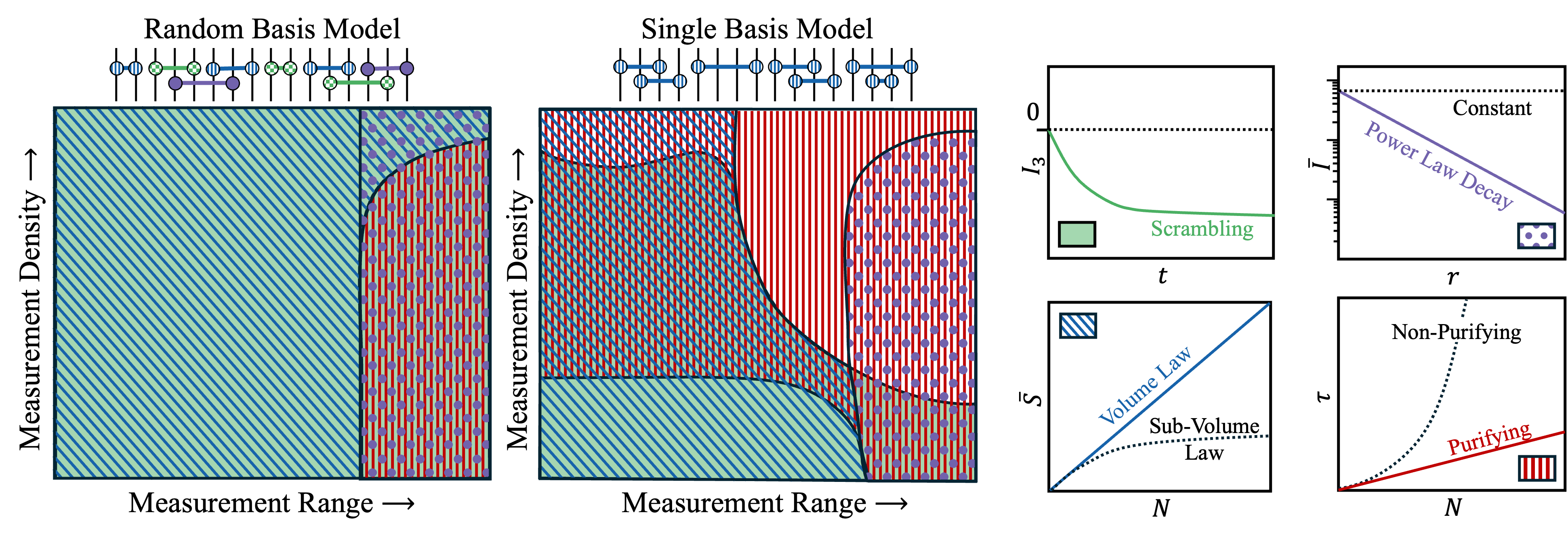

Figure 1: Overview of the key phase diagram and theoretical mapping; schematic illustration of the measurement-induced phases and their characterizations via scrambling, entanglement, and purification properties; and the mapping to a statistical mechanics model related to a power-law XX Hamiltonian.
Circuit Architecture and Measurement Protocols
MoCs are built from two-qubit projective measurements (parity checks) with variable spatial range, governed via Jij∼∣i−j∣−α, and measurement densities per layer (M2/N). Two principal circuit designs are examined:
- Random-basis protocol: Each measurement is randomly chosen from {XX,YY,ZZ}.
- Single-basis protocol: Measurements within each layer share a common basis but basis varies between layers, introducing temporal structure.
The system comprises N qubits partitioned into four equal subsystems (A–D). Key observables are the trajectory-averaged bipartite entanglement entropy (S), mutual information (I) at maximum separation, TMI (I3) for three subsystems, and purification time (τ) after introducing an ancilla system.
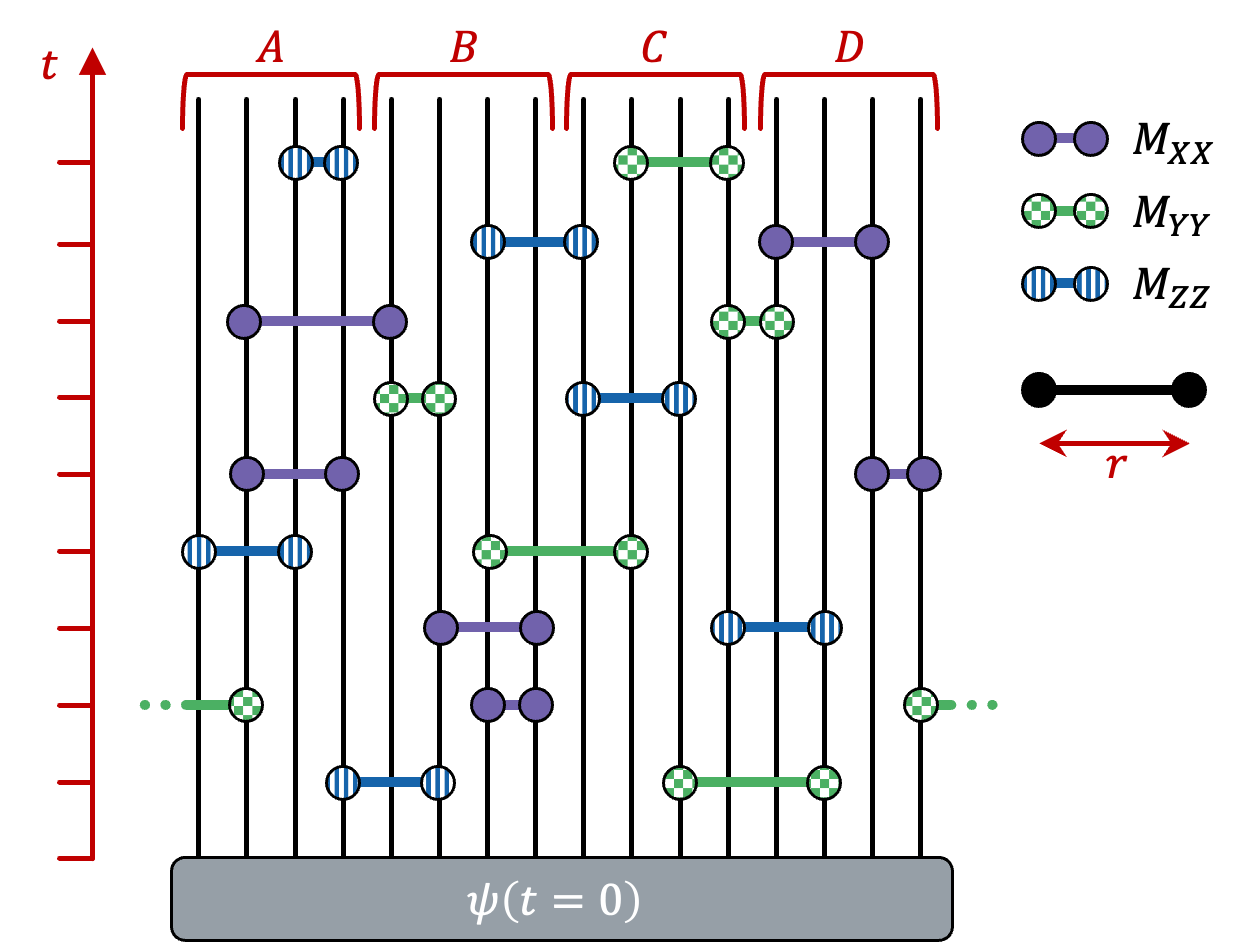
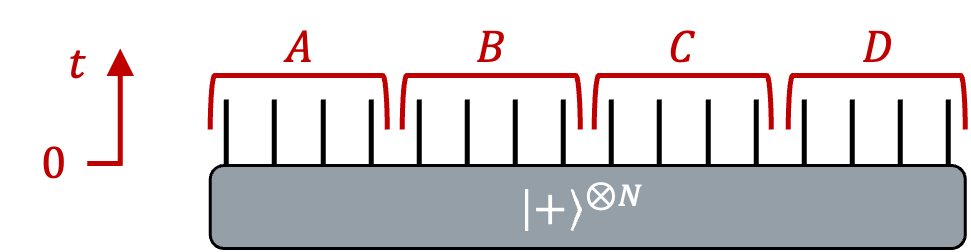
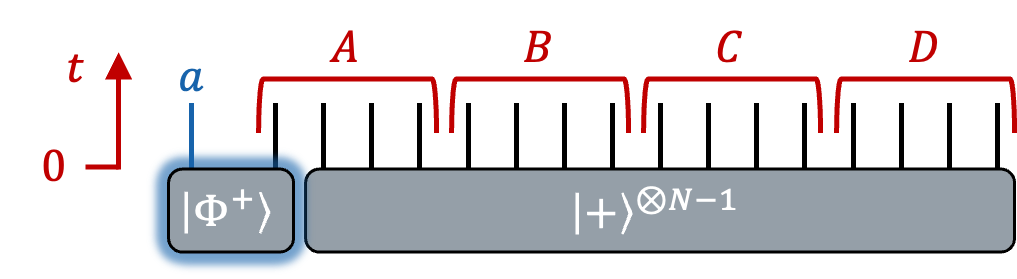
Figure 2: Schematic of the circuit design: subpartitioning, measurement layer architectures, and initialization protocols for pure and mixed states.
Mapping to Statistical Mechanics and Effective Hamiltonians
A central theoretical advance of the study is the replica-based mapping of trajectory-averaged entanglement entropy in random-basis MoCs to the free energy in an emergent two-dimensional statistical mechanics model. The continuous-time limit yields an effective XX Hamiltonian with long-range couplings. The observed transition between volume-law and sub-volume-law entanglement maps directly onto the boundary between spontaneous symmetry breaking and critical XY phases in the Hamiltonian.
Random-Basis MoC: Phase Structure and Transitions
Large-scale Clifford circuit simulations delineate phase diagrams versus measurement range (α) and density (M2/N). Volume-law entanglement prevails in the long-range measurement regime (M2/N0), whereas sub-volume-law behavior emerges for short-range, sparse circuits. The location of the phase boundary aligns with the theoretical prediction M2/N1 from the mapping to a power-law XX chain.
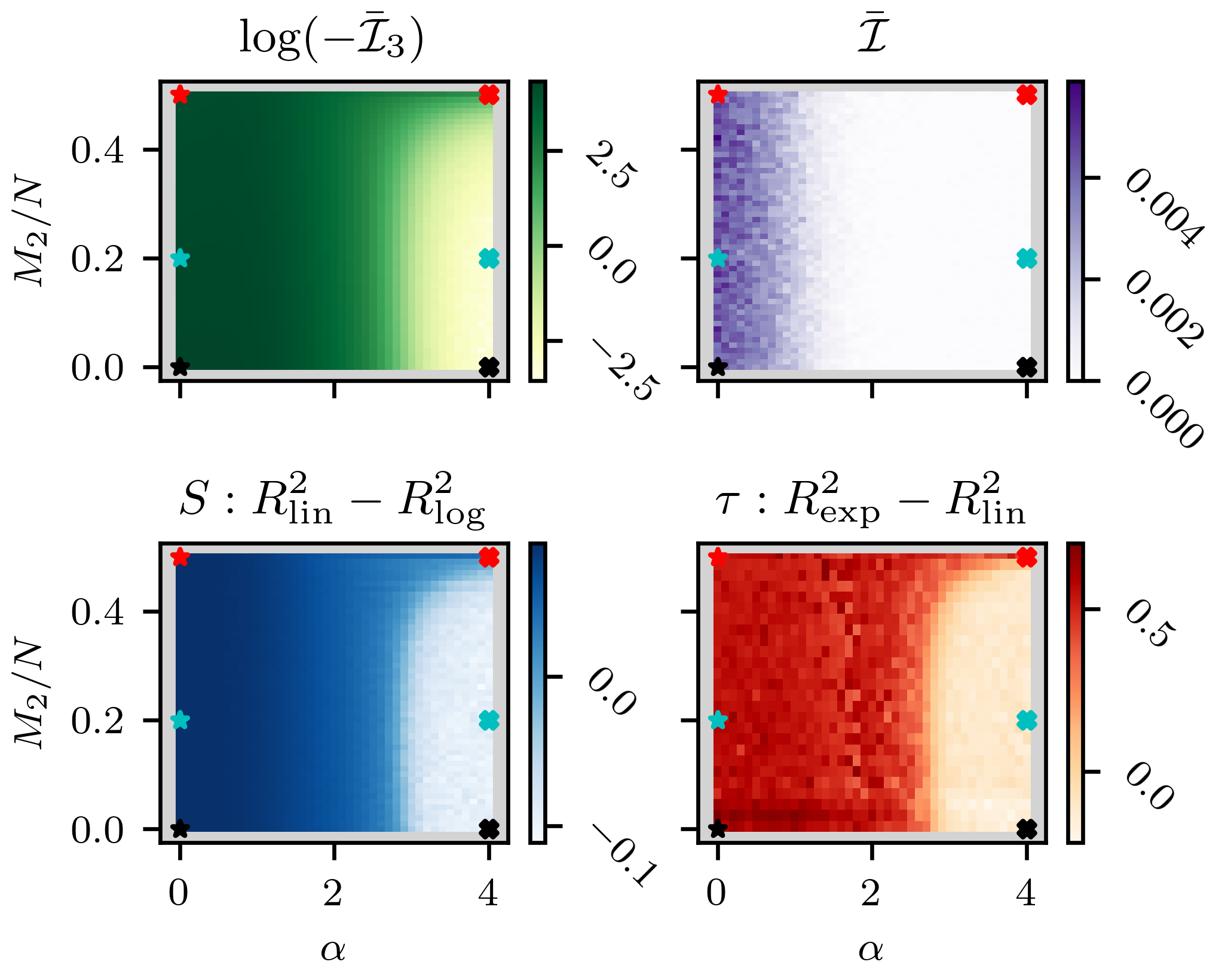
Figure 3: Random-basis phase diagrams: steady-state tripartite mutual information, mutual information, entanglement entropy scaling with system size (linear vs logarithmic), and purification behavior.
Numerical fits reveal that entanglement entropy M2/N2 is linear (volume-law) for long-range and dense measurement scenarios and logarithmic (critical/sub-volume) under short-range, sparse conditions (Figure 4).
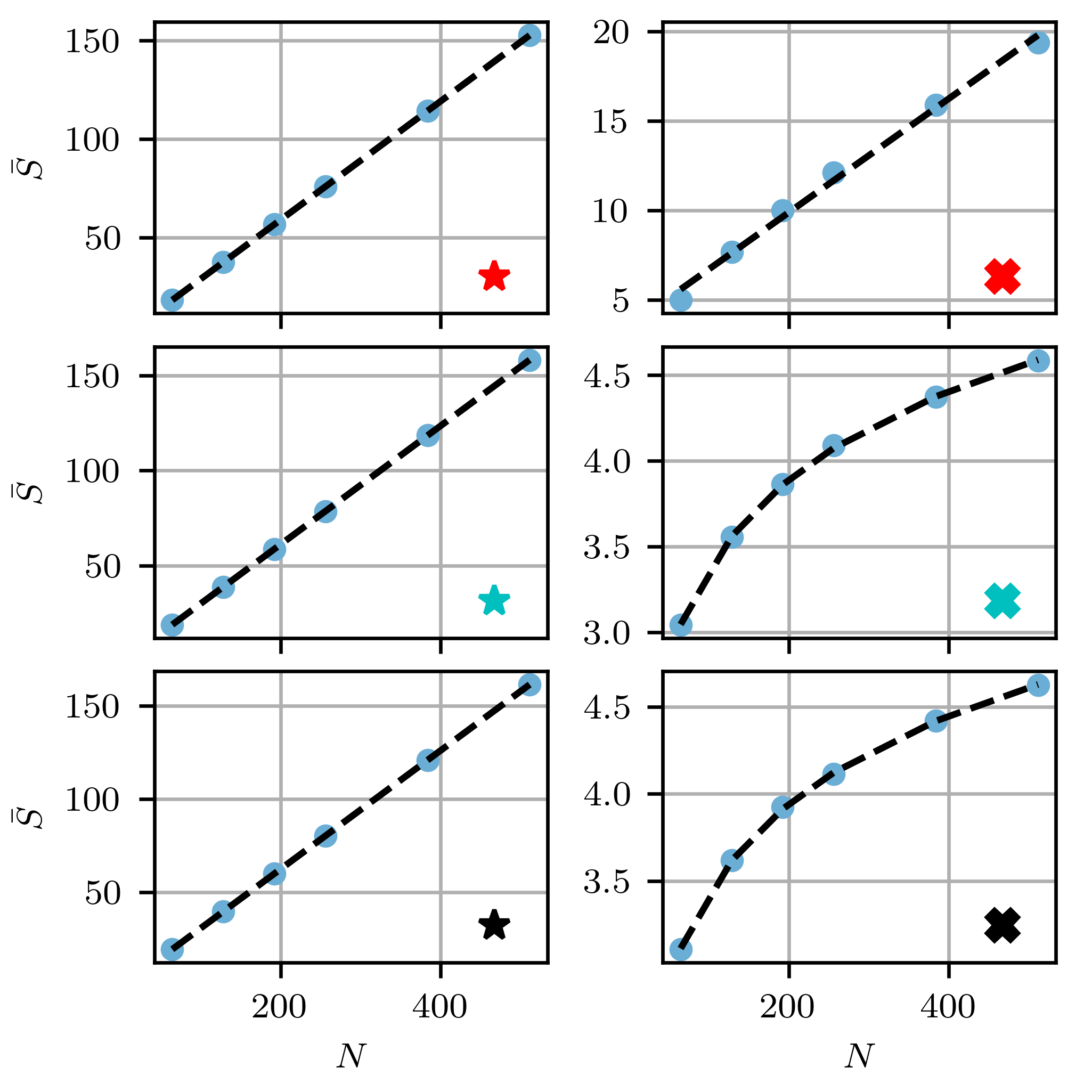
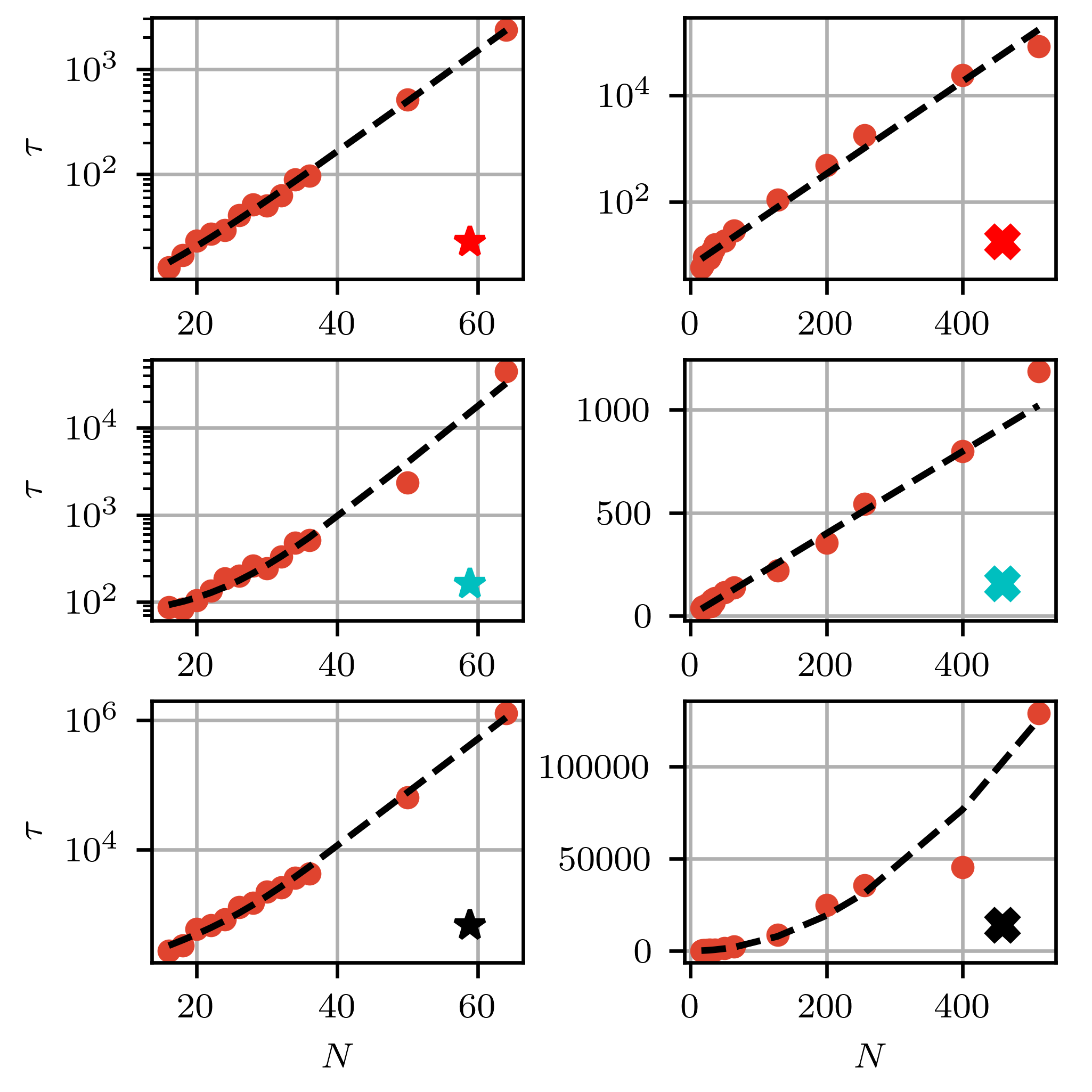
Figure 4: Entanglement entropy scaling and purification timescale fits for distinct points in the parameter space, distinguishing volume-law and critical entanglement regimes.
Purification timescales scale exponentially in the volume-law regime, precluding efficient disentanglement of an ancilla, while critical/sub-volume-law phases exhibit linear scaling in M2/N3—indicating more accessible purification. The onset of purification closely tracks measurement frustration due to noncommutativity, with the fraction of commuting measurements strongly controlled by M2/N4.
Steady-state TMI, M2/N5, is negative and grows with M2/N6 in long-range regimes (scrambling phase). Scrambling time (M2/N7) transitions from M2/N8 in sparse circuits to M2/N9 in dense settings, matching fast scrambling bounds.
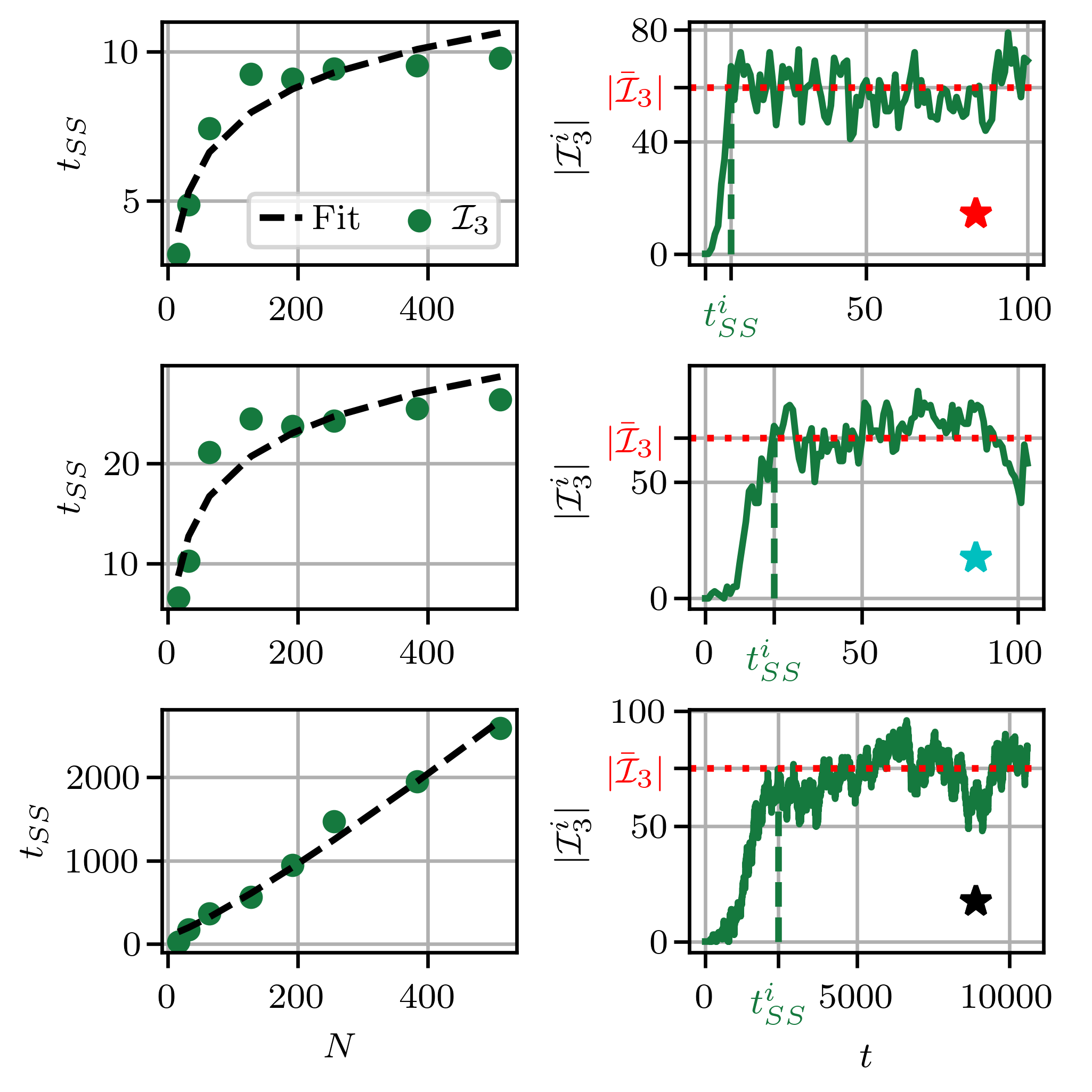
Figure 5: Scaling of scrambling time with system size, demonstrating {XX,YY,ZZ}0 and {XX,YY,ZZ}1 behaviors.
Mutual information as an order parameter distinguishes long-range from short-range entanglement and tracks the presence of Bell pairs across the system (Figure 6).
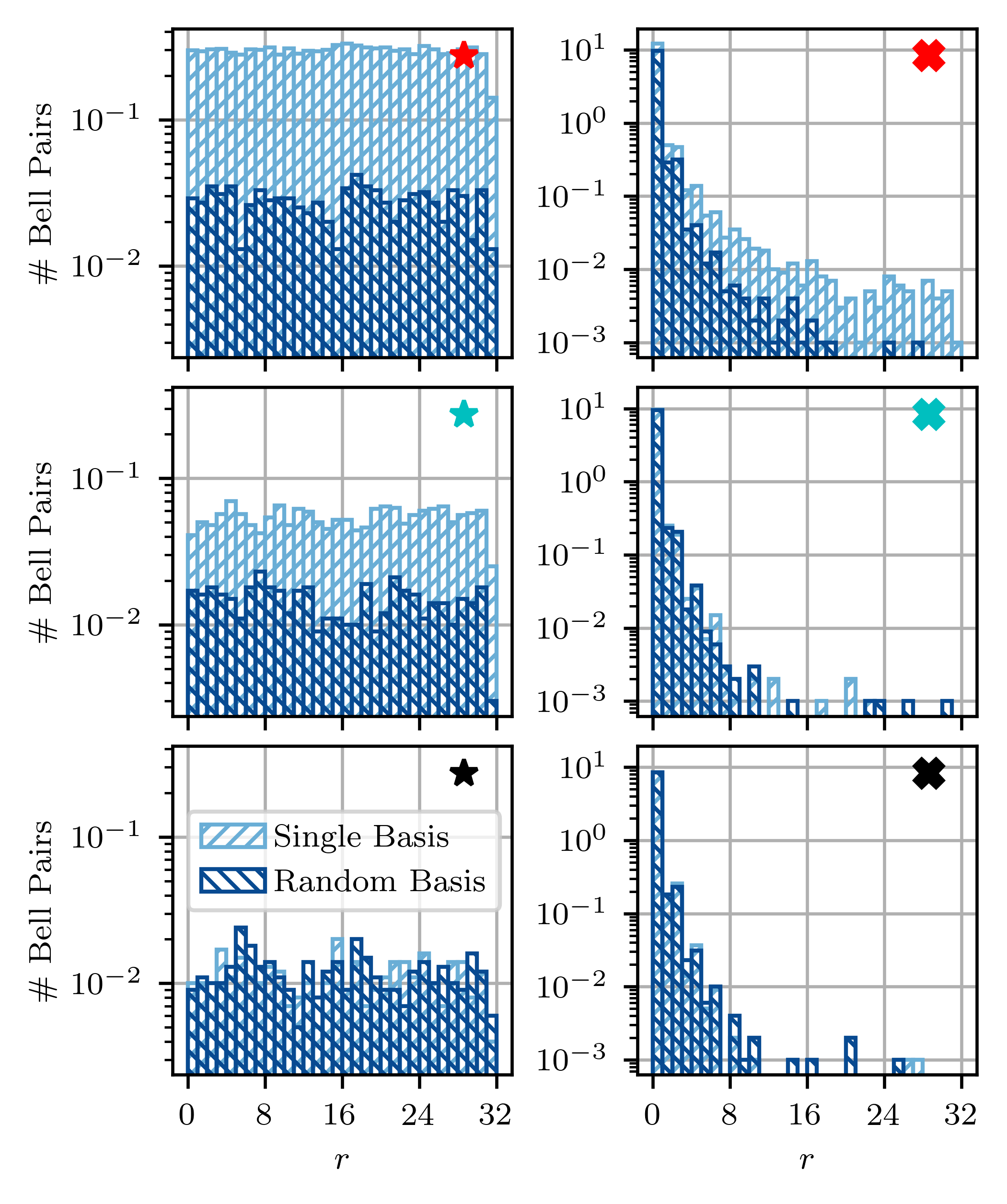
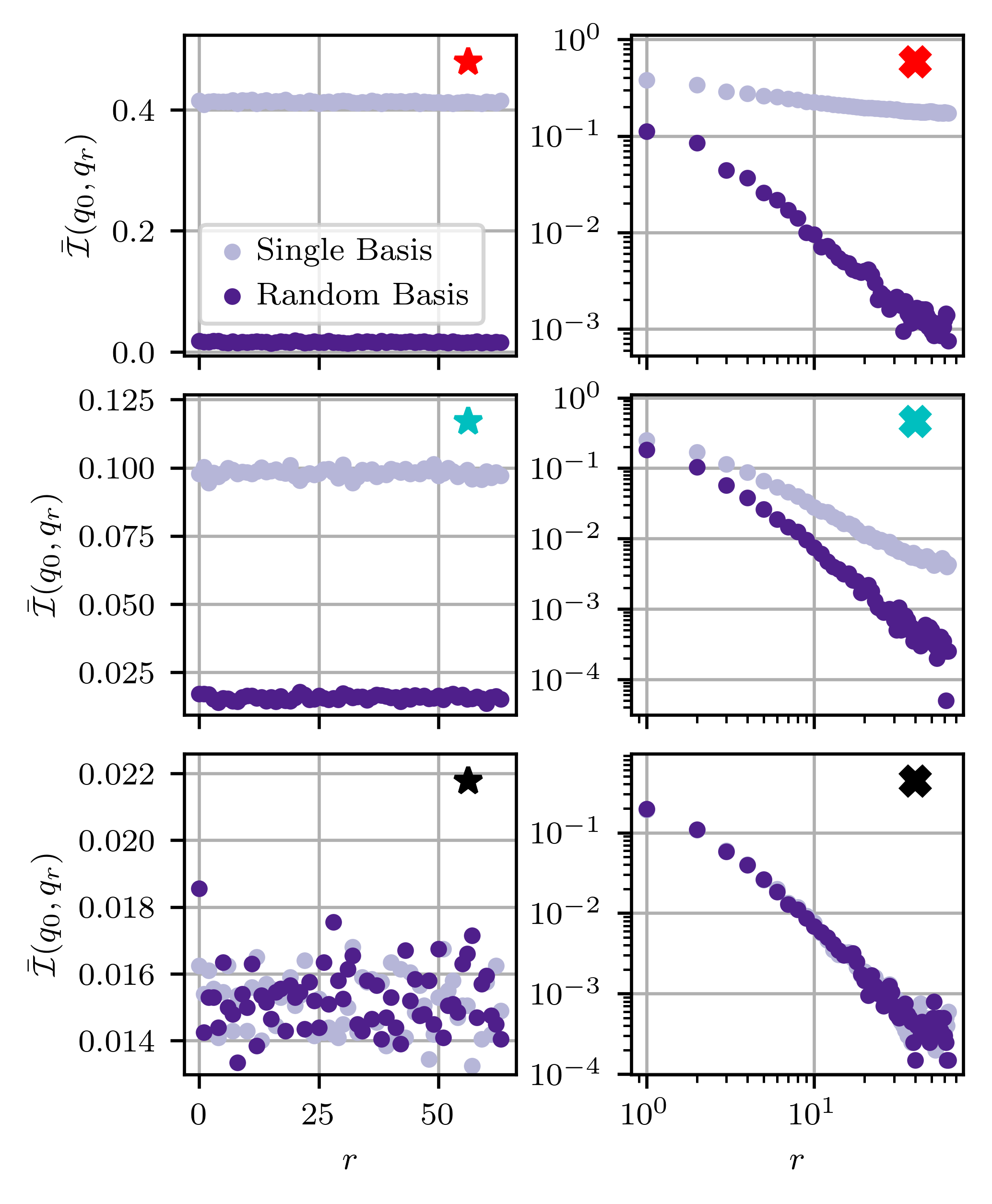
Figure 6: Distribution of Bell pairs and mutual information decay profiles for different measurement regimes and circuit densities.
The study introduces a projective XXZ model, where the measurement basis probabilities ({XX,YY,ZZ}2) interpolate between Ising-like ({XX,YY,ZZ}3) and XY-like ({XX,YY,ZZ}4) dominance. A distinct transition is observed at the SU(2)-symmetric point ({XX,YY,ZZ}5): entanglement entropy peaks and mutual information transitions from power-law decay (XY phase) to constant (Ising phase). Only at this critical point does scrambling arise.
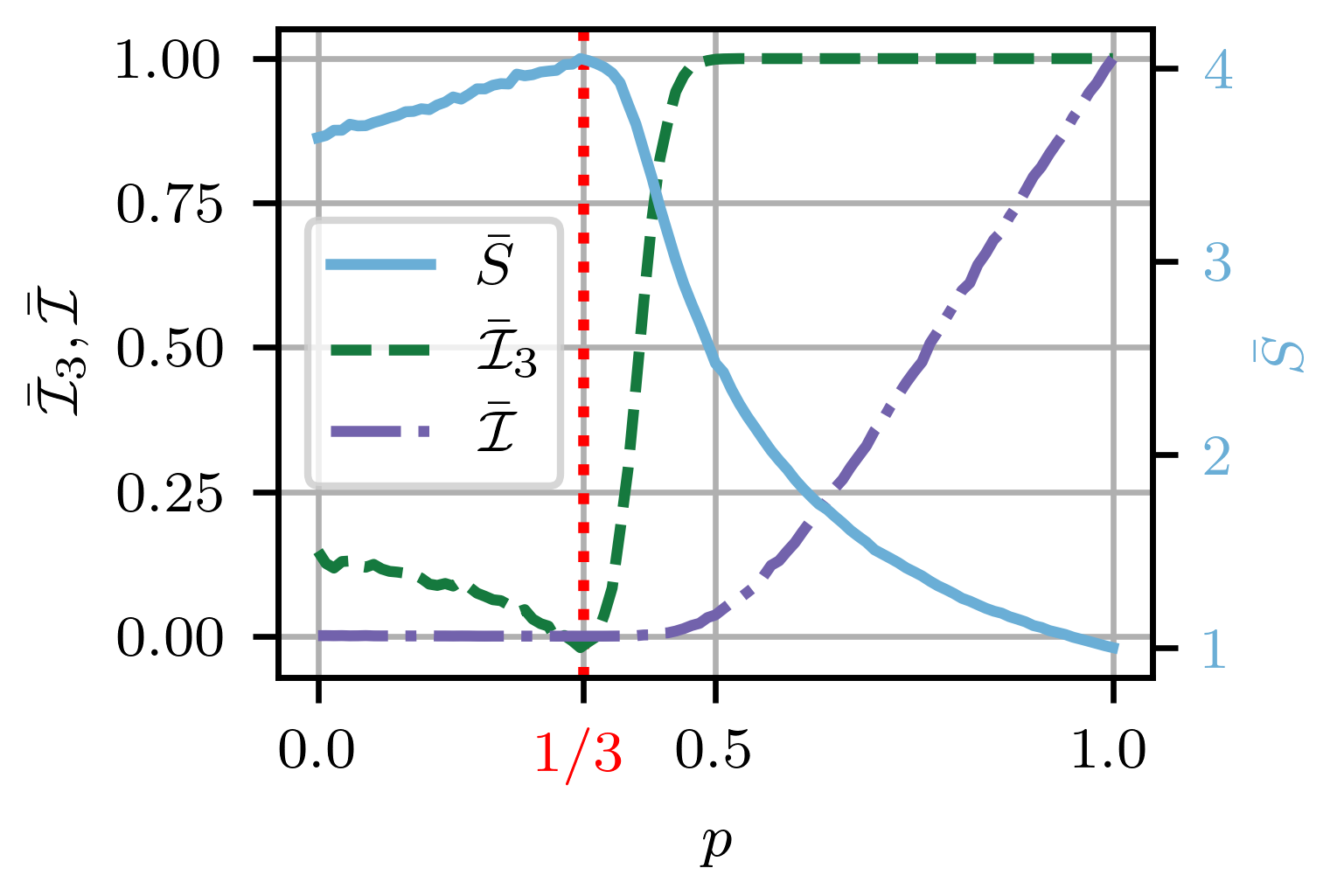
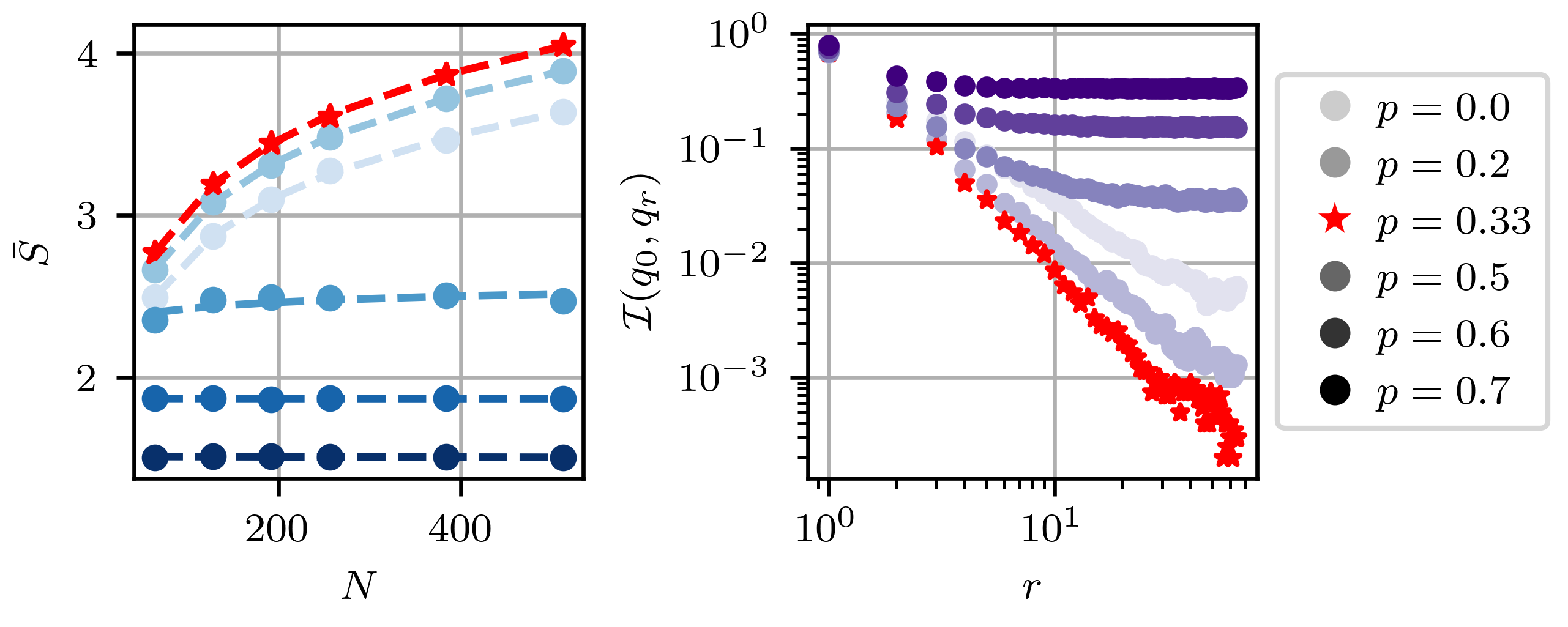
Figure 7: Steady-state observables in the projective XXZ model as a function of {XX,YY,ZZ}6; highlight of phase transition, scrambling, and mutual information decay.
Single-Basis MoC: Structurally Induced Phases and Rapid Purification
The introduction of layerwise measurement basis structure modifies phase boundaries and enhances the purifying properties of MoCs. Steady-state entanglement transitions persist, but become tunably shifted with circuit density. In dense, single-basis circuits, purification occurs on an {XX,YY,ZZ}7 timescale independent of system size, coexisting with volume-law entanglement and suppressed scrambling—enabling efficient preparation of highly entangled resource states.
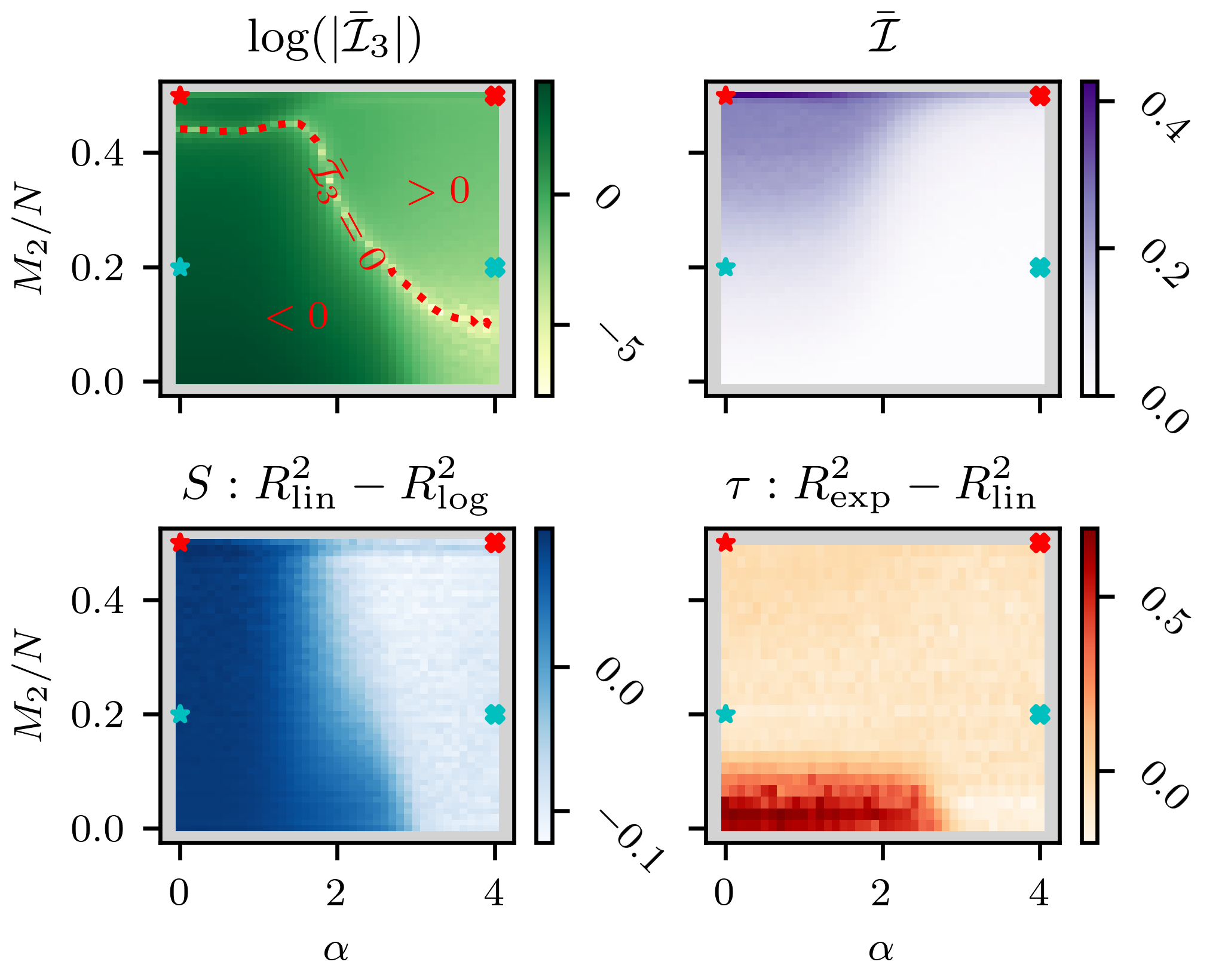
Figure 8: Single-basis phase diagrams: entanglement transition, mutual information, TMI, and purification timescale scaling versus measurement range and circuit density.
Steady-state mutual information and Bell clusters are robustly realized in dense single-basis regimes, confirming long-range entanglement is locally accessible and not scrambled.
Discussion, Implications, and Outlook
The research establishes measurement-only Clifford circuits with power-law measurement range as versatile platforms for engineering diverse entanglement and information phases. Key findings include:
- Entanglement scaling and phase transitions: Mapping to statistical mechanics and XX Hamiltonians enables predictive delineation of volume-law/sub-volume-law transitions tied to measurement range.
- Scrambling dynamics: Measurement-only circuits can realize fast scrambling and distinct scrambling/non-scrambling phase boundaries via circuit density and measurement structure choices.
- Purification efficiency: Single-basis, dense circuits can rapidly purify initial mixed states while maintaining extensive entanglement, opening routes for robust entanglement generation and distribution.
- Bell pair locality and resource state generation: Measurement-only protocols can create states with significant long-range entanglement that remain locally accessible due to suppressed scrambling.
Practical implications are substantial. Dense, structured MoCs offer scalable protocols for preparing robust, highly entangled states without the need for global operations, favorable for quantum networking and architectures with constrained connectivity. Theoretical implications point towards generalizations involving anisotropic projective models, criticality universality, and entanglement-resource engineering.
Conclusion
This work synthesizes numerical and analytical approaches to classify entanglement and information phases in measurement-only circuits with long-range projective measurements. The mapping to power-law XX Hamiltonians elucidates entanglement transitions and criticality. Structured measurement protocols can prepare volume-law entangled, non-scrambling, and efficiently purifying states, with direct applicability to quantum information processing. The findings motivate further exploration into circuit-driven phase transitions, resource state generation, and measurement-induced dynamics in many-body quantum systems.