- The paper demonstrates that engineered two-photon loss converts single-photon loss–induced oscillatory decoherence into a smooth, extended decay, enlarging the metrological window by over an order of magnitude.
- It employs a systematic comparison of TPD-Kerr, TPD-ETPL, and TPD-Kerr-ETPL models via Lindblad master equation simulations using realistic parameters from superconducting circuits.
- The study highlights that dissipation engineering stabilizes non-Gaussian cat states and robust squeezing (S > 3 dB) in continuous-variable systems, promising practical quantum sensors.
Quantum Metrology with Engineered Two-Photon Loss: Extending Robust Sensing via Nonlinear Oscillator Dynamics
Introduction and Motivation
Single-photon loss (SPL) imposes a fundamental decoherence channel in continuous-variable (CV) quantum systems, rapidly degrading nonclassical resources such as squeezing and cat states, thereby limiting quantum metrological advantage. Conventional approaches to robust quantum metrology—e.g., encoding-based or feedback-controlled protocols—require significant hardware and real-time overhead. This work analyzes a fully autonomous loss engineering solution: the addition of engineered two-photon loss (ETPL) to a two-photon-driven (TPD) Kerr nonlinear oscillator, forming the TPD-Kerr-ETPL model. By systematic comparison against the standard TPD-Kerr and TPD-ETPL models, the authors demonstrate that ETPL actively suppresses SPL-induced oscillatory decoherence, converting it into smooth monotonic decay and extending the time interval over which non-Gaussian quantum metrological resources provide a measurable advantage.
Theoretical Model and Dynamical Regimes
The study considers the archetypal TPD Kerr oscillator with Hamiltonian
H=ε(a†2+a2)−Ka†2a2,
with TPD amplitude ε and Kerr nonlinearity K. Open-system dynamics are governed by a Lindblad master equation incorporating natural SPL (κ) and an optional engineered two-photon loss term (strength κ2):
ρ˙=−i[H,ρ]+κD[a]ρ+κ2D[a2]ρ.
Three dynamical cases are considered:
- TPD-Kerr: K=0,κ2=0;
- TPD-ETPL: K=0,κ2=0;
- TPD-Kerr-ETPL: K=0,κ2=0.
The quantum Fisher information gain GQ and quantum squeezing level ε0 are numerically evaluated under realistic SPL rates. The initial state is taken as vacuum.
Loss-Mitigation and Metrological Windows
In the TPD-Kerr model, SPL rapidly induces strong, persistent damped oscillations in both ε1 and ε2, severely restricting the interval of nonclassical advantage to the order-unity timescale (ε3 for ε4 dB). SPL quickly projects the system to a classical mixture of coherent states ε5, with loss of quantum coherence and parity.
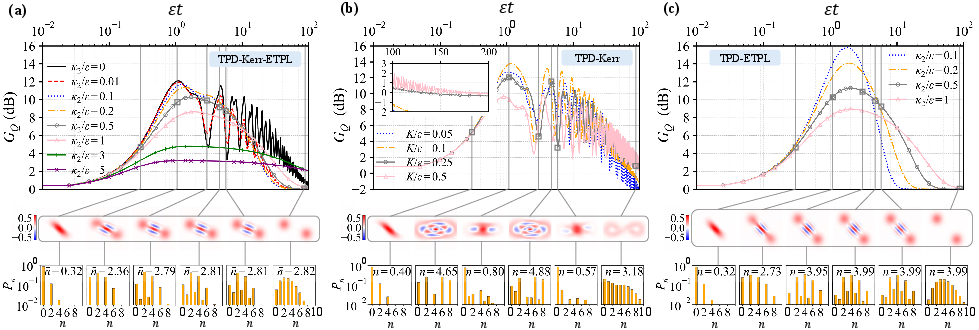
Figure 1: Time evolution of the quantum Fisher information gain ε6, Wigner function, and photon-number distribution across (a) TPD-Kerr-ETPL, (b) TPD-Kerr, and (c) TPD-ETPL models under identical drive and SPL rates.
ETPL drastically modifies this behavior: even weak ε7 damps oscillations and monotonic decay of ε8 emerges. The metrologically useful window (i.e., monotonic, high ε9 interval) is extended by over an order of magnitude (e.g., K0 for K1), facilitating real-time parameter estimation protocols without the need for rapid state capture or feedback. Notably, increasing K2 beyond the Kerr rate further prolongs the decaying tail of K3: strong ETPL confines the evolution within the even-parity manifold, thus mitigating SPL decoherence.
Comparative analysis of TPD-ETPL and TPD-Kerr models, set to generate cat states of the same amplitude, underscores the imperative role of ETPL: only dissipatively stabilized manifolds yield a stable and extended metrological response when SPL is dominant, in stark contrast to the inherent instability of Hamiltonian-only schemes.
Quantum Squeezing, Non-Gaussianity, and Resource Temporal Hierarchy
The squeezing dynamics K4 reveal a temporally layered quantum resource structure. Short-time gains in metrological sensitivity (K5) are associated with Gaussian squeezing (K6), but this regime is fleeting under SPL; subsequently, non-Gaussian even-parity cat states stabilize a second plateau of K7, enabled solely by ETPL.
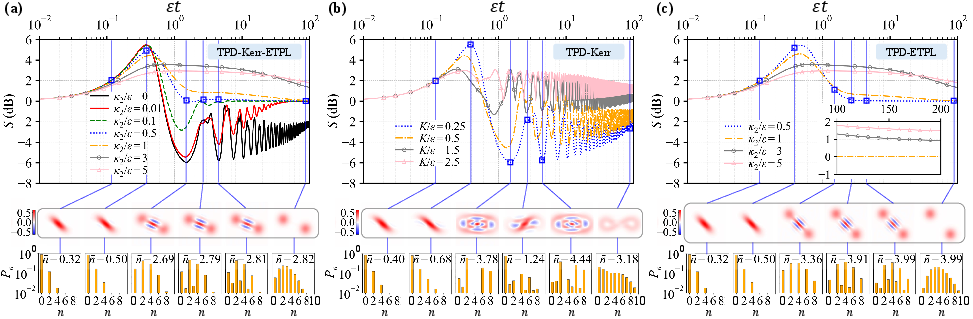
Figure 2: Squeezing level K8, Wigner function snapshots, and photon-number distribution for (a) TPD-Kerr-ETPL, (b) TPD-Kerr, and (c) TPD-ETPL models, highlighting the suppression of antisqueezing and extension of the effective squeezing window by ETPL.
Kerr-only dynamics (K9) rapidly oscillate into strong antisqueezing (κ0), indicating elevated noise and loss of metrological utility. By contrast, ETPL achieves three effects:
- Suppression of persistent antisqueezing oscillations;
- Dramatic extension of the κ1 dB window by up to an order of magnitude;
- Engineering of a robust temporal separation: initial measurement sensitivity derives from squeezing, prolonged advantage from cat-state non-Gaussianity.
At large κ2, the direct relevance of Kerr nonlinearity diminishes entirely, indicated by the near-coincidence of the TPD-ETPL and TPD-Kerr-ETPL trajectories. Thus, a realistic design principle for dissipative stabilization is established: ETPL must be dominant over intrinsic Kerr effects for metrological robustness.
Experimental Realizability and Broader Impact
Superconducting circuit QED platforms readily realize the required hybrid dynamics. Recent demonstrations of MHz-scale ETPL rates with SPL an order of magnitude or more weaker confirm the practical regime considered here. Implementations in nanomechanical, optomechanical, and trapped-ion platforms leveraging engineered multi-phonon dissipation are also experimentally viable.
The demonstrated approach transcends encoding-based and feedback-limited protocols, instead providing autonomous resource stabilization against dominant realistic noise channels. The work substantially broadens the practical design principles for robust, scalable, and application-oriented quantum sensors based on CV architectures.
Conclusion
This work establishes that engineered two-photon loss in two-photon-driven nonlinear oscillators autonomously mitigates SPL-induced decoherence, converting irregular, short-lived, and oscillatory metrological resources into prolonged, smooth, and robust quantum advantages. The extension of both metrological and squeezing windows by more than an order of magnitude, and the stabilization of non-Gaussian even-parity cat states without real-time intervention, constitute decisive advances for practical quantum metrology. The results set a clear design paradigm for the deployment of robust quantum sensors in superconducting, optomechanical, and trapped-ion systems, and provide detailed theoretical groundwork for loss engineering as a resource in open quantum systems (2604.20563).

