- The paper presents a rigorous framework for asymptotic e-processes that ensures asymptotic type I error control using dynamically growing monitoring horizons.
- It establishes uniform asymptotic calibration and supermartingale representations, unifying sequential hypothesis testing with traditional asymptotic methods.
- The work provides practical constructions via cumulative products and p-value calibrations, paving the way for robust, anytime-valid inference in data-driven settings.
Asymptotic e-Processes: Theory and Applications
Introduction and Motivation
The paper "Asymptotic e-processes" (2604.19353) introduces a rigorous framework for asymptotic e-processes, addressing a central methodological gap in sequential hypothesis testing where commonly used e-processes cannot always be constructed exactly due to model misspecification or finite-sample estimation errors. The classical e-process is defined as a nonnegative process (En) adapted to a filtration such that Eτ is an e-variable at every stopping time τ, thus supporting anytime-valid inference via Ville's inequality. However, practical sequential inference frequently requires plug-in or approximately constructed e-variables, motivating extensions of guarantees to settings where only asymptotic validity can be established as sample size grows.
The present work formalizes the notion of an r-asymptotic e-process, a doubly-indexed process (Em,n) (with approximation index m and monitoring index n) that generalizes the classical concept by yielding asymptotic type I error control up to a dynamically chosen horizon rm for each approximation m. This new theory unifies ideas from asymptotic statistics and anytime-valid inference, and systematizes practical construction principles for sequential tests under increasingly accurate, but imperfect, evidence accumulation.
Asymptotic e-process Definition
An r-asymptotic e-process is a nonnegative, bi-indexed process Eτ0, adapted to an array of filtrations, that satisfies a uniform asymptotic e-variable condition over all sequences of stopping times up to horizon Eτ1 for each Eτ2. More precisely, for any sequence of stopping times Eτ3 with Eτ4, it holds that
Eτ5
i.e., the asymptotic calibration holds uniformly in the null model.
Strong practical motivation is given for this form of the definition: requiring classical anytime-validity at every Eτ6 and fixed (finite) Eτ7 is too strong when small approximation errors (such as bias in constructing e-variables) compound over the arbitrarily long monitoring horizon, ultimately breaking Ville-style guarantees. The introduction of a time horizon Eτ8 that grows with approximation accuracy allows precise quantification and control of the cumulative error.
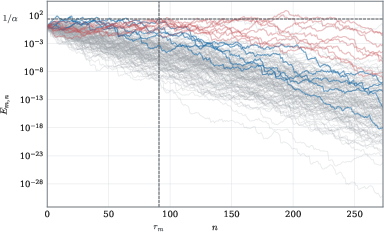
Figure 1: Multiple realizations of an asymptotic e-process Eτ9 for a fixed approximation index τ0, illustrating threshold crossings up to the time horizon τ1 as highlighted by Ville's asymptotic inequality.
Key Properties and Characterizations
Several foundational results are established:
- Equivalence to Limiting e-Process: If τ2 in τ3 for each τ4 uniformly over τ5, and τ6 forms an τ7-asymptotic e-process with τ8, then τ9 is an e-process. Conversely, any sequence approximating a true e-process in this manner satisfies the required asymptotic control.
- Supermartingale Representation: Asymptotic e-processes can always be upper bounded (in expectation) by nonnegative supermartingales with an asymptotic calibration property, thus extending structural parallels to standard e-processes [“Admissible Anytime-Valid Sequential Inference Must Rely on Nonnegative Martingales”, (Ramdas et al., 2020)].
- Diagonal Argument for Diverging Horizon: If the asymptotic guarantee holds uniformly for any fixed, bounded r0, there exists a sequence r1 for which the uniform guarantee holds up to r2, justifying dynamic monitoring horizons in practice.
Asymptotic Ville's Inequality and Statistical Consequences
A central technical contribution is a precise asymptotic analogue of Ville's inequality for asymptotic e-processes. Given a level r3,
r4
which recovers true anytime validity on the infinite horizon as r5.
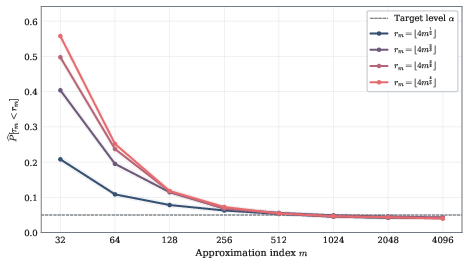
Figure 2: Empirical illustration of the asymptotic Ville’s inequality; for increasing r6, excursion probabilities over a fixed threshold are asymptotically controlled by r7, demonstrating effective asymptotic type I error control.
This result has immediate consequences for sequential hypothesis testing: it provides asymptotic type I error calibration for tests defined via threshold crossings of approximate e-processes, allowing the design of sequential tests under plug-in or computational uncertainty, as arises in nonparametric, high-dimensional, or composite null settings.
Construction and Examples
Cumulative Product Construction
The main practical construction is the cumulative product of asymptotic e-variables. For a suitable array r8 of asymptotic e-variables (with vanishing moment deviations r9), the process
(Em,n)0
is shown to be an (Em,n)1-asymptotic e-process for any (Em,n)2 such that (Em,n)3. This ensures that the cumulative approximation bias remains negligible over the relevant monitoring window.
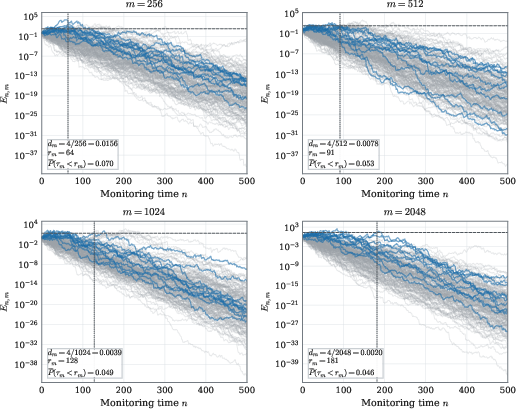
Figure 3: Trajectories from a simulated cumulative product e-process, visualizing threshold crossings at various approximation indices and placement of the horizon (Em,n)4 as prescribed by the theoretical results.
Weighted Average and Time-Mixture
Weighted sums of asymptotic e-variables recover classical time-mixture e-processes in the limit, providing further flexibility and direct analogues of known non-asymptotic constructions, but also highlighting that such weighted averages can fail to be supermartingales.
Calibration of Asymptotic p-Values
A significant extension is established: asymptotic p-values, such as those constructed by the methods in [“Distribution-Uniform Anytime-Valid Sequential Inference and the Robbins-Siegmund Distributions”, (Waudby-Smith et al., 2023)], can be turned into asymptotic e-processes via calibration with p-to-e functions—subject to technical conditions ensuring strong asymptotic uniformity.
Implications and Theoretical Outlook
The formalism of asymptotic e-processes unifies and extends the scope of anytime-safe statistical inference under realistic conditions of misspecification, estimation error, or composite nulls. The main implications include:
- Unified sequential inference: The framework enables robust, transparent control of type I error in practical sequential experiments, clinical trials, and online A/B testing, even when e-processes must be estimated or constructed from data-driven quantities.
- Flexible monitoring: Dynamic adjustment of effective monitoring windows ((Em,n)5) aligns statistical guarantees with practical approximation quality, providing actionable stopping rules without over-claiming validity.
- Bridge to asymptotic statistics: The theory directly connects to classical plug-in approaches, offering a principled pathway to extend traditional asymptotic methods to the anytime-valid context.
- Tool for empirical Bayes and multiple testing: The generalization to plug-in and compound e-values (Ignatiadis et al., 2024) positions asymptotic e-processes as foundational objects for empirical Bayes methods and multiplicity adjustment in high-dimensional sequential designs.
The presented results open a spectrum of technical questions regarding asymptotic type II error (sequential power), adaptation under alternatives, and extensions to alternative forms of asymptotic e-variables (e.g., uniform but not strong uniform asymptotic variants). Empirically, further validation across modern sequential testing applications—including knockoff inference, contextual bandits, and distributional safety—remains an active research direction.
Conclusion
This work provides a rigorous and constructive framework for asymptotic e-processes and elucidates their key theoretical underpinnings, representation results, and statistical implications. Through the controlled use of dynamically increasing monitoring horizons and explicit error tracking, practitioners can deploy sequential tests with reliable asymptotic guarantees in challenging, data-driven environments where exact e-processes are not available. The theory of asymptotic e-processes thus marks a substantial synthesis of sequential analysis, martingale theory, and modern, robust inference principles.

