- The paper introduces EQE-QAOA which leverages invariant subspace identification to achieve exact qubit reduction while preserving measurement statistics.
- It employs isometric encoding to map full Hilbert space dynamics onto a reduced qubit space without sacrificing optimization accuracy.
- Empirical results demonstrate up to 70% qubit reduction on symmetric and constrained instances, offering significant resource savings on NISQ devices.
EQE-QAOA: An Equivalence-Preserving Qubit-Efficient Framework for Combinatorial Optimization
Introduction and Motivation
Quantum Approximate Optimization Algorithm (QAOA) is a central method in quantum combinatorial optimization for the Noisy Intermediate-Scale Quantum (NISQ) era, but its application is fundamentally limited by the number of available high-fidelity qubits. Traditionally, reducing qubit requirements comes at the expense of introducing information loss, which degrades the optimization performance, or requires additional noise-inducing circuit operations or heuristic assumptions. The proposed Equivalence-preserving Qubit Efficient QAOA (EQE-QAOA) framework eliminates this trade-off by exploiting symmetries and conserved quantities that strictly confine the QAOA dynamics to an invariant subspace of the Hilbert space. This invariant subspace admits an exact isometric mapping onto a reduced-qubit representation, ensuring that the dynamics and measurement statistics remain mathematically identical to those in the original full system.
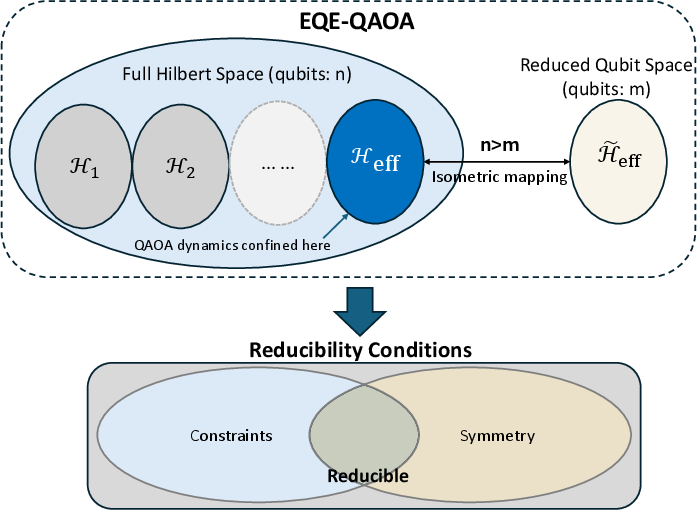
Figure 1: Overview of the proposed EQE-QAOA framework and its reducibility conditions.
Methodology: Invariant Subspace Identification and Isometric Encoding
The crux of EQE-QAOA is the rigorous identification of dynamically invariant subspaces via the algebraic structure of QAOA Hamiltonians. When both cost and mixer Hamiltonians commute with a nontrivial symmetry operator, the entire algorithmic evolution is mathematically restricted to the corresponding joint eigenspace.
Given a QAOA problem instance encoded over n qubits, an explicit procedure for identifying the effective invariant subspace Heff leverages the commutant of the Lie algebra generated by iHC and iHM. Once found, this subspace of dimension M (M<2n) is re-encoded onto m=⌈log2M⌉ qubits using an explicit isometric map. In this encoding, all quantum gates, observables, and measurement post-processing can be performed equivalently in the reduced space.
Scope of Applicability: Reducibility Conditions
Qubit reduction in EQE-QAOA is achievable if and only if the problem structure yields nontrivial conserved quantities—either from explicit constraints or latent symmetries. Unconstrained QUBO problems with all variables independent are irreducible; the absence of structure precludes any dimensional reduction. In practice, most real-world problems—especially in engineering, scheduling, or network optimization—include either explicit constraints (e.g., Hamming-weight, cardinality, capacity limitations) or inherent symmetries due to the underlying topology or objective invariances.
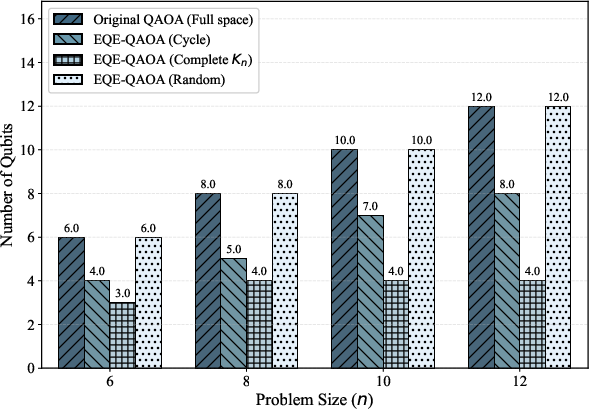
Figure 2: Qubit reduction achieved by EQE-QAOA across different graph families.
The framework is effective for a broad class of combinatorial optimization problems, including but not limited to Max-Cut, vehicle routing, and scheduling under cardinality, subset-sum, or symmetry-induced constraints.
Theoretical Results: Exactness of Reduced QAOA Dynamics
Theoretical analysis yields three core results:
- State and Observable Equivalence: For initial states in Heff, the quantum evolution under QAOA is identical, whether executed in the full space or reduced space. All observable statistics, including measurement probabilities, are exactly preserved.
- Isometric Mappings: A constructive isometric encoding maps the physical basis states of the invariant subspace to computational basis states of the reduced-qubit Hilbert space, enabling a universal and lossless compression.
- Rigorous Applicability Conditions: The absence of nontrivial structure is necessary and sufficient for irreducibility; any constraint or global symmetry induces invariant subspaces amenable to EQE-QAOA compression.
Qubit Requirement Reduction
Empirical evaluation on families of Max-Cut instances (cycle graphs, complete graphs, and Erdős–Rényi random graphs) confirms that EQE-QAOA consistently achieves substantial qubit reductions in graph classes with high symmetry. For complete graphs, the reduction can reach over 70%, compressing n=12 down to as few as $4$ qubits.
Figure 2: Qubit reduction achieved by EQE-QAOA across different graph families.
The degree of qubit reduction correlates directly with the underlying symmetry. Constrained Max-Cut problems with Hamming-weight restrictions (e.g., Heff0) realize progressively more aggressive reductions as the constraint tightens (lower Heff1), confirming that constraint-induced redundancy is efficiently exploited.
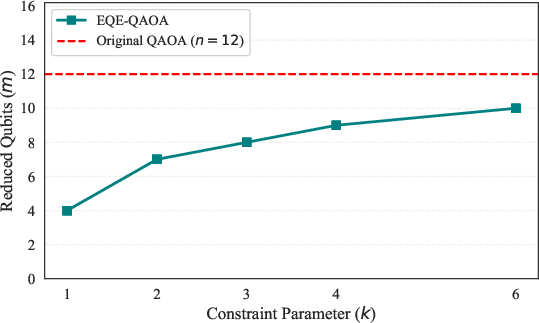
Figure 3: Effect of the Hamming-weight constraint Heff2 on the reduced qubit requirement (Heff3).
Exactness of State and Measurement Statistics
Metrics including state fidelity offset (Heff4), observable difference Heff5, and total variation distance (TVD) between the reduced and original QAOA indicate exact reproduction of quantum states and measurement statistics up to machine precision.
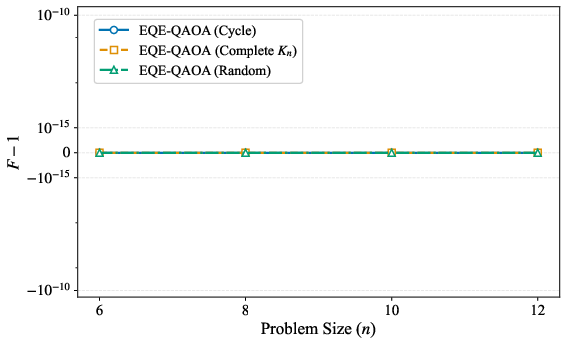
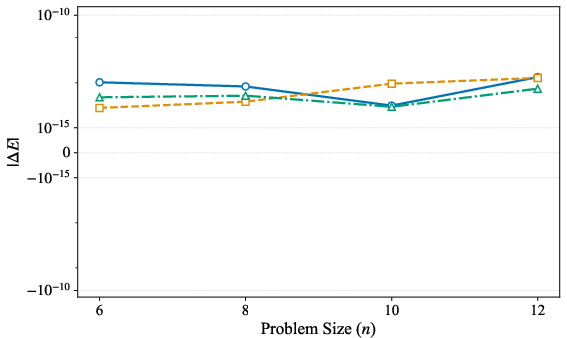
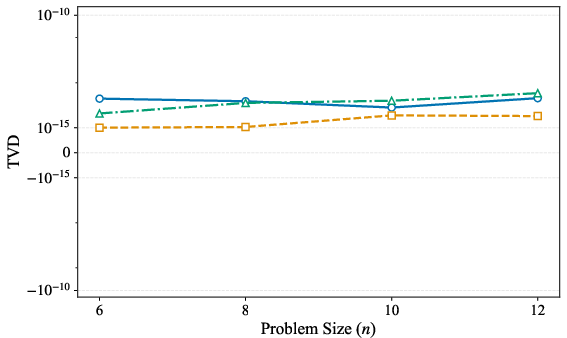
Figure 4: Equivalence validation across general graph families.
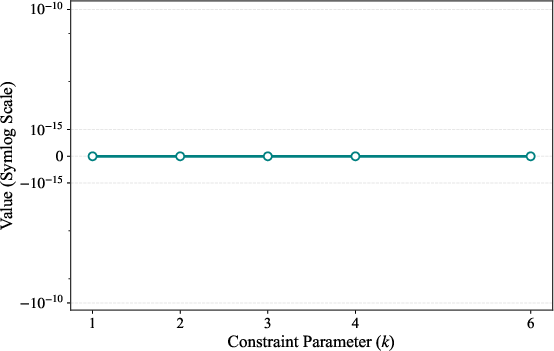
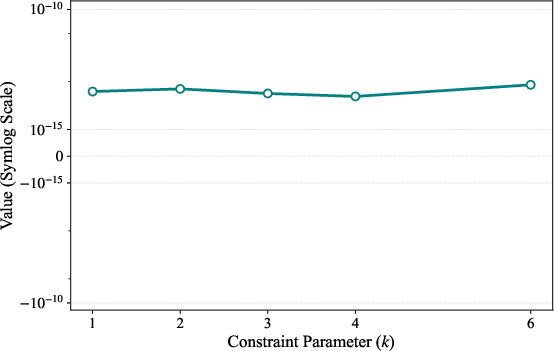
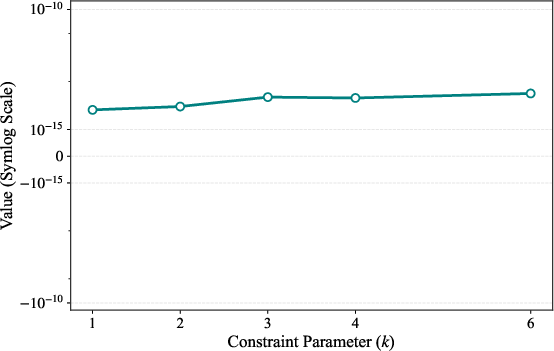
Figure 5: Equivalence validation under the Random-Heff6 constraint setting.
Computational and Memory Resources
Memory requirements for quantum state representation, scaling as Heff7 for standard QAOA, are reduced to Heff8 for EQE-QAOA. For symmetric and constrained instances, this yields orders-of-magnitude lower memory overhead, which becomes increasingly significant as Heff9 grows.
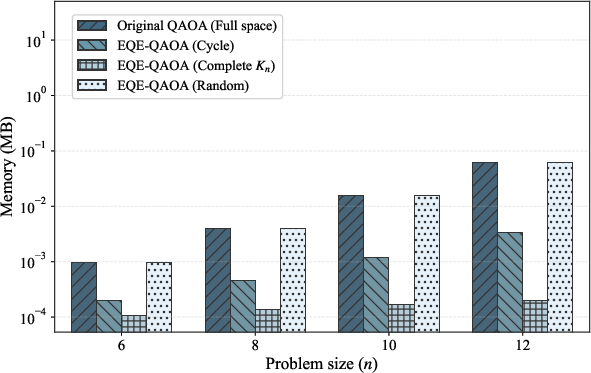
Figure 6: Comparison of state representation memory (Hilbert space dimension) between the original and reduced simulations.
Comparison with Prior Art
Benchmarking against compact encoding, partition-based approaches (e.g., DC-QAOA), and qubit-reuse compilation, EQE-QAOA achieves competitive qubit savings but uniquely preserves the exact optimization result and observable statistics without incurring noise, information loss, or requiring problem-specific manual intervention.
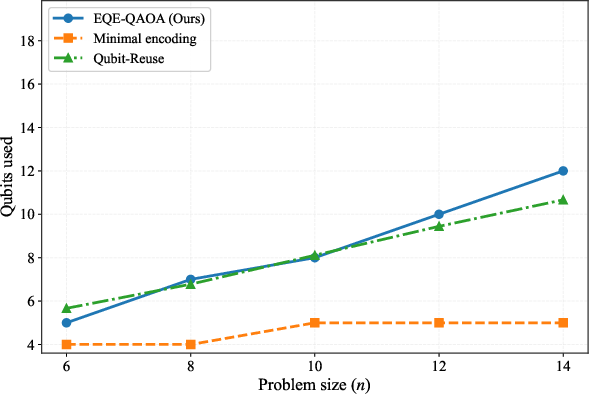
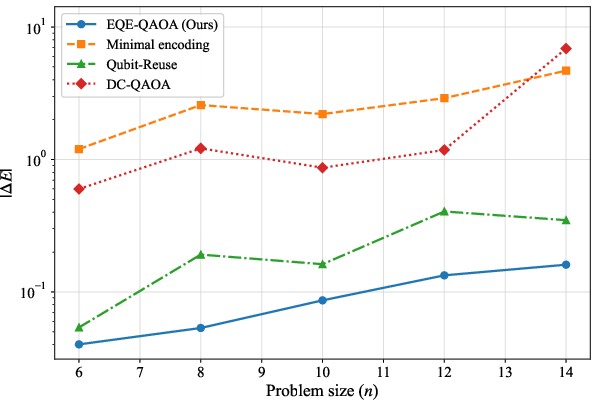
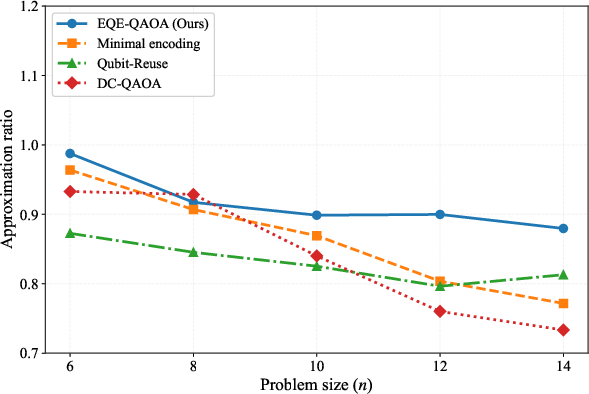
Figure 7: Benchmark comparison of qubit-efficient methods.
Implications and Future Directions
Practical Impact: EQE-QAOA directly addresses the qubit bottleneck for NISQ devices, increasing the tractable problem size and allowing larger-scale combinatorial optimization on near-term quantum hardware and classical simulators. Its mathematically exact reduction also facilitates benchmark studies and resource estimation for future error-corrected quantum architectures.
Theoretical Implications: By formalizing the relationship between problem structure (symmetry, constraints) and Hilbert space decomposability, EQE-QAOA ties together quantum control, group theory, and variational algorithm design. The explicit identification of reducibility conditions provides a concrete criterion for when structure-exploiting quantum algorithms can be losslessly compressed.
Future Research: Integrating EQE-QAOA with problem-specific mixer design, exploring extensions to non-QUBO and higher-order constrained systems, and generalizing subspace reduction to hybrid quantum-classical optimization pipelines constitute immediate areas for further development.
Conclusion
EQE-QAOA introduces a principled, structure-driven approach to reducing qubit requirements for QAOA without performance degradation, underpinned by rigorous algebraic analysis and isometric encoding. Its applicability extends to a wide range of constraint-rich and symmetry-laden combinatorial optimization problems, offering both theoretical clarity and substantial practical quantum resource savings (2604.18285).

