- The paper demonstrates that Kondo-driven f-d hybridization and Berry curvature produce an exceptionally high anomalous Nernst effect in CeCo₂As₂.
- Detailed experiments and DFT+DMFT analyses reveal record Nernst angles and enhanced thermoelectric coefficients compared to conventional ferromagnetic metals.
- The findings underscore the potential of flat-band topology and Kondo pinning for advancing thermoelectric and spintronic device applications.
Enhanced Anomalous Nernst Effect in the Ferromagnetic Kondo Lattice CeCo₂As₂
Introduction
The paper "Enhanced Anomalous Nernst Effect in the Ferromagnetic Kondo Lattice CeCo₂As₂" (2604.17987) presents a detailed investigation of the anomalous Nernst effect (ANE) in CeCo₂As₂, a ferromagnetic (FM) Kondo lattice compound, and its non-$4f$ analogue LaCo₂As₂. The study integrates comprehensive experimental measurements with theoretical modeling, demonstrating that the Kondo effect and the associated f-d band hybridization in CeCo₂As₂ result in an exceptionally large ANE, exceeding the Seebeck coefficient and culminating in anomalous Nernst angles (tanθAN) far beyond what is seen in conventional FM metals. The interplay between Berry curvature (BC), Kondo screening, and band topology is elucidated using DFT+DMFT and tight-binding analyses.
Experimental Characterization of Thermoelectric and Magnetic Properties
Single crystalline samples of CeCo₂As₂ and LaCo₂As₂ were synthesized to enable comparative magnetization, transport, and thermoelectric property measurements. CeCo₂As₂ presents a pronounced enhancement in electronic specific heat (γ=78 mJ mol−1 K−2), approximately triple that of LaCo₂As₂, signifying the heavy-fermion (HF) character and increased carrier effective mass due to Kondo screening. Resistivity and thermopower measurements reflect a broad coherence maximum and positive Seebeck coefficient (Sxx) peak, hallmarks of Kondo lattice physics, while LaCo₂As₂ maintains typical metallic behavior and negative thermopower.
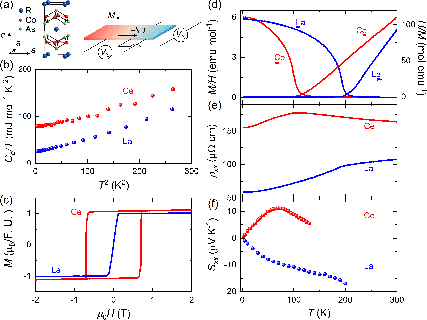
Figure 1: Magnetization, specific heat, and transport properties of CeCo₂As₂ and LaCo₂As₂, highlighting the FM Kondo lattice characteristics and schematic depiction of ANE and Seebeck setup.
Both compounds undergo FM ordering with TC well above 100 K, and magnetization measurements confirm comparable saturated moment and c-axis easy axis. The lower TC of CeCo₂As₂ relative to its coherence temperature implies collective Kondo hybridization within the FM phase.
Anomalous Nernst and Hall Effects: Strong Enhancement in CeCo₂As₂
Hall resistivity (ρyx) and Nernst signal (f0) were measured as functions of temperature and magnetic field for both materials. The anomalous contributions, f1 and f2, are quantitatively larger in CeCo₂As₂ by over an order of magnitude relative to LaCo₂As₂, illustrating the pronounced influence of band topology and Kondo physics.
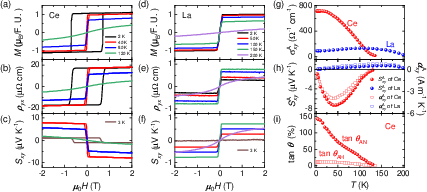
Figure 2: Field-dependent magnetization, Hall resistivity, and Nernst coefficients for CeCo₂As₂ and LaCo₂As₂, showing significant enhancement of anomalous contributions in CeCo₂As₂.
The temperature dependence reveals that CeCo₂As₂ achieves a maximal anomalous Hall conductivity (f3) of 710~f4~cmf5 and peak ANE (f6) of f7V~Kf8 near 40 K. These values are competitive with leading topological magnets (e.g., Co₂MnGa, Co₃Sn₂S₂) and vastly exceed conventional FM metals, for which f9 is typically <1%. Notably, the anomalous Nernst angle in CeCo₂As₂ surpasses 100% below 30 K, reaching 144% at 3 K; this ratio remains below 50% in most other topological magnets.
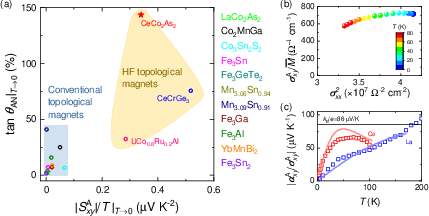
Figure 3: Summary of anomalous Nernst angle (d0) and scaling relations in CeCo₂As₂ and comparative topological systems.
Analysis of d1 normalized by magnetization and scaling with d2 confirms the predominantly intrinsic BC-driven mechanism, with negligible extrinsic skew scattering, reflecting the topological origin of the effect.
Origin of Enhanced ANE: Band Structure, Berry Curvature, and Kondo Pinning
DFT+DMFT calculations elucidate the electronic structure of CeCo₂As₂ and LaCo₂As₂. CeCo₂As₂ possesses flat Kondo bands just above d3, absent in LaCo₂As₂, which significantly increase the density of states (DOS) and thermopower. Tight-binding models identify multiple d4-d5 hybridization gaps and Weyl nodes in close proximity to d6, distributing strong BC across narrow energy windows, thereby amplifying intrinsic AHE and ANE.
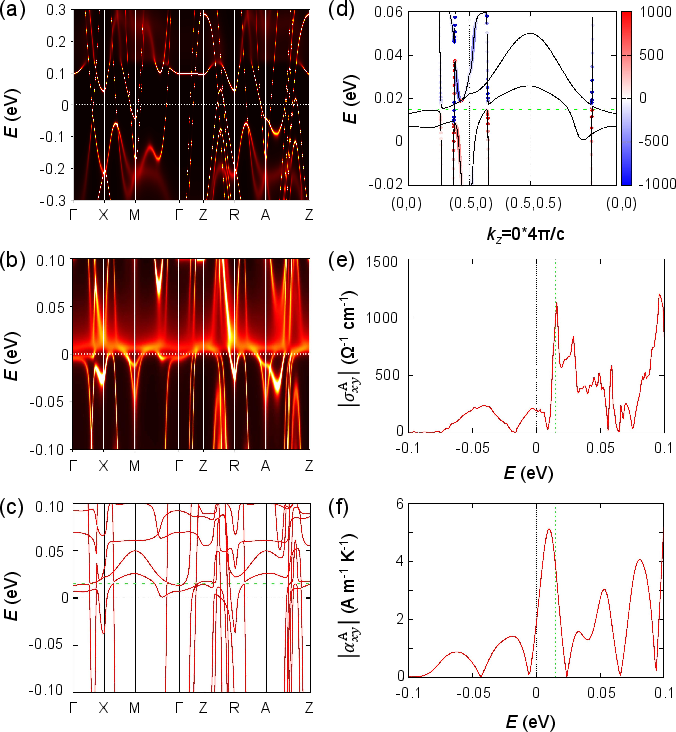
Figure 4: DFT+DMFT band structures, tight-binding model, Berry-curvature-resolved bands, and anomalous transport coefficients in CeCo₂As₂ and LaCo₂As₂.
Calculated d7 and d8 at d9 and tanθAN0 meV align quantitatively with experimental values, supporting the BC hot-zone scenario driven by Kondo pinning. Analysis of the tanθAN1 temperature dependence and fitting to a Sommerfeld expansion reveals a small chemical potential for CeCo₂As₂ (tanθAN2 K), comparable to the coherence temperature, supporting low Fermi temperature-enhanced thermoelectric response and breakdown of the linear Mott relation at elevated temperatures.
Theoretical Implications and Flat-Band Quantum Thermoelectricity
Intrinsic BC mechanisms underpin both AHE and ANE, with their ratio governed by the Mott relation and sensitive to tanθAN3 tuning in BC hot-zones. The large tanθAN4 and ratio tanθAN5 at low temperatures are signatures of flat-band topology, Kondo pinning, and strong BC distribution. The FM Kondo lattice structure yields a time-reversal symmetry-broken flat band, naturally enhancing topological thermoelectric effects, distinct from conventional tanθAN6-electron ferromagnets.
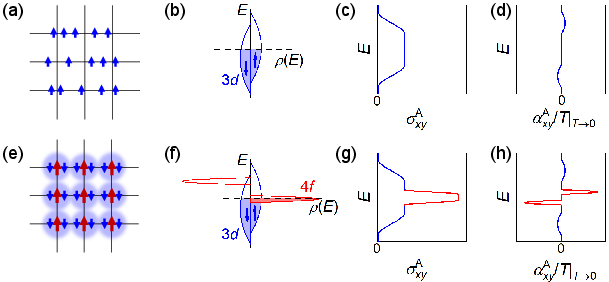
Figure 5: Schematic comparison of spin configuration, DOS, and anomalous transport in itinerant FM versus FM Kondo lattice, emphasizing flat-band effects.
The results imply that correlated topological Kondo magnets, with Fermi level pinned to flat bands by Kondo hybridization, are highly promising for thermoelectric applications, surpassing the need for chemical doping or fine-tuning in conventional topological magnets. The findings also resonate with recent advances in noncentrosymmetric Kondo semimetals, broadening the landscape of BC-driven quantum transport phenomena.
Conclusion
This investigation demonstrates that CeCo₂As₂, a ferromagnetic Kondo lattice, exhibits an exceptionally strong anomalous Nernst effect—surpassing both Seebeck coefficients and conventional FM metals—due to band topology and Kondo-driven flat band formation yielding pronounced Berry curvature near tanθAN7. The study substantiates the theoretical framework for topological thermoelectricity in correlated flat-band systems and suggests that the practical exploitation of Kondo lattices for efficient thermoelectric devices is achievable, especially in scenarios requiring large BC and low tanθAN8 pinning. Future directions include harnessing similar mechanisms in other correlated and topological materials, and leveraging band engineering to optimize thermoelectric and spintronic device performance.

