- The paper demonstrates that complex normalizing flows can be reinterpreted as information Kähler-Ricci flows by connecting log-determinant transformations with Ricci curvature using Wirtinger derivatives.
- It employs both discrete and continuous formulations—using biholomorphic maps and neural ODEs—to track the evolution of geometry and Fisher information metrics in complex manifolds.
- The study offers practical insights for designing generative models with geometric constraints, advocating improved entropy dissipation and uniformization through Ricci flow techniques.
Introduction
The paper "Complex normalizing flows can be information Kähler-Ricci flows" (2604.17954) presents a principled connection between the statistical framework of complex normalizing flows—particularly for modeling complex-valued distributions in generative tasks—and geometric flows in Kähler manifolds, specifically the Kähler-Ricci flow. The core finding is that the log determinant term central to normalizing flow density transformations is closely connected to the Ricci curvature in Kähler geometry via Wirtinger derivatives and Hermitian metrics. This identification enables an information-theoretic reinterpretation of normalizing flows as discrete or continuous analogs of geometric flows, leading to an overview of machine learning and complex differential geometry.
Theoretical Framework
Discrete and Continuous Complex Normalizing Flows
A complex normalizing flow pushes a base, often isotropic complex Gaussian, density q0 to a target density qK by a sequence of biholomorphic maps Ψk,θ, parameterized by θ. The density transformation follows:
logqK,θ(zK)=logq0,θ(z0)−k=1∑Klog∣Cdet∇zk−1Ψk,θ∣2
where ∇z denotes the holomorphic Jacobian (Wirtinger calculus). In the continuous formulation (neural ODEs), density evolution is governed by the instantaneous change of variables theorem, with divergence and trace terms defined over evolving complex manifold metrics.
Kähler-Ricci Flow and Geometric Potentials
Kähler-Ricci flow is defined for a Hermitian metric h (or Kähler form ω) as:
∂t∂hij=−Ricij(h)
where Ric is the Ricci curvature, given in local coordinates as the second order mixed Wirtinger derivative of the log determinant of qK0. The geometric structure is encoded via a Kähler potential qK1 and the corresponding volume form.
The central claim is that the log determinant in the normalizing flow change-of-variable formula corresponds, under differentiation, to Ricci curvature in the Kähler metric. This is formalized by identifying the Fisher information (spatial metric) as a Hermitian metric, showing that under a holomorphic pullback, the log density transformation matches (up to expectation) the Ricci curvature evolution.
Moreover, Bayesian treatment of flow parameters qK2, and integration over the parameter posterior, enables the definition of a Fisher information metric with respect to data coordinates, inverting the standard approach. Under suitable conditions, discrete normalizing flow dynamics converge to the Kähler-Ricci flow in the continuous limit.
Empirical and Geometric Analyses
Complex Normalizing Flow and Curvature Visualization
Numerical results on manifold-valued complex datasets (two moons, Olympic rings, fractal tree) demonstrate the normalizing flow's geometric behavior, including induced scalar curvature and holomorphicity proxies.

Figure 1: Density evolution and scalar/holographic curvature proxies for complex normalizing flows on manifold-valued datasets, visualizing qK3 and induced curvature quantities.
Curvature quantities interact with the flow's ability to disentangle complex modes and uniformize distributions, akin to the uniformizing effect of Ricci flow on geometric structure.
Temporal Evolution of Curvature in Continuous Flows
The paper tracks curvature statistics over timesteps for a continuous complex normalizing flow, quantitatively linking the time-derivative of Fisher information and Ricci curvature to the geometric evolution.

Figure 2: Temporal evolution of curvature metrics along the complexified continuous normalizing flow, reflecting geometric uniformization under Ricci flow conditions.
Holomorphicity in Flow Layers
Architectural components—complex affine coupling, activation functions—are engineered to approximate holomorphicity, which simplifies determinants and preserves Kähler structure. Empirical analyses confirm that approximate holomorphic bias is sufficient for maintaining theoretical and practical performance.
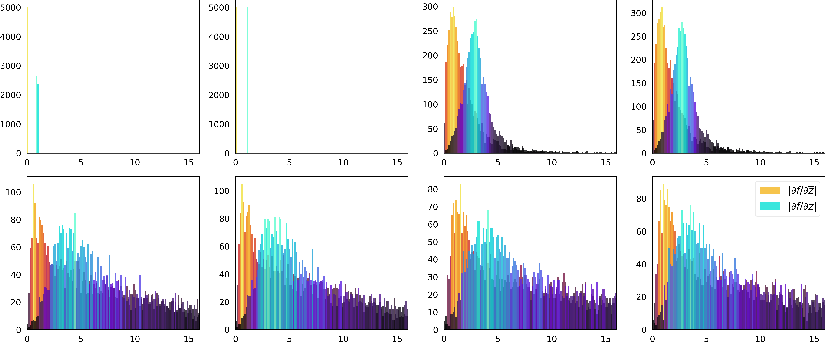
Figure 3: Holomorphic and anti-holomorphic derivative magnitudes per layer in the discrete flow, indicating bias toward holomorphicity for Kähler structure preservation.
Main Analytical Results
The Fisher information metric, defined via mixed Wirtinger derivatives of log density in the normalizing flow, is shown to match the holomorphic pullback metric used in Kähler geometry. Analytical lemmas justify treating this as a Hermitian metric, especially when the base distribution is isotropic complex Gaussian.
KL Divergence Dissipation and Gradient Flows
The dissipation of KL divergence between flow-generated and target densities is connected to the Fisher information and Ricci curvature. Second-order derivatives are bounded from below under log-concave density and closed manifold assumptions, suggesting convexity in entropy dissipation relative to geometric flows.
Relation to Functional Optimization (Mabuchi, Perelman, Dirichlet)
Critical points of the KL divergence and the Mabuchi functional coincide under scalar curvature conditions. The Kähler-Ricci flow is interpreted as a gradient flow with respect to the Dirichlet metric, where the potential evolves as qK4, aligning with Perelman-type functionals.
Surgery, Singularity, and Flow Robustness
At singularity, where the metric determinant collapses, geometric surgery is proposed to restore bijectivity and maintain density support through smooth Kähler potential perturbations. The log-sum-exponential provides a practical density regularization for computational stability at degeneracies.
Practical and Theoretical Implications
The identification between complex normalizing flow transformations and Kähler-Ricci geometric evolutions implies several practical and theoretical advances:
- Machine Learning Architecture: Enables principled design of generative models with explicit geometric constraints, leveraging holomorphicity for computational and statistical efficiency.
- Information-theoretic Analysis: Provides new avenues for analyzing convergence, entropy dissipation, and robustness in flow-based models using geometric quantities.
- Geometric Uniformization: The uniformizing effect of Ricci flow enables regularization of complicated target densities, potentially improving generative model sample quality and mode coverage.
- Extension to Real-valued Flows: Real-valued normalizing flows can be partially realified to complex settings when the dimension is even and holomorphic conditions are met.
The results suggest future investigations into optimal transport problems, kinetic energy functionals, and robust architectures under geometric degeneracies.
Conclusion
This paper establishes a comprehensive and rigorous bridge between complex normalizing flows in probability and generative modeling and geometric flows in Kähler manifolds, specifically via identification of log-determinant terms and Ricci curvature. The connection is shown to hold at the level of Fisher information metrics and is further justified both analytically and through empirical visualization. Practical architectural concessions for holomorphicity and geometric regularization under flow singularities are proposed. The theoretical framework developed here opens prospects for geometric, information-theoretic, and statistical innovations in the design and analysis of flow-based generative models, particularly in settings involving complex-valued data and manifold learning.

