- The paper demonstrates that near-zero ADM mass implies convergence toward Euclidean space under volume-preserving intrinsic flat topology.
- It surveys various geometric convergence frameworks—GH, mm, intrinsic flat, and VF—to elucidate their effectiveness in capturing stability.
- Explicit constructions like bubbles, wells, and tunnels illustrate the challenges in controlling minimal surfaces and preserving geometric regularity.
Geometric Stability of the Schoen-Yau Zero Mass Theorem: An Expert Analysis
Introduction and Context
The Schoen-Yau Positive Mass Theorem sits at the intersection of elliptic PDE, geometric analysis, and general relativity, offering both a scalar curvature constraint and a global rigidity: any complete, asymptotically flat three-manifold with nonnegative scalar curvature and zero ADM mass must be isometric to Euclidean space. This rigidity clause, often termed the Zero Mass Rigidity Theorem, isolates the precise geometric character of Minkowski space among a vast landscape of initial data for Einstein’s equations. However, the question of stability—if manifolds with almost zero mass are geometrically close to Euclidean space—remains underdetermined and forms the central axis of this work.
Historically, analogous stability and rigidity results for sectional and Ricci curvature (e.g., Toponogov, Bishop-Gromov, Cheeger-Colding theory) rested on strong geometric and topological convergence. For scalar curvature and mass, the intricate interplay between minimal surface theory, quasi-local mass, and notions of convergence generates profound technical subtleties. This paper undertakes a comprehensive survey of the known results, illustrative examples, and open questions regarding geometric stability of the Schoen-Yau Zero Mass theorem, scrutinizing which geometric convergence frameworks—Gromov-Hausdorff (GH), metric measure (mm), intrinsic flat (F), and volume-preserving intrinsic flat (VF)—appropriately capture this stability.
Theoretical Foundations and Rigidity
The Zero Mass Rigidity Theorem asserts that if an asymptotically flat three-manifold M3 (more precisely, M∈M per Bray's Penrose Inequality class) has nonnegative scalar curvature and mADM(M)=0, then M is isometric to E3. The isometry is a strong statement, encompassing preservation of distances, volumes, areas, isoperimetric regions, minimal and constant mean curvature (CMC) surfaces, and all quasi-local mass constructs (Hawking, isoperimetric, etc.). The regularity threshold for preservation of mean curvature and minimal surfaces is nontrivial and remains a subject of ongoing investigation.
Analogous results in Ricci and sectional curvature (e.g., Cheeger-Colding almost rigidity theorems) are surveyed to motivate the search for an appropriate stability statement for scalar curvature and ADM mass. The challenge is to find a geometric notion of convergence robust to isoperimetric region degenerations, noncompactness, and the lack of continuous symmetries typical in lower curvature settings.
Geometric Stability Conjectures
The central conjecture proposed is that if a sequence Mj3∈M has mADM(Mj3)→0, then Mj3 should converge to Euclidean space in an appropriate geometric topology. Several candidate topologies are considered, each with their own strengths and known pathologies:
- Gromov-Hausdorff (GH) Convergence: Controls distances but insensitive to area and volume collapse, fails to preclude bubble and tunnel formation observed in explicit construction of sequences.
- Metric Measure (mm) Convergence: Incorporates volume but does not track boundaries or isoperimetric regions effectively.
- Intrinsic Flat (VF0) Convergence: Maintains control of volumes, areas, and rectifiable structure including boundaries, and is robust under filling in negligible-volume regions.
- Volume-Preserving Intrinsic Flat (VF1) Convergence: Strengthens VF2 convergence with explicit volume matching, offering improved semicontinuity properties for mass, capacity, and eigenvalues.
A precise VF3 stability conjecture (see Conjecture~\ref{conj:LS}) is formulated, including technical conditions such as uniform control on diameters of isoperimetric regions and convergence of the asymptotically flat ends to their Euclidean analogues. The restriction to the class VF4 (absence of interior minimal surfaces) is motivated by explicit counterexamples to Penrose-type inequalities and topological pathologies arising from bubble and tunnel formation.
Illustrative Examples and Constructions
Explicit examples are fundamental to understanding the limitations and optimality of any conjecture regarding geometric stability. The survey provides a comprehensive taxonomy:
- Smooth Convergence: Spherically symmetric, mass-decreasing (Schwarzschild) manifolds yielding smooth convergence to Euclidean geometry.

Figure 1: A prototypical sequence of spherically symmetric, asymptotically flat manifolds with vanishing ADM mass smoothly converging to Euclidean space.
- Bubble Formation: Attachment of standard spheres via thin tunnels or necks, resulting in limits with extraneous components if interior minimal surfaces are not excised.

Figure 2: Schematic construction of a manifold sequence exhibiting a bubble—the emergent minimal surface marks the necessity of working within the class VF5.
- Wells: Construction of arbitrarily deep, thin “wells” that do not produce interior minimal surfaces but may enlarge diameters disproportionately relative to their negligible volume; if uncontrolled, such geometric phenomena invalidate simple diameter-based stability statements.
(Figures 5 and 6)
Figure 3: An isometric embedding of a manifold with a single thin, deep well, all mass concentrating toward Euclidean geometry in the limit.
Figure 4: The limiting behavior of an increasingly deep well, which, depending on the scaling regime, may attach a noncompact interval to the Euclidean end.
- Tunnels and Sewing: Construction of short tunnels either externally or within regions, identifying curves or areas to points in the limit, leading to non-manifold limit spaces unless pathological regions are excised.
(Figures 8 and 9)
Figure 5: Construction depicting a single tunnel introducing short cuts—if all minimal surfaces are cut, external regions still converge to Euclidean geometry.
Figure 6: Experimental sewing of multiple tunnels along a curve; the curve in the limit is identified to a point, illustrating potential scrunching phenomena.
These cases illustrate that VF6 and VF7 convergence, unlike GH or mm convergence, can “forget” negligible-volume, high-diameter features, thus recovering geometric stability under correct hypotheses.
Notions of Geometric Convergence
Each convergence framework is analyzed technically:
- GH Convergence: Sensitive to distance-contraction phenomena caused by tunnels or bubbles; fails to imply volume or area control. Explicit examples show that manifolds with vanishing mass can converge to highly non-Euclidean spaces in GH sense unless the class VF8 is enforced.
- Metric Measure Convergence: Negligible-volume features can disappear in the limit, yet this framework does not adequately control boundaries or more subtle geometric features related to mass and isoperimetric regions.
- Intrinsic Flat and VF9 Convergence: Provides strong lower semicontinuity for volume and boundary area; recovers the correct manifold structure in the limit for all known non-pathological examples. The filling volume construction is robust under collapse of subregions and interaction with quasi-local masses and isoperimetric profiles. Semicontinuity results for ADM mass, Laplacian eigenvalues, and capacity have recently been established in this topology.
- VADB and Other Notions: Volume Above Distance Below (VADB) convergence, as well as the M30 framework (Lee-Naber-Neumayer), and geometric convergence away from bad sets (as in Lakzian-Sormani or Dong-Song) offer tools for handling settings in which regions of non-smooth convergence or large-distance contraction (scrunching) are controlled or excised.
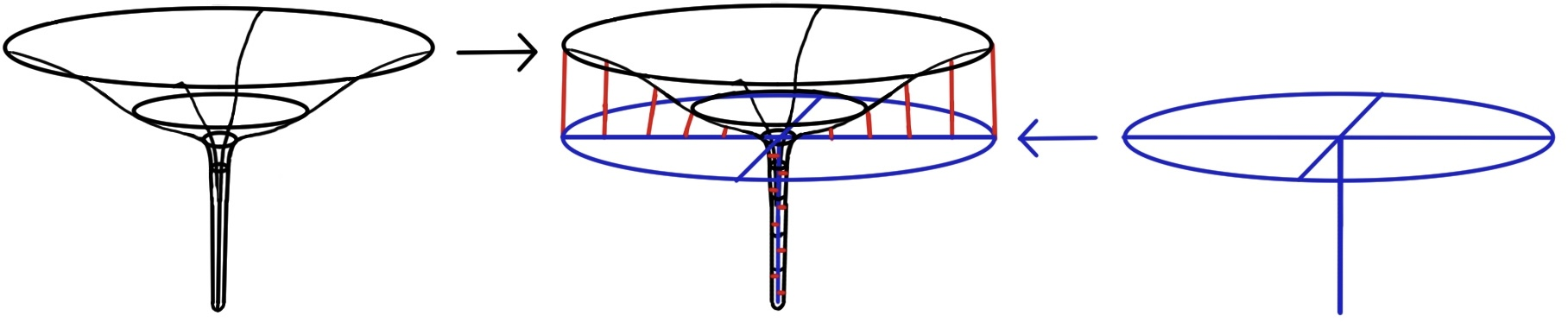
Figure 7: Schematic estimate of GH distance in a well-excision construction, measuring how added features (wells or tunnels) affect extrinsic and intrinsic distances.
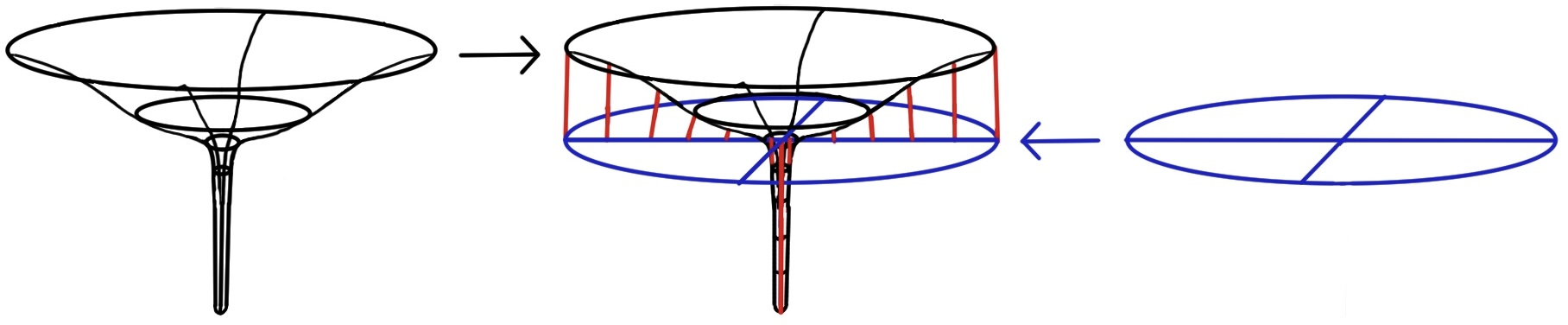
Figure 8: Wasserstein transportation visualized—small-volume artifactual regions have negligible impact on metric measure distance as their transport cost vanishes.
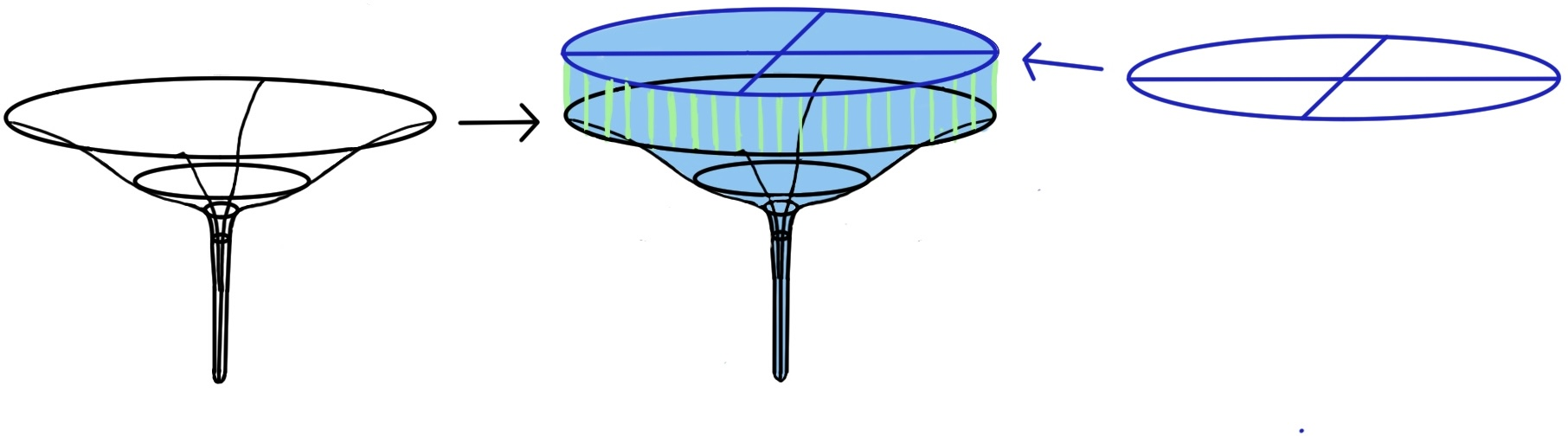
Figure 9: Intrinsic flat fillings between manifolds and their Euclidean limits—areas and volumes are precisely controlled.
Open Problems and Theoretical Implications
A central open question remains: Does there exist a sequence of three-dimensional, asymptotically flat manifolds with nonnegative scalar curvature and no interior minimal surfaces whose ADM mass approaches zero but which do not converge to Euclidean space in the volume-preserving intrinsic flat topology? All known constructions of pathological behavior (bubbles, tunnels, scrunching) necessarily produce interior minimal surfaces, justifying their excision as in the definition of M31.
Verification of the M32-stability conjecture would theoretically cement the role of ADM mass as a truly geometric invariant of the large-scale structure, not merely a formal boundary term. Practically, such a result feeds into the stability analysis of space-times in mathematical relativity, geometric flows, and the regularity theory for constrained curvature variational problems. From a metric geometry perspective, it would further illuminate the subtle interdependencies between curvature, topology, and various weak convergence modes in geometric analysis.
Future directions include exploring:
- The potential to generalize these results to non-spherically symmetric or higher-dimensional cases.
- The introduction and characterization of alternative “scrunching-free” topologies, should a counterexample to the M33 conjecture appear.
- Deeper analysis of the relationship between quasi-local mass, isoperimetric profiles, and intrinsic flat limits in the regime of almost rigidity.
Conclusion
This work provides a systematic survey of the geometric stability properties associated with the Schoen-Yau Zero Mass Rigidity Theorem, situating the conjecture within a sophisticated framework of modern metric geometry, geometric measure theory, and scalar curvature analysis. The examples and claims documented demonstrate both the technical difficulties and the sensitive dependence of stability theorems on the choice of geometric topology. Volume-preserving intrinsic flat convergence currently stands as the most viable framework capable of capturing the precise sense in which almost zero mass enforces almost Euclidean geometry, with the main conjecture awaiting further breakthroughs, particularly in circumventing or controlling potential scrunching phenomena.
The implications of positive solutions to these conjectures would be far-reaching—offering new perspectives on scalar curvature rigidity, geometric convergence, and the analytic underpinnings of the initial value problem in general relativity. Conversely, any counterexample would reshape our understanding, requiring the invention of yet finer notions of geometric convergence. Either outcome will yield substantial theoretical development in the field.