- The paper introduces a persona-based RE framework that integrates AI persona development and scenario-driven XAI user stories to derive explainability requirements.
- It validates the approach on a clinical reasoning simulator featuring multi-agent interactions, demonstrating improved transparency and stakeholder trust.
- Empirical evaluation with medical students shows 78% agreement on enhanced clinical reasoning competence, underscoring its educational impact.
Persona-Based Requirements Engineering for Explainable Multi-Agent Educational Systems
Motivation and Context
The increasing deployment of Multi-Agent Systems (MAS) in educational and healthcare domains—especially those leveraging LLMs and other advanced AI techniques—poses significant challenges regarding transparency and explainability. These black-box systems, when used for critical tasks such as clinical reasoning training, risk eroding user trust if their reasoning processes remain opaque. Conventional Requirements Engineering (RE) approaches are insufficient for addressing the multi-stakeholder, multi-agent, explainability-focused demands of such applications. In this context, the integration of persona-based methodologies into the early stages of RE is proposed as a way to systematically ground explainability requirements in real (and archetypal) user and agent needs.
Framework: Persona-Based RE for Explainable MAES
The paper introduces a persona-driven, human-centered RE framework for Explainable Multi-Agent Educational Systems (MAES). The methodology incorporates six core stages: AI persona development, scenario exploration, XAI user story derivation, RE content structuring, validation with stakeholders, and iterative refinement. AI agents are characterized by detailed personas that include role, underlying model, knowledge base, decision triggers, and explainability profiles. These Agent Personas, together with corresponding Human Personas, drive the generation of fine-grained user stories that focus on explainability dimensions—answering for whom, what, and how explanations must be delivered.
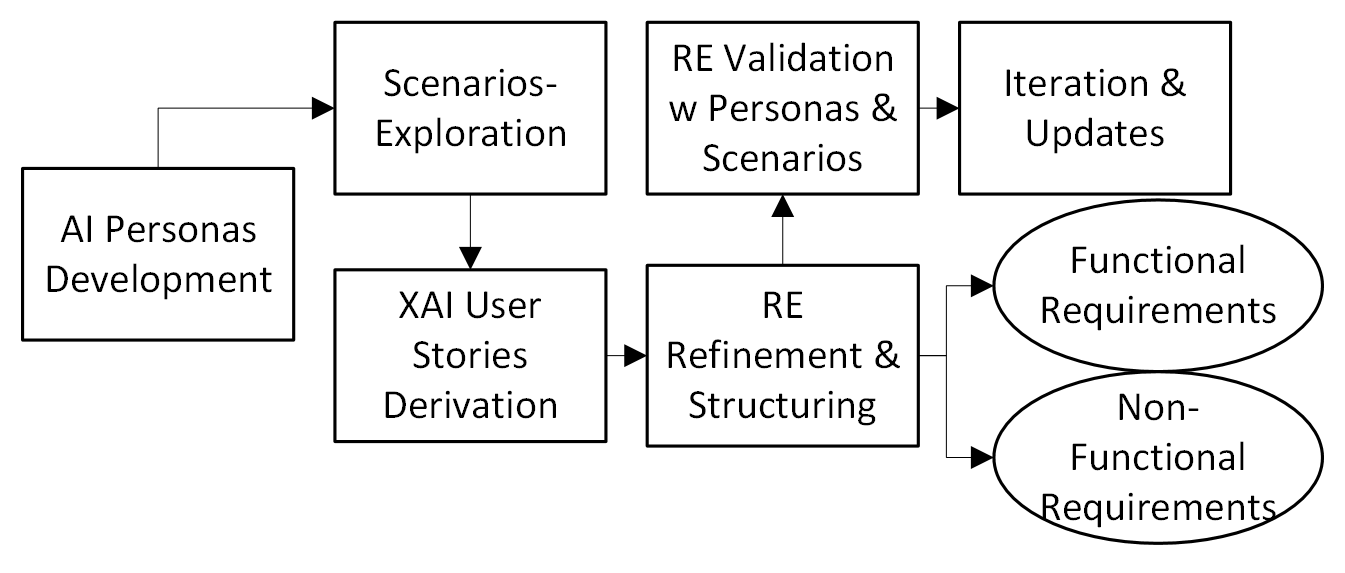
Figure 1: The Persona-Based Requirements Engineering framework operationalizes explainability in MAES through structured persona and scenario interactions.
By structuring requirements in these terms, the framework ensures explainability is a first-class concern in system engineering, not an add-on. Functional and non-functional requirements are directly derived from persona-based XAI user stories, ensuring testability and traceability of system features that address explainability.
MAS for Clinical Scenario Simulation: Agent Structure and Interactions
The methodology is validated in the construction of a MAES for Clinical Scenario Simulation (CSS). The system features multiple specialized AI agents (Patient, Physical Exam, Diagnostic, Clinical Intervention, Evaluation, and Supervisor), each instantiated as a discrete persona with explicit capabilities, knowledge scopes, and explainability affordances. The supervisor agent orchestrates interactions, manages state, and ensures real-time, scenario-coherent operation across the actor network.
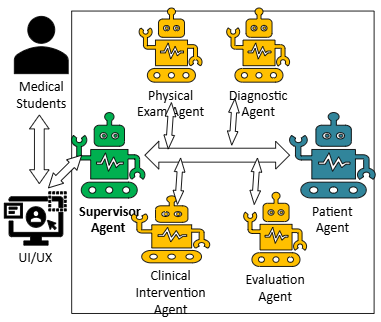
Figure 2: Multi-agent architecture for the clinical reasoning simulator, highlighting agent roles, relationships, and primary interaction pathways.
Human stakeholders (medical students and educators) interact with the platform via a unified interface, engaging with scenario-driven simulations. Key agent explainability capacities include, for example, the Diagnostic Agent returning probabilistic mapping between test results and disease hypotheses, and the Evaluation Agent detailing the rubric and rationale behind student assessments.
Persona Construction and XAI User Stories
AI Personas are meticulously defined, not only for human actors but for each agent class, encapsulating technical implementation details (e.g., LLM-based dialogue, rule-based exam logic) with user-oriented affordances (e.g., counterfactual reasoning capability, feedback turnaround time). XAI user stories, expressed in persona-centric terms (e.g., "As a medical student, I want to understand why..."), are systematically prioritized and converted to high-precision requirements. This rigor prevents ad hoc engineering of explainability features and aligns system capabilities with stakeholder objectives.
For instance, student-facing requirements include on-demand visualizations of feature attribution for diagnostic recommendations and real-time rationales for intervention critiques. Educator-facing requirements encompass transparent logging of evaluation triggers and criteria. These are validated through iterative walkthroughs with both human users and agent proxies, enabling rapid refinement of explananatory affordances.
Empirical Outcomes and Stakeholder Feedback
A post-usage survey of 42 medical students and 2 educators revealed that 78% agreed the system improved clinical reasoning competence, with particular value placed on the immediacy and clarity of agent explanations. Features such as test ordering transparency, intervention feedback, and supervisor guidance scored highly for trust and educational value. Stakeholders emphasized the utility of granular, scenario-anchored explanations, affirming the persona-based approach’s impact on meaningfulness and interpretability of AI-agent actions.
Critical Analysis and Limitations
The persona-based methodology effectively bridges human-centered perspectives and the technical realities of complex MAS environments. Creating agent personas with explicit constraints prevents anthropomorphization and over-expectation of AI capabilities. Nonetheless, the approach is dependent on the completeness and quality of initial persona and scenario construction; biases or oversights at this stage propagate downstream. The proof-of-concept application is currently limited to a single medical education context with a modest dataset; broader generalization and more robust scenario catalogs would strengthen external validity.
Future work must address the extension of persona-based RE to additional verticals, generalize the agent specification schema, and formalize risk management for anthropomorphic bias in stakeholder understanding. The framework’s integration with automated prompt engineering and LLM-based scenario generation offers a promising avenue for scaling to high-stakes and large-scale XAI MAS deployments.
Implications for AI and Requirements Engineering
This research demonstrates that treating AI agents as first-class stakeholder personas in RE processes yields more actionable, contextually grounded, and user-validated explainability requirements. The resultant systems are both more trustworthy and more effective at meeting educational and operational objectives in domains where transparency and interpretability are critical. The formalization of persona-based RE for MAS creates methodological scaffolding for next-generation human-centered XAI, with direct relevance to AI policy, model auditing, and interdisciplinary educational technology.
Conclusion
The persona-based RE methodology detailed in this work constitutes a significant advance in the rigorous elicitation and systematization of explainability constraints for MAES. The blending of AI and human personas, scenario-driven XAI user stories, and tight feedback/iteration cycles delivers a transparent pipeline from stakeholder need to system affordance. The clinical reasoning simulator case validates the framework’s utility and reveals clear directions for scaling and domain transfer. Future research should focus on expanding scenario diversity, formalizing anti-bias protocols, and investigating cross-domain persona transfer in complex XAI-centric MAS.
References:
- "Persona-Based Requirements Engineering for Explainable Multi-Agent Educational Systems: A Scenario Simulator for Clinical Reasoning Training" (2604.17186)

