- The paper introduces HyCoLLM, a hyperbolic framework that mitigates cognitive crowding in LLMs by effectively modeling multi-dimensional cognitive states.
- It employs a two-stage method using a Hyperbolic Cognitive Network and Hyperbolic-Guided Alignment Tuning to align semantic and cognitive representations.
- Experimental results demonstrate a nearly 3x improvement in joint inference accuracy over baselines, highlighting the benefits of hyperbolic geometry.
Multi-Dimensional Cognitive State Modeling in LLMs: Hyperbolic Disentanglement for Cognitive Crowding
Introduction and Motivation
This work addresses a fundamental barrier in the cognitive modeling capacity of LLMs: their inability to consistently handle multi-dimensional, interactive human cognitive states encompassing emotion, thinking style, stance, and intent. While LLMs attain high accuracy when dimensions are considered independently, their performance collapses in joint modeling. Cognitive theories and analysis of the constructed CognitiveBench dataset, which exhaustively annotates these four dimensions, reveal pronounced hierarchical structure in real cognitive states. Empirical Gromov δ-hyperbolicity on this data consistently yields relative δ values near 1%, confirming tree-like geometry.
LLMs, operating in Euclidean representation spaces with only polynomial volume growth, cannot efficiently disentangle the exponential combinatorics of hierarchical cognitive states. This results in "cognitive crowding": semantically and hierarchically distinct states share overlapping vector regions, critically undermining holistic cognitive inference.
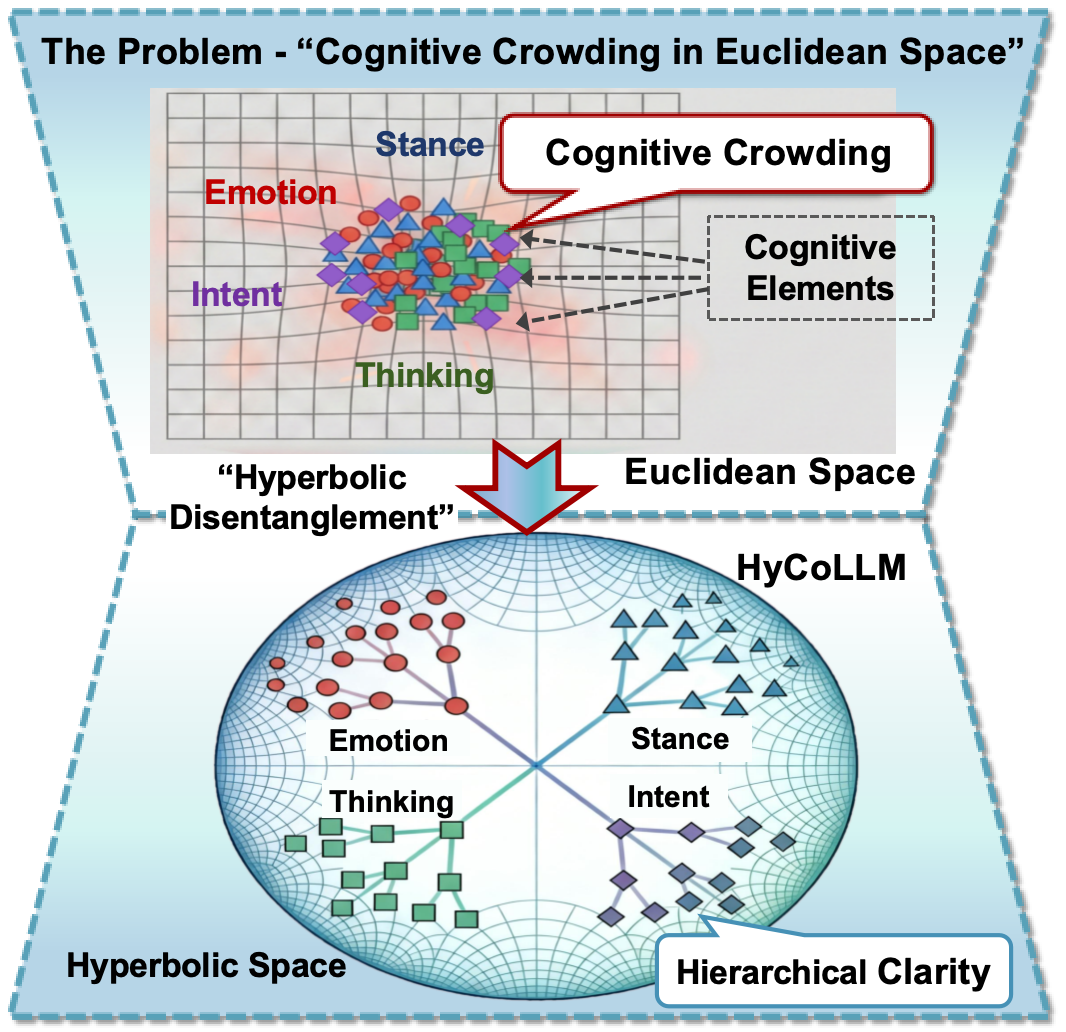
Figure 1: Illustration of alleviating cognitive crowding in Euclidean space via hyperbolic disentanglement.
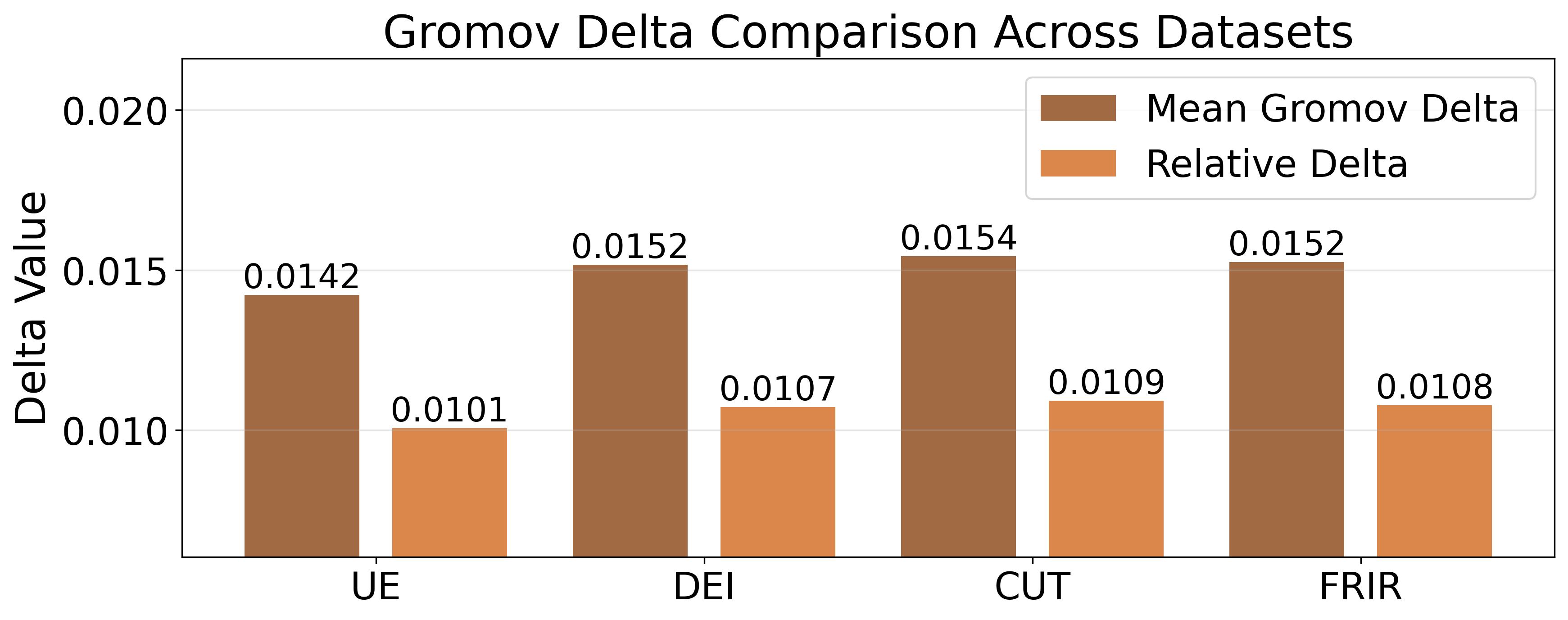
Figure 2: Gromov δ-hyperbolicity analysis reveals strong hierarchical structure across all four datasets.
CognitiveBench: A Multi-Dimensional Cognitive Benchmark
CognitiveBench is introduced as the first large-scale benchmark explicitly supporting joint annotation of emotion, thinking, stance, and intent. Annotation draws on Plutchik’s emotion model, Dual-Process Theory for thinking, social judgment for stance, and Speech Act Theory for intent, yielding a high-fidelity hierarchy of cognitive states. Corpus construction centers on four domains with high cognitive engagement: international trade, US election, DEI, and interest rates.
Label distributions (see Figure 3) and Cohen’s κ calculations demonstrate both broad cognitive and domain coverage and high annotation reliability. The dataset exposes both the complexity and the intertwined nature of human cognition, and Gromov δ-hyperbolicity further justifies the need for non-Euclidean representation regimes.
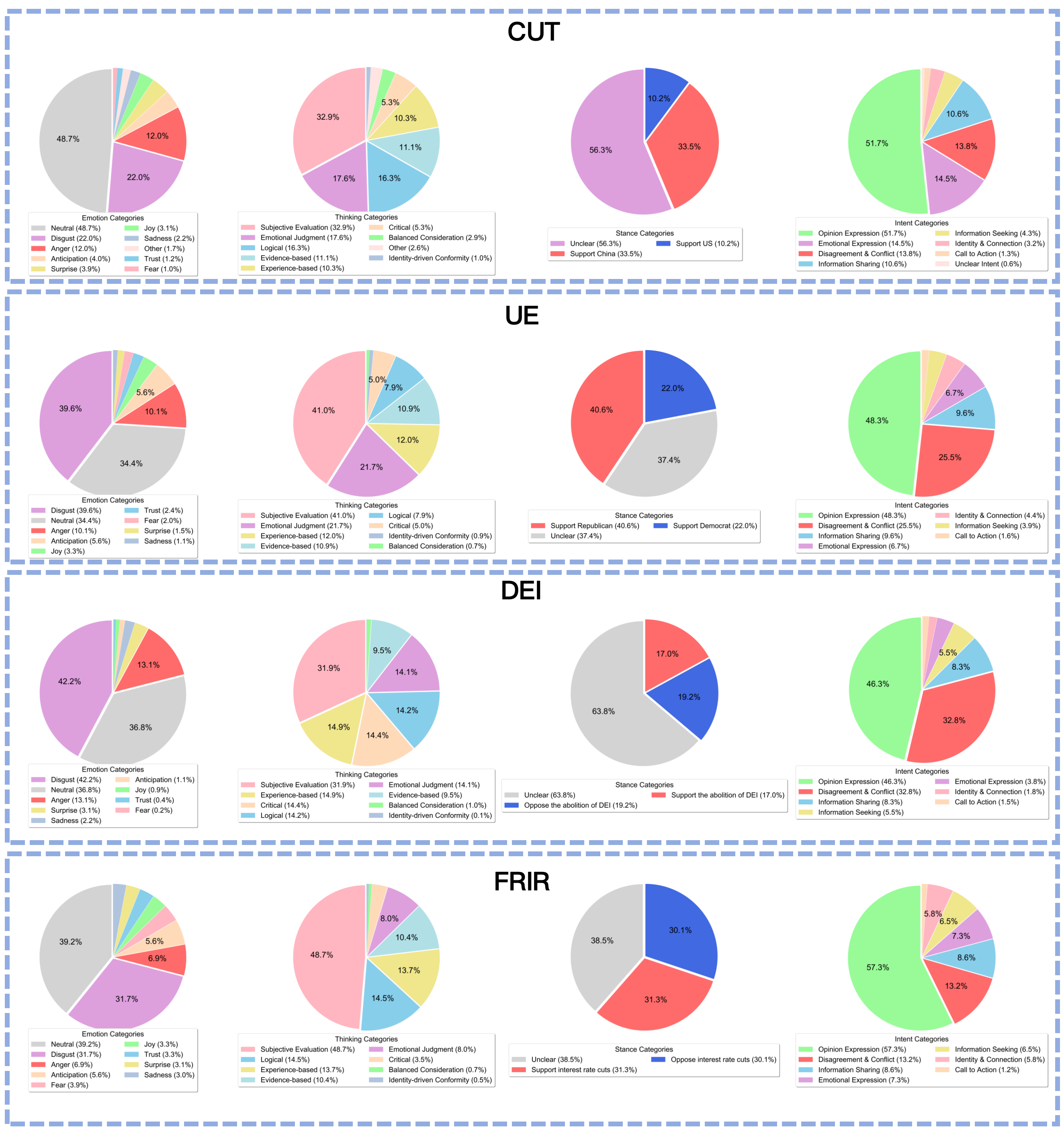
Figure 3: Distribution of cognitive labels demonstrates diversity and coverage across all CognitiveBench domains.
Cognitive Crowding: Geometric Analysis and Implications
The core architectural bottleneck is formally characterized as a mismatch between the polynomial capacity of Euclidean spaces and the exponential separation required for hierarchical trees. Embedding theory demonstrates that representing a tree of branching factor b and depth k in Rd under bounded-distortion constraints requires exponential radius growth in k, while a d-dimensional hyperbolic ball achieves this with linear radius growth.
Empirically, closed-source and open-source models (e.g., GPT-4o, Qwen3-XB) achieve competitive independent dimension metrics, but multi-dimensional joint accuracy (PMA@4) plummets (≤5.7% for GPT-4o, near chance). This is a direct failure to preserve holistic cognitive alignment.
HyCoLLM: Hyperbolic Cognitive Large Language Modeling
HyCoLLM is proposed to address the geometric bottleneck. The framework proceeds in two stages: (i) disentanglement of cognitive dimensions in hyperbolic space using a Hyperbolic Cognitive Network (HCN), and (ii) alignment of LLM semantic features to the hyperbolic cognitive prior via Hyperbolic-Guided Alignment Tuning (HGAT).
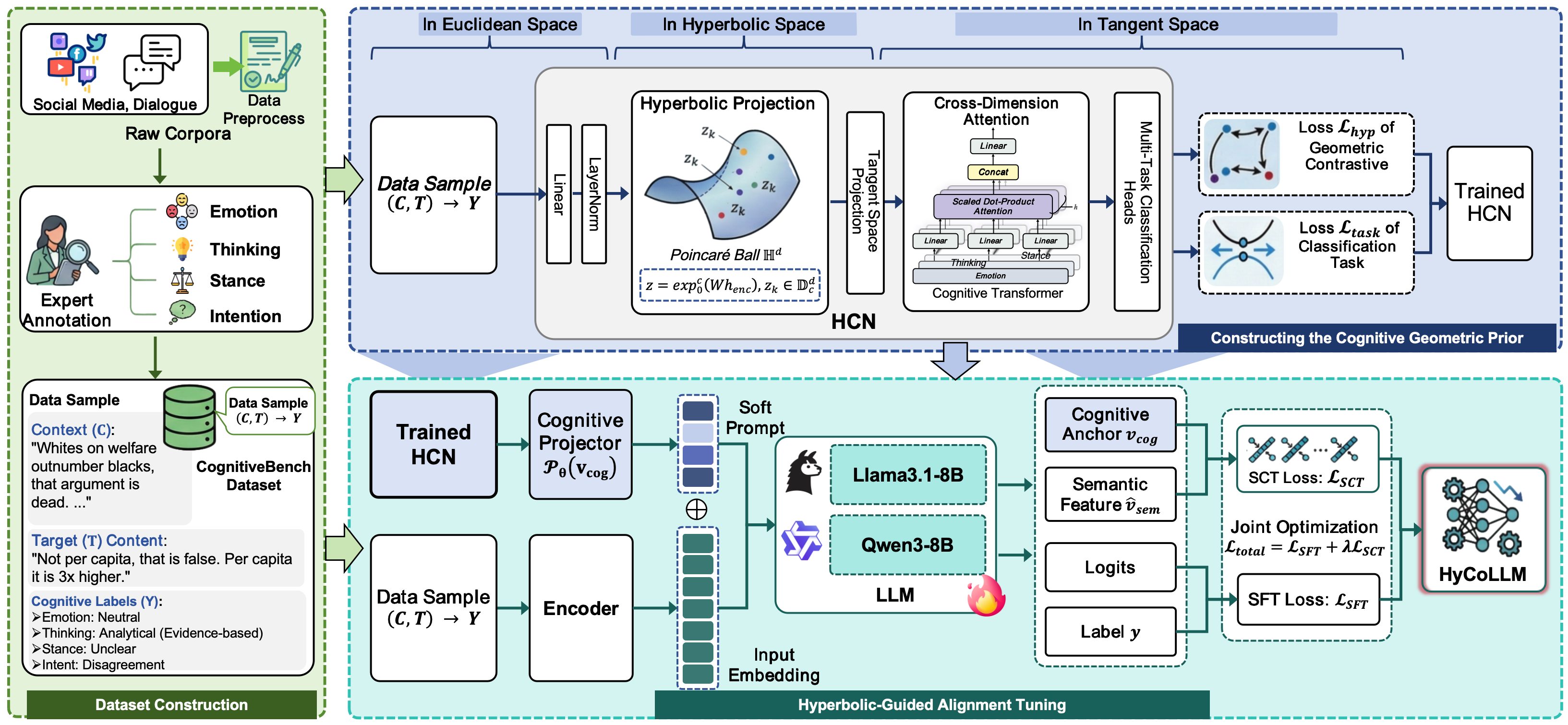
Figure 4: The overall framework of HyCoLLM, with dual-phase geometric disentanglement and alignment.
Hyperbolic Cognitive Network (HCN)
Inputs are projected into the Poincaré ball, yielding dimension-specific cognitive feature vectors, which are aggregated through cross-dimensional attention. Geometric regularization and contrastive losses, based on the Poincaré distance, enforce separation of distinct cognitive states. This yields "cognitive anchors" with guaranteed hierarchical structure, overcoming Euclidean crowding.
Hyperbolic-Guided Alignment Tuning (HGAT)
To bridge the tangent (Euclidean) and hyperbolic spaces, a cognitive projection network transforms the cognitive anchor into a soft prompt, which is prepended to LLM input embeddings. The generation is regularized by a Semantic-Cognitive Topology (SCT) loss, aligning the semantic output with the cognitive anchor via cosine similarity. This ensures that LLM predictions are topologically consistent with the cognitive hierarchy.
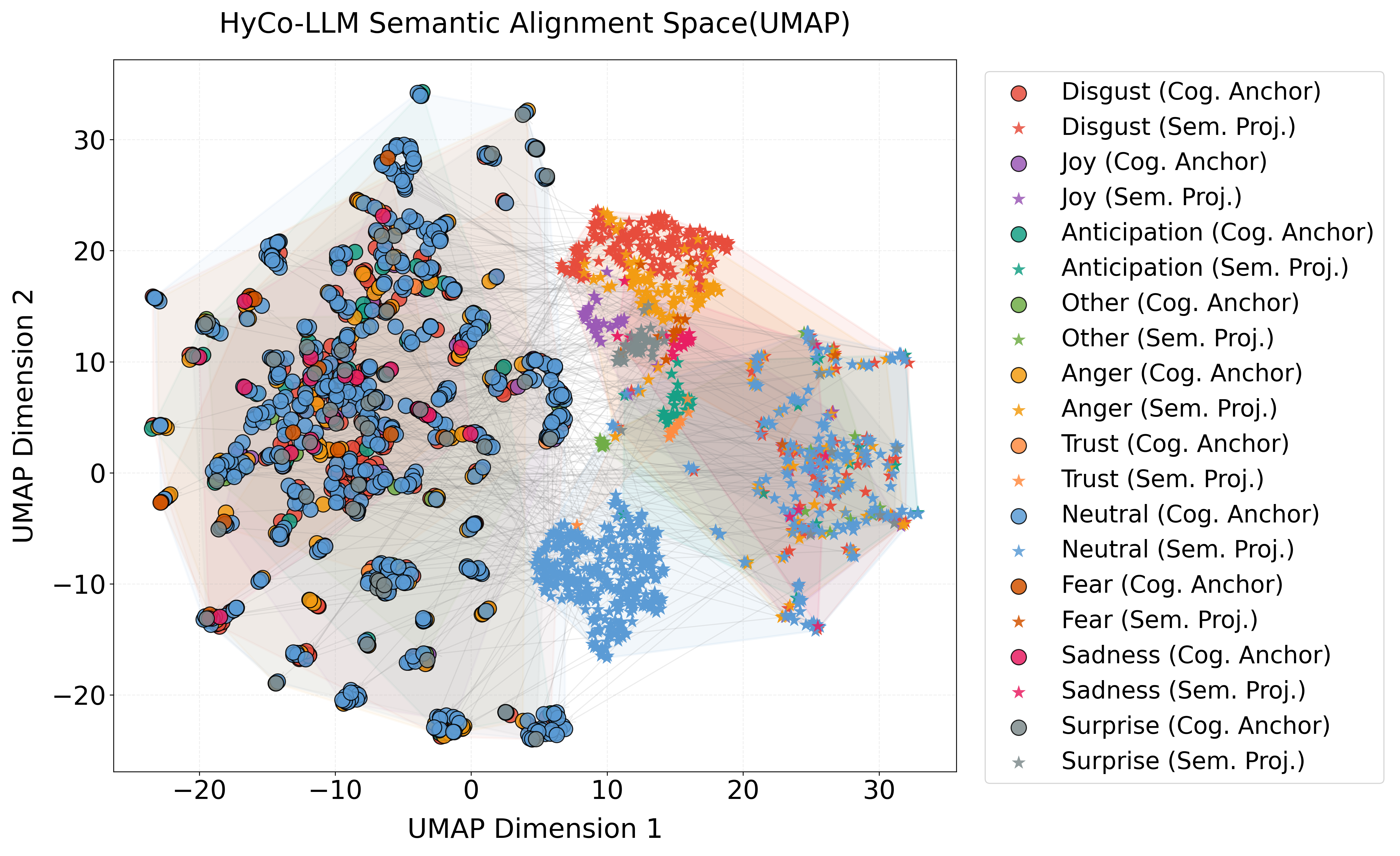
Figure 5: UMAP visualization; LLM semantic features (stars) are topologically aligned to well-dispersed HCN cognitive anchors (circles).
Main Experimental Results
HyCoLLM achieves significant gains over both closed-source and SoTA open LLMs. On CognitiveBench, an 8B-parameter HyCoLLM delivers PMA@4 accuracy of 15.5%, nearly a 3x improvement over GPT-4o and a 40% gain over a Qwen3-8B SFT baseline. This result is robust across all constituent dimensions and domains and shows clear superiority over scaling the parameter count under SFT.
Comprehensive ablation demonstrates that both the hyperbolic geometry and alignment components are essential: removing hyperbolic structure or alignment losses each triggers substantial drops in holistic cognitive consistency. Cross-domain generalization (FRIR, unseen during training) provides further evidence; HyCoLLM maintains the highest joint accuracy and lowest Hamming loss (see Table in main text).
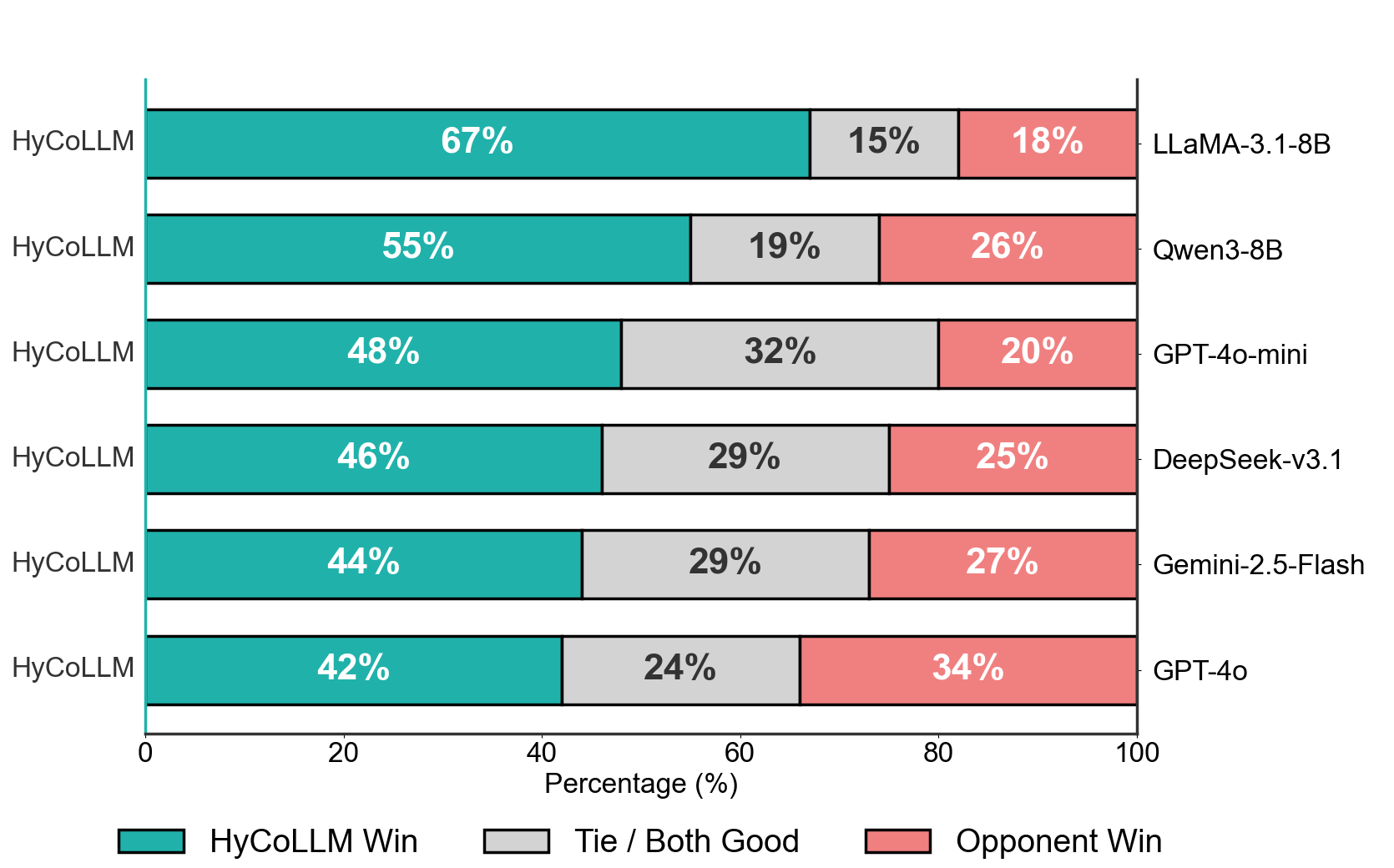
Figure 6: Results from blinded human evaluation confirm improved holistic consistency and superiority of HyCoLLM.
Computational and Optimization Analysis
HyCoLLM incurs only modest training overhead (10–18%) compared to SFT, with costs diminishing as model size increases. Crucially, there is no additional inference latency, as hyperbolic computations are offloaded to training and encoded into parameters and prompt embeddings.
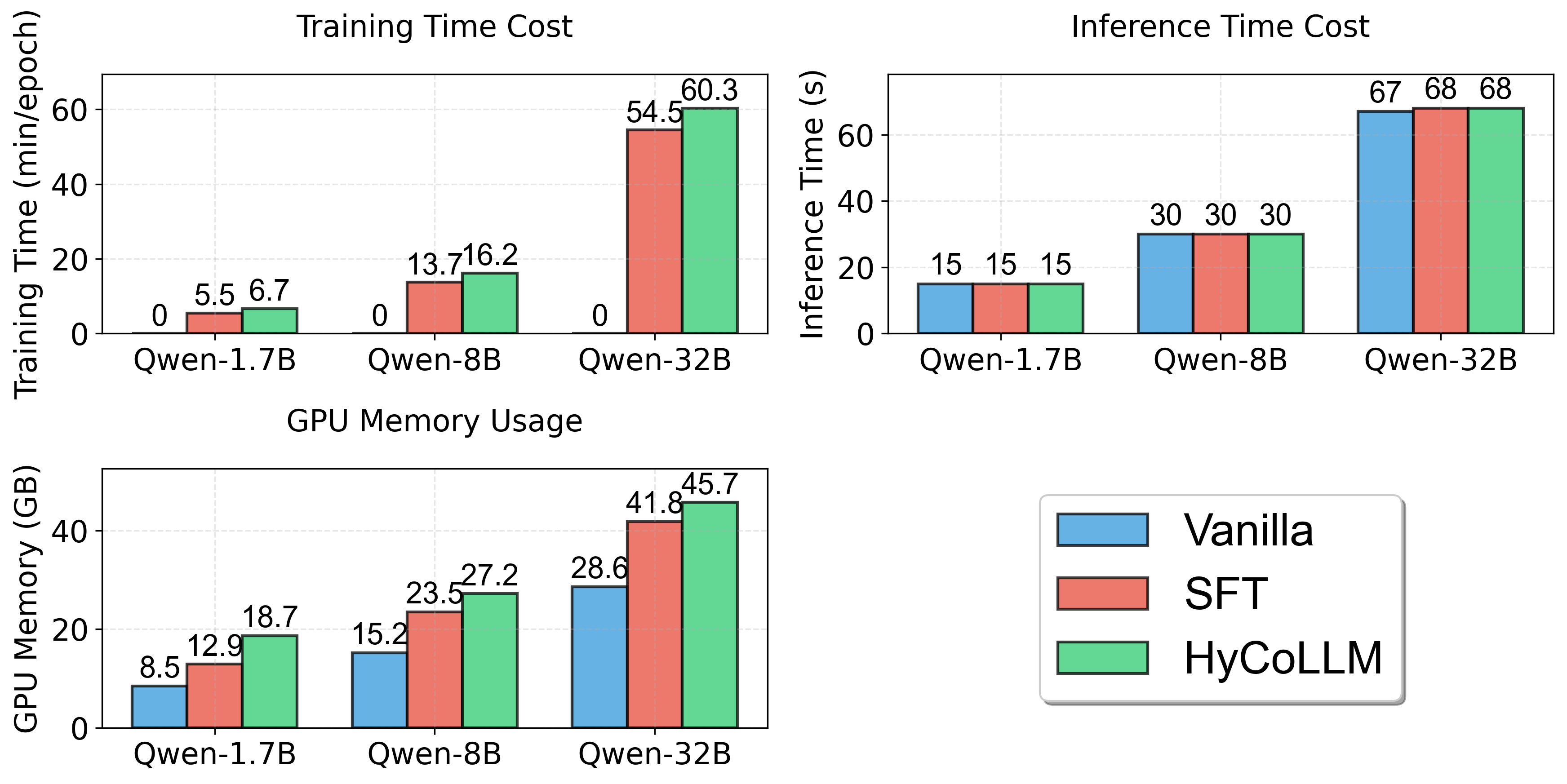
Figure 7: Computational cost analysis shows negligible inference latency and moderate training overhead for HyCoLLM.
Hyperparameter studies reveal a distinct optimal SCT alignment loss weight (δ0) and prompt length (δ1). Excessively strong or weak alignment damages cognitive structure retention.
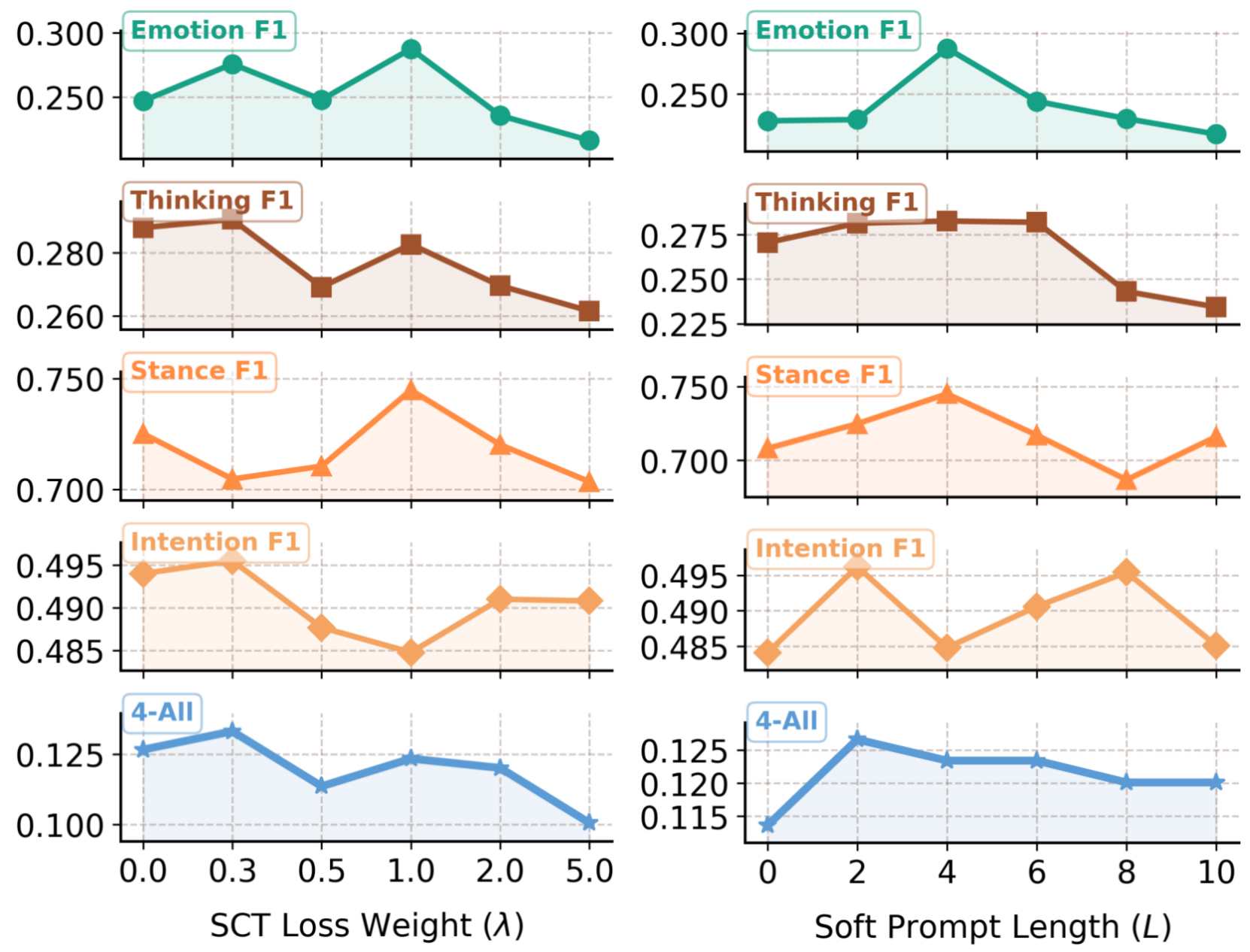
Figure 8: Sensitivity analysis demonstrates clear optima in SCT loss balance and prompt length for holistic cognitive modeling.
Optimization curves show stable convergence with a persistent contribution of the SCT loss throughout training.
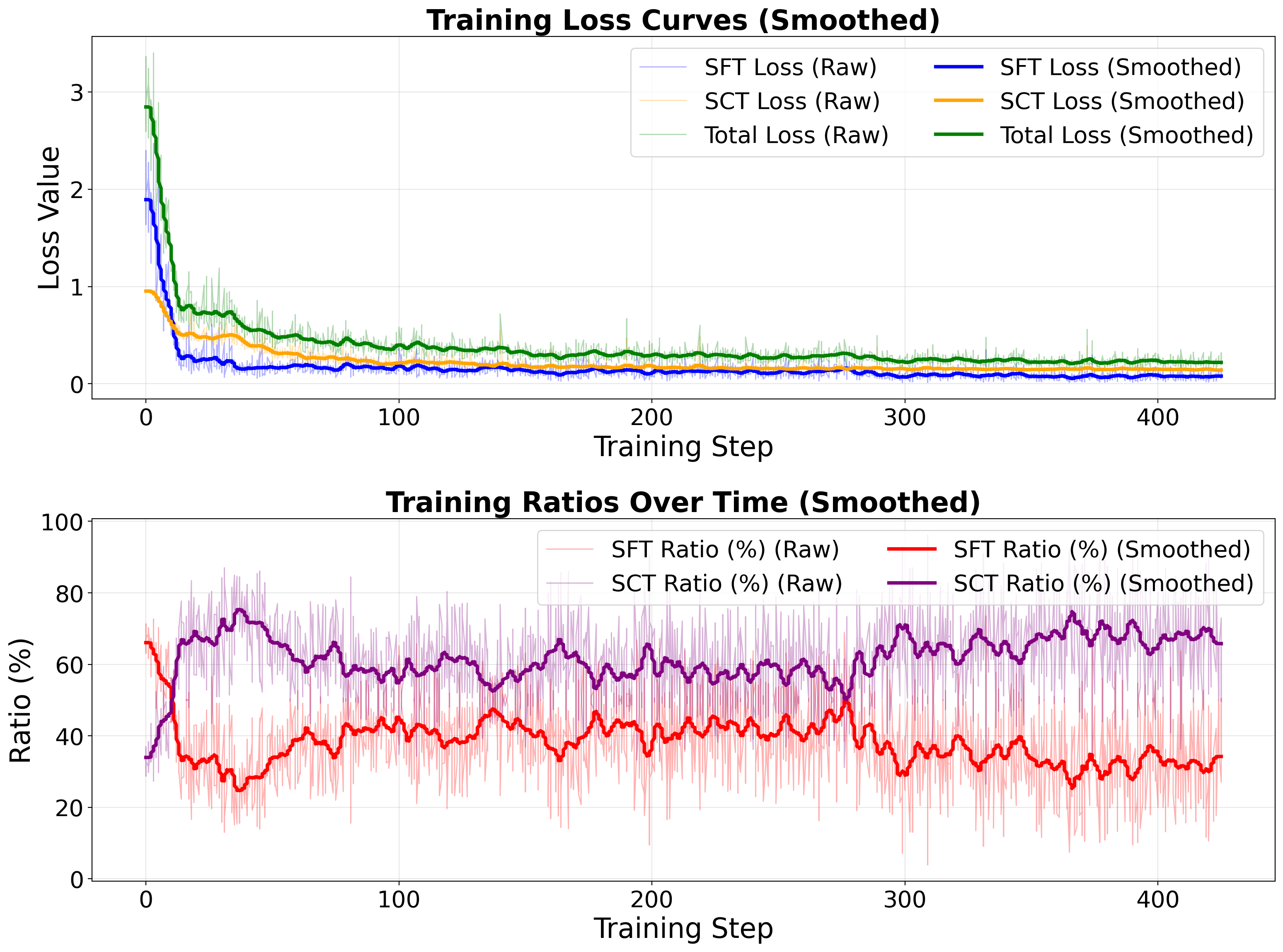
Figure 9: Loss curves exhibit stable convergence; the SCT loss ramps up as token generation loss plateaus, enforcing lasting geometric guidance.
Theoretical and Practical Implications
This work formalizes the geometric limitation of Euclidean LLM representations for multi-dimensional cognitive modeling. By aligning LLMs with hyperbolic priors, HyCoLLM provably lifts the embedding bottleneck, enabling small models to consistently outperform much larger baselines. The implications are profound: effective cognitive modeling in AI must respect not only the semantics of cognition but also its underlying mathematical structure.
From the practical perspective, architectures that incorporate non-Euclidean geometry—particularly when aligning to datasets demonstrating intrinsic hierarchy—have greater cognitive generalization power and domain transfer. This result is likely to generalize to any reasoning or inference task where hierarchical relationships predominate (e.g., theory-of-mind, advanced commonsense reasoning, social inference).
Conclusion
HyCoLLM demonstrates that geometric misalignment is the critical failure point for holistic cognitive modeling in LLMs. Hyperbolic disentanglement and representation alignment not only mitigate cognitive crowding but unlock new performance regimes, frequently enabling small parameter models to surpass SoTA closed and open LLMs on holistic cognitive state inference. The explicit formulation of structural constraints and alignment losses provides a general recipe for neural modeling of any high-dimensional, hierarchically organized reasoning space.
Future Directions
The adaptability of these methods to weakly-supervised or low-resource settings, increased efficiency in Riemannian optimization, and the principled transfer to tasks with diverse hierarchical taxonomies represent immediate next research steps. Additionally, understanding the effect of geometry-guided cognitive alignment on general-domain LLM capabilities (e.g., logical, algorithmic, or mathematical reasoning) calls for further investigation.
Ethical concerns—such as misapplication in manipulative dialogue, privacy leaks, or amplification of annotation bias—must also remain a central consideration in the deployment of such cognitive-aligned LLM architectures.
Summary
This work provides a comprehensive solution to the problem of cognitive crowding in LLMs via hyperbolic geometric priors and alignment. The approach robustly outperforms high-parameter baselines, is theoretically grounded, and computationally efficient, and points to geometry-aware architectures as a critical direction for advanced cognitive AI systems (2604.17174).