- The paper reveals that Apple Intelligence’s privacy token system, lacking cryptographic device binding, is vulnerable to practical token replay attacks.
- It details a two-phase attack where extracted TGT and OTT tokens are exploited to bypass device checks, causing impersonation and denial-of-service effects.
- Empirical results show tokens remain valid for days, highlighting the urgency for stronger cryptographic binding and timely token revocation mechanisms.
Security Analysis of Token Authentication in Apple Intelligence: Practical Exploitation and Mitigations
Overview and Motivation
The paper "Too Private to Tell: Practical Token Theft Attacks on Apple Intelligence" (2604.15637) rigorously examines the authentication and authorization mechanisms employed by Apple Intelligence (\ai), a generative AI service integrated into Apple devices. The authors dissect the privacy-centric design of \ai—centered on device-based, anonymous access tokens and Private Cloud Compute (PCC)—and expose vulnerabilities that enable cross-device token theft attacks. The critical discovery is that the non-transferability assumption, fundamental to Apple's privacy design, is not cryptographically enforced, permitting practical replay attacks in which access tokens can be extracted from one device and exploited on another, anonymously usurping service allowances.
Technical Anatomy of Apple Intelligence Authentication
Apple Intelligence operates under a two-stage token system informed by Privacy Pass (RFC 9578). The workflow is comprised of:
- Device Eligibility and TGT Issuance: Clients first prove device authenticity to the PCC Identity Service and receive a long-lived Token Granting Token (TGT).
- Service Authorization and OTT Issuance: The TGT is redeemed via OHTTP relay for a batch of single-use One-Time Tokens (OTT), enabling quota-limited access to \ai services. All subsequent authorization is decoupled from device identification.
- Token Validation Procedures: OTTs are validated at the service gateway. TGTs are optionally validated within PCC nodes, but enforcement is disabled by default in macOS 26.0.
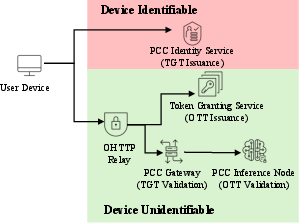
Figure 1: Security components of \ai, depicting privacy layers and token workflows in PCC.
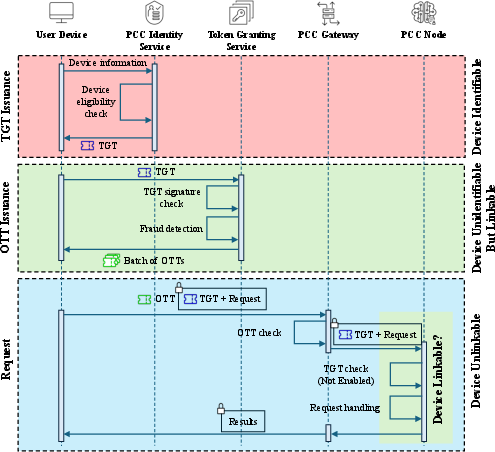
Figure 2: Authentication protocol of \ai, highlighting identity verification and token relay processes.
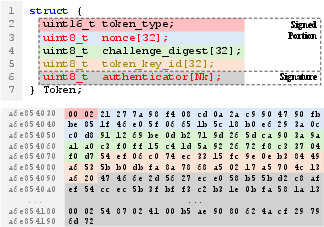
Figure 3: The token format of TGT and OTT, illustrating cryptographically signed fields and their uniqueness across tokens.
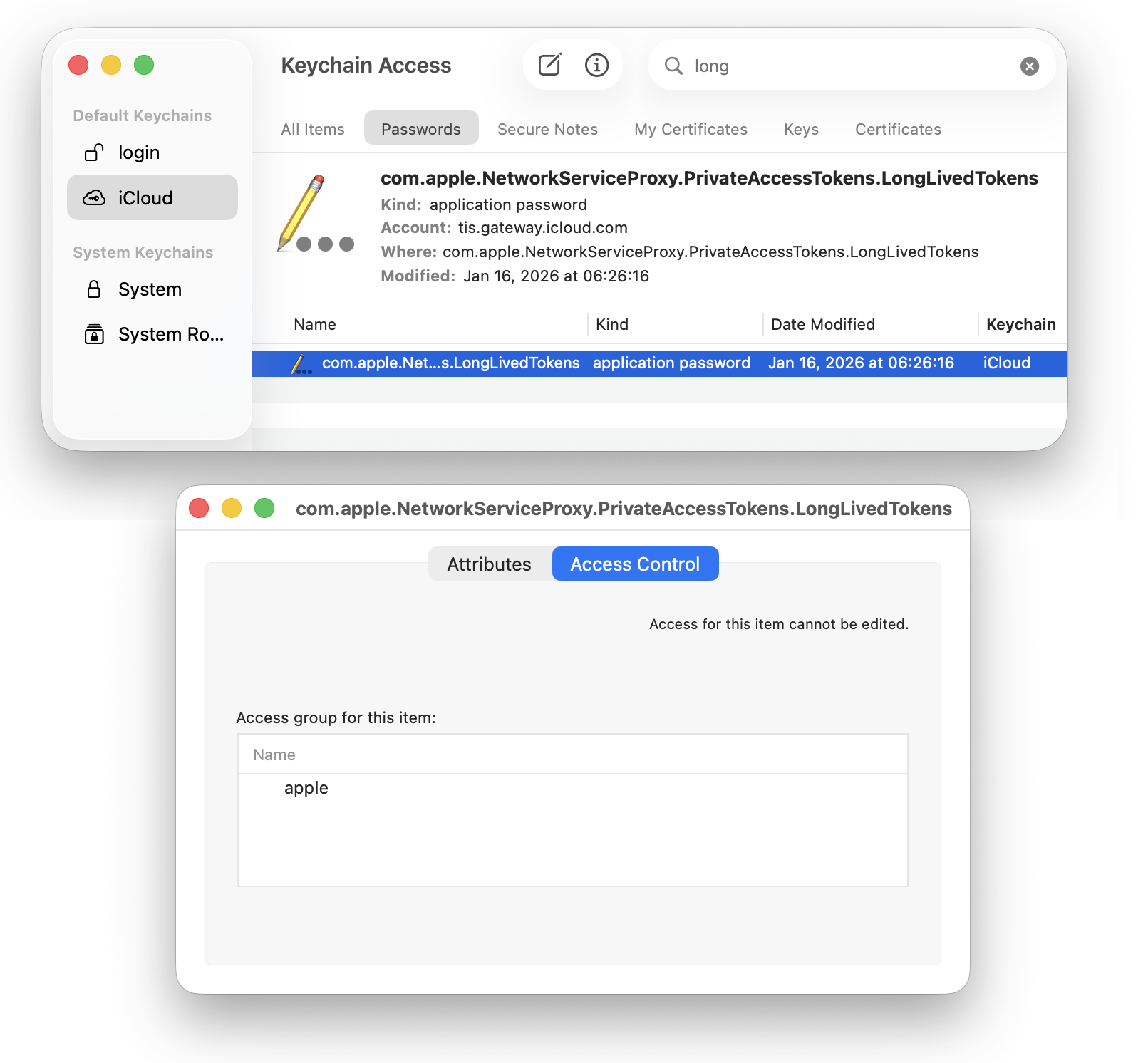
The keychain architecture on Apple devices, including login and iCloud keychains, is utilized to store these tokens. Token signature/validation relies solely on cryptographic keys without binding to hardware identifiers, enabling non-principal replay.
The \sysname Attack: Practical Token Replay and Exploitation
The core attack presented (\sysname) leverages the loose security boundaries around access tokens:
- Token Extraction Phase: Malicious software (requiring only regular user privileges and simple social engineering to bypass keychain prompts) extracts TGT and OTT tokens from the victim's device.
- Token Replay Phase: The attacker imports the stolen tokens onto another device, successfully masquerading as the victim, entirely bypassing device-specific checks.
- Consequences: The attacker consumes \ai allowances attributed to the victim; when quotas are exhausted, the victim experiences DoS-like symptoms without explicit evidence of compromise.
Numerical results from empirical testing underscore severe outcomes:
- TGTs are valid for days, permitting repeated quota exhaustion via replay.
- OTTs batch issuance confirms rate-limiting tied to TGT, fully exploitable when stolen.
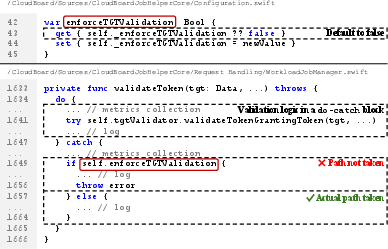
Figure 4: Swift code logics of PCC showing default bypass behavior for TGT validation due to configurable enforcement.
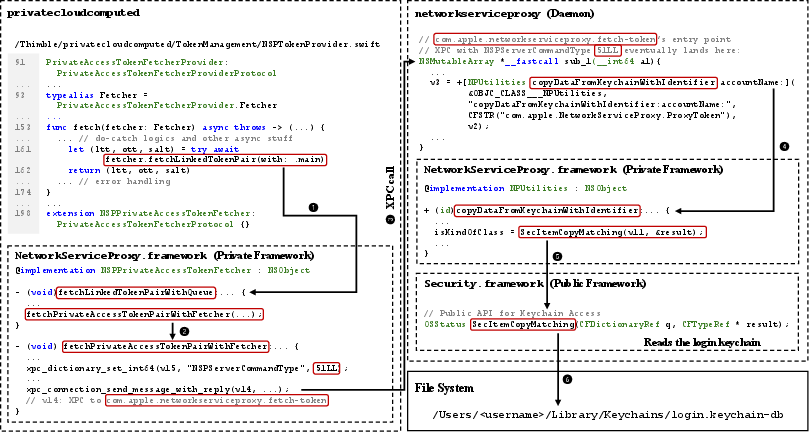
Figure 5: Workflow for token fetching and storage in the privatecloudcomputed subsystem, pinpointing keychain vulnerabilities.
Security Implications and Broader Threat Landscape
The attack is scalable and stealthy:
- No privilege escalation is required; attacks can be automated, feeding a pool of stolen tokens on infrastructure such as farms of inexpensive Mac minis.
- Apple’s privacy design (OHTTP relay, anonymous tokens) precludes tracing attackers at the server layer.
- Token revocation is unsupported; once stolen, tokens remain valid until expiry (no user-initiated remedy).
These points markedly differentiate \sysname from traditional API key leakage or cookie theft attacks, as discussed in the paper. Victim awareness is minimal, and detection is infeasible given the architectural anonymity.
Mitigation Approaches and Apple’s Response
Several mitigations are discussed:
Practical and Theoretical Implications
From an operational perspective, this research illustrates the inherent conflict between privacy-promoting designs (e.g., Privacy Pass) and the requirement for strong access control. The findings reveal that anonymous token-based authentication, if not tightly cryptographically bound to user hardware, creates avenues for scalable impersonation and resource exhaust. The implications extend to other AI services adopting similar privacy methodologies: cryptographic device binding must be enforced, and revocation must be supported for secure deployment.
Future developments could include integrating device-attestation protocols, leveraging hardware enclaves, and combining privacy-preserving authentication with continuous risk analysis. The rapid evolution of privacy-centric AI services demands ongoing adversarial analysis and rigorous security engineering.
Conclusion
The paper presents a comprehensive, technically grounded vulnerability analysis of Apple Intelligence’s authentication protocol, demonstrating that privacy-focused token mechanisms, absent strong device binding, are susceptible to scalable replay attacks. The empirical results deliver concrete evidence of practical DoS and impersonation at the user level. While Apple has taken remediation steps, the attack surface persists, underscoring the necessity for cryptographic non-transferability and revocation capabilities in the design of secure, privacy-preserving AI platforms.