- The paper introduces a primal bootstrap method that replaces nonlocal smearing with local Chebyshev sampling to enforce positivity and linearized unitarity at finite kinematic resolution.
- It yields compact, non-projective bounds on Wilson coefficients, including a robust upper bound on the EFT cutoff relative to the Planck scale in D=5 dimensions.
- The study reveals novel quadratic Regge-like bands organizing the extremal spectral density, offering new insights into gravitational UV completion constraints.
Primal Bootstrap with Gravitational Poles: Sampling the S-Matrix and Deprojecting the Swampland
Introduction and Theoretical Motivation
This work develops a functional, sampling-based primal bootstrap framework for deriving constraints on the space of low-energy effective field theories (EFTs) coupled to gravity. The focus is on numerically tractable, crossing-symmetric dispersion relations, and the enforcement of both positivity and linearized unitarity directly at finite kinematic resolution. This is applied to scalar field scattering in various spacetime dimensions, probing the space of allowed Wilson coefficients under the nonperturbative consistency conditions encoded by analyticity, crossing, and unitarity of the S-matrix.
In dynamical gravity, the forward amplitude is dominated by the long-range t-channel graviton pole, which invalidates standard positivity/dispersion sum rules at fixed t. Prior work circumvented this with smeared dispersion relations; however, smearing inherently complicates the imposition of linearized unitarity, and (in the gravitational context) corresponds only to projective (scaling-invariant) bounds on coupling space. This paper introduces an alternative: sampling-based primal bootstrap. The essential innovation is the extraction of functional S-matrix constraints at a finite set of kinematic points, enabling control over subtractions and direct imposition of both spectral positivity and upper bounds from linearized unitarity.
Sampling Versus Smearing — Technical Implementation
The methodology replaces nonlocal smearing with local sampling at Chebyshev nodes in the relevant kinematic variable (t or the fully crossing-symmetric parameter a), discretizes the spectral integral and the partial wave expansion, and then solves the resulting finite-dimensional constrained optimization problem. The kernel's structure (see equation 3.6 of the paper) and the explicit form of crossing-symmetric improved sum rules ensure that all functional and crossing constraints can be enforced as linear equality (or inequality) conditions.
While the approach leads to a numerically challenging linear program—requiring correlated scaling of energy, spin, and kinematic discretization cutoffs—the paper documents that stable and convergent results are feasible when these parameters are jointly optimized. The sampling method also yields, as part of its solution, the entire extremal spectral density saturating the bounds.
Projective Bounds—Comparison with Previous Techniques
Projective bounds (i.e., constraints on ratios of Wilson coefficients, insensitive to overall rescaling) obtained via fixed-t sampling for D≥6 match prior smeared approaches, while in D=5 the sampling method yields mildly stronger bounds (e.g., g2/8πG≥−16.5 versus g2/8πG≥−18 with smearing).
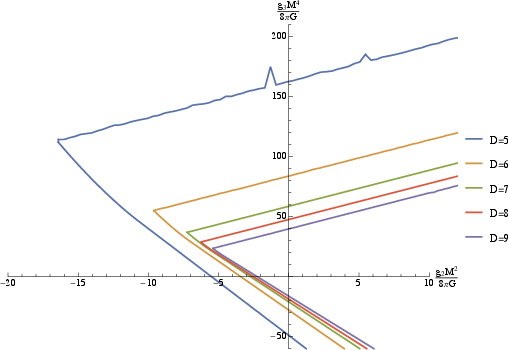
Figure 2: Allowed regions in the g2/8πG,g3/8πG plane obtained by primal sampling in t0 and t1; the t2 result is slightly stronger than previous smeared bounds.
The extremal spectrum for t3 reveals a novel organization. Unlike the sparse extremal states in previous dual-bootstrap analyses, the dominant spectral weight clusters along several quadratic Regge-like trajectories in the t4 plane; off these trajectories, the spectral density is highly suppressed.
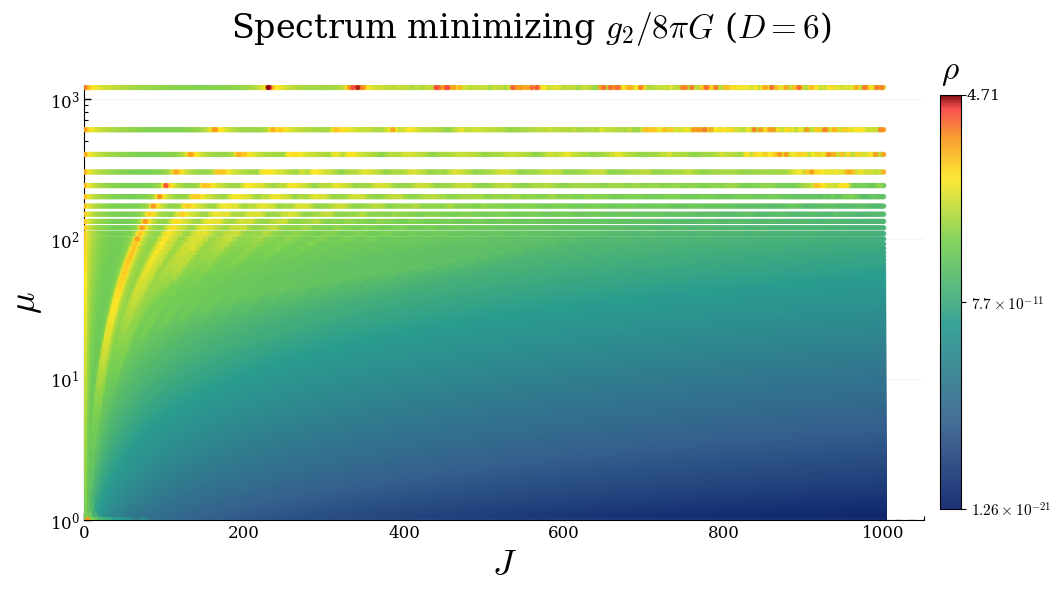
Figure 3: Log plot of the extremal spectral density t5 in t6 at the projective lower bound of t7; only quadratic Regge-like bands contribute substantial spectral weight.
Non-Projective Bounds and Deprojection
A principal technical achievement is the robust imposition of linearized unitarity as an upper bound on the spectral density (i.e., t8) alongside positivity. This converts the projective constraints into absolute (non-projective) bounds, now sensitive to the normalization of the couplings, including the Planck scale itself—a concretization of the "deprojection" of the EFT-hedron when gravitational coupling cannot be rescaled away.
In t9, the authors obtain an explicit upper bound on the ratio of the EFT cutoff to the Planck scale: t0, i.e., the cutoff scale cannot be parametrically separated from t1. This is a strong, model-independent restriction emerging from S-matrix consistency rather than UV completion data.
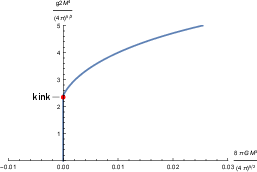
Figure 5: The allowed region in t2 space for a scalar coupled to gravity in t3. Imposing linearized unitarity renders the region compact, manifesting a nontrivial upper bound on t4.
As t5, t6 retains an upper bound, indicating an intrinsically non-smooth collapse of gravitational bounds to the non-gravitational EFT parameter space.
Extremal Spectra: Quadratic Regge Bands
At the non-projective boundary—i.e., at maximal allowed t7—the extremal spectral densities in t8 and above display a new, sharply organized structure: the entire support is concentrated in narrow quadratic Regge-like bands in the t9 plane. Spectral density is nearly binary, either vanishing or saturating its upper unitarity bound. Each band boundary fits a quadratic trajectory a0; the band index a1 produces a further quadratic hierarchy in the coefficients a2, e.g., a3.
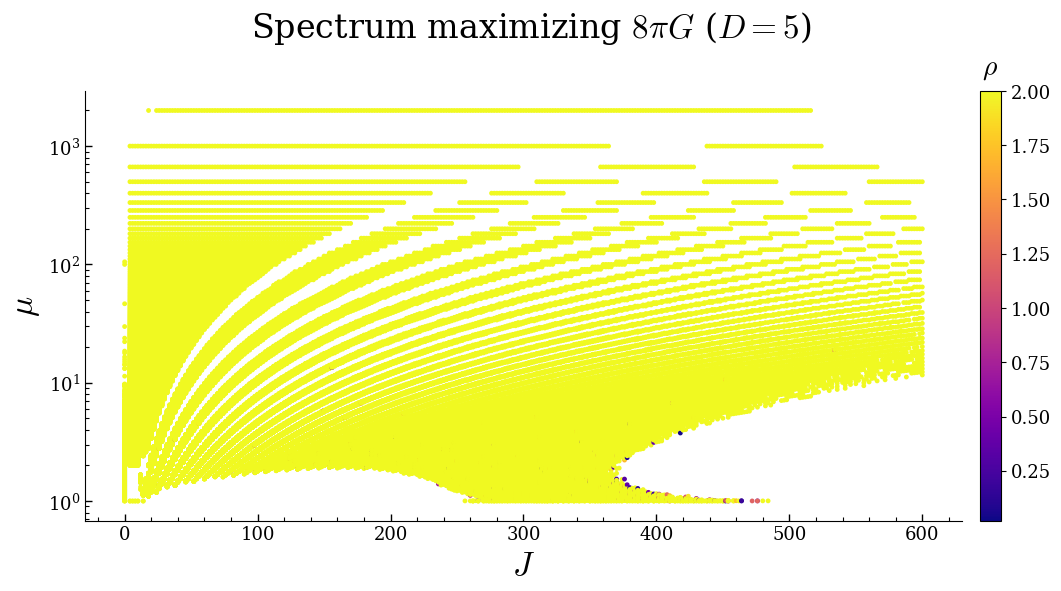
Figure 6: Log plot (binary support) for the extremal a4 in a5 at saturation of the gravitational coupling upper bound; quadratic bands in a6 dominate the spectrum.
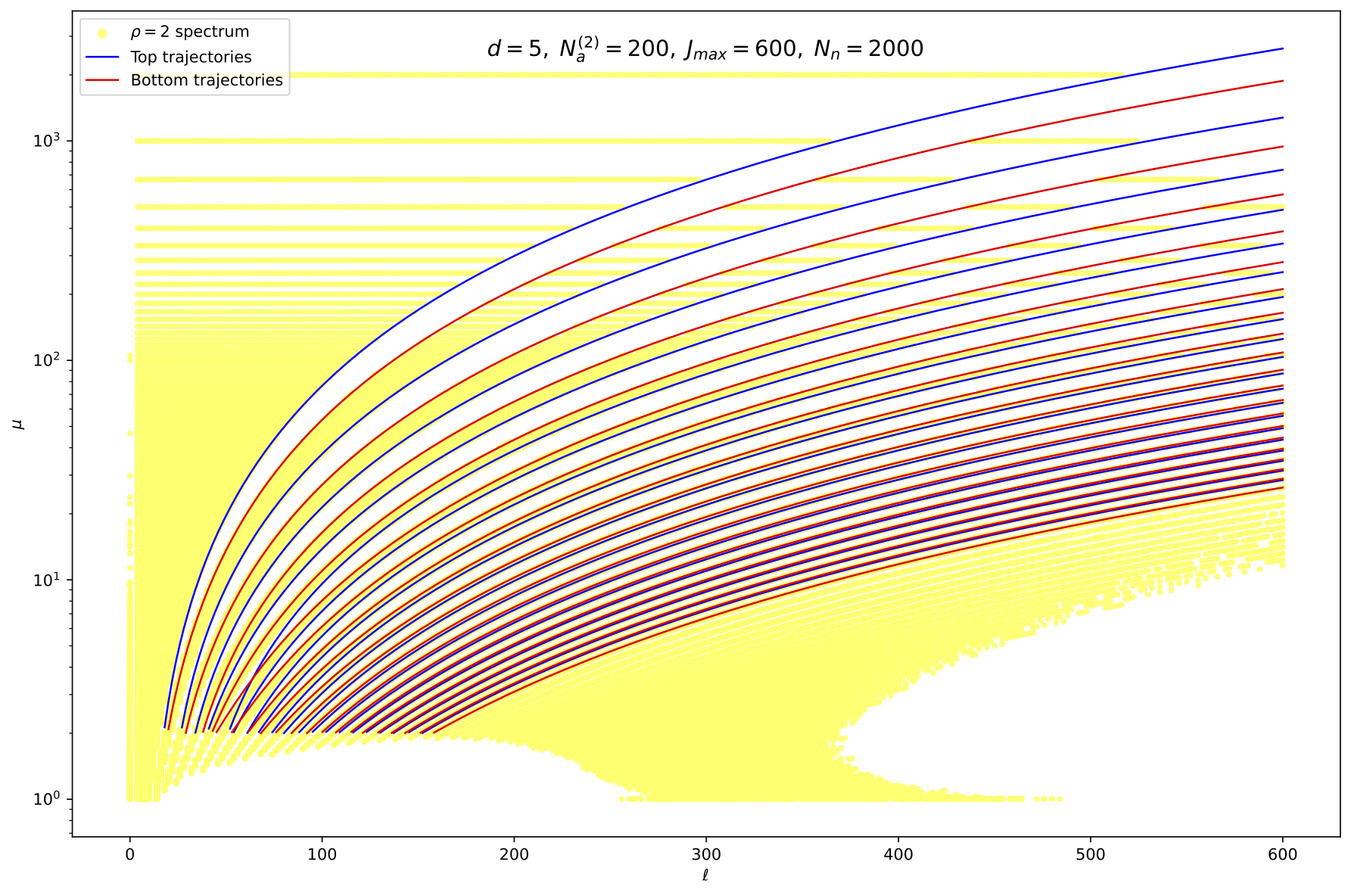
Figure 8: The explicit quadratic fit to the extremal trajectory boundaries in the a7 plane.
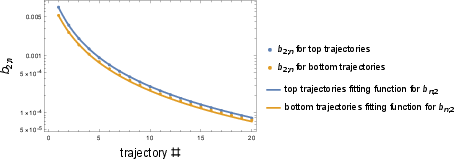
Figure 1: The a8 coefficient hierarchy across bands—fits tightly to an inverse quadratic in the band index a9.
This quadratic banding structure is in contradistinction to the linear Regge trajectories prevalent in field and string theory and observed in prior S-matrix bootstrap analyses. No input enforcing quadratic or linear behavior is imposed—hence, this structure arises dynamically from the constraints of crossing, analyticity, and unitarity with a graviton pole.
The work includes detailed convergence studies, documenting the necessity of correlated scaling of t0/t1 (sampling points), t2 (energy/mass resolution), and t3 (spin cutoff). Sampling via Chebyshev nodes is essential for control of the graviton pole divergence. The stability region for convergence is mapped; outside this, the optimization either exhibits drift (underconstrained by excessive spin truncation) or lacks feasible solutions (insufficient spin to resolve the pole).
Practical and Theoretical Implications
- Model-independent bounds: The finite upper bound on t4 is enforced regardless of UV completion details, gauge charges, or symmetry-breaking patterns.
- Deprojection in gravitational EFTs: Gravity forces the bootstrap beyond projective geometry, fundamentally altering the structure of allowed coupling regions.
- Extremal spectrum phenomenology: The emergence of quadratic Regge-like bands is unambiguous—future work may interpret which class of UV completions or emergent collective phenomena these structures correspond to.
- Generalization: The primal approach is extendable to higher-t5 sum rules, to systems with additional light states, and, in principle, to nonperturbative or non-Einsteinian gravitational setups.
- Future developments: Incorporation of exact partial wave unitarity (going beyond linearized unitarity), full treatment of gravitational and EFT loop corrections, and explicit connection to swampland conjectures require semidefinite or nonlinear programming extensions.
Conclusion
The primal sampling-based bootstrap framework enables nonperturbative control of the EFT parameter space in the presence of gravitational long-range interactions. By working with direct sampling and linear programs rather than nonlocal smearing, the approach implements both lower and upper bounds, yielding compact allowed regions in coupling space and directly producing extremal spectral densities. Quadratic Regge-like bands dominate the saturating spectral configurations—a new organizing principle with implications for the structure of gravitational UV completions and the boundary between landscape and swampland. This work shifts gravitational S-matrix bootstrap from geometric to fully quantitative, enabling a precise mapping of consistent low-energy effective theories.
References:
- "Sampling the Graviton Pole and Deprojecting the Swampland" (2604.15235)

