Abstract: A review of recent multiboson and vector boson scattering (VBS) measurements from the ATLAS and CMS Collaborations at the LHC is presented. Results are reported from precision diboson cross-section measurements, novel CP-sensitive and polarisation observables in $Wγ$ production, VBS observations in semileptonic and fully leptonic final states including the first measurements at $\sqrt{s}$ = 13.6 TeV, and observations of triboson processes. These results constitute a comprehensive test of the electroweak gauge sector of the Standard Model, and provide stringent constraints on anomalous gauge couplings in the effective field theory framework.
The paper presents precision measurements of diboson and triboson production using innovative neural network observables and effective field theory techniques.
It employs advanced machine learning methods, including RNN and GNN discriminants, to enhance sensitivity to CP-odd SMEFT contributions and anomalous quartic gauge couplings.
The results, featuring high-significance VBS observations and detailed differential cross sections, provide robust constraints on electroweak processes and potential BSM physics.
Multiboson and Vector Boson Scattering Measurements in ATLAS and CMS
Overview
The paper "Multiboson and VBS measurements in ATLAS and CMS" (2604.14753) synthesizes recent experimental advances in the study of multiboson production and vector boson scattering (VBS) at the LHC, focusing on results from the ATLAS and CMS collaborations. It reports on precision measurements of diboson and triboson production, newly established CP- and polarization-sensitive observables, and systematic probes of the electroweak sector, including the stringent constraints placed on anomalous gauge couplings within the effective field theory (EFT) formalism. The work establishes the empirical foundation for a high-precision program in electroweak physics leveraging the LHC Run 2 and first Run 3 datasets.
Precision Diboson Measurements
ATLAS' measurement of ZZ→ℓℓνν at s=13~TeV utilizes the full Run 2 dataset, achieving a fiducial cross section σfid(ZZ→ℓℓνν)=21.0±1.0~fb, with consistency between fiducial and inclusive cross sections and SMNNLO predictions. The analysis provides differential results in kinematic variables up to high transverse momenta, directly informing constraints on neutral anomalous triple gauge couplings (TGCs) using both vertex-based and SMEFT approaches.
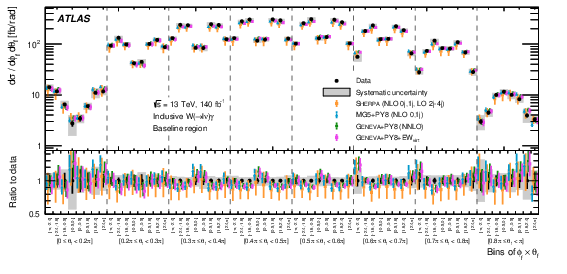
In Wγ production, ATLAS performs a double-differential cross section measurement in W decay angles, extracting polarization fractions compatible with the SM and providing new sensitivity to the W spin-density matrix.
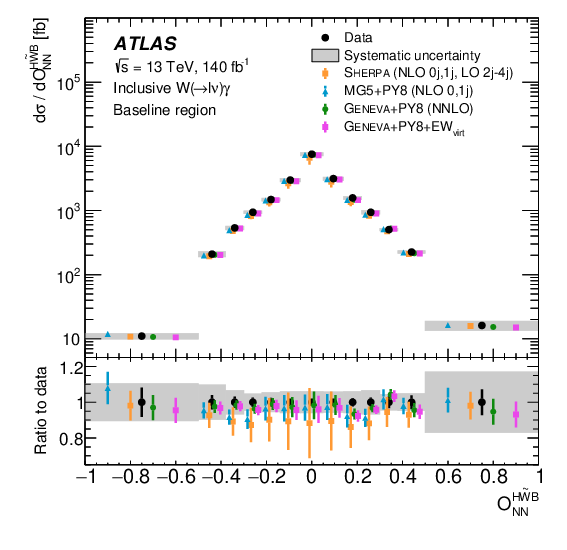
Figure 1: Left: Measured double-differential cross section in W decay angles ϕℓ and θℓ. Right: Differential cross section as a function of a CP-sensitive neural network observable.
A novel neural-network-based observable is defined to separate linear and quadratic CP-odd SMEFT contributions to the WWγ vertex, more than doubling sensitivity relative to classical angular observables and resulting in improved limits on CP-odd dimension-6 operators. These results critically test higher-order QCD and electroweak corrections at the highest available precision.
Vector Boson Scattering: Discovery and Precision Era
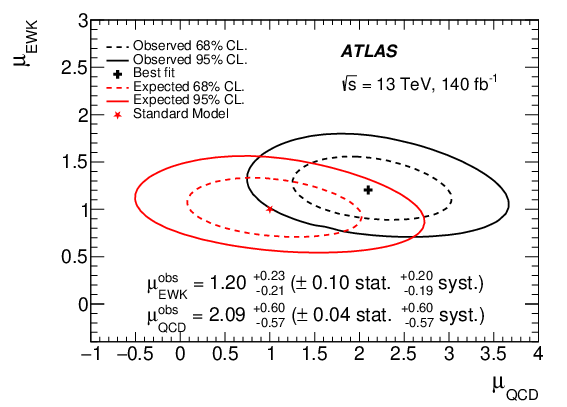
VBS is characterized by the production of two vector bosons in association with forward jets, probing gauge cancellations essential for unitarity and providing a natural EFT-sensitive topology. The ATLAS observation of electroweak s=130 production in semileptonic final states achieves a combined signal strength modifier s=131, with observed significance of s=132, an unambiguous establishment of the process in these high-statistics topologies. The analysis leverages a combination of RNN-based multivariate discriminants across all lepton flavors.
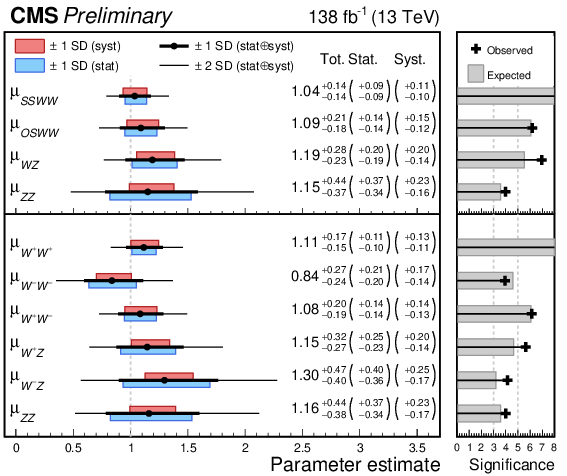
Figure 2: Left: Two-dimensional fit for VBS semileptonic signal strength; Right: Combined VBS signal strength modifiers for seven CMS channels.
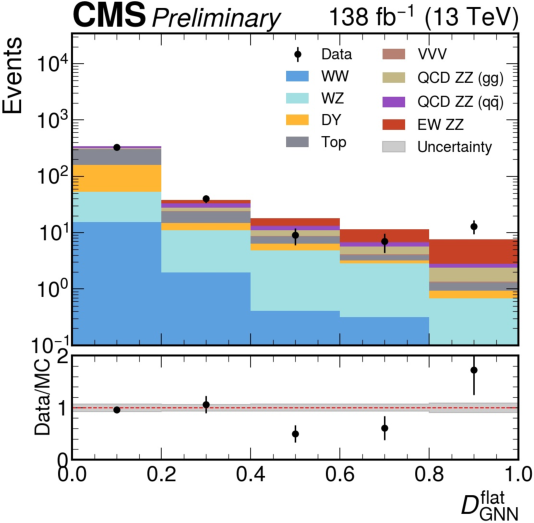
CMS' global combination across seven VBS channels (fully leptonic and semileptonic) consolidates experimental control, showing all measured signal strengths compatible with the SM and enhancing the robustness of subsequent SMEFT and anomalous quartic gauge coupling (aQGC) searches. Notably, the missing piece in experimental VBS coverage, electroweak s=133 production, is observed in CMS by combining the s=134 and s=135 channels, reaching a combined significance of s=136. Signal extraction here is powered by GNN discriminants.
Figure 3: Distribution of the GNN discriminator in CMS s=137 VBS after maximum-likelihood fit.
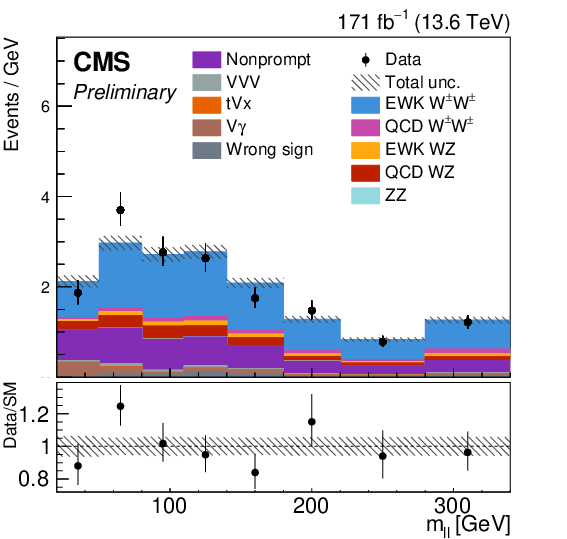
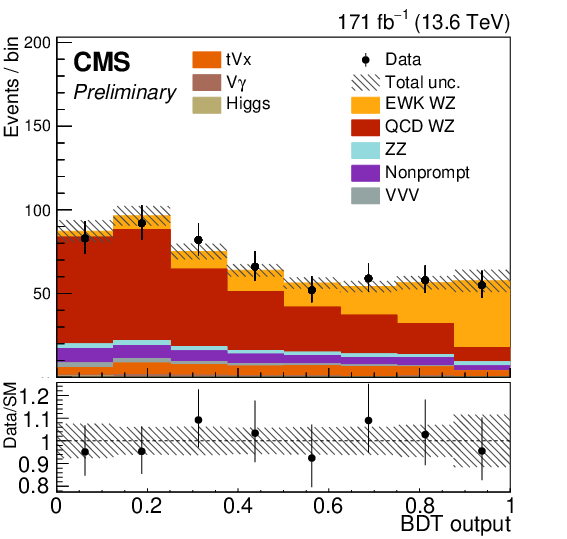
First VBS measurements at s=138 TeV with the enlarged Run 3 dataset mark a shift towards high-precision studies, with s=139 (σfid(ZZ→ℓℓνν)=21.0±1.00) and σfid(ZZ→ℓℓνν)=21.0±1.01 (σfid(ZZ→ℓℓνν)=21.0±1.02) channels providing the first probes of VBS topologies at the new energy frontier. The increased center-of-mass energy and luminosity extends discovery and exclusion reach, especially in the high-σfid(ZZ→ℓℓνν)=21.0±1.03 and high-σfid(ZZ→ℓℓνν)=21.0±1.04 regions targeted by BSM-sensitive analyses.
Triboson Production and Quartic Gauge Coupling Sensitivity
Triboson production directly constrains quartic gauge couplings via multi-boson emission, complementing VBS. ATLAS reports observation-level sensitivity for σfid(ZZ→ℓℓνν)=21.0±1.05 (σfid(ZZ→ℓℓνν)=21.0±1.06) production with a measured cross section of σfid(ZZ→ℓℓνν)=21.0±1.07~fb and significance of σfid(ZZ→ℓℓνν)=21.0±1.08, as well as evidence for σfid(ZZ→ℓℓνν)=21.0±1.09 at Wγ0. Limits are placed on dimension-8 operators relevant to aQGC.
CMS presents the simultaneous measurement of Wγ1 and Wγ2 contributions at both Wγ3 and Wγ4~TeV, exploiting the separation of nonresonant and resonant contributions. At Wγ5~TeV, evidence for triboson production (Wγ6) is achieved, with a combined inclusive signal strength Wγ7, compatible with the SM.
Implications and Outlook
The systematic establishment of all major multiboson and VBS channels, and the transition towards measurement-dominated uncertainties, has profound implications for the global SMEFT and aQGC program. The precision and differential reach allow for:
Robust constraints on BSM physics: High-statistics differential distributions, especially in kinematic regions sensitive to higher-dimension operators, tightly constrain a range of EFT operators not accessible via direct searches or inclusive Higgs measurements.
Direct probes of gauge and CP structure: Polarization and CP-sensitive observables, leveraging advanced ML techniques, enable detailed mapping of TGC and QGC structures and provide first-class constraints on CP-odd interactions at the weak scale.
Future developments: The expected increase in luminosity at the HL-LHC will further reduce statistical uncertainties and extend sensitivity in the high-energy tails, making precise multi-variable SMEFT fits feasible and significantly augmenting the discovery potential for subtle deviations from the SM.
Conclusion
The multiboson and VBS program at the LHC has reached comprehensive experimental coverage, with robust precision measurements and the routine use of advanced analysis techniques. All major VBS channels are established, triboson production is observed or evidenced, and the experimental platforms (ATLAS, CMS) are well-positioned for precision phase studies. The interplay with EFT and aQGC interpretations will provide a stringent, model-independent avenue for probing the electroweak sector and potential new physics at the multi-TeV scale (2604.14753).
“Emergent Mind helps me see which AI papers have caught fire online.”
Philip
Creator, AI Explained on YouTube
Sign up for free to explore the frontiers of research
Discover trending papers, chat with arXiv, and track the latest research shaping the future of science and technology.Discover trending papers, chat with arXiv, and more.