- The paper presents AgileLog, introducing forkable shared log abstractions to safely isolate agentic writes in streaming systems.
- It details continuous fork (cFork) semantics, enabling sub-50μs fork creation and efficient promotion of validated agent writes.
- Evaluation shows Bolt achieves zero latency degradation and low metadata overhead under heavy, multi-agent workloads.
AgileLog: Forkable Shared Log for Agentic Data Streams
Motivation and Problem Scope
The proliferation of AI agents, especially those driven by LLMs, has fundamentally changed the operational patterns over data streaming systems. Traditional data streaming infrastructures—centered on shared logs as the foundational abstraction—are encountering critical limitations when tasked with supporting agentic workloads. Agents are not only statistically and semantically different from traditional stream consumers: they are inherently exploratory, often speculative, place unique load profiles on core infrastructure, and crucially, can induce correctness or safety violations on write. Critically, modern data streaming stacks provide no primitives for logical, performance, or isolation semantics, nor for safe, stateful agentic write integration.
The authors of "AgileLog: A Forkable Shared Log for Agents on Data Streams" (2604.14590) present a compelling case that current streaming systems fundamentally lack the appropriate abstractions for these agentic use cases. They argue for a forkable shared log abstraction and propose AgileLog, together with its implementation, Bolt, to address the core challenges.
AgileLog Abstraction: Forking Primitives
AgileLog defines a shared log abstraction with first-class support for forking, yielding a logically separate, cheap, and performance-isolated child of the main shared log. Forking supports both shallow and deep (multi-level) scenarios, enabling agents to operate over isolated copies without perturbing traditional consumers or other agents.
The central innovation is the notion of a continuous fork (cFork), which, unlike severed forks (sForks), maintains a unidirectional inheritance of parent writes post-fork, while keeping child writes private unless explicitly promoted. This enables agents to operate on real-time data while exploring alternate write paths or executing speculative tasks safely.
The critical semantics and API are as follows:
- cFork: Creates a fork where the child continuously inherits parent appends; agent writes are isolated. Supports promotion.
- sFork: Traditional fork, severed after the fork point.
- Promote: Validated agentic writes on a cFork can reify the fork as the new parent.
- Squash: Discards a fork and its uncommitted state.
Figure 1 illustrates the semantics and application points for these primitives, including their use for testing, analytics, multi-agent exploration, and what-if analysis.
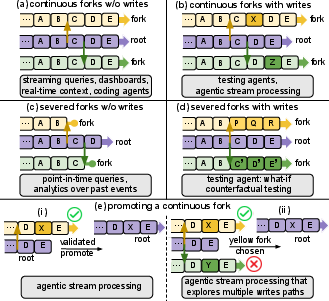
Figure 1: Forking and inheritance primitives in AgileLog, illustrating agentic use cases and the unidirectional isolation of cForks.
Key claims made include the practicality and low overhead of these new primitives, their ability to maintain linearizable orderings between agentic and canonical append streams, and safe, efficient multi-agent exploration or sandboxing on production data—all without the cross-talk or hazards endemic to current stream infrastructures.
Architecture and Implementation: Bolt atop Diskless Design
Bolt, the AgileLog implementation, is architected for zero-data-copy, metadata-only fork creation with strict logical and performance isolation. The core is built atop the diskless shared log pattern: brokers are stateless, appends are made durable via cloud object stores (e.g., S3, MinIO), and metadata such as log order and mapping are managed in a replicated state machine layer (e.g., on Raft).
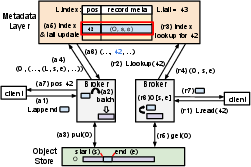
Figure 2: Diskless architecture with durable cloud object storage and metadata sequencing, enabling broker isolation and scalable fork operation.
Forks are instantiated by duplicating metadata pointers—never data—which guarantees sub-50μs fork creation time regardless of parent length. Performance isolation is enforced by serving parent and fork operations from different brokers, leveraging the scalability of disaggregated storage.
To avoid even metadata copy overhead, the authors introduce a Hierarchical Log Index (HLI) structure. Each fork stores local appends only, inheriting the parent's index up to the fork point through references, and mapping inherited positions through cumulative local counts. This triggers recursive lookups only on inherited positions, imposing negligible lookup overhead even across many generations (≤2μs, 5% at depth 7).
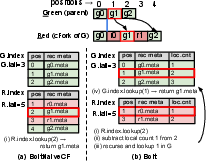
Figure 3: cFork implementation: BoltNaiveCF’s eager metadata propagation (a) vs. Bolt’s tail-only updates and hierarchical log index (b). Red boxes indicate lookup mapping logic.
To ensure continuous inheritance in cForks while avoiding critical-path metadata bloat, Bolt exclusively propagates tail updates (not index entries) from parent to descendants in the inheritance tree, via a Lazy Tail Tree (LTT) structure realized using an efficient BST-based Euler tour. This allows logarithmic-time propagation of tail updates and minimal overhead, regardless of fork tree depth/wideness.
Fork operations, such as promotion of a cFork or squashing of disused branches, are implemented through targeted metadata updates at the consensus layer, further avoiding unnecessary data motion.
Evaluation and Numerical Results
The authors provide comprehensive empirical characterization:
- Fork creation: Bolt achieves ≈50μs fork latency, compared to >100ms for metadata-copy-based schemes.
- Performance isolation: Under heavy agentic workloads, Bolt exhibits zero-degradation in parent log latency and throughput, even as cFork counts scale into the hundreds; Kafka, by comparison, suffers 14× higher mean latency and up to 130× higher p99 latency under analytic workloads interfering with latency-critical consumers.
- Memory overhead: Bolt's avoidance of metadata duplication means 8MB per 1000 forks, compared to 4.4GB for naive schemes.
- Promotes: Bolt supports microsecond-scale cFork promotion with minimal blocking, enabling practical in-situ validation of agentic writes.
- Real agent applications: Experiments with LLM-powered analytics, stream processing, and supply chain agents demonstrate consistent, robust isolation and safe write integration, with Bolt transparently preventing propagation of bad data or agent errors to production consumers.
Practical and Theoretical Implications
The research provides a design foundation for agentic stream systems with fork, validate, and promote workflows. By making fork semantics cheap and scalable, Bolt supports diverse agentic patterns, from safe multi-agent exploration, robust production testing, what-if analysis, to context-sandboxed iterative development.
Theoretical implications include introducing unidirectional isolation in log-structured streams, supporting linearizability of interleaved agentic and non-agentic appends via cForks, and opening avenues for data system abstractions that provide temporal, logical, and performance isolation in the presence of highly dynamic, multi-agent workloads.
Forking as a general primitive is well established in other contexts (filesystems, OSs, databases), but AgileLog is the first to bring continuous fork and promote workflows to shared log streaming systems. This positions it as a natural base for agent-safe, future-proof infrastructures that can support the anticipated explosion in both number and complexity of AI agents deployed in enterprise data environments.
Future Directions
Future developments inspired by this work may include more sophisticated merge and reconciliation primitives (as opposed to restricted promote), fork-aware event lineage tracking, policy-driven automatic promotion or squashing, agent-coupled resource scheduling, and hybridization with branch-and-merge patterns in analytic database systems. Broader adoption in cloud-native, multi-tenant, and serverless stream analytics architectures seems plausible, particularly as diskless architectures gain market share.
Conclusion
AgileLog and Bolt demonstrate that cheap, logically isolated forking is achievable and beneficial in shared log infrastructures, directly addressing the operational and safety needs of AI agents on streaming data. By formalizing forkable shared logs with strong isolation and integration guarantees, this work paves the way for robust, agent-compatible streaming infrastructures (2604.14590).

