- The paper demonstrates that PBE outperforms hybrid functionals in accurately predicting long-range CT exciton energies in C60 and PTCDA complexes.
- TDDFT calculations using plane-wave DFT with ONCV pseudopotentials reveal functional-dependent shifts in exciton peaks, especially for charge-transfer transitions.
- The results underscore the need for xc functionals that correctly balance nonlocal exchange and collective correlation effects for extended molecular systems.
Exciton Screening in C60 and PTCDA Complexes: TDDFT Calculations with GGA and Hybrid Functionals
Introduction and Motivation
The investigation of exciton screening effects and the accuracy of exchange-correlation (xc) functionals in large molecular complexes is critical for understanding electronic excitations, particularly charge-transfer (CT) excitons, in organic semiconductors and molecular aggregates. This paper applies linear-response time-dependent DFT (TDDFT) to C60 and PTCDA systems, systematically benchmarking PBE (GGA), B3LYP (hybrid), and HSE (range-separated hybrid) functionals over a range of exciton radii traversing the screening length domain. The central focus is on the dependence of excitonic energy accuracy on electron-hole separation and the implications for functional selection in modeling extended systems.
Methodology and Computational Details
The calculations were performed using plane-wave DFT in Quantum Espresso with ONCV pseudopotentials. Benchmarking was conducted on equilibrium geometries, with molecular stacks and arrays of C60 and PTCDA constructed at experimentally relevant intermolecular distances, employing direct geometry optimization and van der Waals corrections. TDDFT response calculations used the Lanczos method for obtaining absorption spectra, with the perturbing field aligned along relevant molecular axes or stacking directions to resolve CT and Frenkel excitonic transitions.
Test calculations validated functional accuracy on small molecules (CO, CH4, C6H6), revealing the typical behavior: PBE underestimates excitation energies, while B3LYP/HSE hybrids show reduced error. For extended systems, a systematic functional-dependent error analysis was performed by mapping the excitation energies as a function of intermolecular distance and stack geometry.
Results: Exciton Spectra in C60 Complexes
For single C60 molecules, PBE yields photoabsorption peaks at 3.45, 4.35 eV; B3LYP at 3.88, 4.98 eV; HSE at 3.92, 5.02 eV. Experimental peaks are 3.8, 4.9 eV, affirming that hybrids slightly overestimate, and GGA underestimates, energy values. CT exciton peaks in arrays appear only when the perturbing field is polarized along the intermolecular axis, confirming their collective character. As the intermolecular distance decreases (3.8 → 2.8 Å), intensity and splitting of CT exciton peaks increase, signifying enhanced electron delocalization and charge transfer.
PBE yields collective exciton peaks (for CT-type) at 2.65–2.8 eV, closely matching experiment, while B3LYP/HSE overshoot by 0.5–0.7 eV (placing peaks at 3.2–3.4 eV). For localized Frenkel-type excitons, hybrids show better agreement, while PBE underestimates. The functional-dependent error persists for multi-molecular arrangements, reflecting intrinsic limitations in xc functional asymptotic behavior.
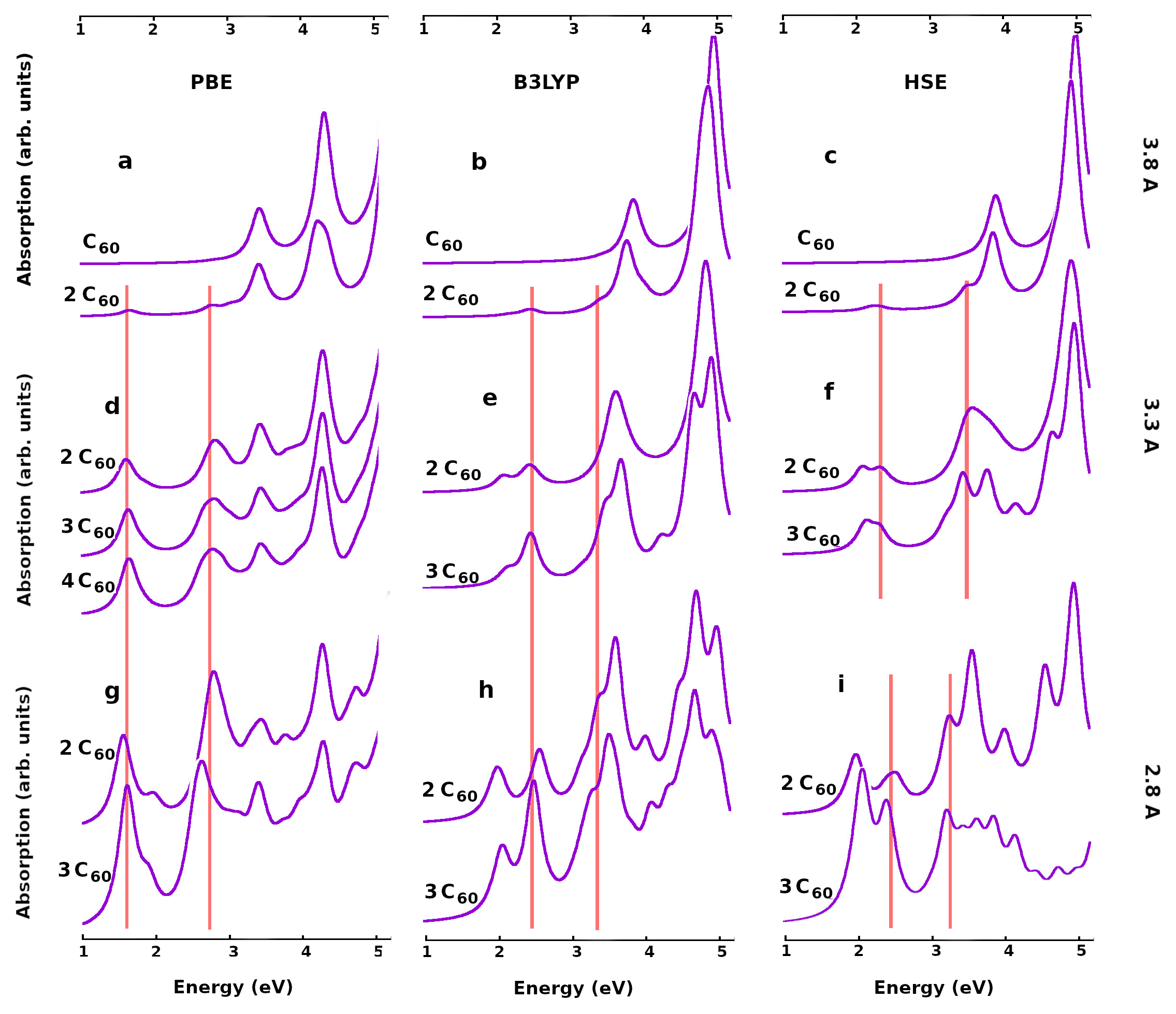
Figure 1: Photoabsorption calculations for C60 with PBE, B3LYP, and HSE functionals; inset highlights the evolution of CT and Frenkel peaks with increasing molecular aggregation.
Results: Exciton Spectra in PTCDA Complexes
In PTCDA monomers, the main Frenkel exciton peak occurs at 2.16 eV (PBE), 2.38 eV (B3LYP), 2.41 eV (HSE), with experiment at 2.2–2.25 eV. Again, hybrids overestimate by ~0.2 eV, while PBE is within 0.1 eV. In molecular stacks (rotated/non-rotated), CT exciton peaks shift dramatically with stacking geometry and functional. In rotated stacks, PBE gives a CT peak at 2.89 eV (two molecules, 3.35 Å), while experiment is 2.5–2.6 eV; hybrids overestimate by >0.5 eV. For non-rotated stacks, CT peaks are at much lower energies (1.5 eV for PBE, 1.97 eV for B3LYP, 2.02 eV for HSE), matching photoluminescence experiments (1.75–2 eV) only for hybrids.
The radius of the CT exciton, estimated at 13–14 Å, becomes commensurate with the screening length typical of solid-state molecular complexes. This scale dependence manifests in the functional performance: PBE accurately captures xc asymptotics for large-radii excitons, while hybrids, by partially replacing GGA exchange with Fock exchange, misrepresent long-distance balance and correlations.
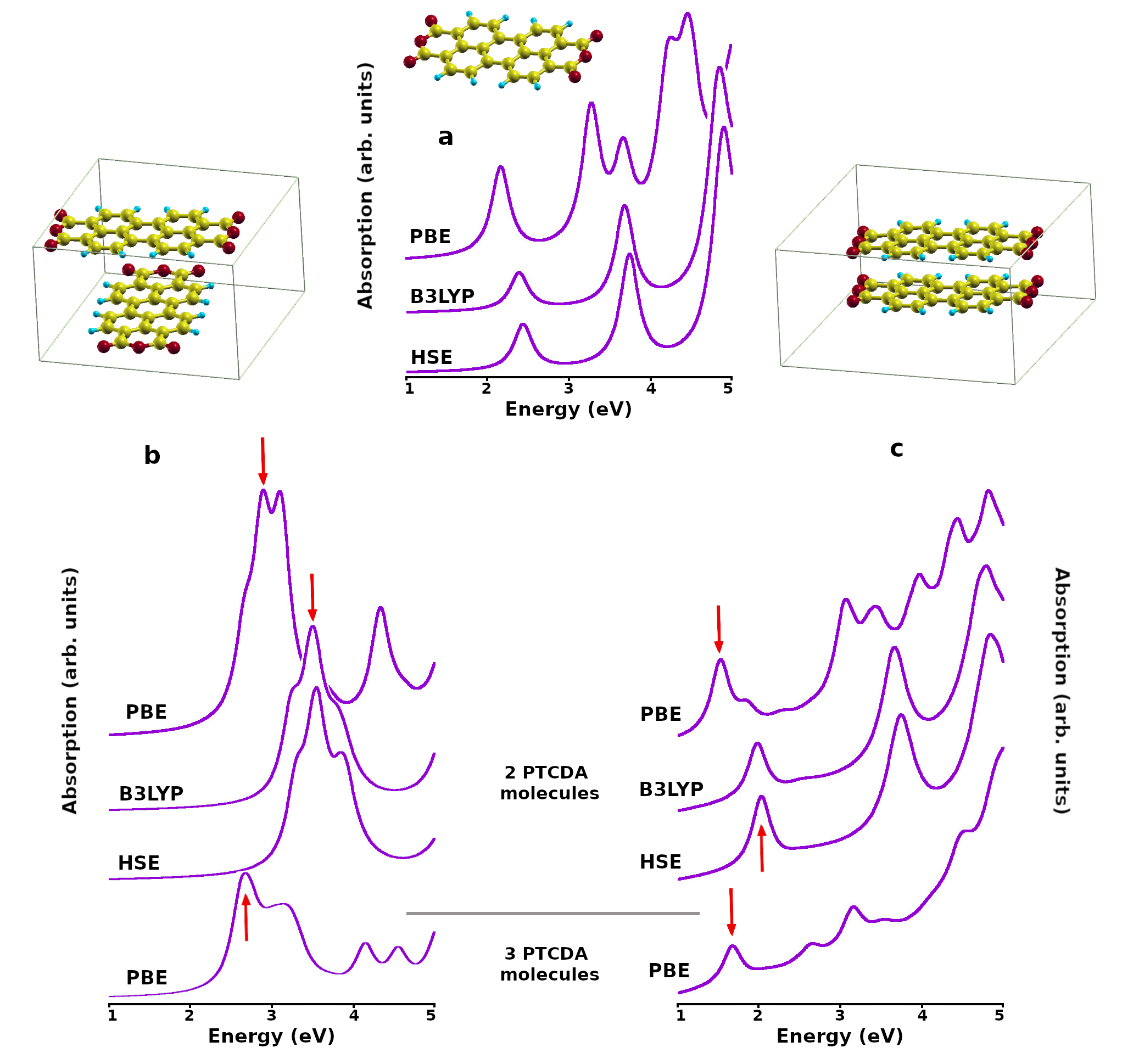
Figure 2: PTCDA photoabsorption spectra for single molecules and stacks with varying orientations, comparing PBE, B3LYP, and HSE predictions against experimental CT and Frenkel exciton energies.
The numerical evidence decisively demonstrates that hybrid functionals increase accuracy for short-range (localized) excitons due to improved nonlocal exchange, but their performance deteriorates for large-radius excitons due to disrupted balance between exchange and correlation at long range. PBE, with its correct xc asymptotic structure for extended systems, outperforms hybrids for CT exciton energies in the long-range screening regime.
The accuracy threshold for CT exciton energies is established: hybrids (B3LYP/HSE) err by ~0.5 eV, while PBE maintains errors within 0.1–0.2 eV for large-radius excitons. This overturns prevalent practice favoring hybrids even for large-scale excitonic calculations and highlights the necessity for xc functionals that can correctly describe correlated electronic response across screening length scales.
Implications and Future Directions
Practically, these findings indicate that for excitonic phenomena with radii matching or exceeding the screening length (10–15 Å), GGA-type functionals (specifically PBE) provide more accurate descriptions than standard hybrids. Theoretical implications emphasize the inadequacy of merely incorporating nonlocal exchange for modeling extended CT and Rydberg excitons; correlated screening effects require functional forms with proper asymptotic compensation.
Future developments should focus on designing xc functionals incorporating both nonlocal exchange and collective correlation effects, possibly leveraging advances in RPA-type kernels or many-body models. Application to larger organic crystals and interfaces is warranted, as is the benchmarking of PBE against emergent functionals that bridge GGA and hybrid paradigms with explicit long-range correlation.
Conclusion
This study critically evaluates the screening behavior and exciton energetics in C60 and PTCDA complexes, establishing the superiority of the PBE functional for CT excitons with radii comparable to the screening length. Standard hybrid functionals fail to accurately capture xc asymptotics at large distances, consistently overestimating CT exciton energies. In extended molecular systems, PBE emerges as a reliable, computationally tractable alternative, with implications for both fundamental modeling and materials design in organic excitonics and photovoltaics.

