Published 15 Apr 2026 in quant-ph | (2604.13486v1)
Abstract: Quantum simulation is a cornerstone application of quantum computing, yet how fundamental quantum resources--entanglement and non-stabilizerness (``magic")--shape simulation fidelity remains an open question. In this work, we establish a rigorous connection between these resources and the statistical behavior of algorithmic errors arising in Hamiltonian simulation based on the Trotter-Suzuki formula. By analyzing ensembles of states with fixed entanglement entropy or magic, we make two key discoveries: First, the variance of the Trotter error decreases with increasing entanglement entropy, indicating a stronger concentration of error for entangled states. Moreover, we find that the kurtosis of the error exhibits a negative linear dependence on magic, implying that states with high magic possess lighter-tailed error distributions and thus a reduced probability of large deviations. These findings reveal a subtle phenomenon: quantum resources that obstruct classical emulation may, paradoxically, enhance the intrinsic robustness of quantum simulation, highlighting a constructive interplay between complexity and stability in quantum computation.
The paper reveals that increased entanglement systematically reduces Trotter error variance, resulting in statistically concentrated error distributions.
The paper shows that higher magic content leads to a negative linear dependence on error kurtosis, thereby mitigating the probability of error outliers.
The paper validates these theoretical bounds using numerical simulations on the quantum Ising model, indicating robust error suppression in quantum simulation.
Taming Trotter Errors with Quantum Resources: An Expert Essay
Motivation and Problem Statement
Quantum simulation is a primary motivation for quantum computation, underpinned by the exponential complexity associated with representing quantum phenomena such as entanglement and non-stabilizerness (termed "magic"). While these resources are well understood as classical bottlenecks, their quantitative influence on quantum simulation algorithms—specifically, how they modulate the error statistics of digital algorithms like Trotter-Suzuki—remains largely uncharacterized. This paper rigorously investigates the relation between intrinsic quantum resources (entanglement entropy and magic) and the statistical landscape of errors arising in Hamiltonian simulations using the Trotter-Suzuki formula.
Main Contributions and Theoretical Results
This work formalizes and numerically substantiates two results: (1) Increased entanglement entropy systematically reduces the variance of Trotter errors, leading to tighter concentration around the mean; (2) Higher magic content leads to a negative linear dependence in error kurtosis, suppressing the probability of extreme outliers in the error distribution.
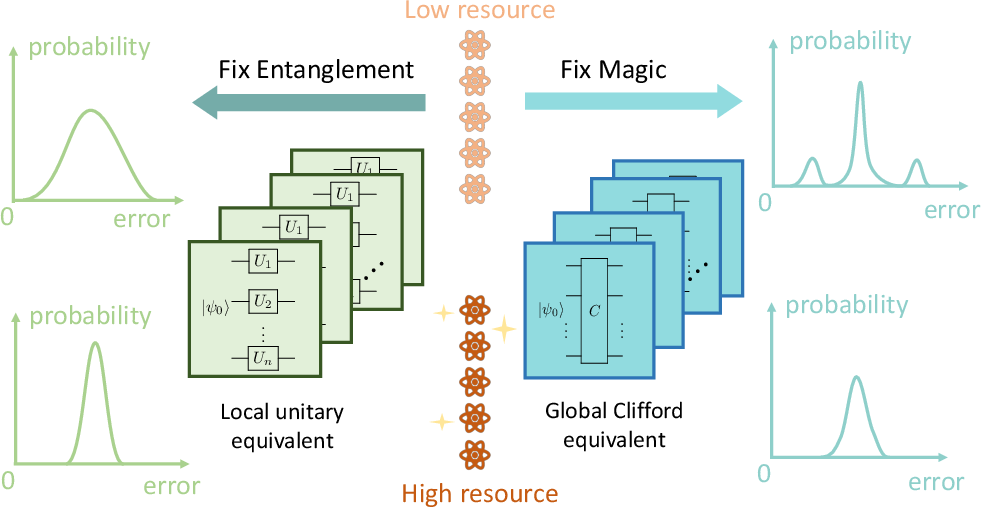
Figure 1: Entanglement reduces error size, while magic suppresses outliers. Local-unitary and global-Clifford equivalent ensembles demonstrate distinct error-statistics modulation.
The analysis leverages ensembles of states with fixed entanglement entropy (local-unitary-equivalent) and fixed magic (global-Clifford-equivalent), relating their statistical characteristics to analytic bounds and numerical computation in prototypical quantum models such as the quantum Ising model with mixed fields (QIMF).
Entanglement and Variance Suppression
For an initial state ∣ψ0⟩, the variance of the leading-order Trotter error sE(ψ)=⟨ψ∣E†E∣ψ⟩, over ensembles ∣ψ⟩∼LU(ψ0), is proven to be upper-bounded by subsystem entanglement entropy:
where S(ρjj′) quantifies entanglement in relevant subsystems. As entanglement grows due to quantum evolution, the variance shrinks—implying robust statistical concentration.
Non-stabilizerness, quantified via linear stabilizer entropyM(ψ), is invariant under Clifford gates. The paper rigorously derives that error kurtosis, evaluated over the global-Clifford ensemble GC(ψ0), exhibits a negative linear dependence on magic:
Kur∣ψ⟩∼GC(ψ0)[sE(ψ)]=α+βM(ψ0)
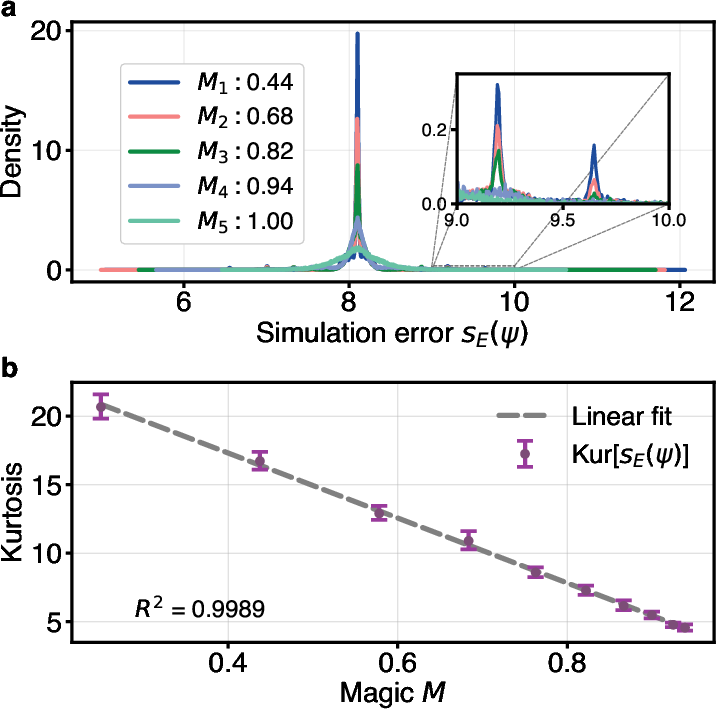
with β<0 for typical local Hamiltonians. Thus, increasing magic yields lighter tails in the error distribution, directly reducing the likelihood of large deviations.
Figure 3: Magic reduces the kurtosis of simulation errors, suppressing outlier probability as empirically shown for QIMF.
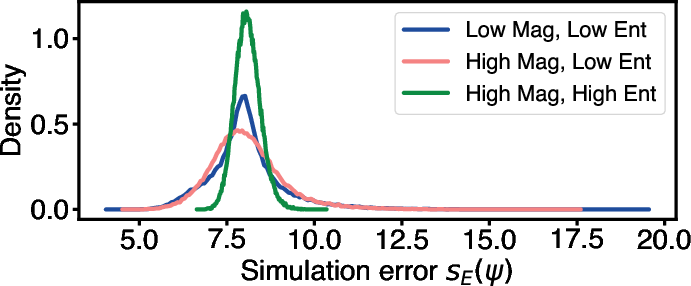
Figure 4: Error distribution for locally and globally randomized ensembles, illustrating the combined effects of entanglement and magic.
Resource Dynamics During Quantum Evolution
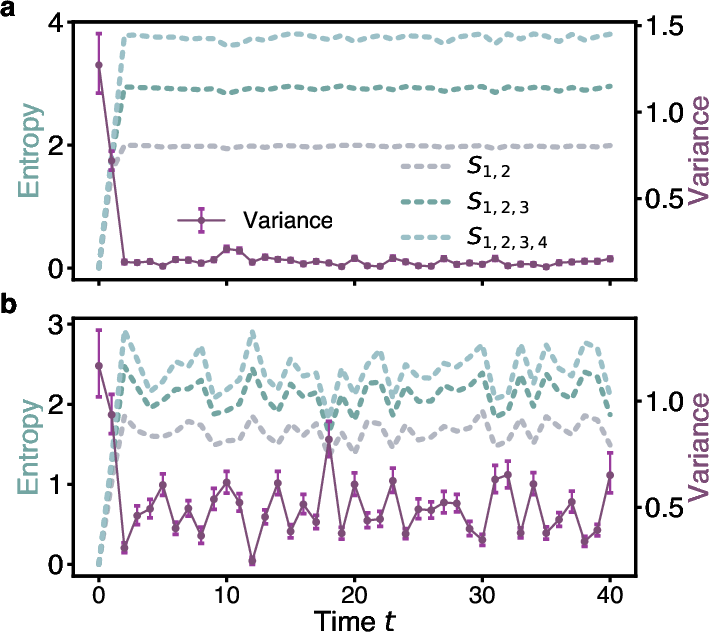
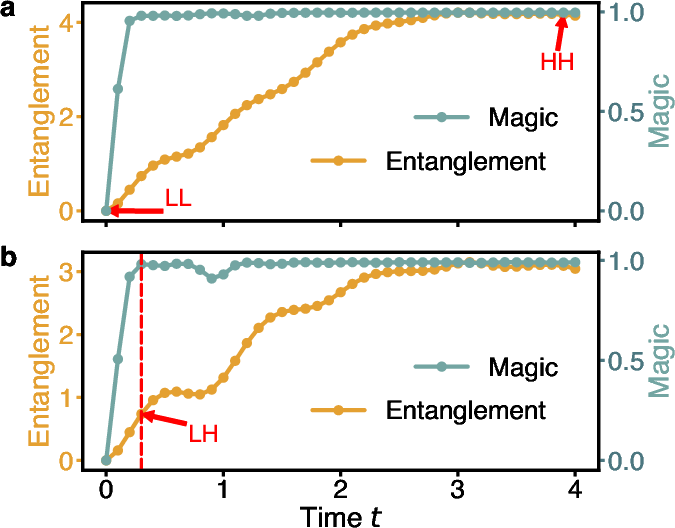
Both entanglement and magic typically exhibit rapid growth during generic quantum evolution dynamics, aligning most states towards statistically stable error regimes—rendering worst-case error bounds mostly irrelevant in practice.
Figure 5: Time evolution in QIMF yields monotonic increases in entanglement and magic, saturating toward optimal regimes for error suppression.
Long-Time Simulation Stability
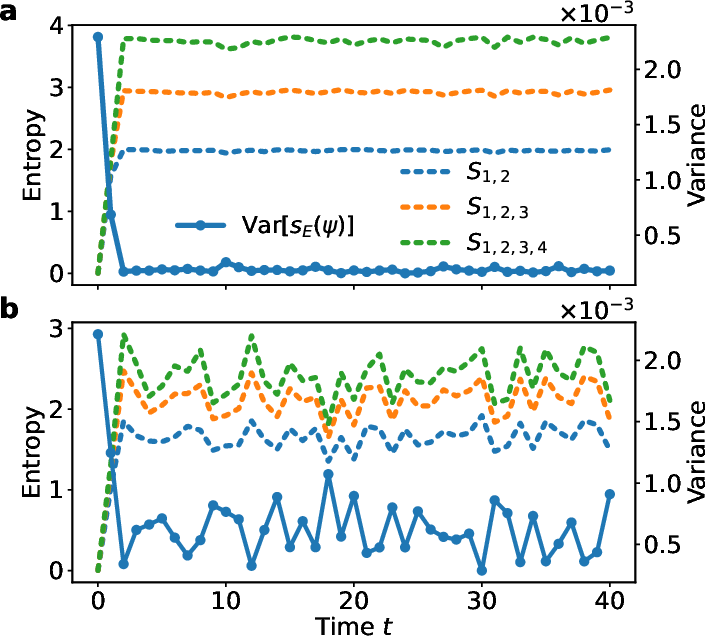
The paper extends these resource-based effects to long-time quantum evolution, demonstrating that accumulated simulation error variance is similarly suppressed as entanglement flourishes in the state trajectory.
Figure 6: Entanglement reduces the variance of long-time simulation error for multi-step Trotterization.
Numerical Validation
Bootstrap resampling is utilized to supply confidence intervals for variance and kurtosis in the numerical experiments. Detailed QIMF and Heisenberg model simulations validate analytical bounds, confirming both the reduction in variance with entanglement growth and the tail suppression by increased magic.
Implications and Future Directions
These findings imply a duality: quantum resources that inhibit classical simulation (entanglement and magic) inherently stabilize quantum algorithmic errors, leading to robust, concentrated error statistics. Practically, this offers concrete guidance: initial states and dynamics rich in entanglement and magic yield marked statistical stability, supporting reliable quantum simulation benchmarks. The theoretical framework invites further exploration into resource-driven error suppression for other algorithms and noise models, suggesting a unified perspective where complexity and reliability co-evolve in quantum computation.
Future AI and quantum algorithm development may leverage resource-aware protocols, dynamically adjusting simulation strategies based on evolving quantum entanglement and magic profiles. Characterizing these statistical regimes beyond Hamiltonian simulation—e.g., in variational and error-corrected quantum computation—promises to unify computational efficacy and algorithmic robustness.
Conclusion
This paper establishes that quantum resources—entanglement and magic—quantitatively suppress error variance and tails in digital quantum simulation, fundamentally enhancing algorithmic stability. The link between complexity and robustness not only strengthens resource theory but also offers practical tools for optimizing quantum computations, providing a statistically favorable foundation for realizing quantum advantage in simulation tasks.
“Emergent Mind helps me see which AI papers have caught fire online.”
Philip
Creator, AI Explained on YouTube
Sign up for free to explore the frontiers of research
Discover trending papers, chat with arXiv, and track the latest research shaping the future of science and technology.Discover trending papers, chat with arXiv, and more.