- The paper establishes that under split-injectivity of boundary inclusion maps, a manifold’s double admits a psc metric if and only if the original manifold has one with mean convex boundaries.
- It employs advanced surgery theory, area-minimizing hypersurfaces, and tangential extension techniques to navigate topological obstructions in high dimensions.
- The results clarify geometric and group-theoretic conditions for constructing psc metrics, paving the way for future research in scalar curvature and minimal hypersurface theory.
The Doubling Conjecture for Positive Scalar Curvature: Summary and Analysis
Introduction and Context
The paper "The doubling conjecture for positive scalar curvature" (2604.12901) addresses a long-standing question in Riemannian geometry regarding the interplay between positive scalar curvature (psc) metrics and boundary conditions. Specifically, it investigates Rosenberg–Weinberger's doubling conjecture, which asserts that a compact manifold with boundary admits a psc metric with mean convex boundary if and only if its double (i.e., the union of the manifold with itself along the boundary) also admits a psc metric.
The motivation stems from classical constructions indicating one direction of the implication: if such a metric exists on a manifold with strictly mean convex boundary, then a smooth psc metric can be constructed on its double. The converse—that a psc metric on the double implies a psc metric with mean convex boundary on the original manifold—remained open, particularly in the presence of topological and fundamental group obstructions.
Main Results
The paper provides substantial progress on the doubling conjecture by establishing its validity for a broad class of high-dimensional manifolds (dimension at least 5), subject to precise algebraic-topological criteria regarding fundamental groups and tangential structures.
Algebraic and Topological Criteria
The core technical condition is a split-injectivity requirement for the induced maps from the fundamental group of each boundary component to that of the full manifold. More precisely, for each boundary component Ni, the homomorphism (ιi)∗:π1(Ni)→π1(M) must be split-injective. Additional constraints depend on the spin- and non-spin character of the manifold:
- Spin or Totally Nonspin Case: If the dimension is at most 11, the split-injectivity alone suffices. For higher dimensions with non-connected boundary, a triviality assumption on the fundamental group map for secondary boundary components and vanishing of the α-invariant (for spin manifolds) is required.
- Almost Spin Case: An isomorphism at the cohomological level (on H2 with Z/2 coefficients) is needed for the map induced by each boundary inclusion, reflecting subtle effects around the Stiefel-Whitney classes.
Theorem A (paraphrased):
If M is an oriented, compact manifold of dimension at least 5, either spin or totally nonspin, and if the boundary inclusions satisfy the split-injectivity and (when relevant) triviality/vanishing conditions, then the doubling conjecture holds.
Theorem B (paraphrased):
If M is almost spin and the cohomological isomorphism and boundary connectedness assumptions are satisfied, the doubling conjecture holds.
Moreover, the results apply to product manifolds and cover cases previously highlighted as possible counterexamples, such as (K3#2)×[−1,1], which, according to this work, does admit a psc metric with mean convex boundary.
Techniques and Methodology
The proof framework is a sophisticated blend of surgery theory (as developed in the works of Gromov-Lawson, Schoen-Yau, and subsequent refinements), cobordism and tangential structures, and the theory of area-minimizing hypersurfaces:
- Tangential 2-type Extensions: The paper systematically leverages the notion of tangential structures and their extensions to translate surgery principles into the setting necessary for constructing desired metrics.
- Surgery Theorems for Both Scalar and Mean Curvature: Modern versions of the surgery theorem are applied, ensuring that surgery on handles of certain indices preserves the relevant curvature properties (see [GL80a], [Lawson-Michelsohn]).
- Area-minimizing Hypersurfaces and Monotonicity: For disconnected boundary cases, existence and regularity results for area-minimizing hypersurfaces (including up to dimension 11) are exploited to construct geometric "interfaces" enabling reduction to cases with connected boundary via cutting and gluing arguments.
- Iterated Coverings and Local Constructions: Key constructions utilize finite covers of self-cobordisms and careful control over the fundamental group to produce hypersurfaces with required separation properties.

Figure 1: Constructing a psc-metric on a manifold with strictly mean convex boundary via extension and doubling methods.
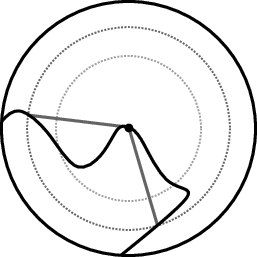
Figure 2: Schematic of the relationship between a hypersurface S, its conic region Cr, and level sets in the area-minimizing argument.


Figure 3: Cobordism and doubling construction; gluing boundaries to form the closed manifold (ιi)∗:π1(Ni)→π1(M)0 containing (ιi)∗:π1(Ni)→π1(M)1 transversely intersecting a generator.

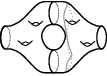
Figure 4: Cutting open the double of (ιi)∗:π1(Ni)→π1(M)2 along a boundary component (ιi)∗:π1(Ni)→π1(M)3 and relating the pieces to area-minimizing submanifolds.
Notable Applications and Special Cases
- Dimension Four: The conjecture is addressed with caveats; counterexamples to related scalar curvature conjectures in 4-manifolds are well-known via Seiberg-Witten theory. However, specific classes, such as connected sums of K3 surfaces or products involving (ιi)∗:π1(Ni)→π1(M)4, are shown to satisfy the doubling conjecture under outlined methods.
- Low Dimensions (≤ 3): The conjecture is vacuously true in dimension 1, follows from Gauss–Bonnet in dimension 2, and from the Carlotto–Li characterization in dimension 3. Techniques here blend classical geometric arguments with modern surgery.
Hypersurfaces and Minimality Conditions
A secondary thread in the paper examines whether a closed manifold (ιi)∗:π1(Ni)→π1(M)5 with a given embedded hypersurface (ιi)∗:π1(Ni)→π1(M)6 allows for a psc-metric making (ιi)∗:π1(Ni)→π1(M)7 minimal, stably minimal, or totally geodesic. The paper provides explicit counterexamples—showing that such a realization is not always possible, even on manifolds that admit psc metrics.
However, under the group-theoretic and tangential extension criteria, the paper proves that if (ιi)∗:π1(Ni)→π1(M)8 is two-sided, connected, and satisfies suitable split-injectivity, then local modifications of any background psc-metric on (ιi)∗:π1(Ni)→π1(M)9 may yield a new psc-metric for which α0 is minimal (and, for dimensions at least 6, of product type locally near α1).

Figure 5: Constructing the required psc-metric α2 on α3 adjusted locally to make α4 minimal.
Theoretical and Practical Implications
These results have several implications:
- They remove the need for restrictive global hypotheses (such as conditions on the fundamental group required in prior results that invoked the Baum-Connes or Gromov-Lawson-Rosenberg conjectures, both of which have counterexamples) and replace them with explicit, checkable conditions.
- The inclusion of area-minimizing hypersurface techniques connects geometric measure theory with global differential topology and geometry, highlighting the effectiveness of analytic tools in addressing topological curvature obstructions.
- The proofs clarify the role of tangential structures and group splittings in the theory of positive scalar curvature with boundary.
These advances solidify the landscape of high-dimensional psc geometry with boundary and offer a blueprint for addressing similar conjectures involving different curvature constraints or additional geometric structures.
Future Directions
Moving forward, possible extensions and open problems include:
- Sharpness of Dimension Bounds: Extending the area-minimizing hypersurface machinery beyond dimension 11 as regularity theory progresses.
- Weakened Group-Theoretic Conditions: Investigating whether the split-injectivity requirement can be further weakened, potentially via controlled surgery or secondary index techniques.
- Broader Tangential Structures: Generalization to broader classes of tangential structures or further interactions with index theory, especially for almost spin and non-orientable settings.
- Higher Codimension Hypersurfaces: Exploring further the minimality and scalar curvature problem for higher codimension submanifolds, possibly in the context of non-compact or non-simply connected ambient spaces.
Conclusion
This work rigorously resolves the doubling conjecture for positive scalar curvature under broad and natural topological conditions, integrating state-of-the-art techniques from surgery theory, minimal hypersurface theory, and cobordism. It additionally addresses geometric realization problems for hypersurfaces in psc manifolds, provides explicit criteria where such constructions are possible, and exhibits obstructions in their absence. Collectively, these results clarify both the geometric and topological mechanisms underlying the existence of psc-metrics with boundary conditions and set the stage for future investigations at the intersection of geometry, topology, and analysis.

