- The paper introduces an integrated ISAC framework that fuses sensing and communication in NTNs to enable predictive, context-aware control.
- It presents a multi-layer architecture leveraging LEO, MEO, GEO satellites, HAPS, and UAVs with diverse multiplexing strategies to optimize spectral efficiency.
- The research discusses standardization gaps and tradeoffs, emphasizing joint waveform design and edge intelligence for robust maritime and disaster response applications.
ISAC-Enabled Non-Terrestrial Networks for 6G: Architecture, Standardization, Tradeoffs, and Emerging Use Cases
Introduction and Motivation
ISAC integration within NTN introduces a transformative paradigm for 6G: converging sensing and communication functions into a unified framework at the air, space, and ground layers. The severe limitations faced by NTN—such as Doppler effects, high latency, interference, and unreliable CSI—necessitate the adoption of ISAC as a fundamental network design principle. By leveraging sensing-derived environmental information, ISAC architectures facilitate predictive, adaptive, and context-aware control in highly dynamic NTN environments, moving beyond classical reactive frameworks.
ISAC Architectural Principles and Enabling Technologies
The multi-layer ISAC-enabled NTN architecture is designed to harness the unique strengths of LEO, MEO, and GEO satellites, HAPS, UAVs, and terrestrial infrastructure, orchestrated through advanced waveform, hardware, and signal processing co-design.
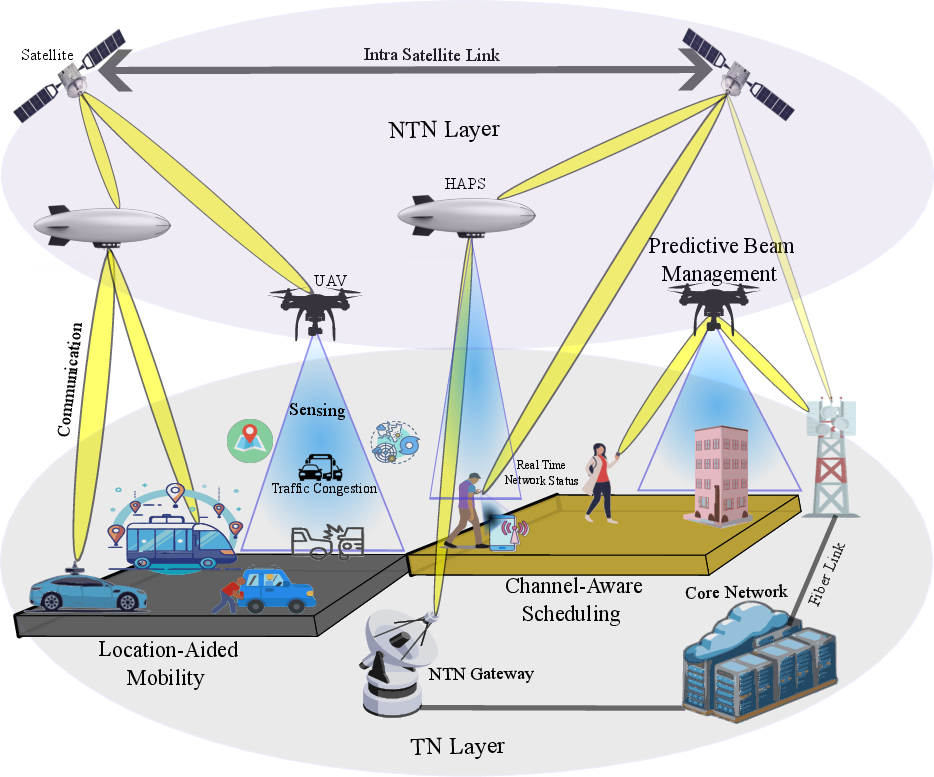
Figure 1: ISAC-enabled NTN system architecture.
This architecture is realized through three primary multiplexing paradigms: Frequency-Division ISAC, Time-Division ISAC, and Non-Orthogonal ISAC. Non-Orthogonal ISAC maximizes spectral efficiency and sensing precision, albeit at substantial complexity, and is critical for applications demanding simultaneous high-throughput and high-resolution environmental awareness. RIS deployment on spaceborne and aerial platforms enhances coverage and reflection path diversity, while edge intelligence enables real-time joint inference and system control.
Key differentiators of ISAC-enabled NTNs compared to terrestrial ISAC solutions include managing LoS criticality, combating large Doppler drifts, and efficiently utilizing payload and power within constrained orbital platforms. Importantly, sensing and communication form a tightly-coupled, closed-loop system: channel impairments and target signatures are treated as joint state variables to inform both functions, rather than as isolated sources of error or noise.
Use Cases: Sensing-Driven NTN Applications
ISAC-enabled NTN architectures unlock a set of mission-critical, large-scale applications characterized by the need for persistent coverage, robust connectivity, and high-fidelity situational awareness.
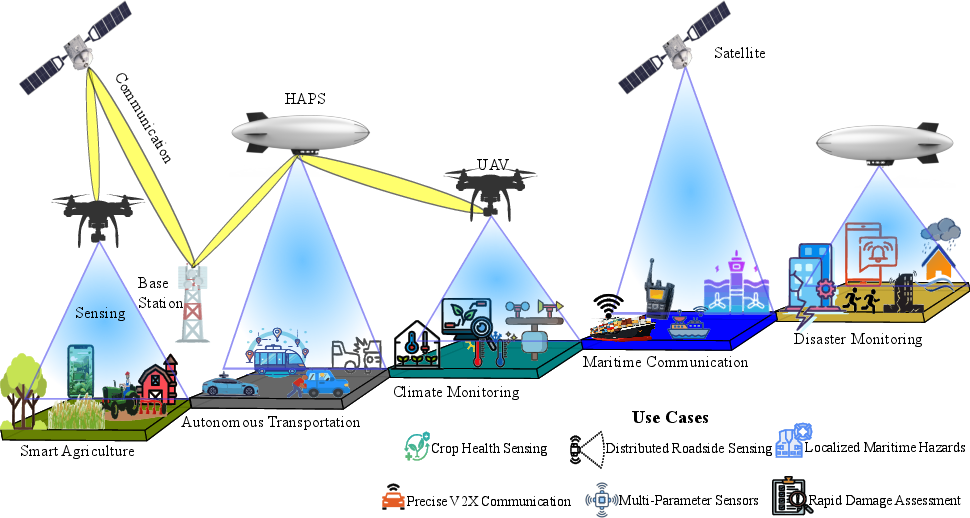
Figure 2: ISAC-enabled NTN applications and use cases across smart agriculture, transportation, environmental monitoring, maritime services, and disaster response.
Maritime Communication & Surveillance
NTNs overcome the scarcity of terrestrial coverage in maritime domains, supporting ubiquitous broadband connectivity and vessel tracking. Reflected echoes provide actionable data for ship trajectory estimation, hazard detection, and sea-state monitoring, consolidating communication and surveillance without additional infrastructure.
Disaster Monitoring & Emergency Response
ISAC-enabled NTNs implement Post-Disaster Sensing-as-a-Service (SaaS) by provisioning both rapid connectivity recovery and persistent monitoring of environmental conditions. Sensing and communication are synergistically employed for survivor localization, resource scheduling, and operational safety in areas beyond the reach of terrestrial systems.
Autonomous Transportation & Air Mobility
Collective perception and predictive mobility are realized by fusing sensing outputs from satellites, UAVs, and ground vehicles into a shared intelligence layer. This enables robust coordination and collision avoidance in complex, heterogeneous traffic domains.
Environmental Monitoring & Smart Agriculture
NTNs equipped with ISAC provide scalable platforms for tracking climate events, pollution, deforestation, and precision agriculture metrics like soil moisture and crop state. This is particularly significant for rural and remote regions devoid of conventional infrastructure, where persistent observation is critical for sustainability and digital inclusion.
Standardization Landscape and Open Gaps
Standardization is proceeding in 3GPP and ETSI, with ISAC treated as a distinct technological trajectory—primarily focused on the terrestrial context in current releases. Rel-19 and Rel-20 address ISAC use cases, channel models (E-GBSM), and core network adaptations, with normative work on gNB-based ISAC just commencing. Crucially, ISAC-NTN integration is not an explicit focus in ongoing releases, and technical specifications do not address waveform, feedback, or resource management constraints unique to satellite and aerial platforms.
A non-trivial standardization gap persists for:
- Resource management and control channel design optimized for ISAC operations
- Modulation and waveform robustness under extreme Doppler and delay
- Quality and reliability feedback for adaptive sensing-communication control
Future releases will need to account for these aspects to achieve practical, interoperable ISAC-NTN deployments.
Case Study: ISAC-Enabled NTN for Maritime Situational Sensing
The representative case study elucidates how ISAC harmonizes communication and sensing objectives for maritime domains, where satellite-generated joint waveforms provide both data transfer and real-time target monitoring. This environment features large propagation delays, severe Doppler, multipath from sea-surface reflections, and highly dynamic node mobility. Sensing outputs (e.g., delay, Doppler, AoA) derived from target echoes enable predictive beam alignment, Doppler pre-compensation, and resource pre-scheduling—effectively converting impairments into control variables.
This joint operation introduces a nuanced tradeoff: higher sensing precision boosts reliability and predictive control but can degrade data rates due to increased pilot or processing overhead (longer coherent processing intervals). Sensing-enriched feedback, processed via edge intelligence on aerial relays, reduces signal ambiguity, compensates for delayed CSI, and enables robust links in environments traditionally underserved by communication-only NTNs.
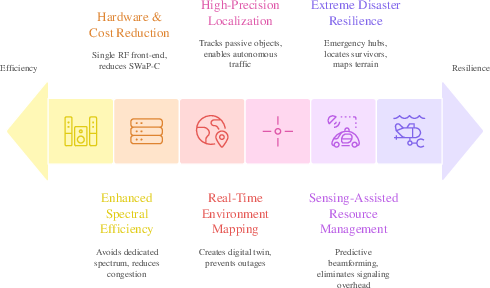
Figure 3: Key benefits of ISAC-enabled NTN, ranging from efficiency enhancement to resilience improvement.
The combined architecture facilitates:
- Hardware and spectrum efficiency via joint waveforms, reducing payload and power requirements.
- Predictive, rather than reactive, system adaptation—a necessity given feedback bottlenecks in NTN.
- Enhanced reliability and reduced outage in high mobility scenarios, alongside more predictable E2E latency.
- Multi-objective beamforming and local processing to mediate the tradeoff between sensing accuracy, throughput, and resource consumption.
Challenges and Future Directions
Several critical challenges remain:
- Waveform Design: Need for robust delay-Doppler-native ISAC waveforms; terrestrial designs are insufficient under NTN Doppler and delay spreads.
- Channel Modeling: Conventional static or mildly time-varying models fail; joint estimation strategies are required for coupled channel and target parameter estimation.
- On-board Processing: Payload constraints limit raw data offload; real-time, compressed, or feature-extracted observations are required.
- Control and Feedback: Sensing-aware control channels and closed-loop adaptation mechanisms must be defined; open-loop operation is fundamentally limiting for performance.
- Interference Management: NTN sensing signals are vulnerable to terrestrial interference; regulatory-compliant coordination and novel coexistence policies are necessary.
Future developments will require multi-disciplinary collaboration across waveform engineering, low-power edge AI, system control, and regulatory frameworks.
Conclusion
The synthesis of ISAC into NTN constitutes a foundational progression toward perception-driven 6G wireless systems, where reliable, resilient, and intelligent connectivity is intertwined with persistent environmental awareness. While standardization gaps and technical challenges remain, the presented architecture and use cases elucidate the critical role of ISAC as a core NTN capability—not a peripheral enhancement. Full realization in practice will necessitate systematic integration into both technological and regulatory frameworks, cementing ISAC-enabled NTNs as the enabling substrate for global-scale, next-generation networks.
Reference:
"ISAC-Enabled Non-Terrestrial Networks for 6G: Design Principles, Standardization, Performance Tradeoffs, and Use Cases" (2604.11593)

