- The paper identifies a fundamental misalignment between engagement-driven recommendations and users' deeper, reflective welfare.
- It uses a unified framework detailing observability bias, feedback-loop dynamics, and emergent collective effects to explain societal issues.
- The study advocates for systemic interventions and policy reforms to realign algorithms with user well-being and collective welfare.
Introduction
The paper "Functional Misalignment in Human–AI Interactions on Digital Platforms" (2604.11459) presents a unified theoretical framework addressing the deep structural misalignment between the optimization objectives of social media recommender systems and the genuine welfare of human users. While recommender systems excel at predicting and promoting measurable user behaviors such as clicks, likes, and shares, the paper argues that these systems systematically diverge from optimizing for users’ reflective preferences and broader collective welfare. The core contention is that adverse societal phenomena—ranging from polarization to declining mental health—are emergent consequences of this functional misalignment, not isolated failures or unintended side effects.
Mechanistic Foundations of Functional Misalignment
The paper identifies three interlocking mechanisms responsible for propagating functional misalignment at scale: (1) an observability and predictability bias, (2) feedback-loop dynamics, and (3) emergent collective effects. These form a recursive architecture in which algorithms, trained on salient behavioral signals, exacerbate and exploit cognitive heuristics (System 1), creating feedback loops that systematically deviate platform outcomes from users’ considered interests and societal welfare.
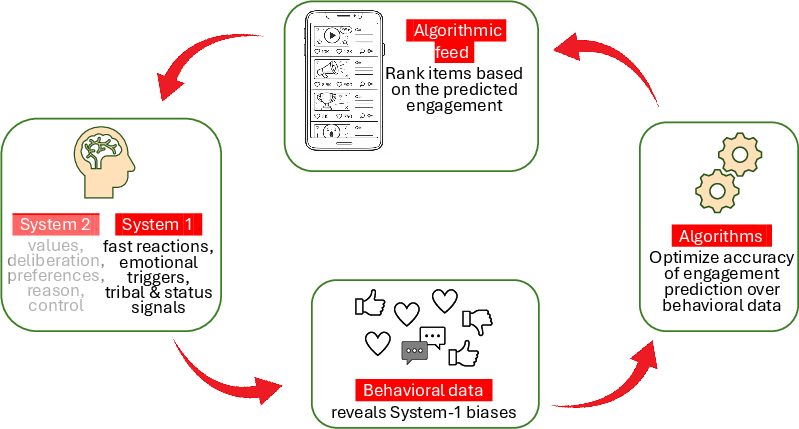
Figure 1: Functional misalignment framework: Social media algorithms trained to accurately predict user engagement learn to amplify System-1 biases (outrage, envy, status-seeking, in-group cues), creating feedback loops that systematically misalign platform outcomes from users’ reflective preferences and collective welfare.
Observability and Predictability Bias
The first mechanism, observability mismatch, arises since recommendation systems optimize for behaviors most easily measured—rapid, emotionally salient actions reflecting System 1 cognitive processes—rather than users’ deliberative, reflective System 2 judgments. Heuristic-driven actions are frequent, consistent, and predictable, making them prime targets for optimization. This disproportionately aligns algorithmic objectives with predictable biases such as outrage, envy, and in-group cues, rather than with long-term preferences or well-being.
Feedback-Loop Dynamics
Recommender systems are embedded within closed feedback loops: algorithmic outputs influence user behavior, which in turn serves as future training data. These loops amplify initial micro-level biases into substantial macro-level disparities via path-dependent, cumulative processes. Notably, the result is a rich-get-richer distribution of attention, emergent instability, and the erosion of diversity and welfare, consistent with findings of inequality and unpredictability in artificial cultural markets [salganik2006experimental].
Emergent Collective Effects
At large scale, these micro-level amplification mechanisms produce emergent societal phenomena, including polarization, emotional contagion, norm misperception, and intergroup hostility. Systemic prioritization of engagement ensures that the most reliably affective content dominates exposure, entrenching population-level pathologies.
Empirical Domains of Pathological Outcomes
The framework is substantiated through three domains: political polarization, mental health and collective well-being, and crowdsourcing/collective decision-making.
Political Polarization
The framework reconceptualizes polarization not as a product of echo chambers or misinformation per se, but as an emergent property of algorithmic amplification of affective (rather than ideological) division. Algorithms systematically skew content toward high-arousal, out-group animosity—deepening affective polarization, facilitating norm misperception, and entraining durable identity-based schisms [brady2017emotion]. The framework underscores that interventions focused solely on correcting misinformation or increasing cross-cutting exposure fail to address the generative mechanism: engagement optimization over affective cues.
Mental Health and Collective Wellbeing
A robust literature now links social media to negative mental health outcomes, especially among adolescents and vulnerable populations [teague2026digital]. The paper attributes this trend to misalignment between engaged content and user welfare, noting that recommendation algorithms amplify content exploiting status threats and upward social comparison. The result is a feedback-driven proliferation of envy, status anxiety, and body dissatisfaction—mechanisms borne out in studies on algorithmic exposure and eating disorder risk [griffiths2024does]. This process is rooted in prestige bias and the evolutionary mismatch between ancestral cognitive heuristics and modern digital architectures.
Crowdsourcing and Collective Decision-Making
The paper analyzes non-personalized systems such as crowdsourced ranking, demonstrating that feedback loops based on popularity signals, combined with cognitive biases (e.g., position bias), destabilize the “wisdom of crowds.” Early random fluctuations, not objective quality, drive aggregate success, with instability and inequality emerging as collective outcomes [burghardt2020origins]. Functional misalignment thus generalizes beyond personalized recommendation.
Measurement and Evaluation
The paper argues that conflating observable behavior with underlying preferences or values is methodologically flawed. Behavioral proxies reflect System 1 reactivity rather than reflective, stable preferences. This necessitates multi-objective evaluation protocols, preference elicitation strategies that can surface System 2 signals, and longitudinal designs to detect preference drift and causal relationships between engagement and welfare.
Experimental Design
Conventional interventions (e.g., fact-checking, exposure diversification) show limited or counterproductive efficacy because they do not disrupt the feedback-driven, engagement-maximizing core. The paper advocates for system-level interventions targeting the structural roots of misalignment—such as the use of System 2 elicitation [agarwal2024system], prosocial ranking objectives [stray2026prosocial], and network control strategies capable of steering collective dynamics [liu2011controllability]. The research agenda should prioritize experiments designed to decouple engagement from harm and stabilize emergent welfare-aligned equilibria.
Policy Considerations
A critical insight is that improvements to data acquisition, predictive accuracy, or transparency cannot resolve functional misalignment if optimization remains tethered to engagement as the principal objective. Instead, the argument is presented for imposing formal constraints on feedback architectures and optimization objectives, with governance interventions targeting incentive realignment and systemic control. The framework thus demands normative decisions regarding the values that algorithmic systems should serve, moving beyond narrow technical fixes to reexamine foundational platform incentives.
Conclusion
The framework elucidated in this paper offers a rigorous, integrative account of how structural features of human–AI interaction propagate negative societal outcomes via functional misalignment. By bridging cognitive, algorithmic, and complex systems perspectives, the work shifts focus from localized failures to the coupled, dynamical processes underpinning engagement-driven platforms. The central implication is that technical and policy interventions must recognize and modify the feedback architectures and objectives at the heart of digital platform design. Future developments should focus on the design, measurement, and control of human–algorithm ecosystems to ensure alignment with reflective human preferences and collective welfare, rather than mere behavioral predictability.

