- The paper identifies the complete set of possible values for δχ(H,2) in tripartite graphs with color-critical structures.
- Using modular proofs with removal, intersection, and blow-up lemmas, the authors derive sharp degree thresholds for 2-colorability.
- Extremal constructions such as G1(n)–G6(n) illustrate the discrete chromatic spectrum, linking classical Turán problems with modern graph techniques.
Chromatic Profiles for Tripartite Graphs: Discrete Structure and Structural Classification
Introduction and Motivation
The paper "On the chromatic profile for tripartite graphs and beyond" (2604.09394) addresses the longstanding question regarding the chromatic profile δχ(H,r) for graphs H with χ(H)=3. The key parameter, δχ(H,r), denotes the infimum c such that every H-free graph G on n vertices with δ(G)≥cn is r-colorable. For H0 and H1, the authors completely determine the set of possible values of H2, connecting extremal graph constructions and local structural graph parameters.
The study is motivated by classic results from Mantel, Turán, and the Erdős–Stone–Simonovits theorem, and builds on foundational work on the chromatic profile for triangles and odd cycles, e.g., Haggkvist, Jin, and Brandt–Thomassé. Allen et al. posed the explicit challenge of fully determining H3 for arbitrary H4 [ABGKM2013].
Main Results: Discrete Classification and Structural Dichotomy
The central achievement is the complete determination of the chromatic profile H5 for all graphs H6 with H7, proving that the set is finite and discrete: H8
Each value is sharp and corresponds to an explicit family of tripartite critical graphs. The classification relies on a dichotomy: non-color-critical graphs realize H9 following Erdős–Simonovits, while color-critical cases are classified by odd girth and containment in a finite library of extremal constructions.
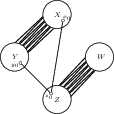
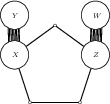
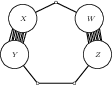
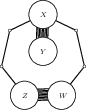
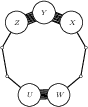
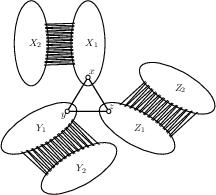
Figure 1: The extremal constructions χ(H)=30 through χ(H)=31, each realizing a distinct threshold in the chromatic profile for tripartite graphs.
Extremal Constructions and Graph Families
A salient aspect of the paper is the construction of extremal templates χ(H)=32, each engineered to show the sharpness of the thresholds and to serve as counterexamples for specific χ(H)=33.
- χ(H)=34, ..., χ(H)=35: These are iterative blow-ups of odd cycles and certain join operations, precisely connected with the families χ(H)=36. For example, χ(H)=37 is a “hexapartite” construction originally due to Häggkvist, realizing the threshold χ(H)=38.
The structural classification depends on the odd girth χ(H)=39 and whether δχ(H,r)0 embeds into one or more of these infinite families. The flowchart gives a quick decision procedure for the value of δχ(H,r)1 based on these containment criteria.
Vertex-Extendable Threshold and Reduction to Core Parameters
An auxiliary innovation is the introduction of the vertex-extendable threshold δχ(H,r)2: the minimum δχ(H,r)3 so that, in an δχ(H,r)4-free graph δχ(H,r)5 with δχ(H,r)6 and the property that δχ(H,r)7 is δχ(H,r)8-colorable for some vertex δχ(H,r)9, c0 must itself be c1-colorable. The main technical reduction, proved via iterative applications of the Removal Lemma and Zarankiewicz-type intersection bounds, is: c2
where c3 and c4 is color-critical. The paper further provides exact values for c5 as a function of c6’s containment in the extremal families.
The proof strategy is modular and combines probabilistic, spectral, and intersection-type arguments:
These methods yield sharp upper bounds, while the constructed extremal graphs give matching lower bounds, establishing tightness.
Implications for Turán-type Problems and Regularity
The discrete spectrum and their associated extremal graphs connect with regular Turán numbers: For each c7 in the discrete list, maximal regular c8-free graphs reach the threshold degree prescribed by c9. The results also extend and clarify the landscape for odd cycles and help map out the chromatic profile for further families (H0, H1) as directions for future work.
Theoretical and Practical Significance
- Sharp bounding of chromatic profiles for any tripartite or color-critical H2 allows for direct application in extremal combinatorics, coloring, and sparse random graphs subject to forbidden structures.
- Modular framework: Introduction of vertex-extendability gives a recursive parameter suitable for generalization to higher chromatic numbers.
The strategies deployed can serve as a blueprint for addressing further open cases of Allen et al.'s Problem 45.
Future Directions
The combinatorial reductions to finite template containment, and the successful full solution for H3 and H4, indicate that progress on higher H5 or H6 will hinge on new generalizations of the vertex-extendable paradigm. Determining H7 for H8-chromatic H9 is highlighted as the next critical step. Extension of these methods to chromatic profiles of oriented graphs (digraphs) is also posed.
Conclusion
The paper achieves a complete, discrete classification of G0 for tripartite and color-critical graphs, introducing refined structural parameters and techniques. The multifaceted approach—combining extremal constructions, intersection lemmas, and recursive threshold definitions—resolves questions open since Erdős–Simonovits. The results advance the understanding of the interplay between forbidden subgraphs, degree constraints, and colorability, and provide foundational tools for future progress on chromatic profiles.