- The paper demonstrates that for d ≤ m, d-th order moments of tomographic projections fully capture the corresponding Haar-invariant moments, independent of the ambient dimension.
- It employs the Fourier-slice theorem to construct a canonical method for reconstructing full moment tensors from lower-dimensional projections, enhancing statistical efficiency.
- The work unifies cryo-EM results with general tomographic settings by establishing a precise geometric threshold, while also outlining challenges in non-uniform sampling scenarios.
Group-Invariant Moments Under Tomographic Projections: A Geometric Perspective
Problem Setting and Motivation
Tomographic imaging models involve recovery of high-dimensional functions (e.g., f:Rn→R) from lower-dimensional random projections, encapsulated by observations of the form Y=P(R⋅f), where R is uniformly drawn from SO(n) and P projects onto an m-dimensional subspace. This formalism models central problems in structural biology such as cryo-EM, where 3D molecular structures are only indirectly observed via 2D projections at random, unknown orientations. The analysis of identifiability in such models has historically relied on the behavior of group-invariant moments, especially in high-noise settings where direct recovery is infeasible.
A core question has been whether the information content in moments of the observed projections matches that in the unprojected (ambient) domain: specifically, when does the d-th order projected moment carry the full d-th order Haar-invariant moment of the original function, and is this property independent of the ambient dimension n? The paper addresses this by establishing precise geometric and algebraic conditions for such moment equivalence, generalizing and unifying key results from the cryo-EM literature.
Geometric Conditions for Moment Equivalence
The foundational result demonstrates that for Haar-uniform R and any Y=P(R⋅f)0, the Y=P(R⋅f)1-th moment of the projected data (Y=P(R⋅f)2) determines the full Y=P(R⋅f)3-th Haar-orbit moment of Y=P(R⋅f)4 independently of Y=P(R⋅f)5. This geometric principle relies fundamentally on the structure induced by the Fourier-slice theorem: every tomographic projection samples an Y=P(R⋅f)6-dimensional central slice of the ambient Fourier transform Y=P(R⋅f)7; as a consequence, any Y=P(R⋅f)8 frequencies with Y=P(R⋅f)9 can be simultaneously represented in one such central slice, allowing for full reconstruction of corresponding R0-order invariants.
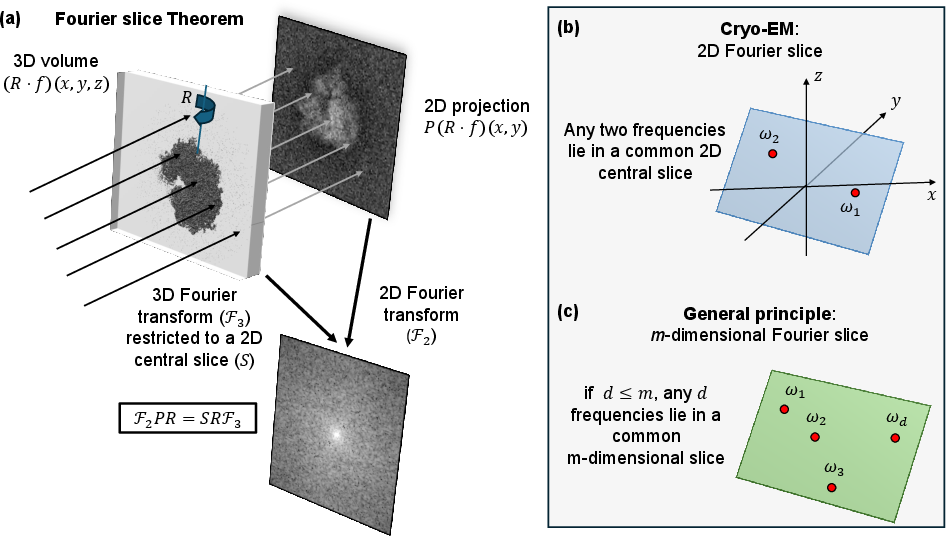
Figure 1: The moment-lifting mechanism: (a) illustrates the Fourier-slice theorem in 3D; (b) depicts the classical cryo-EM case R1, where second-order projection statistics suffice; (c) generalizes to arbitrary R2.
The direct implication is that identifiability or recovery results in the unprojected setting based on order-R3 moments transfer without loss to the tomographic setting, as long as R4. In the classical cryo-EM use case, this recovers Kam's theorem: the covariance (second moment) of randomly oriented 2D projections suffices to determine the rotationally invariant 3D covariance of the underlying volume.
The paper establishes the following core theoretical contribution:
Theorem:
For Haar-uniform R5, the R6-th order projected moment tensor R7 determines the full Haar-orbit R8-th order moment R9 for all SO(n)0, regardless of the ambient dimension SO(n)1. Specifically:
- SO(n)2 for the canonical embedding SO(n)3.
- For any SO(n)4 in a common SO(n)5-D subspace, SO(n)6, for suitable SO(n)7.
- Strong claim: Full SO(n)8-th order Haar moments over all frequency tuples in SO(n)9 are determined by P0 whenever P1.
Consequently, any recovery algorithm or identifiability criterion expressible using P2-th order Haar-invariant moments in the unprojected model applies identically in the tomographic setting. The result is sharp: for P3, the reduction fails generically, as not all frequency tuples are accessible via a single projection slice.
An explicit algorithmic prescription for reconstructing P4 from P5 is provided. For a given query P6 with P7, one first identifies an P8-dimensional subspace containing these frequencies and expresses each P9 in a suitable coordinate system. The projected moment tensor is then directly evaluated at the corresponding points in m0.
Relation to Existing Results and Generalizations
This result unifies and generalizes several isolated observations from the literature:
- It subsumes the classical cryo-EM covariance theorem as a special case.
- The approach works for arbitrary orders m1 and dimensions m2, provided m3, establishing a universal geometric threshold.
- The proof and construction are canonical and group-theoretic, relying critically on Haar-invariance; for non-uniform orientation distributions, the equivalence breaks, and identifiability may degrade or require additional weighting. The question of partial recovery for non-uniform distributions remains open and is pertinent for practical imaging settings where uniform sampling is unavailable.
The findings establish a new principle: the dimension of the projection imposes a hard cutoff on the maximal order of invariant information transmissible by tomographic data.
Numerical and Algebraic Implications
The results, while abstract, have immediate and important implications:
- Statistical efficiency: There is no “moment inflation” penalty for tomographic projections; the sample complexity determined by the unprojected model carries over without degradation for all m4.
- Algorithmic tractability: Algorithms for orbit recovery via invariant moments extend to the tomographic regime with minimal modification, as sampling and reconstructive procedures are equivalent at the moment level.
- Sharp threshold: The work gives a precise geometric sense in which the dimensionality of projections governs the maximal recoverable invariant “moment order”—with m5 as the threshold.
Discussion and Future Directions
The precise geometric argument links the moment order to the projection dimension, clarifying which statistical invariants survive the projection process. While the mechanism relies fundamentally on uniformity of orientation sampling (Haar measure), practical considerations—especially in biomedical imaging—often involve non-uniform or unknown distributions. Extending the moment-lifting argument or quantifying losses under these more general settings constitutes a natural next step.
For m6, only a restricted subset of order-m7 invariants is accessible, raising intriguing open questions about partial moment recovery or hybrid approaches combining experimental control and mathematical reconstruction. Algebraic methods—potentially involving invariant theory or higher-order slice geometry—may provide further insight.
Conclusion
This work formulates and proves a geometric and algebraic principle characterizing when tomographic projections preserve the full information content of Haar-invariant moments under group action, showing that the projected m8-th order moments determine all m9-th order invariants for d0. This bridges classical results from cryo-EM to a broad, abstract regime, and lays a geometric foundation for moment-based identifiability in group orbit recovery under projections. The dimension threshold d1 emerges as intrinsic, with clear implications for the design and analysis of statistical and computational methods involving group-invariant data under tomography.

