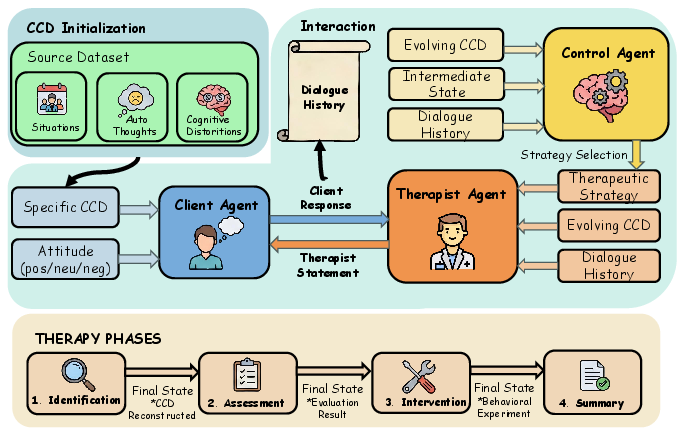
- The paper introduces a multi-agent framework that dynamically reconstructs cognitive conceptualization diagrams to simulate clinically authentic CBT sessions.
- It leverages the CCDChat dataset of 4,500 curated sessions and demonstrates superior performance in CTRS and PANAS evaluations.
- The control agent coordinates phased therapy, enforcing information asymmetry to mimic real-world therapeutic reasoning.
Multi-Agent Cognitive Behavioral Therapy Simulation via Dynamic Cognitive Conceptualization Diagrams
Motivation and Paradigm Shift
The CCD-CBT framework addresses two foundational limitations prevalent in prior LLM-based CBT simulation approaches: reliance on static cognitive profiles and the use of omniscient (single-agent) simulation. Most previous models predetermine and fix a client's cognitive-affective schema for the entirety of the therapeutic session, rendering the dialogue a mere execution of a static script. Furthermore, omniscient designs allow the model to access both the client and therapist's internal states, producing unrealistically successful and clinically implausible interactions. CCD-CBT innovatively introduces a multi-agent architecture, separating roles into Client, Therapist, and Control Agents. This enables dynamic reconstruction of the client’s Cognitive Conceptualization Diagram (CCD) and enforces information asymmetry, requiring the Therapist Agent to operate solely from inferred states, emulating real-world therapeutic reasoning.
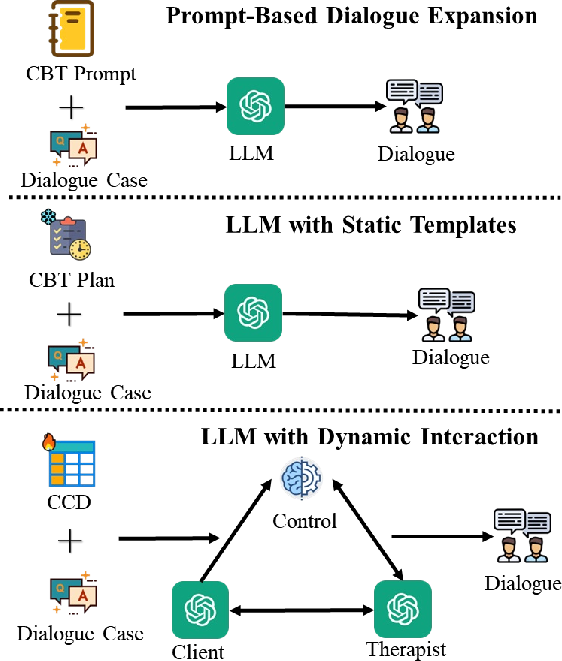
Figure 1: Comparison of CBT simulation paradigms, contrasting early prompt-based methods, static cognitive modeling, and the dynamic multi-agent framework of CCD-CBT.
Framework Architecture and Agent Separation
CCD-CBT models psychotherapy as a structured, multi-phase process, aligning with clinical CBT best-practices. The framework contains three distinct LLM-driven agents:
This structure yields adaptive, multi-turn dialogues where the therapist must infer and reason about the client’s psychological status rather than relying on omniscient access.
Dataset Construction: CCDChat
CCD-CBT enables the creation of CCDChat, a synthetic multi-turn CBT dataset with 4,500 curated sessions. Each session is grounded in a distinct CCD, derived from clinically validated C2D2 resources, covering broad situational contexts (e.g., family, work, health). The dataset enforces phased therapeutic completeness and integrates realistic attitudinal variations.
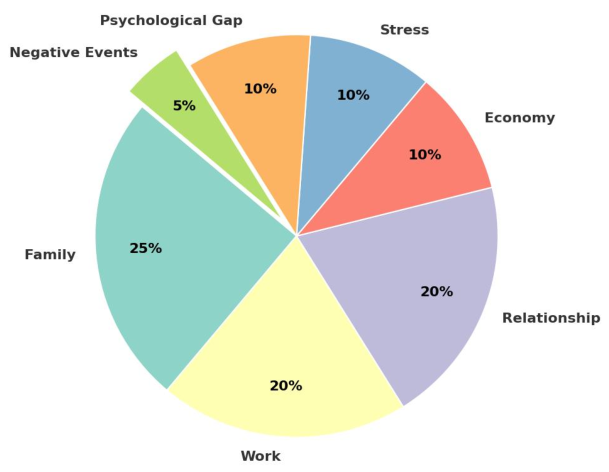
Figure 3: Distribution of situational contexts within CCD-CBT and CCDChat, demonstrating coverage across seven primary life domains.
This resource is characterized by explicit CBT grounding, end-to-end CCD guidance, and consistently structured, extended dialogues, marking a departure from template-based and rule-driven prior datasets.
Evaluation and Numerical Results
CCD-CBT models were fine-tuned using LoRA on the CCDChat corpus, with separate adapters for each agent and phase. Evaluation incorporates both automatic (via CTRS and PANAS scales using GPT-4o-mini) and expert-based metrics.
CTRS (Clinical Competence):
CCD-CBT achieves the highest scores across five of six dimensions, notably outperforming baselines in CBT-specific Strategy and Guided Discovery by >0.2 points. The model consistently excels in procedural competence metrics, confirming the necessity of dynamic CCD guidance for structured intervention.
PANAS (Emotional Outcomes):
CCD-CBT induces the most pronounced increase in positive affect and largest decrease in negative affect across all client attitudes, especially under challenging neutral and negative stances.
Ablation Studies:
Eliminating CCD guidance or fine-tuning results in significant drops in CTRS metrics, particularly Strategy and Focus, underscoring the additive contributions of CCDChat and dynamic CCD planning.
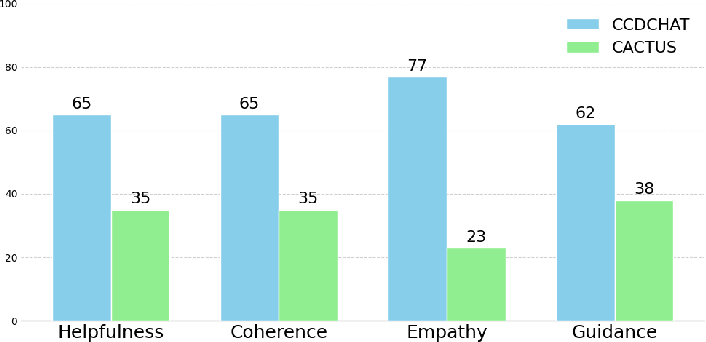
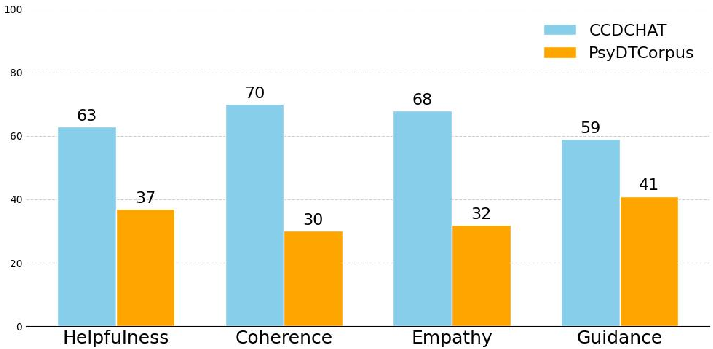
Figure 4: Human evaluation results showing CCDChat dialogue preference over CACTUS and PsyDTCorpus baselines across Helpfulness, Coherence, Empathy, and Guidance.
Human Evaluation:
Licensed CBT practitioners rate CCDChat dialogues consistently superior to both CACTUS and PsyDTCorpus across all clinical dimensions (p<0.05), confirming empirical authenticity and therapeutic effectiveness.
Component Analysis and Dataset Quality
The Control Agent’s dynamic CCD reconstruction achieves high fidelity, with mean alignment scores (2.77/3), especially for core beliefs and coping strategies. Attitudinal and belief content analyses reveal robustness and minimal performance variance, validating the model’s resilience and adaptability to diverse patient schemas.
CCDChat guarantees clinical phase completeness (Identification, Assessment, Intervention, Summary). Baseline datasets omit critical stages (e.g., “Assessment” and “Homework Assignment”), leading to degraded professional fidelity. Quantitative CTRS scoring across datasets corroborates CCDChat’s superiority in therapeutic skill dimensions.
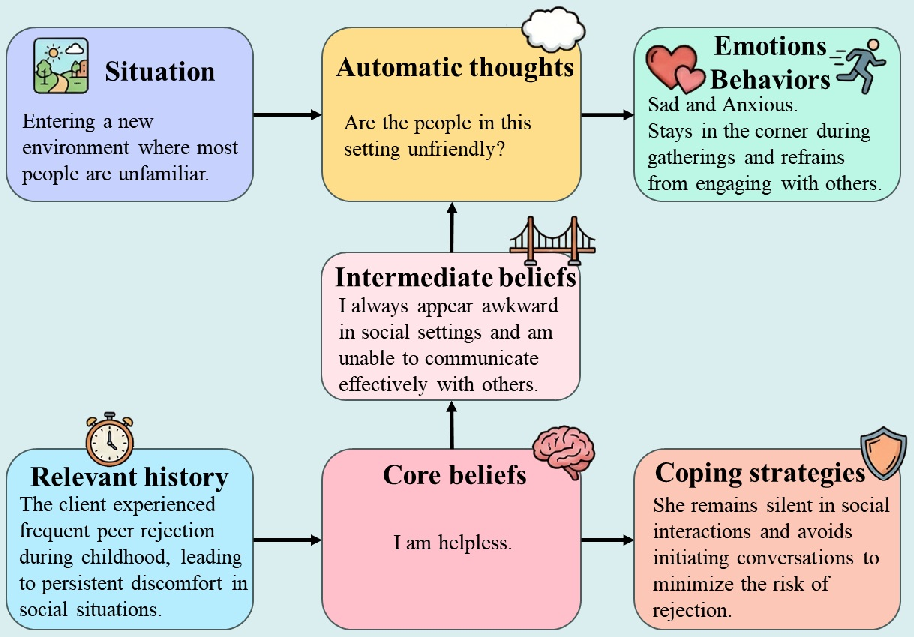
Figure 5: Components and relationships within the Cognitive Conceptualization Diagram, central to therapy session structuring in CCD-CBT.
Case Study and Process Walkthrough
A full-case walkthrough demonstrates the framework’s phased approach: initial situation and automatic thoughts elicit emotions and behaviors; therapist uses Socratic questioning and downward arrow techniques to probe core beliefs and relevant history; structured assessment quantifies belief/emotion intensities; intervention phase guides the client through alternative thought generation and behavioral experiment design; summary phase consolidates practice and affirms progress.
Practical and Theoretical Implications
CCD-CBT exemplifies an advance in simulating clinically authentic psychotherapy sessions by enforcing information asymmetry and dynamic cognitive profiling. Practically, it provides a scalable mechanism for training and evaluating digital counselors and can augment mental-health support for populations with limited therapist access. Theoretically, the framework demonstrates the necessity of modeling agent-specific knowledge and interactional inference for aligning conversational AI with real-world therapeutic constraints. The CCDChat dataset establishes a high-fidelity benchmark for future research in theory-grounded clinical dialogue and agent collaboration.
Future Directions and Limitations
Future extensions may encompass multi-session modeling, incorporating non-verbal and multimodal signals, and broadening CCD diversity for cross-cultural generalizability. The reliance on synthetic, Chinese-language data introduces demographic bias, and the single-session paradigm omits longitudinal therapeutic dynamics—addressing these limitations is crucial for further deployment and fairness.
Conclusion
CCD-CBT delivers a multi-agent, dynamically guided simulation of CBT that aligns with clinical realities better than previous static and omniscient paradigms. Models trained on CCDChat demonstrate superior therapeutic competence and affective regulation, validated through both automatic and expert human evaluation. The research provides both a novel computational framework and a clinically grounded dataset, advancing the realism and efficacy of digital mental-health agents (2604.06551).