- The paper introduces a novel semiclassical Monte Carlo method to study disorder effects in the J1-J2 Heisenberg model at maximal frustration.
- Key findings show a transition from a valence bond glass ground state to a glassy spin liquid and finally to a paramagnet with increasing temperature.
- The study identifies a low-temperature, field-independent specific heat anomaly as a clear experimental marker for disorder-dominated quantum phases.
Valence Bond Glass and Glassy Spin Liquid in Disordered Frustrated Magnets
Introduction and Motivation
The characterization and identification of nontrivial quantum-disordered ground states in frustrated magnets, especially in the presence of quenched disorder, represent a fundamental issue in contemporary quantum magnetism. Thermodynamic signatures such as the absence of conventional long-range magnetic order and anomalous low-temperature specific heat are typically interpreted as evidence for quantum spin liquid (QSL) phases. However, the robustness of such inference is challenged by the possibility of alternative disorder-induced glassy quantum phases displaying similar phenomenology.
This work applies a novel semiclassical Monte Carlo (SC) approach to the disordered spin-1/2 J1-J2 Heisenberg model on the square lattice, focusing on elucidating the implications of randomness in the maximally frustrated regime (J2/J1=0.5). The main outcomes are the theoretical identification of a valence bond glass (VBG) ground state and a sequence of thermal crossovers into a glassy spin liquid (GSL) and a conventional paramagnet (PM). The study provides unambiguous numerical diagnostics and discusses experimental relevance, emphasizing the impact of disorder-activated collective singlet excitations.
Model and Simulation Methods
The disordered J1-J2 Heisenberg Hamiltonian is constructed by introducing random nearest-neighbor (nn) and next-nearest-neighbor (nnn) exchanges, J1,ij and J2,ij, each sampled from box distributions of disorder width Δ. The principal interest is the strong frustration regime where J2/J1=0.5.
A semiclassical mapping is employed, in which quantum spin fluctuations are represented by Ising spin and bond (dimer) variables, with quantum effects captured via constraints and energetics associated with dimerization. The SC model is simulated using Markov chain Monte Carlo, with a suite of local and bond-based updates, as well as explicit projection to the physical Hilbert space, permitting statistically robust exploration of both frozen and fluctuating singlet sectors. Benchmarking is performed via exact diagonalization (ED) on small clusters.
Quantitative Diagnostics of Glassy and Spin Liquid Phases
Disorder-Induced Valence Bond Freezing
Analyzing the disorder-driven evolution of nn spin-spin correlation distributions P(χ) reveals sharp signatures of translational symmetry breaking—the hallmark of glassiness.
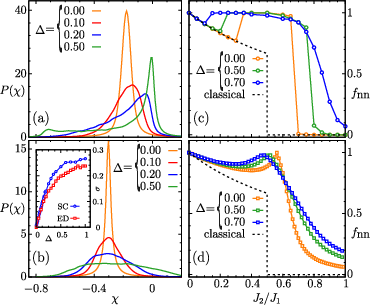
Figure 1: Distribution of nearest-neighbor spin correlations from SC (a) and ED (b). In the clean limit, J20 is sharply peaked; with increasing J21, broad distributions arise, reflecting frozen, spatially random valence bonds. Panels (c),(d): non-monotonic J22 dependence of nn energy contribution highlights strong frustration-driven energy redistribution.
The SC and ED results concur, both displaying broadening of J23 with growing J24, underlining the freezing of singlet bonds onto links with locally strong exchanges. At the same time, the fractional energy in nn correlations J25 shows a pronounced non-monotonic enhancement around the maximal frustration point, beyond the classical prediction.
Thermodynamic Measures: Freezing Parameter and Specific Heat
The freezing parameter J26 and the fraction J27 of fully frozen singlets provide quantitative order parameters for the VBG and GSL regimes. The scaling J28 persists for all J29 at low J2/J1=0.50, confirming the short-range, glassy nature of the frozen phase.
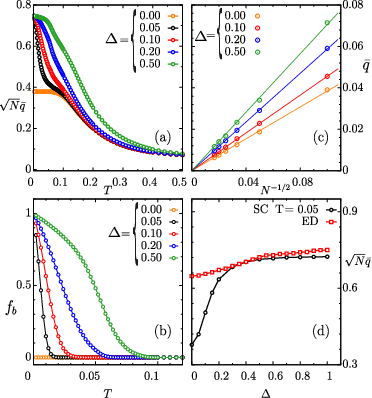
Figure 2: (a) Temperature-dependence of freezing parameter J2/J1=0.51 for various J2/J1=0.52. (b) Fraction of frozen nn singlets. (c) Finite-size scaling of J2/J1=0.53. (d) Benchmarking of J2/J1=0.54 between SC and ED.
At finite disorder, J2/J1=0.55 and J2/J1=0.56 reveal a sequence of two thermal crossovers: VBG (with static singlet freezing) transitions to GSL (dynamic, glassy dimers), and finally to PM at higher J2/J1=0.57.
The specific heat J2/J1=0.58, a central thermodynamic probe, exhibits a key anomaly: for small but finite J2/J1=0.59, a nearly linear low-J10 rise emerges and persists up to a scale set by the disorder strength.
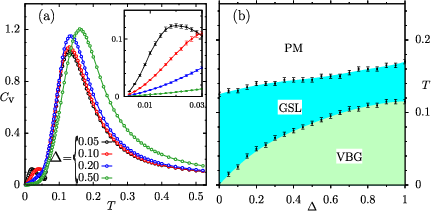
Figure 3: (a) Temperature dependence of specific heat for different disorder strengths from SC simulations; the low-J11 linear behavior is established in the inset. (b) J12-J13 phase diagram, with boundaries annotated by features in J14, J15, and J16.
This low-J17 anomaly results from disorder-induced collective singlet-pair rotations, rather than mobile spinon excitations, implying weak field coupling and providing clear experimental diagnostics.
Phase Structure and Phase Diagram
Synthesizing these diagnostics yields a J18-J19 phase diagram. At strong frustration and finite disorder, the ground state is identified as VBG: a nonmagnetic quantum phase with rigid, randomly frozen singlets but no long-range order. On heating, VBG melts to GSL—characterized by slow many-body dynamics and fluctuating dimers—before crossing over to a PM at higher J20.
Importantly, the data do not support the persistence of a conventional QSL ground state with mobile, fractionalized spinon excitations in the presence of significant disorder. Instead, spinon mobility is suppressed (Anderson-localized), and disorder-dominated singlet excitations become the dominant low-energy sector.
Experimental Implications and Theoretical Consequences
A pivotal claim of the study is that the low-J21 linear specific heat in the VBG/GSL regimes is insensitive to external magnetic fields, in marked contrast to QSLs. This emerges because the relevant excitations are collective singlet reconfigurations within the J22 subspace. Such field independence has been observed in double-perovskite systems (e.g., SrJ23Cu(TeJ24WJ25)OJ26), validating the theoretical interpretation and offering a direct experimental criterion distinguishing VBG from spinon-based QSLs.
The framework positions GSLs as a robustly realizable, experimentally testable alternative to canonical QSLs in disordered frustrated magnets. The inherently slow GSL dynamics may benefit quantum information applications due to reduced decoherence.
Conclusion
This study provides a comprehensive numerical and conceptual analysis of disorder-induced glassy quantum phases in the paradigmatic J27-J28 Heisenberg model under strong frustration. The results highlight:
- The identification of the VBG as the true ground state in the presence of quenched disorder, melting to a GSL and then a PM with increasing temperature.
- The efficacy of the semiclassical method for large-scale disordered systems, cross-validated by ED.
- The emergence of a low-J29, field-independent, quasi-linear J1,ij0 as a universal thermodynamic marker of VBG.
- Strong guidance for interpreting thermodynamic experiments on candidate materials and for future theoretical efforts to classify disorder-driven quantum phases.
These insights necessitate a careful reassessment of materials previously claimed as QSLs, as experimental signatures might alternatively point toward glassy spin-disordered states rather than true fractionalization-driven QSLs. This substantially informs ongoing searches and the theoretical landscape of quantum magnetism.
Reference:
Dash, S., Narang, V., Kumar, S. "Valence Bond Glass and Glassy Spin Liquid in Disordered Frustrated Magnets" (2604.05501)

