- The paper establishes that local Hamiltonian rank deficiency drives quantum fragmentation independent of global symmetries.
- It introduces a rigorous framework to classify entangled frozen states emerging from classical Krylov subspaces using both analytical and numerical methods.
- The study reveals how algebraic structures, including the Temperley-Lieb model, influence spectral statistics and non-ergodic dynamics in quantum many-body systems.
Quantum Hilbert Space Fragmentation and Entangled Frozen States
Introduction and Problem Statement
The paper "Quantum Hilbert Space Fragmentation and Entangled Frozen States" (2604.05218) provides a comprehensive and quantitative framework for understanding quantum Hilbert space fragmentation (HSF). It establishes the central role of local Hamiltonian rank deficiency as the minimal and universal mechanism that enables quantum fragmentation, and systematically classifies the resulting structure of quantum-inert, entangled frozen states (EFS) within mobile classical Krylov sectors. The work rigorously demonstrates that quantum fragmentation is not contingent on global symmetries or algebraic structures such as the Jones relation; rather, it originates from the presence of entangled null states induced by locally constrained dynamics.
Mechanism: From Classical to Quantum Fragmentation
In classical HSF, product-basis (computational) states are partitioned into disconnected Krylov subspaces by local rewriting rules, as captured by combinatorial semigroup dynamics. Weak classical fragmentation is defined by the largest connected subspace being extensive in the full Hilbert space, while strong fragmentation yields only exponentially small mobile sectors. Quantum fragmentation generalizes this: within a classically mobile Krylov component, local rank-deficient projections can generate entangled states that are dynamically inert under the Hamiltonian, giving rise to EFS.
The key mechanism is the intersection of local kernels within a mobile sector:
KF(λ)=i⋂ker(hi∣Kcl(λ))
where hi is the local term and Kcl(λ) is a classical mobile Krylov sector. The EFS cannot be represented as product states due to entanglement structure enforced by the null spaces; they are classically mobile but quantum-frozen.
This decomposition further splits the classical mobile sector as:
Kcl(λ)=Kq(λ)⊕KF(λ)
where Kq(λ) is the mobile quantum component.
Model Architectures and Algebraic Structure
The paper investigates four representative models which interpolate between minimal and maximal algebraic structure:
- Asymmetric triplet-flip projector (no symmetry)
- GHZ projector (Z2 symmetric)
- Cyclic qutrit projector (Z3 symmetric)
- Temperley-Lieb (TL) model (full bond-algebraic structure, Jones relation)
Minimal Ingredients
The asymmetric projector demonstrates that pure rank deficiency suffices—no symmetry is necessary for quantum fragmentation. Here, the local coupling matrix projects triplets $000$ and $111$ onto an asymmetric combination. The resulting EFS populate every sector with mobile triplets, their number scaling as the Fibonacci sequence, matching the count of classical sectors. A closed-form for the quantum sector dimension (number of entangled-frozen states) is derived, showing an explicit reduction relative to the classical dimension attributable to each EFS.
Symmetry-Enriched Fragmentation
Upon enforcing discrete symmetry (GHZ: Z2; Cyclic qutrit: hi0), the mechanism of fragmentation is unchanged, but symmetry-related degeneracies emerge. Symmetry does not induce fragmentation but organizes the resultant sectors into degenerate or enriched charge subspaces, sometimes allowing further decomposition by symmetry label.
Algebraic Enhancement: TL Model
In models such as the TL chain, the local projector satisfies the Jones relation and the bond algebra fragments hi1 into an extensive number of irreducible representation sectors (standard modules), leading to a fundamentally different structure—strong quantum fragmentation—where all irreducible subspaces are vanishingly small compared to the quantum mobile Krylov space.
Numerical and Analytical Results
A principal diagnostic is the gap ratio distribution hi2 within the largest quantum mobile Krylov subspace hi3, evaluated via exact diagonalization for moderate sizes. For weakly fragmented cases (asymmetric, GHZ, cyclic), the spectrum exhibits GOE (or mGOE for symmetry-enriched) level statistics, indicating that individual irreducible components thermalize, with the sector structure reflecting symmetry multiplicities. In strongly fragmented cases (TL model), Poisson statistics are approached, signaling absence of spectral rigidity due to exponentially proliferating irreducible components.
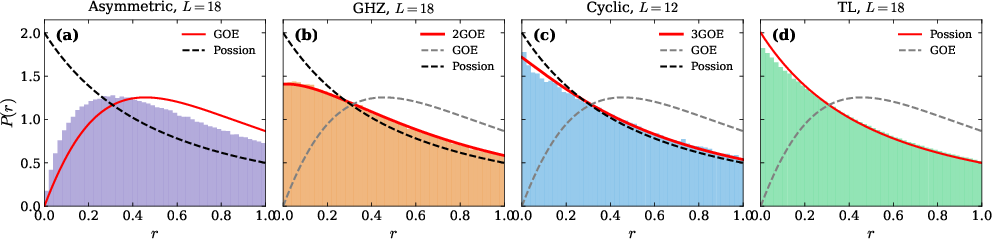
Figure 2: Gap ratio distribution hi4 for distinct eigenvalues in hi5 of the largest mobile sector, showing convergence to GOE, 2GOE, 3GOE, and Poisson respectively for the four models.
Distinct behaviors in the finite-size drift and mGOE superposition—versus approach to Poisson—diagnose the fragmentation class. The TL model's hi6 with hi7, while for the others hi8 remains hi9.
Weak versus Strong Quantum Fragmentation
A crucial formal contribution is the quantum analog of classical weak/strong fragmentation, operationalized by the ratio Kcl(λ)0 (maximal irreducible quantum block to total mobile quantum Krylov dimension). If this ratio remains finite as Kcl(λ)1, fragmentation is weak; it vanishes in the strong case due to proliferation of algebraic substructure, as in the TL chain.
Practical and Theoretical Implications
The existence and construction of entangled frozen states that are robust against all local dynamics but do not rely on symmetry suggest a fundamentally dynamical kind of non-ergodicity, distinct from both many-body localization and scarred subspaces. The EFS subspaces offer intriguing connections to quantum error correction and information storage, as they are protected by dynamical constraints rather than external symmetry or disorder.
The explicit construction of entangled-frozen wavefunctions and their counting in the presence or absence of symmetries provides a blueprint for designing models with tailored fragmentation properties, with implications for engineering slow quantum dynamics, robust decoherence-free subspaces, and testing non-ergodic phases in programmable quantum simulators.
Additionally, models such as the GHZ projector admit trotterized simulations, enabling direct experimental realization in near-term quantum devices, where the weak/strong fragmentation boundary and crossover in spectral statistics can be probed.
Conclusion
The paper rigorously demonstrates that quantum Hilbert space fragmentation robustly arises from rank-deficient local interactions within classically fragmented models, independent of symmetry. Symmetries and bond algebra enrich but do not originate fragmentation, instead controlling the reducibility and sector structure of quantum Krylov spaces. The identification and explicit construction of entangled frozen states clarifies their central role in ergodicity breaking for a broad class of constrained quantum systems. The weak/strong classification captures the essential difference in the scaling of irreducible block structure under added algebraic constraints and is robustly manifested in spectral diagnostics.
These theoretical insights chart a clear course for controlled exploration of non-ergodic dynamics in both abstract algebraic and physically realistic quantum many-body systems, with promising practical implications for dynamical quantum control and error-robust information storage.

