- The paper introduces a modified black hole solution with a coupled Kalb–Ramond field and perfect fluid dark matter, showing systematic decreases in the horizon and photon sphere radii as parameters increase.
- Methodology includes analyzing photon trajectories, synthetic accretion disk images, and quasinormal mode frequencies using both 6th-order WKB and time-domain techniques.
- Findings imply that enhanced Lorentz violation and dark matter effects yield observable shifts in shadow size, emission features, and gravitational wave ringdown, offering a pathway for multi-messenger tests.
Optical Appearance and Ringdown of Black Holes in a Kalb–Ramond Field Coupled to Perfect Fluid Dark Matter: An In-Depth Analysis
Theoretical Framework and Black Hole Solutions
The study presents a comprehensive analysis of static, spherically symmetric black holes in the background of a Kalb–Ramond (KR) field nonminimally coupled to perfect fluid dark matter (PFDM). This framework extends general relativity by introducing a Lorentz-violating antisymmetric tensor field characterized by a parameter α and includes PFDM via the parameter λ, both altering the gravitational sector. The resulting metric,
ds2=−f(r)dt2+f(r)1dr2+r2(dθ2+sin2θdφ2),
with f(r) explicitly depending on both α and λ, embodies nontrivial IR and UV modifications. These parameters induce significant modifications of horizon structure, photon sphere, and geodesic properties, with reductions in the horizon radius rh, photon sphere radius rph, critical impact parameter bc, and ISCO radius risco as either λ0 or λ1 increases.
Photon Trajectories, Black Hole Shadow, and Photon Rings
The propagation of null geodesics is governed by effective potentials encoding the parametric deformations from the KR field and PFDM. The paper details the classification of photon trajectories via impact parameter λ2, with critical values distinguishing between direct, lensed, and photon-ring (multi-orbit) rays. The function λ3, as defined by the transformed radial equation, encapsulates the allowed and forbidden regions for photon motion.
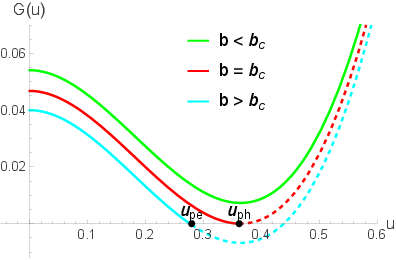
Figure 1: The function λ4 delineates the permitted and forbidden domains in photon propagation for λ5 and λ6, crucial for shadow formation.
The relationship between the number of photon orbits λ7 and the impact parameter λ8 captures the transition from direct escape to capture and supports an explicit multi-image structure, essential for interpreting high-resolution images of black hole environments.
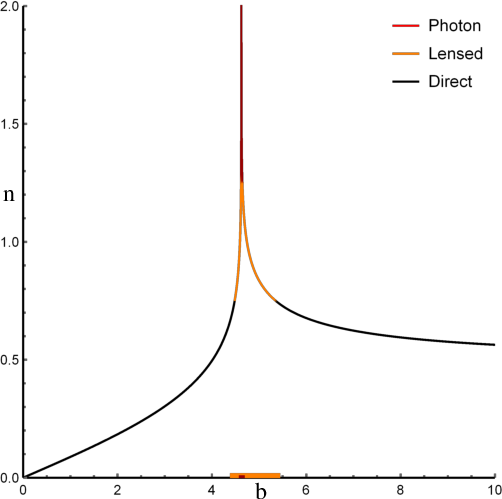
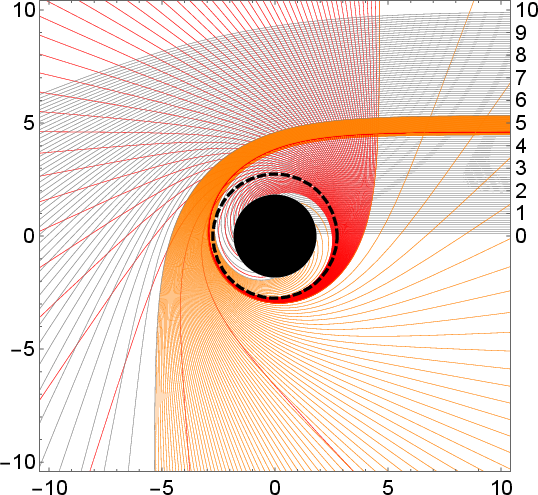
Figure 2: Mapping of λ9 and associated photon trajectories demonstrates the onset of ring formation as ds2=−f(r)dt2+f(r)1dr2+r2(dθ2+sin2θdφ2),0 approaches ds2=−f(r)dt2+f(r)1dr2+r2(dθ2+sin2θdφ2),1.
The shadow boundary—the observable photon ring—shrinks monotonically as ds2=−f(r)dt2+f(r)1dr2+r2(dθ2+sin2θdφ2),2 or ds2=−f(r)dt2+f(r)1dr2+r2(dθ2+sin2θdφ2),3 increases, which has direct implications for interpreting EHT-like observations in environments where exotic fields and nonbaryonic matter are present.
Thin Accretion Disk Models and Optical Appearance
Three thin-disk emission models are thoroughly examined, each with distinct emissivity prescriptions. The transfer functions ds2=−f(r)dt2+f(r)1dr2+r2(dθ2+sin2θdφ2),4, determined by repeated photon-disk intersection points, encode the structure of direct, lensing, and photon rings present in the observed intensity.
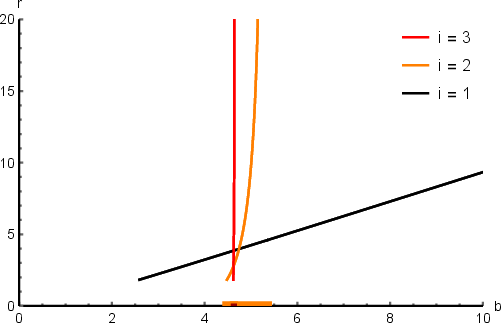
Figure 3: The leading transfer functions ds2=−f(r)dt2+f(r)1dr2+r2(dθ2+sin2θdφ2),5 showcase the diminishing contribution of higher-order disk images to the total observed intensity.
Images of the accretion disk exhibit a marked dependence on the KR and PFDM parameters. Direct emission features single-peaked profiles, but strong-field lensing generates multi-peak observed intensity profiles, with the separation and prominence of photon rings modulated by ds2=−f(r)dt2+f(r)1dr2+r2(dθ2+sin2θdφ2),6 and ds2=−f(r)dt2+f(r)1dr2+r2(dθ2+sin2θdφ2),7.
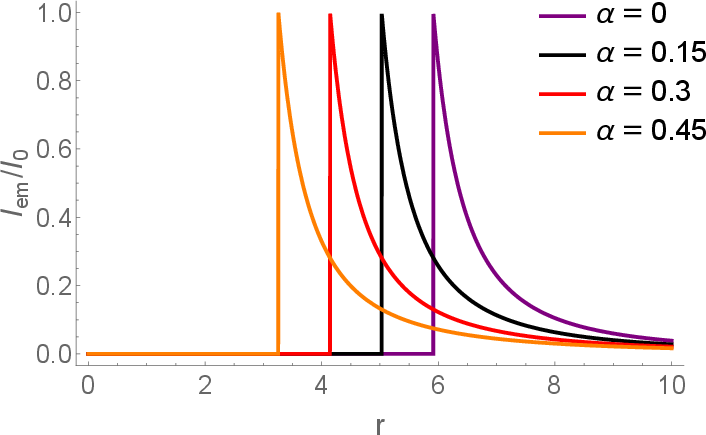
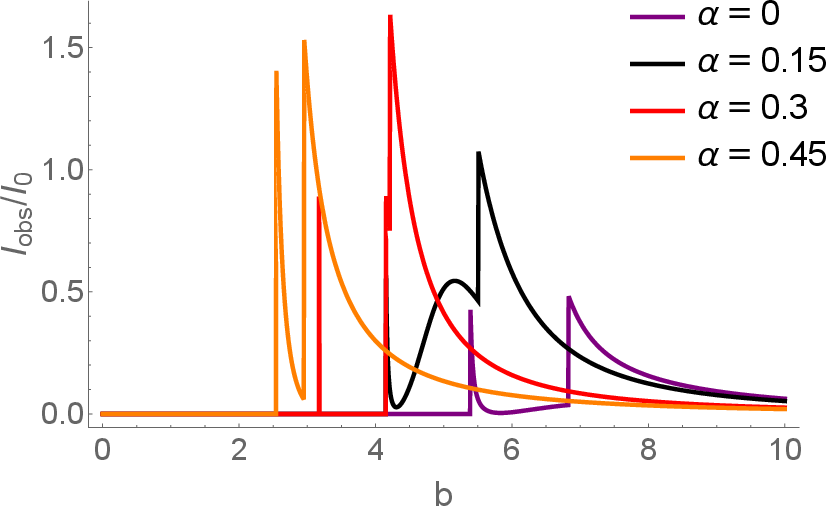
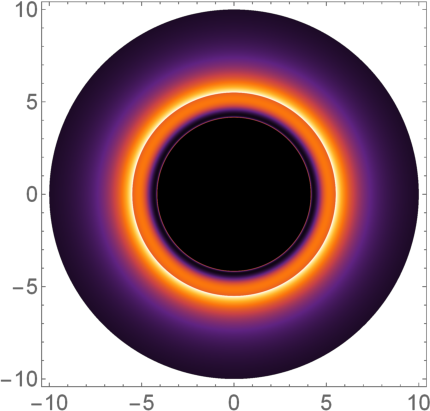

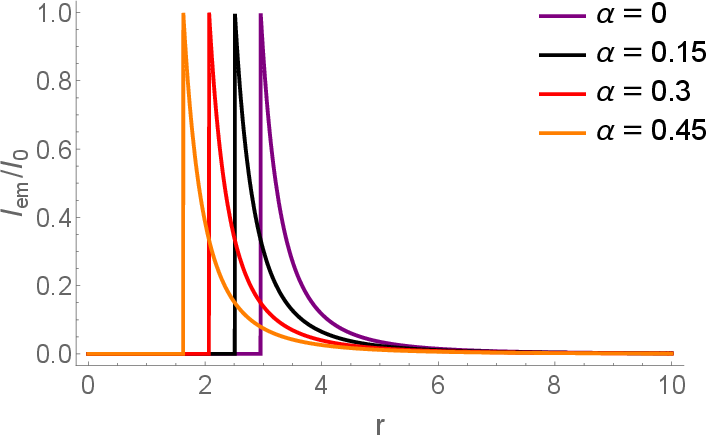
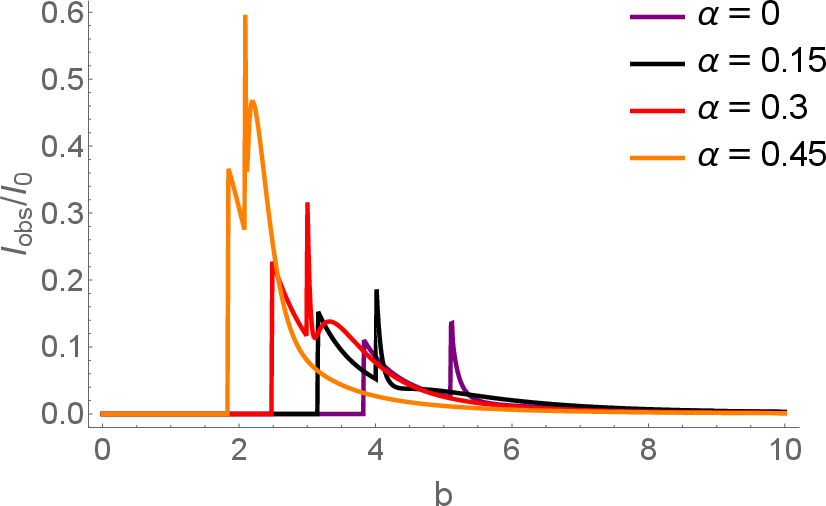
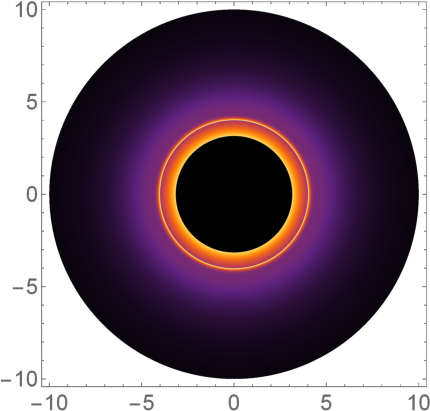

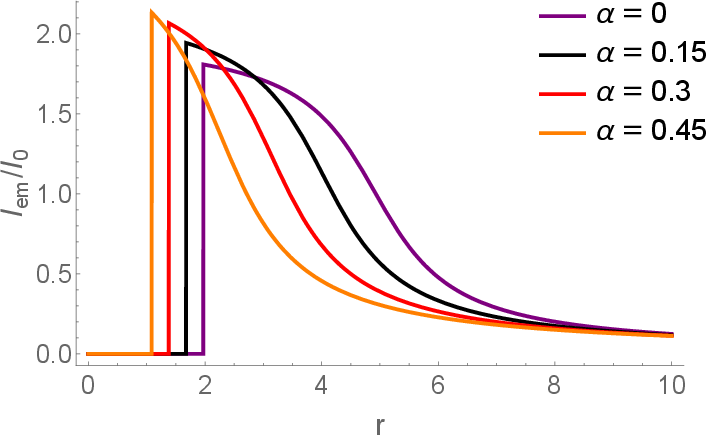
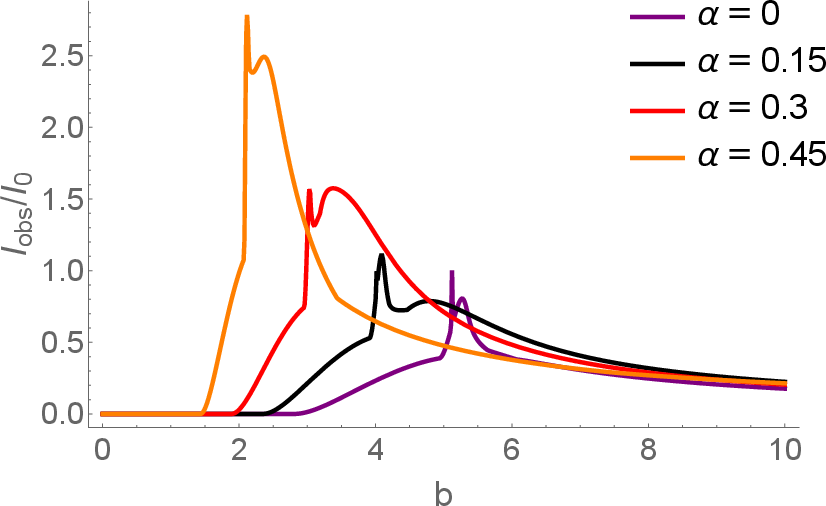
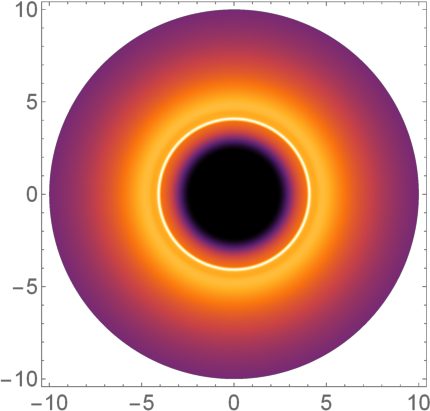

Figure 4: Synthetic disk images for varying ds2=−f(r)dt2+f(r)1dr2+r2(dθ2+sin2θdφ2),8 (with fixed ds2=−f(r)dt2+f(r)1dr2+r2(dθ2+sin2θdφ2),9) illustrate the compressive effect on both emission and observed intensity maps.
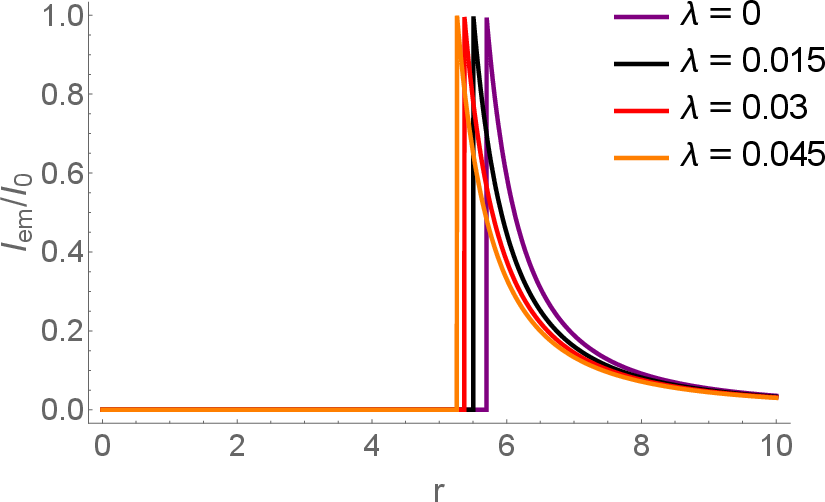
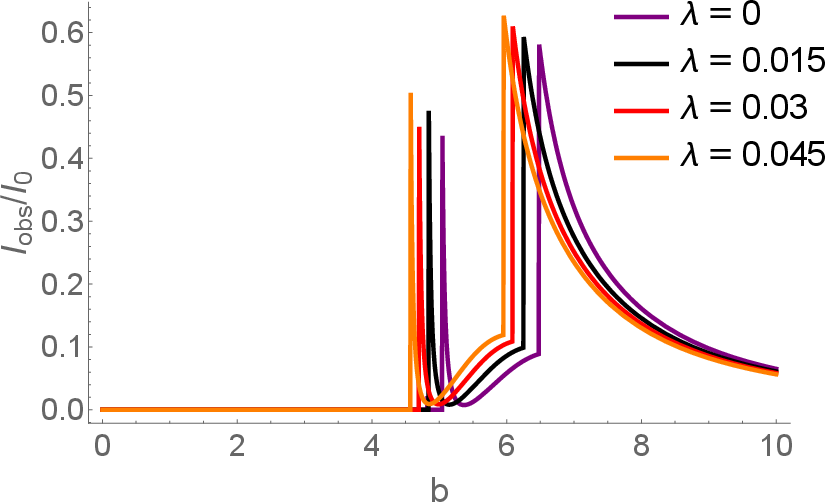
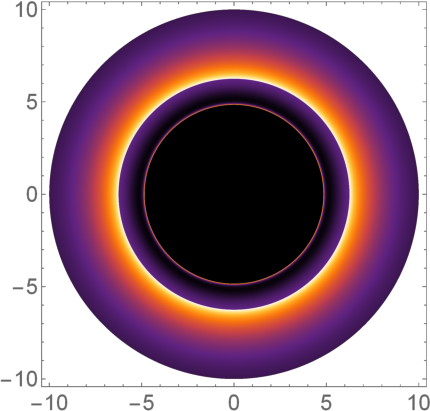

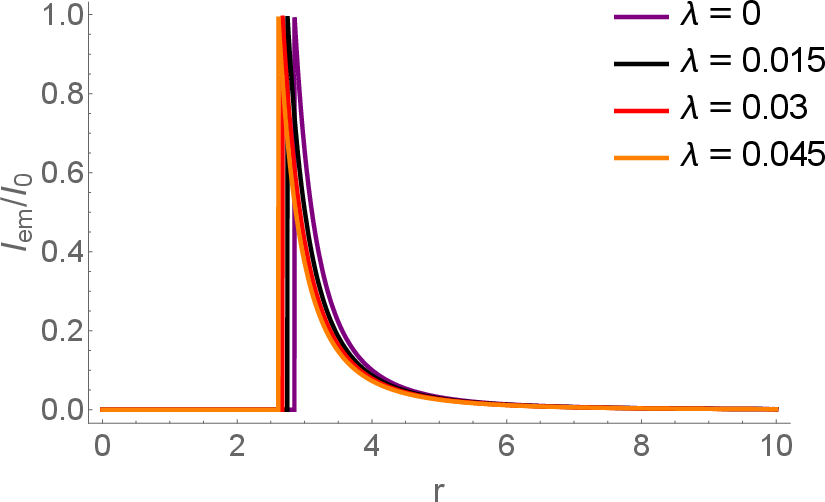
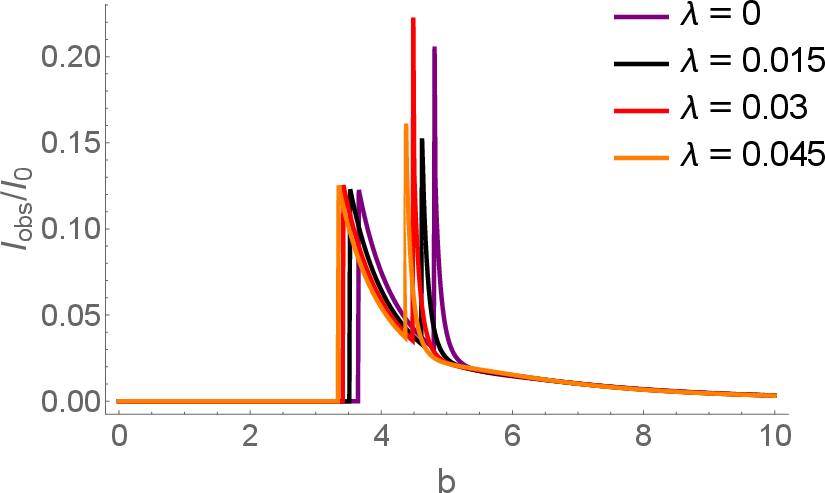
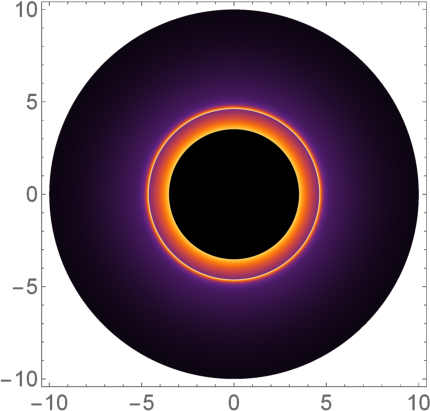

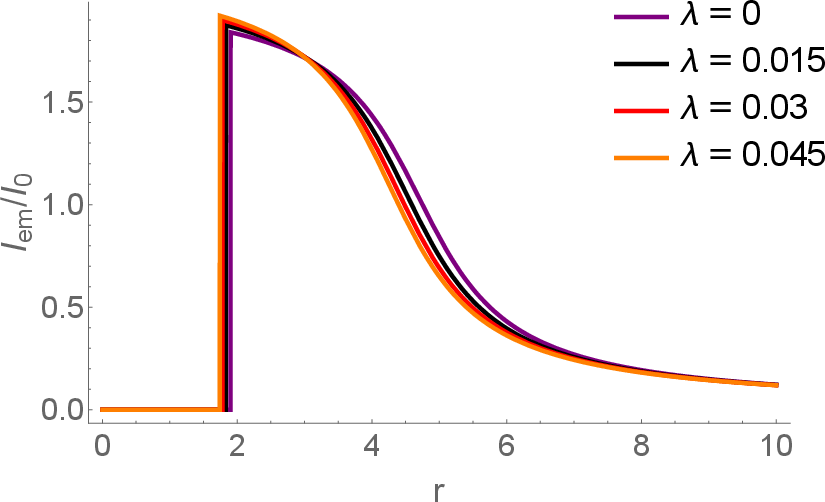
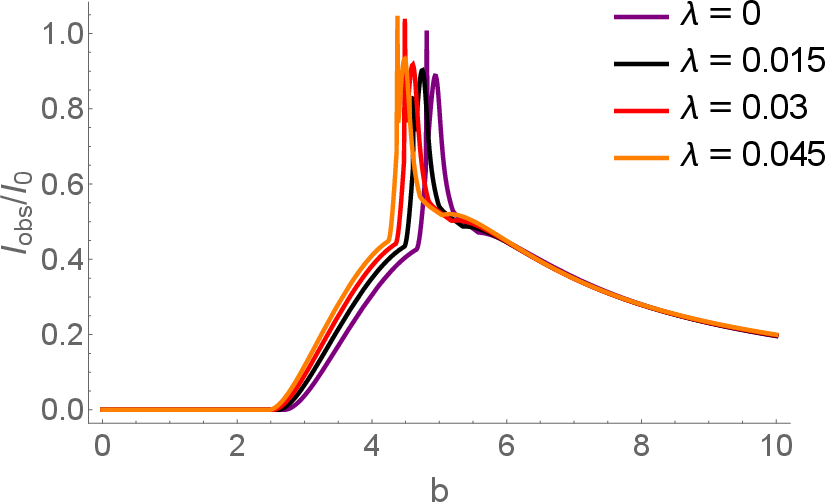
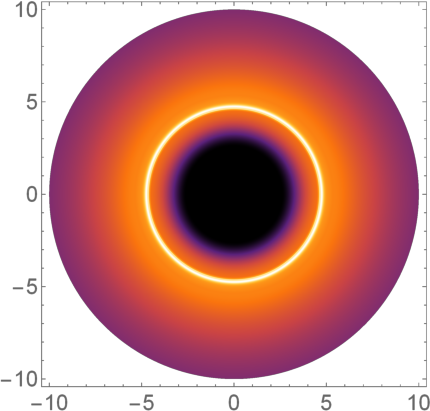

Figure 5: Disk morphology for varying f(r)0 (with fixed f(r)1) further corroborates the systematic contraction of bright rings and the photon ring radius.
The impact of varying f(r)2 and f(r)3 reveals that enhanced Lorentz violation or dark matter density compresses all detectable disk and shadow features toward smaller angular radii, an effect of direct observational interest.
Black Hole Ringdown and Quasinormal Mode Analysis
The study investigates scalar, electromagnetic, and axial gravitational perturbations, each governed by Regge-Wheeler–like wave equations with effective potentials f(r)4 exhibiting parameter-sensitive peak heights and widths.
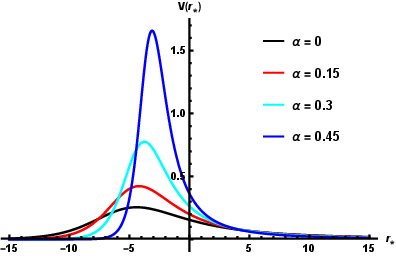
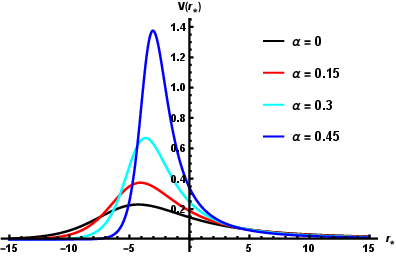
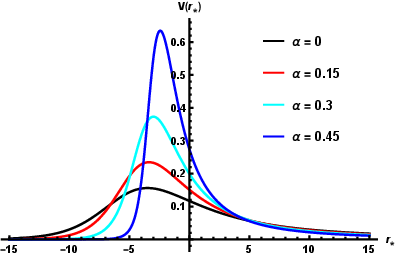
Figure 6: Effective potential profiles for different perturbation spins manifest the impact of f(r)5 on mode trapping and transmission.
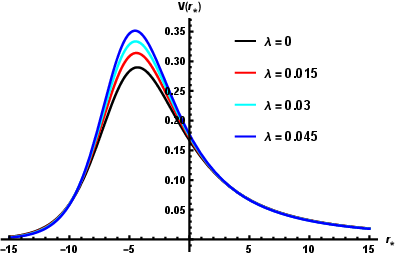
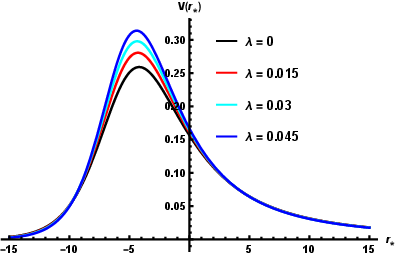
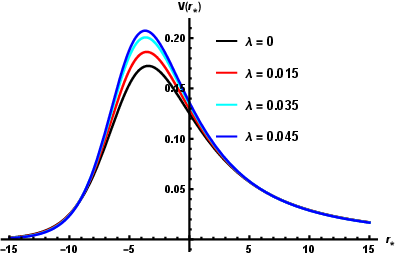
Figure 7: Increasing f(r)6 elevates barrier height and sharpens confinement of the perturbation field.
For each spin, the real and imaginary parts of the QNM frequencies (f(r)7) are computed via both 6th-order WKB and time-domain (Prony) methods. As f(r)8 or f(r)9 increases, both α0 and α1 grow, signifying more rapid oscillations and faster ringdown decay. Notably, scalar modes have the largest α2 and the fastest decay, while axial gravitational modes are the slowest to damp.
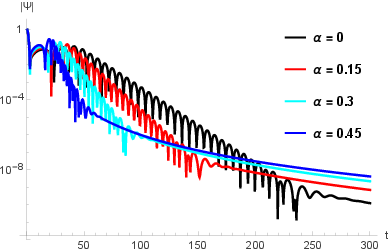
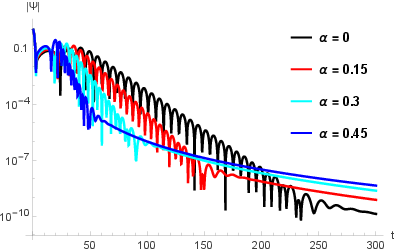
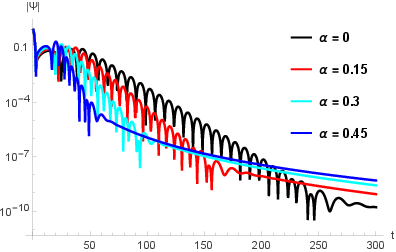
Figure 8: Time-domain profiles highlight differential damping behaviors across field spins for fixed α3.
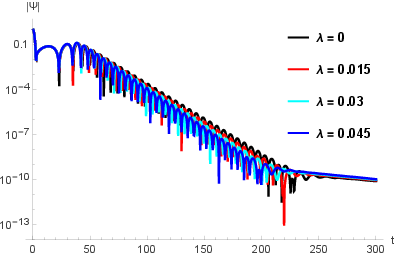
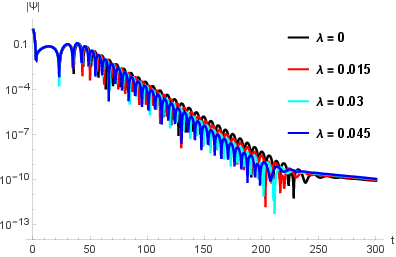
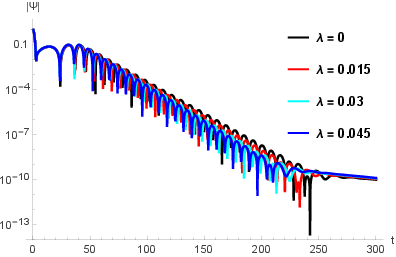
Figure 9: Variations in ringdown persistence and frequency with increasing α4 are directly visible in the time-evolution data.
At high-α5 (eikonal) limit, the QNM frequencies align with the orbital frequency and instability exponent of the photon sphere, demonstrating a direct correspondence between optical and dynamical signatures, with decreasing relative error as α6. This provides a robust theoretical link relevant to multi-messenger astrophysical tests.
Implications and Future Directions
The results establish that modifications from Kalb–Ramond fields and PFDM yield measurable shifts in both optical and gravitational-wave signatures around black holes. Observed shadow size, photon ring location, peak disk emission, and QNM spectrum are all systematically reduced and tightened with increasing Lorentz-violation or dark-matter background. This has two direct implications:
- Observational constraints: Precise VLBI imaging and ringdown spectroscopy can jointly constrain α7 in real astrophysical scenarios, distinguishing modified gravity and exotic matter models.
- Model discrimination: Departure from the standard Kerr paradigm in horizon-scale and GW data—especially when multi-modal QNM spectra are available—can be used to test the presence of nontrivial Lorentz violation and/or dark matter halos.
Theoretical extensions may involve inclusion of black hole spin, non-spherical accretion, or polarized/mixed perturbation analysis. Further, non-eikonal QNM modes and the regime of strong gravitational lensing with plasma or magnetic fields require detailed study for direct application to upcoming observational campaigns.
Conclusion
This investigation clarifies how the combined effects of a Kalb–Ramond field and perfect fluid dark matter alter the optical structures and dynamical ringdown signals of black holes. The explicit connection between deformation parameters α8 and both multimodal observational features provides a concrete avenue for future constraints and theoretical exploration in both electromagnetic and gravitational wave observations. The parametric trends identified herein will be critical for assessing alternative gravitational phenomenology in astrophysical tests across the next generation of observational platforms.

