- The paper proposes a novel MPAS framework that hierarchically synthesizes realistic 3D defects using 1D, 2D, and 3D geometric primitives.
- It employs multimodal MLLM-driven instruction parsing and spatial-distribution normalization to enhance training robustness and physical plausibility.
- The system achieves state-of-the-art performance on multiple datasets, demonstrating its industrial relevance and scalability for defect detection.
Synthesis4AD: Synthetic Anomalies for Robust 3D Anomaly Detection
Introduction
"Synthesis4AD: Synthetic Anomalies are All You Need for 3D Anomaly Detection" (2604.04658) presents a comprehensive framework for addressing the scarcity and uneven distribution of abnormal samples in industrial 3D anomaly detection. Synthesis4AD combines high-fidelity synthetic anomaly generation, multimodal instruction parsing via MLLMs, and a robust training and inference pipeline based on Point Transformer architectures. The core contribution lies in the MPAS (Multi-dimensional Primitive-Guided Anomaly Synthesis) framework, which models realistic 3D defects using a hierarchy of geometric primitives, and the integration of a scalable system (Synthesis4AD) that leverages this capacity for practical industrial deployment.
System Architecture
Synthesis4AD is structured as a pipeline with three stages: knowledge-driven synthetic anomaly generation, detector training, and online inference. The system is encapsulated via 3D-DefectStudio and an MLLM parser that interprets product-side knowledge—including textual specifications, expert priors, and visual cues—into executable instructions for defect synthesis.
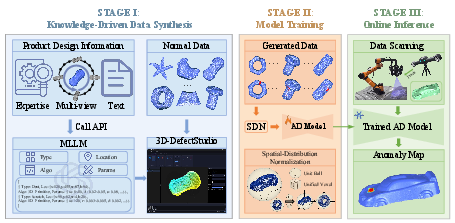
Figure 2: Three-stage Synthesis4AD pipeline, integrating MLLM-driven instruction parsing, 3D anomaly injection, task-specific detector training, and prototype-based online inference.
MPAS: Multi-dimensional Primitive-Guided Anomaly Synthesis
A central limitation of previous defect synthesis for 3D point clouds is the reliance on simplistic geometric operators (e.g., spheres, lines) which produce toy-level, physically implausible anomalies. MPAS overcomes this by introducing a hierarchical support mechanism based on 1D, 2D, and 3D primitives:
- MPAS-1D: Synthesizes point/line-based anomalies such as scratches or grooves using geodesic path expansion and distance-weighted displacement fields.
- MPAS-2D: Employs planar supports to induce bending or fractures, aligning deformation with realistic mechanical failure modes through intersection band extraction, hinge axis estimation (via PCA), and region-specific transformations.
- MPAS-3D: Enables free-form, volumetric defects by defining convex hull-based surface supports and superimposing parametric Gaussian displacement fields with local surface smoothing, allowing simulation of compound and irregular industrial damage.
The MPAS hierarchy thus subsumes lower-dimensional defect generation, offering significant expressiveness and improved structural realism. Importantly, all modules generate accurate point-wise anomaly masks, facilitating supervised representation learning.
MLLM-driven Synthesis Automation and Validation
To address the complexity of translating product engineering knowledge into geometric defect configurations, Synthesis4AD utilizes an MLLM to convert multimodal input (e.g., textual descriptions, images, expert annotations) into structured synthesis instructions. A validation module ensures physical plausibility and adaptiveness to target point clouds, guaranteeing the execution of only meaningful anomaly patterns.
Representation Learning and Training Pipeline
Supervision is achieved by training a Point Transformer on the paired synthetic anomalies and ground-truth masks. Synthesis4AD introduces two critical regularization strategies:
- Spatial-Distribution Normalization (SDN): Category-wise canonicalization and voxel downsampling to address cross-category scale/statistics variability and ensure stable optimization.
- Geometry-faithful Augmentations: Random rotations, Gaussian noise injection, and point dropout simulate real-world variances in pose and sensor artifacts.
These augmentations crucially enhance the generalization and robustness of the learned representations, making the system suitable for complex, unstructured industrial data.
Online Inference via Prototype Matching
During deployment, the encoder operates in a one-class, unsupervised anomaly detection regime. Prototype vectors, computed from normal data in the training distribution, form the reference manifold in the learned feature space. Each test sample is mapped to this space, and both point-level and object-level anomaly scores are determined by feature deviations from prototypes. This ensures robust and interpretable localization and quantification of defects.
Experimental Results
Extensive evaluation is conducted on public 3D anomaly detection datasets (Real3D-AD, MulSen-AD) and a challenging real-world industrial part dataset. Synthesis4AD consistently achieves state-of-the-art results in both object-level detection (O-ROC) and fine-grained point-wise localization (P-ROC), surpassing previous methods—including those based on memory banks, 2.5D projections, and prior forms of anomaly synthesis—by substantial margins.
- On Real3D-AD: Synthesis4AD reaches 80.9% O-ROC and 84.8% P-ROC mean scores, with nearly perfect detection on multiple categories.
- On MulSen-AD: Achieves 89.6% O-ROC and 72.0% P-ROC mean scores, outperforming second-best methods by >3-7% depending on metric.
- On collected real industrial scans, Synthesis4AD yields 95.9%/73.8% (O-ROC/P-ROC) mean performance—a significant improvement over the best alternative baseline.
Further, ablation shows that each axis of contribution (MPAS-3D synthesis, SDN, augmentation) is indispensable. Performance rises monotonically with increased diversity and scale of synthesized anomalies.
Feature and Prediction Visualization
The feature distributions induced by Synthesis4AD exhibit tighter alignment between synthetic and real anomaly clusters, while offering improved separation from the normal manifold, compared to MC3D-AD and GLFM.
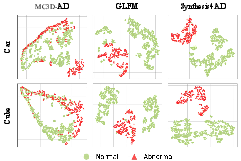
Figure 4: Feature space visualization comparing MC3D-AD, GLFM, and Synthesis4AD outputs, all using identical PointMAE backbones.
Synthesis4AD also delivers sharper, mask-correlated heatmaps in industrial part test cases, reducing false positives and accurately localizing subtle structural defects.
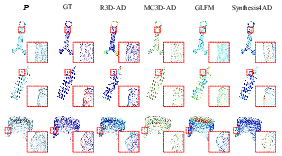
Figure 1: Model prediction visualizations on a real-world scan; Synthesis4AD localizes anomalies more precisely and minimizes spurious activations compared to baselines.
Implications and Future Directions
Synthesis4AD demonstrates that large-scale, realistic synthetic anomalies are sufficient for robust, generalizable 3D anomaly detection if coupled with proper regularization and task-driven training. This has immediate industrial inspection relevance, where abnormal data rarely covers the long tail of real defects or must be simulated for rare classes.
The core design—combining cognitive-level MLLM parsing, flexible geometric synthesis, and prototype-based detection—transcends rule-based or adversarial data augmentation, offering a blueprint for future research in closed-loop, feedback-driven synthetic supervision (where generation is guided by downstream detection gaps).
Remaining gaps include end-to-end closed-loop optimization between synthesis and detector learning, and deeper modeling of material- and process-dependent defect modes.
Conclusion
Synthesis4AD establishes a high-fidelity, scalable paradigm for 3D anomaly detection, addressing the training data bottleneck through physically meaningful, MLLM-guided synthetic supervision, and an effective representation learning pipeline. It achieves strong empirical results and provides a modular, extensible platform for industrial shape-based anomaly analysis and points toward a new direction in combinatorial, knowledge-driven defect simulation and detection.

