- The paper introduces a dismagicker, a non-Clifford unitary that minimizes the stabilizer Rényi entropy (M2) in many-body quantum states.
- It employs an interleaved optimization that combines dismagicker sweeps with Clifford disentanglers to simultaneously suppress non-stabilizerness and entanglement entropy.
- The framework advances classical simulation and quantum state preparation, as demonstrated by results on random states and a 1D Heisenberg chain.
Dismagicker: A Framework for Active Non-Stabilizerness Reduction in Quantum Many-Body States
Introduction and Theoretical Motivation
Entanglement and non-stabilizerness ("magic") constitute distinct quantum resources underpinning both the complexity of many-body quantum states and the boundary of classical simulability. Conventional approaches in tensor network algorithms, especially in the context of Matrix Product States (MPS) and Multi-scale Entanglement Renormalization Ansatz (MERA), leverage disentanglers—Clifford unitary circuits that systematically minimize entanglement entropy—to enable efficient classical representations and manipulations. However, the Gottesman-Knill theorem reveals a profound limitation: pure entanglement control, even at a volume-law level, does not necessarily render a state classically intractable and cannot capture quantum computational advantage. The key missing resource is non-stabilizerness, which quantifies the deviation from the Clifford-stabilizer polytope and delineates the classical-quantum computational boundary [Veitch_2014; howard2014contextuality; Bravyi2019simulationofquantum].
"Dismagicker" introduces a new operational primitive: a non-Clifford unitary designed explicitly to reduce the non-stabilizerness (as measured by the stabilizer Rényi entropy, M2) of a quantum many-body state. This concept structurally mirrors the disentangler for entanglement but targets magic suppression. The framework developed targets both theoretical and practical bottlenecks encountered in classical and hybrid quantum-classical simulation paradigms, enabling advanced resource management for classical simulation advantage and quantum state preparation.
Dismagicker Framework: Algorithmic Construction and Interleaved Optimization
The construction of the dismagicker is embedded within an MPS variational framework. At each step:
- A local two-site tensor is targeted.
- A parametric non-Clifford unitary (the dismagicker) is optimized via direct minimization of M2, efficiently evaluated using the Pauli operator basis and perfect sampling methods.
- A subsequent local Clifford circuit acts as a disentangler to minimize entanglement entropy (EE), exploiting the fact that Clifford circuits preserve non-stabilizerness.
- Each sweep interleaves both steps, systematically suppressing both quantum resources, updating the MPS tensors via SVD.
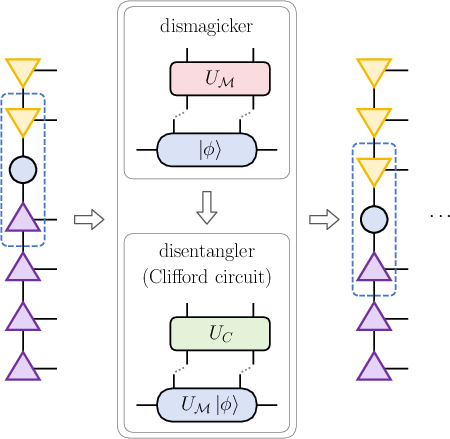
Figure 1: Schematic of the interleaved optimization flow of dismagicker and Clifford disentangler on an MPS. Each sweep first applies non-stabilizerness reduction followed by entanglement suppression on two-site blocks.
The optimization of the dismagicker employs either deterministic minimization (for small systems) or a variational sampling strategy over Clifford-plus-single-qubit rotation gate sets (for larger systems). The critical distinction from traditional entanglement-minimization is that dismagicker operations alone need not reduce EE and can even leave it invariant or increase it; hence, synergy with Clifford disentanglers is essential.
Numerical Results: Random Many-Body States and Physical Hamiltonians
Random 6-Qubit States
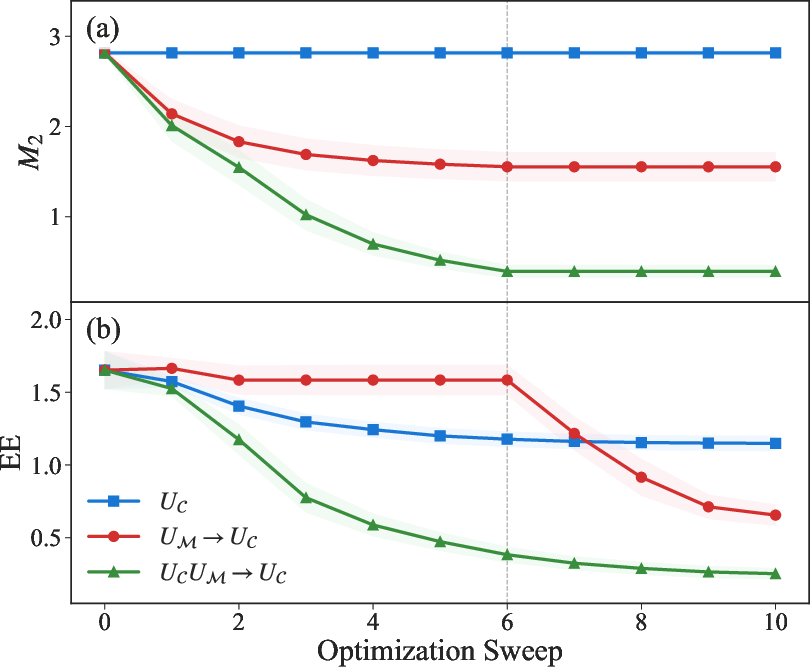
To probe efficacy, random states with both large EE and M2 are prepared via composition of depth-6 Clifford circuits followed by non-Clifford random unitaries. Three protocols are contrasted:
Strong numerical suppression of M2 is achievable; however, optimizing only for M2 can plateau due to persistent entanglement, while naive alternating strategies do not synergize both reductions efficiently. The interleaved protocol achieves a deeper, joint suppression than purely sequential composition. Notably, perfect annihilation of M2 (return to the stabilizer polytope) is in general not achieved, reflecting the inherent geometric complexity of the set of non-Clifford resource states.
Many-Body Hamiltonian: 1D Heisenberg Chain
The protocol is further benchmarked on the ground state of the 1D Heisenberg chain with L=20 sites. Starting from a DMRG-prepared MPS with limited bond dimension, the protocol applies joint local dismagicker and Clifford disentangler sweeps, with each dismagicker unitary sampled from a random Clifford plus single-qubit rotation ensemble.
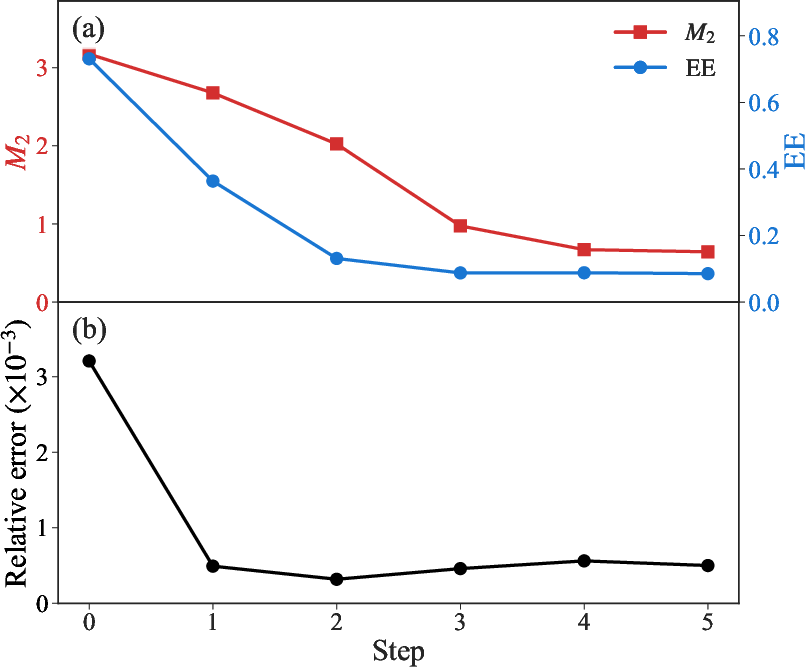
Figure 3: Joint optimization for the Heisenberg chain, L=20. Left: Evolution of M20 and EE versus sweeps. Right: Rapid reduction of ground-state energy error upon optimization, outperforming bare DMRG.
The result is a simultaneous reduction in both M21 and EE, and a substantial improvement in the accuracy of the energy estimation from the fixed-bond-dimension MPS. The transformation effectively rotates the physical Hamiltonian and state into a basis more amenable to efficient MPS representation. Attempts to incorporate the dismagicker optimization into the standard DMRG sweep (à la CAMPS [qian2024augmentingdensitymatrixrenormalization]) were less effective; the authors attribute this to a structural conflict between entanglement-based truncation and M22 minimization, with the former potentially disrupting the non-stabilizerness-reducing trajectory.
Implications and Connections to Broader Quantum Resource Theory
The dismagicker formalism resolves a hitherto unaddressed gap in the quantum resource theory framework for many-body simulation: the lack of an active, variational tool for direct M23 reduction. By unifying the operational control of both entanglement and non-stabilizerness in tensor network algorithms, this technique enables several downstream applications:
- Improved classical simulation: States with lower M24 content are closer to the stabilizer polytope, benefiting from low stabilizer rank decompositions and improved classical simulability even for large EE.
- Efficient quantum state preparation: Disentangling both entanglement and magic reduces the quantum circuit depth and non-Clifford resource overhead for state initialization, crucial for pre-fault-tolerance quantum computational schemes.
- Resource theory development: The operational definition and explicit construction of M25 gates opens avenues for studying the geometric structure of the resource manifold (Clifford orbits, stabilizer polytope boundary, etc.).
The formalism also sheds light on fundamental questions regarding the independence of entanglement and non-stabilizerness. For instance, the authors highlight product states possessing maximal M26 but zero entanglement, and GHZ states manifesting maximal entanglement but vanishing M27.
Future Directions and Theoretical Prospects
Several principal lines of future inquiry are highlighted:
- Efficient Proxies/Measures: Alternative or local proxies for M28, or other monotonic measures of non-stabilizerness [Haug2023stabilizerentropies, PhysRevLett.128.050402], may allow for scalable dismagicker optimization in larger systems.
- Extension Beyond MPS: Generalization of the dismagicker concept to PEPS, tree tensor networks, or fermionic matchgate systems is of significant interest, as Clifford and Gaussianity-preserving operations are already central in these frameworks [2026-0062].
- Dynamical Problems: Application of dismagicker optimization during real-time dynamics, where both EE and M29 grow rapidly and limit classical simulation, constitutes a critical problem domain [PhysRevLett.134.150404, PhysRevLett.134.150403].
- Optimization Landscapes: Understanding the geometry of M20 minimization and potential existence of local minima or geometric obstructions in magic reduction.
- Quantum-Classical Hybrid Algorithms: Embedding dismagicker protocols within low-depth quantum-classical hybrid loops or variational quantum eigensolvers for state preparation and quantum chemistry.
Conclusion
This work establishes the dismagicker as a fundamental operational primitive for non-stabilizerness reduction in quantum many-body systems, with broad relevance for classical-quantum simulation efficiency, quantum state engineering, and quantum resource theory. By explicitly constructing variational non-Clifford gates for M21 minimization and synergizing them with entanglement-reducing Clifford circuits, this framework realizes a unified approach to the manipulation of the key quantum resources blocking classical tractability. The results suggest that systematic non-stabilizerness control will be integral to future advances in both algorithmic tensor network methods and resource-efficient quantum simulation (2604.04046).