- The paper presents a comprehensive scientometric analysis of 15 years of Augmented Humans research, charting evolving methodologies and thematic shifts.
- It employs mixed methods including citation network analysis and transformer-based topic modeling to track the transition from traditional wearables to haptics and embodied interactions.
- Findings highlight geographic and author dominance—particularly by Japanese HCI researchers—and emphasize challenges in theory building, inclusiveness, and ethical frameworks.
Fifteen Years of Augmented Humans Research: A Comprehensive Scientometric Analysis
Introduction and Field Definition
"15 Years of Augmented Human(s) Research: Where Do We Stand?" (2604.03715) delivers a large-scale scientometric dissection of the Augmented Human(s) conference (AH/AHs), systematically charting the formation and thematic evolution of this specialized HCI field over 15 years (2010–2025). The study positions Augmented Humans (AH) as research dedicated to restoring or extending physical, cognitive, affective, sensory, and social capabilities via technology, firmly situating the field apart from philosophical transhumanism and focusing on empirical system development: sensors, on/near-body wearables, implants, BCI, prosthetics, exoskeletons, AR/VR, and haptic/tactile interfaces.
Definitional ambiguity remains core—Augmented Humans research overlaps with adjacent concepts (HA, AR, transhumanism), lacking sharp boundaries. This ambiguity is mirrored in the corpus's topical diversity, ranging from interface and wearable system design to social, ethical, and philosophical analyses.
Corpus and Methodological Rigor
A corpus of 787 papers from all AH/AHs conference proceedings (2010–2025) constitutes the basis for mixed-methods bibliometric and topic modeling analyses. The methodology includes:
- Citation network analysis (internal and external referent papers, venue influence)
- Bibliometric geolocation and author productivity analysis
- Transformer-based topic modeling (BERTopic with all-MiniLM-L6-v2, UMAP/HDBSCAN for dimensional reduction/clustering, tuned with domain stop-word filtering and MMR-based topic word selection)
- Longitudinal topic prevalence tracking
- Temporal shift analysis (pre- and post-2020 AH/AHs organizational split)
Data is exhaustively normalized/reconciled across sources (ACM, Crossref, Semantic Scholar).
Macro Trends: Growth, Authorship, and Geographic Distribution
The publication count demonstrates a bimodal distribution, peaking in 2015 and again in 2025, with interleaved stagnation periods reflective of field reorganization and venue split-to-journal transition. The AH/AHs conference has historically been Eurocentric in location but is dominated by Japanese HCI researchers in terms of contribution—12 of the top 15 most prolific authors are affiliated with Japanese institutions.
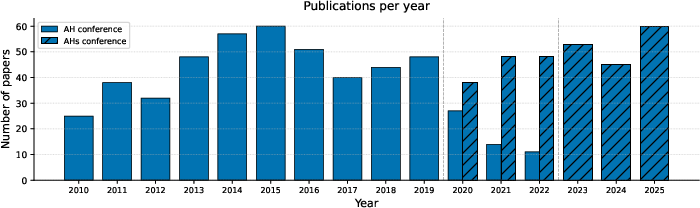
Figure 1: Annual AH/AHs paper count highlighting key peaks and transitions driven by conference format evolution and organizational splitting.
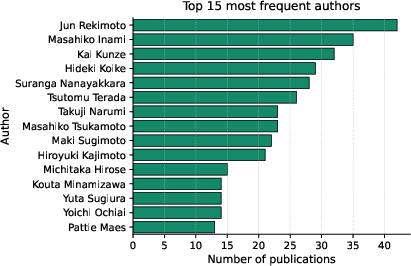
Figure 2: The top 15 most frequent authors, illustrating the concentration of contributions within a core Japanese HCI contingent.
Topical Landscape and Evolution
Topic modeling reveals five dominant research foci:
- Haptics: Haptic feedback, wearables, tactile electrical stimulation (emergent dominance post-2016)
- Wearable Interaction: Wearable input, sensing, activity recognition (early field driver)
- Vision & Eye Tracking: Gaze-based/visual interfaces, eye tracking, visual feedback (steady, then declining)
- Embodied Interaction: Virtual embodiment, robot embodiment, full-body interaction
- Sports/Motion: Augmented sports, physical exertion, real-time feedback
Temporal analysis shows a clear thematic drift from wearable interaction and eye tracking (pre-2016) to haptics and embodied interaction (2017–present), coinciding with advances in actuator and VR technology and a proliferation of haptics and embodiment studies.
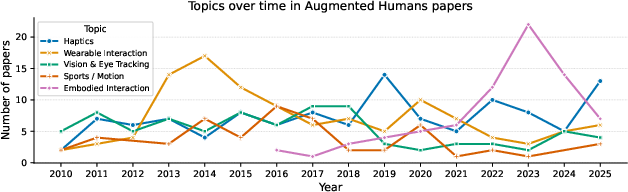
Figure 3: Topic prevalence shifts illustrating the decline of early Wearable Interaction and Vision topics, with recent surges in Haptics and Embodied Interaction.
The corpus word cloud further confirms dominance of these themes in the abstracts.
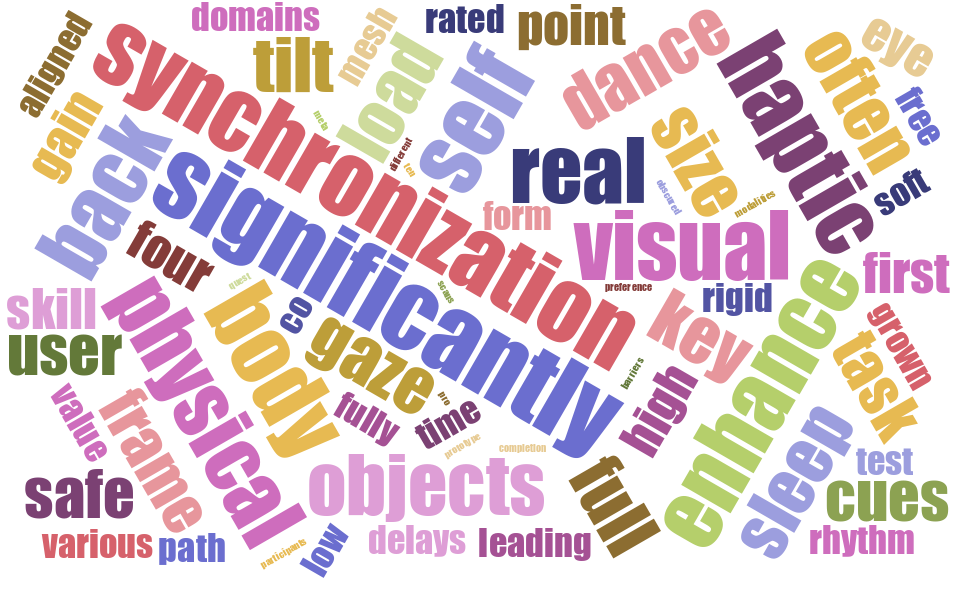
Figure 4: A word cloud (N=733) visualizing salient terms and confirming topic centrality.
Citation and Intellectual Structure
Citation analysis demonstrates a strong dependence on, and influence over, ACM CHI and UIST. The most cited works by AH(s) are typically published outside of AH(s), underscoring the prestige and centrality of traditional HCI venues (CHI, UIST) for canonical demonstrations and methods in the research area.
- Only 1 of the 10 most cited papers within AH(s) originates from the conference itself; others are CHI/UIST publications (e.g., PossessedHand, Skinput, OmniTouch).
- Top AH(s) papers by external citation impact focus on activity recognition, multimodal input, and XR, with activity recognition via wearables constituting the most cited contributions.
Bidirectional venue flow is asymmetric: while AH(s) draws intellectual foundations primarily from CHI/UIST, it receives a heterogenous influx of citations from a wide array of venues, with strongest external impact again on CHI, UIST, and to an extent, VR/XR and ubiquitous computing venues.
Field Core and Thematic Coherence
While topic and citation dispersion suggest some fragmentation, the conference has accumulated a recognizable core orientation: systematic exploration of human-machine integration within the sensorimotor loop to augment and expand human action/perception. Representative advances include:
- Parallel/co-embodiment systems (multiple body schemas)
- Haptic collaboration in remote/telepresence
- Sensory amplification or diminishment tech (altered or diminished reality)
- On-skin/eye-tracking input innovations
The field thus operationalizes augmentation with an emphasis on bodiliness, user agency, and augmentation of "natural" capacities, rather than solely environmental or device interaction.
Theoretical and Practical Implications
The findings indicate persistent definitional ambiguity but demonstrate a progressive shift toward experimental, agency-centric, body-integrative paradigms, leveraging advancements in actuators, perception sensors, VR, and machine intelligence.
- The lack of a singular intellectual core, as observed in HCI at large [see "The big hole in HCI research" and follow-on meta-analyses], persists, yet the field's clear orientation towards embodied, sensorimotor augmentation distinguishes it from broader HCI fragmentation dynamics.
- Methodological challenges in cumulative theory-building (e.g., prototype and case-study reliance, difficulty with longitudinal/wild studies) could be alleviated by more rigorous open-science and multi-site comparisons.
- The growing intersection with AI-mediated augmentation raises unresolved issues regarding agency distribution, autonomy, and ethical responsibility in shared-control and predictive/adaptive augmentation systems.
- There is an explicit need to balance research focusing on “supernormal” enhancement with robust engagement of assistive and accessibility technology communities, addressing inclusion and the social stratification risks of augmentation.
Limitations
By concentrating solely on the AH/AHs conference and not covering broader journals or philosophical (transhumanist) publications, the analysis is inherently limited and potentially biased toward “accepted” trajectories. Non-inclusion of the Augmented Human Research journal and potential survivorship bias must be factored when generalizing the conclusions.
Conclusion
The extensive scientometric mapping in this analysis demonstrates the broadening and deepening of Augmented Humans research as a sub-field—highlighting persistent definitional instability, evolving topical foci, trans-continental authorial dominance, and complex citation ecologies. The AH(s) conference, while sharing structural challenges with broader HCI, contributes a distinct, agency-mediated, body-focused augmentation agenda. Future trajectories should prioritize theoretical clarification, cumulative empirical practice, societal inclusion, and ethical frameworks as integration between human and machine becomes more pervasive.
(2604.03715)

