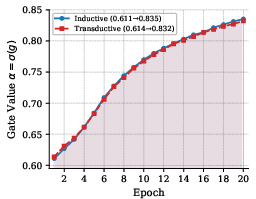
- The paper's main contribution is the development of AlertStar, an embedding-based model that fuses qualifier context with path features to predict network alerts.
- It employs multi-head attention and a trainable sigmoid gate to integrate cross-attention and feed-forward branches, achieving superior performance in MRR and Hits@k.
- The framework supports complex query answering and scalable threat detection, offering actionable insights for SOC and CERT deployments.
Path-Aware Hyper-Relational Alert Prediction in Knowledge Graphs: An Authoritative Analysis of "AlertStar"
The paper addresses a critical gap in network intrusion detection: the lack of semantic depth and inductive reasoning over attacker-victim interactions in conventional alert-based defenses. Standard intrusion detection systems generate overwhelming volumes of alerts, but Advanced Persistent Threats decompose campaigns into low-priority alerts distributed across hosts and time, evading isolated analysis. The core challenge is path-aware alert prediction: given observed alert history, infer future attack targets, types, and propagation paths.
Existing relational knowledge graph approaches represent events as binary triples (h,r,t) but fail to capture distinguishing alert metadata (timestamps, ports, protocols, intensities). Hyper-relational knowledge graphs (HR-KGs) overcome this by encoding each alert as a qualified statement (h,r,t,Q), incorporating a variable set of per-edge qualifiers Q. The prediction task thus becomes a hyper-relational knowledge graph completion (HR-KGC) problem: for given (h,r,?,Q), rank candidate targets, possibly including unseen IPs at inference time (inductive regime), using contextual qualifiers.
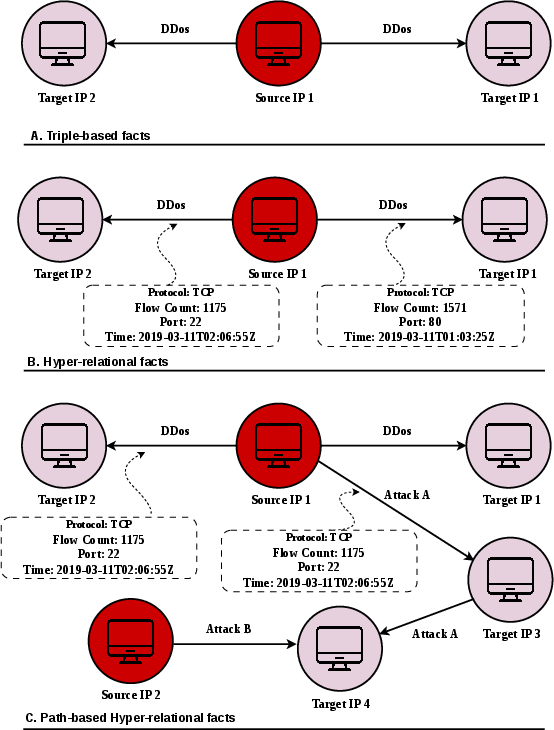
Figure 1: Three representational levels: (A) triple-based facts, (B) hyper-relational facts, (C) path-based hyper-relational reasoning.
Methodological Framework
Overview of Paradigms and Models
The paper systematically investigates three methodological paradigms for HR-KGC on alert data:
- Graph Propagation: Extending Neural Bellman-Ford Networks (NBFNet) to hyper-relational graphs (HR-NBFNet) with qualifier-aware message passing and a multi-task variant (MT-HR-NBFNet) incorporating joint tail, relation, and qualifier-value supervision.
- Embedding-Based Fusion: The core contribution—AlertStar—fuses qualifier context and structural path features within embedding space using multi-head cross-attention and feed-forward path-composition, mediated by a trainable gate. MT-AlertStar further adds multi-task objectives, all within a Transformer backbone.
- Complex Query Answering: HR-NBFNet-CQ extends qualifier-aware NBFNet to answer diverse first-order logic queries (1-hop, 2-hop, intersection, union), enabling compositional path-based threat reasoning.
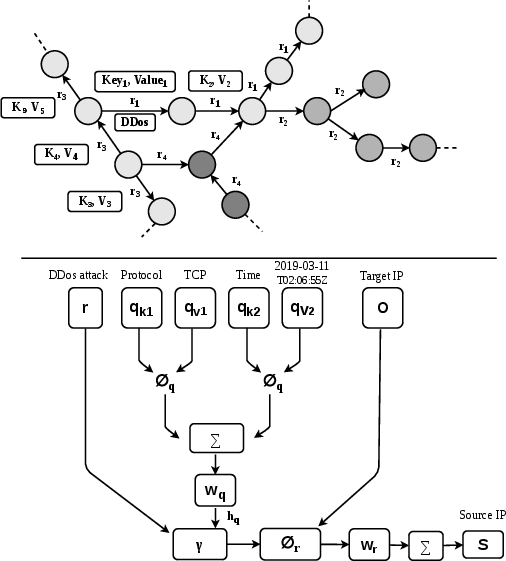
Figure 2: HR-NBFNet combines StarE qualifier encoding with Bellman-Ford propagation, injects flow-level context at every message-passing step, and enables bidirectional reasoning.
Detailed Model Architectures
AlertStar receives a triple (h,r,Q) and aggregates all qualifier key-value pairs into a qualifier context matrix UQ. Through multi-head attention, it produces a qualifier-enriched relation embedding e~r, which is combined via two branches:
- Cross-attention with the head entity
- Feed-forward path-composition with residuals
A trainable sigmoid-gated scalar α=σ(g) adaptively fuses the two representations before taking a dot product with each candidate tail embedding.
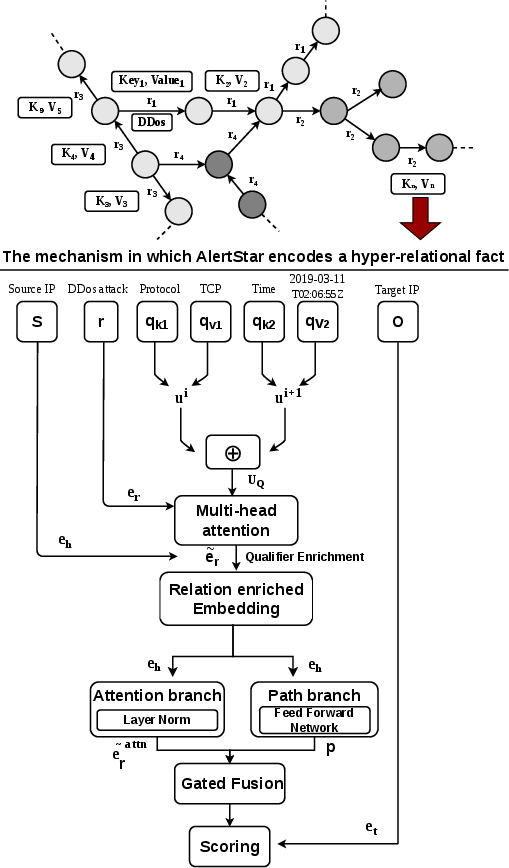
Figure 3: Architecture of AlertStar. Qualifier pairs are aggregated and attended to in embedding space, with path and attention branches fused via a learned gate.
MT-AlertStar processes the masked entity/relation/qualifier sequence with a multi-layer Transformer. Its relation-token output acts as shared context for three MLP heads: tail prediction, relation classification, and qualifier-value classification. Task-specific masking ensures no target leakage during auxiliary prediction.
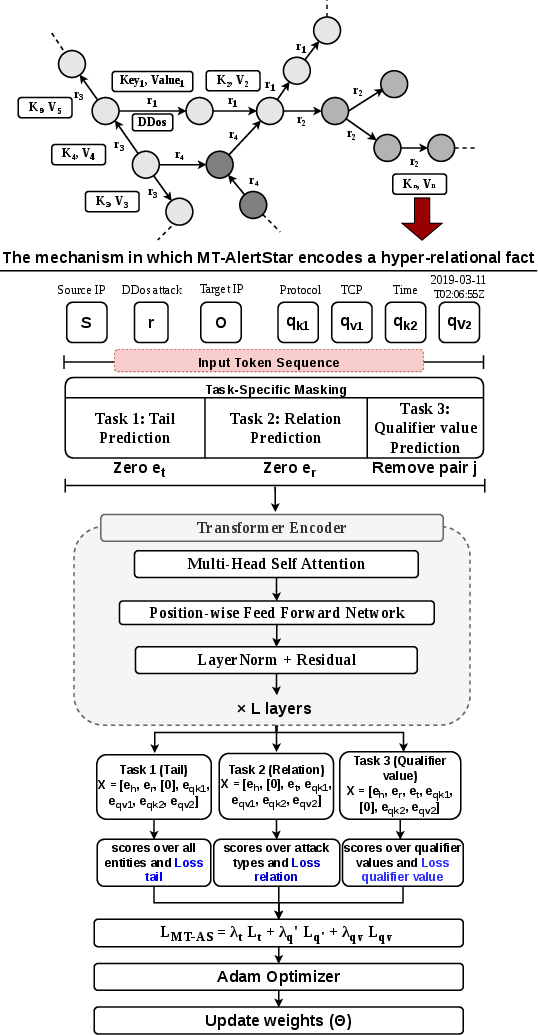
Figure 4: Architecture of MT-AlertStar. The masked token sequence is encoded by a Transformer; the relation-token output is shared across all prediction heads.
HR-NBFNet/MT-HR-NBFNet generalize Bellman-Ford path reasoning to HR-KGs by encoding qualifiers at every edge and in the source node initialization, propagating context through L layers, before MLP-based scoring. Multi-task heads exploit path-enriched representations for richer supervision.
Empirical Evaluation and Results
Experiments on the Warden and UNSW-NB15 alert datasets—benchmarked under three qualifier density regimes (33%, 66%, 100%) and both inductive/transductive protocols—demonstrate several critical findings:
Complex Query Generalization
Complex query answering is evaluated through HR-NBFNet-CQ and StarQE across 1p, 2p, 2i, and 2u query patterns, with HR-NBFNet-CQ specifically excelling on intersection queries—which are operationally critical for coordinated attack detection—while 2-hop chains remain challenging, especially at low qualifier coverage.
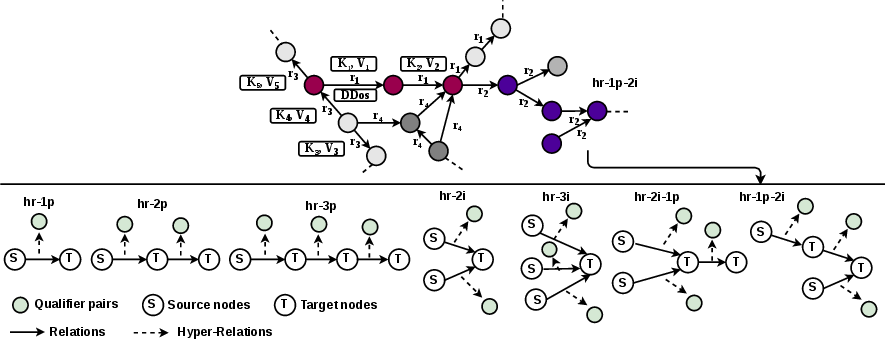
Figure 6: Hyper-relational query templates; qualifiers per edge are arbitrarily variable, supporting rich multi-path and intersectional queries.
Implications and Future Research
Theoretical Implications
The findings refute the assumption that explicit path-based message passing is superior in all inductive HR-KG settings. For dense and context-rich alert graphs, embedding-based fusion with qualifier-aware attention suffices for strong generalisation and efficiency, challenging canonical KGC orthodoxy. The results further establish qualifier context—not just global topology—as the dominant signal for alert prediction in complex domains.
Practical Implications
These results directly inform real-world Security Operations Centers (SOC) and CERT deployments: embedding-based HR-KGC approaches are simultaneously more accurate and scalable for alert prediction than path-propagating models, particularly when context metadata is densely annotated. The framework natively enables generalization to unseen entities (e.g., unobserved IPs), critical for operational applicability.
Research Directions
Future work could:
- Integrate temporal ordering of alerts as an explicit qualifier, permitting time-aware reasoning about sequential attack steps.
- Extend to open-set (zero-shot) taxonomy generalization by meta-learning over qualifier context and host behaviors.
- Hybridize embedding-based ranking (AlertStar) with graph-propagation verification for complex queries.
- Evaluate at scale on operational alert streams for robustness, latency, and actionable CERT analytics.
Conclusion
This study establishes a comprehensive, principled, and empirically validated HR-KGC framework for proactive, path-aware alert prediction in network security. Embedding-based models—specifically MT-AlertStar—deliver state-of-the-art prediction under both inductive and transductive assumptions, robust to qualifier density, and computationally efficient. The extension to complex query answering demonstrates operationally meaningful compositional reasoning, and ablation studies dissect the architectural choices underpinning robustness. These contributions mark a significant advance in the intersection of hyper-relational representation learning and cybersecurity analytics, setting a rigorous foundation for both practical deployment and future research in AI-driven threat intelligence.