- The paper demonstrates that ultra-collinear contributions cancel at all orders by gauge invariance, preserving the standard SCETII factorization in massive form factors.
- It employs a systematic effective field theory cascade with explicit loop calculations and Ward identities to unravel multi-loop cancellations.
- The work also establishes a framework for resumming massive logarithms using rapidity regulators, enhancing precision in collider phenomenology.
Introduction and Motivation
This work establishes the treatment and ultimate cancellation of ultra-collinear momentum regions in the on-shell massive Sudakov form factor, resolving long-standing questions in high-energy factorization analysis. The study leverages a systematic effective field theory (EFT) framework, demonstrating that despite the emergence of an infinite tower of ultra-collinear regions in diagrammatic expansion, their net contribution cancels at all orders due to gauge invariance. The standard leading-power SCETII factorization thus remains intact. The implications are profound for both precise phenomenology at colliders and theoretical understanding of factorization, massification (IR matching), and the enumeration of power-suppressed effects.
Theoretical Framework and EFT Cascade
The conventional method-of-regions analysis of high-energy amplitudes with massive external fermions identifies, beyond the hard, (anti-)collinear, and soft sectors, a hierarchy of ultra-collinear and ultra-soft regions with progressively lower virtuality, m2j+2/Q2j. In standard SCETII, modes below m2 can, in principle, connect collinear/anti-collinear sectors via "messenger" fields. The effective theory cascade involves matching from QCD onto SCETI, then onto SCETII at the mass scale, and finally onto a sequence of boosted HQETs (bHQETs) at vanishingly small virtualities.
(Figure 1)
Figure 1: Example of Ward identity cancellation at two loops. Ultraviolet and infrared structures are exhibited for specific momentum regions, demonstrating cancellation between diagrams in QCD and SCETII/bHQET.
(Figure 2)
Figure 2: Another two-loop Ward-identity cancellation, again highlighting the role of ultra-collinear regions and their decoupling after summing over graphs.
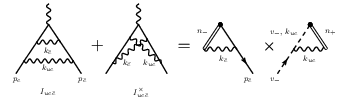
Figure 3: Two-loop example in the non-abelian case, showing analogous cancellation of the ultra-collinear sector as enforced by gauge invariance.
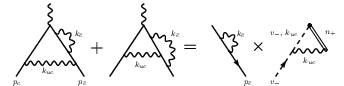
Figure 4: Three-loop example demonstrating integrand-level factorization and cancellation of ultra-collinear contributions across the EFT matching hierarchy.
A central outcome is the proof (by explicit computation and Ward identity arguments) that, on shell and with dimensional regularization, all ultra-collinear contributions are scaleless and their matching coefficients Zj are unity for j≥1. Consequently, the factorization formula,
F1(Q2,m2)=C(Q2,μ)Zc1/2(m2,μ,ν)Zcˉ1/2(m2,μ,ν)S(m2,μ,ν)+O(λ2),
remains unaltered at leading power. This result holds to all perturbative orders and for all multi-loop topologies, in both abelian and non-abelian gauge theories.
Rapidity Regularization and Resummation
The soft and (anti-)collinear functions in SCETm2j+2/Q2j0 exhibit rapidity divergences, requiring regularization. The authors adopt the m2j+2/Q2j1-rapidity regulator to compute the soft m2j+2/Q2j2 and jet m2j+2/Q2j3 functions through two loops, extracting all m2j+2/Q2j4 dependence. Results using this regulator facilitate systematic resummation via both m2j+2/Q2j5- and rapidity-RG evolution, extending NNLL accuracy for mass logarithms and capturing hierarchies of quark masses. For multiple quark flavors with widely separated masses, the formalism accommodates sequential EFT matchings at threshold scales, ensuring full control over flavor decoupling and the associated logarithmic structure.
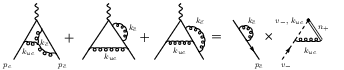
Figure 5: Non-vanishing two-loop graphs contributing to the soft function m2j+2/Q2j6 in the presence of massive fermion loops, underpinning the calculation of rapidity-divergent matrix elements.
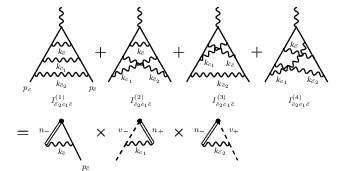
Figure 6: Leading non-vanishing loop graphs for the jet function, with massive fermion insertions, relevant for determining m2j+2/Q2j7 at two loops.
The renormalization program corresponds to minimal subtraction of all m2j+2/Q2j8 and m2j+2/Q2j9 poles, with anomalous dimensions for each function computed to NNLO. The sum of rapidity anomalous dimensions cancels between soft and jet functions, ensuring physical results for the form factor.
Explicit IR Regularization: Gauge-Boson Mass
Unlike dimensional regularization, physical IR regularizers such as a small gauge boson mass II0 render the ultra-collinear and ultra-soft modes dynamical—i.e., their matching coefficients become non-zero and dependent on II1. The factorization is now manifest at the amplitude level, and the appearance of II2 terms is systematically captured via the bHQET structure. For QED, the exponentiation of infrared divergences is seen to directly result from this factorization structure.
Implications for Massification and Multi-Scale QCD
A crucial application of these results is the precise linkage (“massification”) between the massive and massless form factors via an explicit factorization theorem:
II3
The universal II4-factor encodes all collinear/soft mass logarithms and is independent of the particular process under study. With the EFT/RG machinery in place, the resummation of these logarithms—including for processes with hierarchical fermion masses—proceeds unambiguously, and the definitions of the functions remain regulator- and scheme-consistent.
The extension to the scalar gluon form factor, where internal massive fermion loops structure the IR divergences, is described. The soft and jet functions are recalculated in the appropriate representation, and extractable anomalous dimensions are presented. The results clarify the separation between hard matching, collinear, soft, and low-energy jets in the presence of massive virtual quarks.
Conclusions
This work thoroughly establishes that ultra-collinear contributions to the on-shell Sudakov form factor in QCD cancel to all orders by gauge invariance. The leading-power SCETII5 factorization formula remains valid, and physical observables are free from ambiguities associated with the method-of-regions partitioning into ultra-collinear sectors. For practical calculations, the combination of the II6-rapidity regulator, explicit loop evaluations, and a hierarchical EFT cascade provides a complete framework for systematically organizing and resumming all mass and rapidity logarithms, including in multi-scale and multi-flavor settings.
Future development is anticipated in several directions: incorporating subleading power corrections, expanding to multi-jet amplitudes with complex color structure, and systematizing the treatment of endpoint singularities and "massification" at higher orders in complex processes.
- (Figure 1): Example of Ward identity cancellation at two loops.
- (Figure 2): Another two-loop example of Ward-identity cancellation.
- (Figure 3): Two-loop example of Ward-identity cancellation in a non-abelian gauge theory.
- (Figure 4): Three-loop example of Ward-identity cancellation.
- (Figure 5): Non-vanishing two-loop graphs contributing to the soft factor II7.
- (Figure 6): Leading non-vanishing loop graphs contributing to the jet function II8.
Reference:
"The Fate of Ultra-Collinear Modes in On-Shell Massive Sudakov Form Factors" (2604.02859)

