- The paper presents a comprehensive investigation of metalanguage in NLP by distinguishing natural from symbolic forms to improve linguistic interpretation.
- It employs methodologies such as grammar-guided prompts and benchmark evaluations to assess metalinguistic performance in translation and legal contexts.
- The research reveals LLM limitations in processing explicit metalinguistic information, underscoring the need for human oversight and improved model calibration.
The topic of metalanguage—the use of language to reflect on, describe, or analyze language itself—constitutes a vital area of inquiry in computational linguistics and NLP. "Speaking of Language: Reflections on Metalanguage Research in NLP" (2604.02645) provides a comprehensive perspective on the conceptual landscape of metalanguage, its application domains (from linguistics to education and law), and the challenges and opportunities it presents, especially in light of the growing prominence of LLMs.
The authors delineate the distinction between natural and symbolic metalanguage: natural metalanguage employs ordinary language for linguistic self-reflection, while symbolic metalanguage encompasses controlled, formal notations. Their argument is predicated on the observation that many critical real-world tasks—including language pedagogy, linguistic documentation, lexicography, and legal interpretation—demand nuanced processing and generation of metalanguage, underscoring its underexplored significance in NLP and LLM evaluation.
The study rationalizes the investigation of metalanguage within NLP from two principal perspectives. First, many scientific and applied disciplines rely on metalinguistic inquiry (e.g., producing pedagogical material, constructing dictionaries, or interpreting statutes). Building tools that can process, generate, or leverage metalanguage directly supports these workflows.
Second, modeling language understanding and linguistic meaning at a metalinguistic level aligns with the goals of theoretical and applied NLP. This involves both the extraction and formalization of linguistic rules and the interpretability of model behaviors vis-à-vis explicit linguistic constructs.
Applications and Task Settings
Learning and Generalization from Reference Grammars
The paper surveys work leveraging documentary linguistic resources—dictionaries and especially grammar books—for improving language technologies in low-resource settings. Results indicate that, for languages with minimal parallel data, integrating dictionary entries alongside full grammar books in LLM prompts yields translation scores (chrF++ 25–55) that approach the threshold of usability for translation tasks in languages such as Chuvash, Dogri, and Kalamang. These findings highlight the feasibility of grammar-guided approaches but are contradicted by subsequent research, which suggests that current LLMs may not reliably comprehend or utilize metalinguistic content in such resources. This fuels debate regarding the degree to which LLMs can synthesize and operationalize explicit grammar-like information ([tanzer2023mtob], [hus-anastasopoulos-2024-back], [aycock-etal-2025-iclr], [marmonier-etal-2025-explicit]).
Efforts to induce grammatical rules, lexical selection preferences, and morphotactic structures from raw text exemplify the generative use of metalanguage in NLP. These outputs directly inform both linguistic research and practical applications, such as instructional content for language teachers.
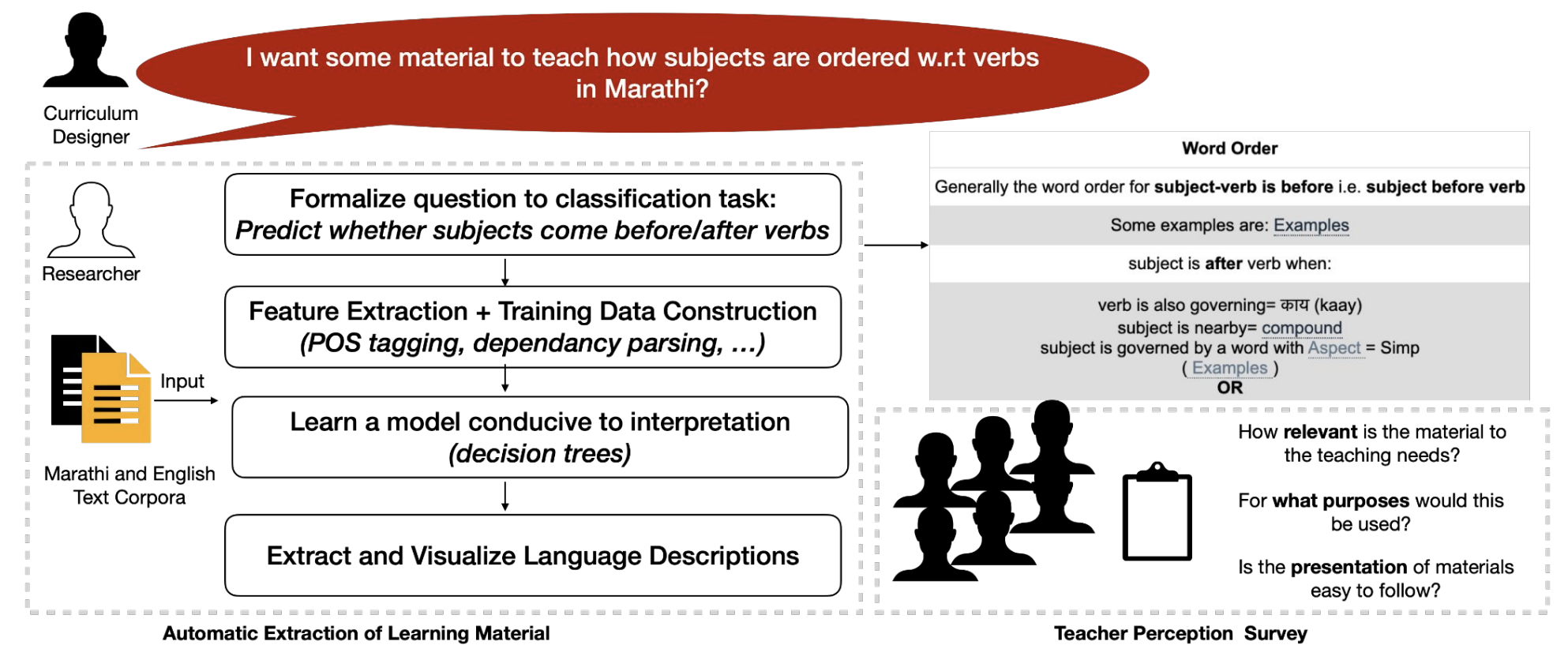
Figure 1: Workflow for the collaboration of NLP researchers and language-learning curriculum designers, to create pedagogical materials. The input, intermediate, and final outputs include metalanguage.
A crucial point is the limited progress in integrating LLMs into typologists' or field linguists' workflows, raising questions about the transferability of LLM metalinguistic capacities from curated benchmarks (e.g., PuzzLing Machines, LingOly) to real-world settings with ambiguous and incomplete data.
Benchmarking LLMs on authentic metalinguistic QA datasets, such as ELQA, reveals that while LLMs can generate fluent and often accurate answers to learners' metalinguistic questions, human-generated answers frequently exhibit higher accuracy. Moreover, the language in which prompts are posed significantly influences LLM performance, a finding that challenges the notion of inherent LLM multilingual robustness ([behzad-23], [behzad-etal-2024-ask]).
In legal interpretation, the question of whether LLMs can supplant or support human interpretive processes is empirically scrutinized. Despite claims made by judicial actors regarding LLMs’ potential for ordinary meaning analysis, the research finds instability and frequent misalignment between LLM outputs and human judgments. Larger models show reduced sensitivity to prompt format, but are not immune to implausible answers, indicating that LLMs are not (and should not be) viewed as authoritative arbiters in legal reasoning ([purushothama-25], [waldon-25-LLMs]).
The work systematizes metalanguage research along four axes:
- System-level vs. Instance-level: Whether the focus is on broad linguistic systems (grammatical generalizations, typological facts) or particular linguistic tokens/utterances.
- Monolingual vs. Multilingual: Application and evaluation in single vs. multiple language contexts, including second-language settings.
- Symbolic vs. Natural Metalanguage: The form of metalanguage—formal notation (e.g., trees, logic) versus ordinary language descriptions.
- Processing vs. Generation: Tasks involving understanding/input of metalanguage versus producing/externalizing metalinguistic content.
These dichotomies not only categorize existing work but also influence methodological choices, dataset construction, and evaluation paradigms.
Open Research Directions
The paper articulates a set of open problems which can be grouped into intrinsic evaluation, interpretability, and extrinsic application:
- Evaluation of LLM Metalinguistic Abilities: Benchmarks and tasks targeting linguistic structure prediction, self-referential language, mention/use distinction, pragmatic metalinguistic phenomena, and prompt-language dependencies.
- Model Interpretability: Calibration between a model’s explicit metalinguistic outputs and its internal generalizations, tracing metalinguistic phenomena to representational correlates, and dissecting the influence of metalinguistic supervision in training/inference.
- Applied Uses: Leveraging metalanguage for inductive biases, improved language documentation, educational tools, and the empirical study of metalanguage in domain-specific corpora (e.g., law).
Implications and Future Outlook
The recognition of metalanguage as a multifaceted and foundational aspect of advanced NLP tasks suggests that the future trajectory of LLM research should explicitly target improved calibration and alignment between internal linguistic representations and their overt metalinguistic articulations. Theoretical advances in how LLMs process, generate, and generalize from metalanguage could yield systems that not only perform better on traditional comprehension tasks but are also capable of explicit, accurate linguistic reasoning, benefiting linguistics, education, and law.
Moreover, the cautionary findings regarding LLMs' instability and prompt sensitivity in high-stakes domains reinforce the need for frameworks that combine LLM-driven generation with critical human oversight, especially in interpretive applications.
Conclusion
Metalanguage research bridges implicit linguistic competence and explicit knowledge representation, interfacing with both the theory and practice of NLP. The multidimensionality of metalinguistic phenomena demands refined benchmarks and methods. Progress in this direction will inform the design of next-generation NLP models with robust, interpretable, and generalizable linguistic reasoning capabilities. The ongoing investigation of how models learn from, and operationalize, metalanguage is likely to have broad ramifications for both AI research methodology and downstream real-world deployments.

