- The paper introduces a dispersion-engineered approach that aligns guided-mode and Fabry-Perot resonances to achieve broadband angular selectivity.
- It employs rigorous coupled-mode theory and topology optimization to transition from 1D gratings to isotropic 2D metastructures.
- The proposed metastructures achieve a ~20% fractional bandwidth in subwavelength architectures, enabling advanced applications in photovoltaics and sensing.
Introduction
Angle-selective optical components underpin advancements in photovoltaics, displays, high-sensitivity detectors, and analog photonic information processing. While numerous methods—including multilayer thin films, epsilon-near-zero (ENZ) metamaterials, volume Bragg gratings, and guided-mode resonant slabs—offer routes to angular filtering, a persistent limitation is attaining isotropic, broadband angular selectivity in optically thin architectures. This work presents a strategy based on rigorous dispersion engineering and topology optimization to design two-dimensional (2D) metastructures that exhibit highly isotropic and broadband angular selectivity, leveraging guided-mode resonances (GMRs) and intricate interaction with Fabry-Perot (FP) backgrounds. Both theoretical predictions and empirical demonstrations are provided for metastructures yielding complementary angle-selective responses over relative bandwidths of ~20%, surpassing bandwidth limitations imposed by traditional resonance linewidth considerations.
Theoretical Framework and 1D Grating Design
Angular selectivity is fundamentally bounded by correlations between spectral and angular bandwidths due to momentum conservation and lattice periodicity. In periodic GMR structures, the goal is to engineer resonances whose dispersion is nearly parallel to the light line over a broad band, thereby yielding angularly selective but broadband responses. Using temporal coupled-mode theory (CMT), the critical role of resonance symmetry and its alignment with the FP modes of the host slab is elucidated.
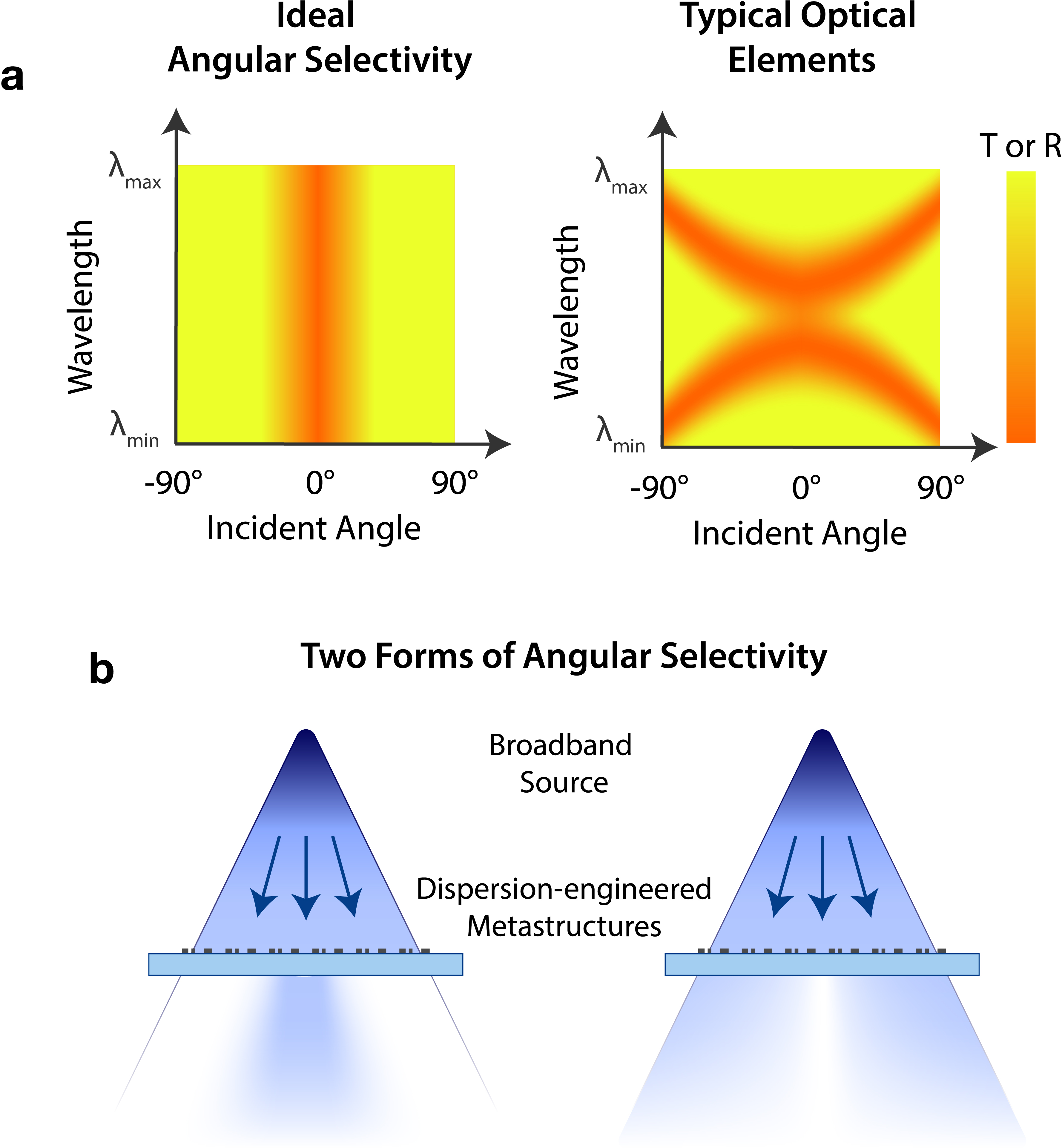
Figure 1: a) Ideal (left) versus practical (right) angular response functions (transmittance/reflectance). b) Two complementary forms of angular selectivity explored: strong scattering at normal incidence, transmission at oblique angles (left); opposite response (right).
Dispersion calculations, combined with CMT, indicate that broadband angular selectivity is possible when two non-orthogonal odd-symmetry GMR bands are degenerate with the FP peaks. In practice, a 1D dielectric silicon grating on glass with tailored trench width demonstrates broadband suppression of transmittance near normal incidence, with the angular rejection band (FWHM) ~18° over a fractional optical bandwidth Δω≈25%, while maintaining subwavelength device thickness.
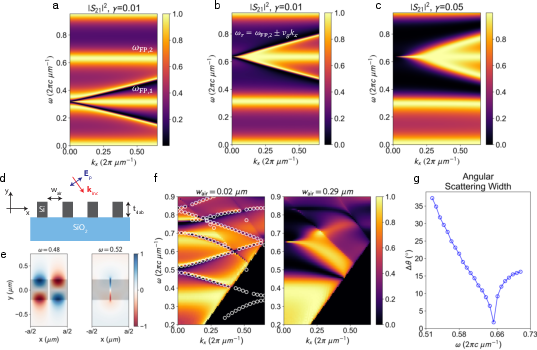
Figure 2: Dispersion engineering and response analysis in 1D gratings; (a–c) CMT-predicted transmittance; (d) cross-section of grating; (e) GMR mode profiles; (f) FDTD-simulated transmittance versus angle and structure; (g) angular suppression bandwidth.
A key numerical result is that the achieved angular selectivity is over a bandwidth much wider than the resonance linewidth indicates, due to destructive and constructive phase alignment between FP and GMR modes, and not simple Lorentzian broadening via Q reduction.
A major technical challenge is generalizing the angle-selective response from 1D periodic gratings (where it is inherently directional) to 2D, isotropic metastructures without prohibitive band folding and mode mixing. The naive strategy of superimposing orthogonal gratings produces excess bands that reduce spectral bandwidth and isotropy. Instead, topology optimization is applied. By discretizing the unit cell and leveraging gradient-based optimization tools within rigorous coupled-wave analysis (RCWA), the permittivity distribution is iteratively adjusted to maximize a figure of merit for isotropic, broadband angular rejection.
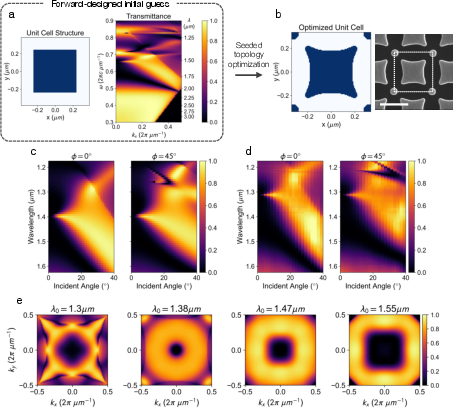
Figure 3: (a) Naively extended 2D grating and corresponding transmittance; (b) topology-optimized structure (left: design, right: SEM); (c) simulation and (d) experiment, showing transmittance for different azimuths; (e) 2D k-space angular response at select wavelengths.
The resulting topology-optimized Si metastructure (thickness: 475 nm, period: 705 nm) experimentally manifests highly isotropic angular selectivity over a ∼20% bandwidth, with both simulated and measured angle-resolved spectra displaying strong suppression near normal incidence and efficient transmission at larger angles. Full 2D k-space analysis confirms isotropy across all wavelengths of interest.
Bandpass Angular Selectivity and Complementary Functionality
Practical applications often require not only angular rejection near normal but also the inverse: high transmission within a specified angular window and strong off-axis reflection. By detuning the GMR band from the FP resonance in a modified 1D Si grating and extending to 2D via geometric parameter tuning (without topology optimization), an isotropic bandpass filter is realized with ≈15% fractional bandwidth.
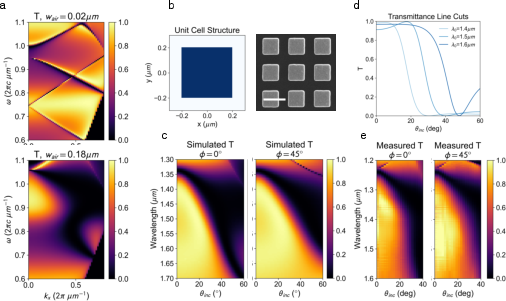
Figure 4: (a) Simulated 1D grating transmittance for two trench widths; (b) 2D unit cell design and fabrication; (c) simulated angular transmittance for principal directions; (d) spectral line cuts; (e) measured device response.
This inverse-design approach yields compact metastructures less than half a wavelength thick, outperforming conventional multilayer Brewster stacks or photonic crystal heterostructures, which require orders of magnitude larger thickness for comparable performance.
Discussion, Tradeoffs, and Implications
A generalized design criterion derived from CMT dictates that broadband angular selectivity is maximized when the overlap parameter
1−r24rγnefftslab≥1
is satisfied, with r as the background Fresnel reflectivity, γ as resonance decay rate, and neff,tslab as effective index and slab thickness. Increasing Q0 (reducing Q1) expands bandwidth, but at the cost of enlarging the angular rejection band due to group velocity reduction—a fundamental bandwidth/angular width tradeoff not present in classical Lorentzian broadening. High-index platforms facilitate broader bandwidths but impose minimum angular widths, especially pronounced in the visible, where materials such as TiOQ2 present lower indices and greater challenge.
This framework extends readily to different wavelength regimes and material platforms, including transparent dielectrics for visible and IR, although device miniaturization and fabrication constraints become nontrivial. The optimized meta-optics enable integration with AR/VR, solar energy harvesting (as angle-selective backgrounds for photon recycling), and analog information processing (e.g., spatial frequency filtering, edge detection) [see also Cotrufo et al., "Dispersion engineered metasurfaces...”].
Conclusion
This work demonstrates a versatile dispersion-engineering and topology optimization methodology for designing optically thin metastructures with highly isotropic broadband angular selectivity. The synergy of analytic design (via GMR–FP alignment) and numerical topology optimization yields metastructures that overcome traditional spectral-angle band coupling constraints, enabling performance beyond the reach of thick VBGs or multilayer stacks. These advances establish practical blueprints for integrated, on-chip angle-selective devices applicable across sensing, photovoltaics, and wavefront shaping, and motivate future efforts towards even greater spectral/angle decoupling using resonant phenomena with high group velocity, such as low-loss ENZ systems or surface lattice resonances.

