- The paper identifies precise conditions for triggering physical plasmoids during dynamic current sheet formation using the Orszag-Tang vortex configuration.
- It demonstrates that correct timing, threshold perturbation amplitude, and spectral content are essential to distinguish physical plasmoids from numerical artifacts.
- The study employs convergence diagnostics via power spectra, confirming quantitative agreement with reconnection theories and providing guidance for high-resolution simulations.
Introduction
Magnetic reconnection is a fundamental non-ideal MHD process governing explosive energy release in astrophysical and laboratory plasmas, underlying phenomena from solar flares to sawtooth crashes in tokamaks. In high-Lundquist-number (S) plasmas, the classical Sweet-Parker reconnection scaling is too slow by several orders of magnitude. The discovery and analysis of the plasmoid instability provided theoretical justification for observed fast reconnection rates. Above a critical S (∼104), current sheets undergo secondary tearing, generating chains of plasmoids and facilitating rapid topological change.
The work "Triggering physical plasmoids in forming current sheets: conditions and diagnostics" (2604.02065) systematically elucidates the precise conditions required to trigger genuine (physical) plasmoid formation when the current sheet forms dynamically—focusing on the Orszag-Tang vortex as a prototypical MHD configuration, using high-fidelity pseudo-spectral simulations. The study scrutinizes the interplay of numerical resolution, noise, and perturbation protocol, resolving ambiguities in prior spectral simulations where the expected plasmoid activity was absent even in the plasmoid-unstable regime.
The Orszag-Tang vortex is initialized with analytically prescribed velocity and magnetic fields promoting the spontaneous formation of a central current sheet. The subsequent evolution drives progressive thinning, maximizing the current density at t≃1.9 Alfvén times (τA), with the current layer attaining a length Lcs≃3 and half-thickness δ≃6×10⁻³ at its peak, corresponding to S∼105 (evaluated via S=LcsvA/η, where vA is the upstream Alfvén speed and S0 resistivity). The sheet's maximum aspect ratio matches the Sweet-Parker scaling, confirming classical macroscopic predictions.
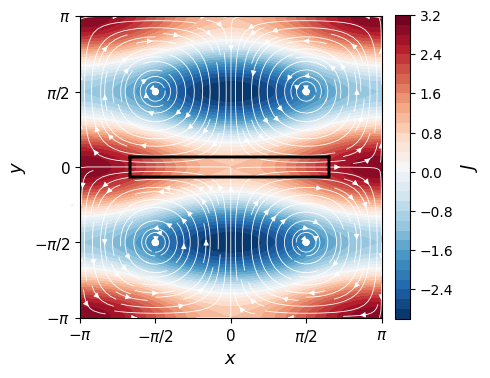
Figure 1: Initial configuration of the Orszag-Tang vortex: colormap of current density S1 and velocity streamlines, highlighting the stagnation-point topology and nascent current sheet.
Current sheet dynamical evolution is depicted for representative times, showing intensification and thinning followed by relaxation post-peak.
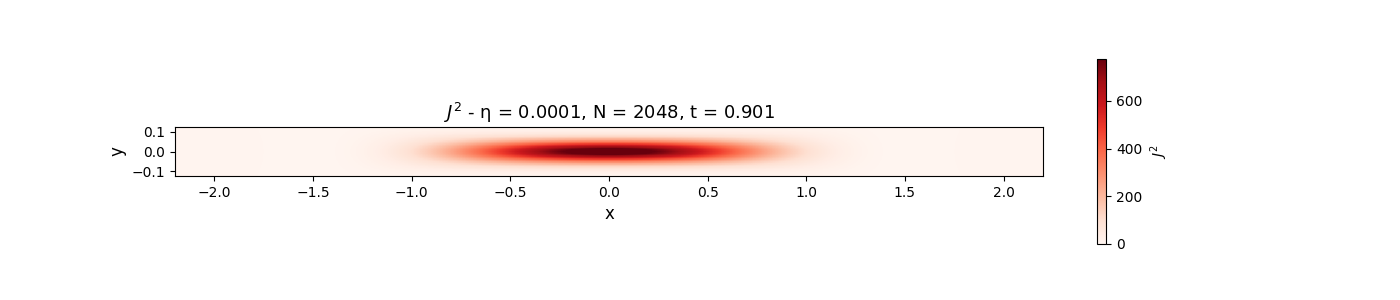
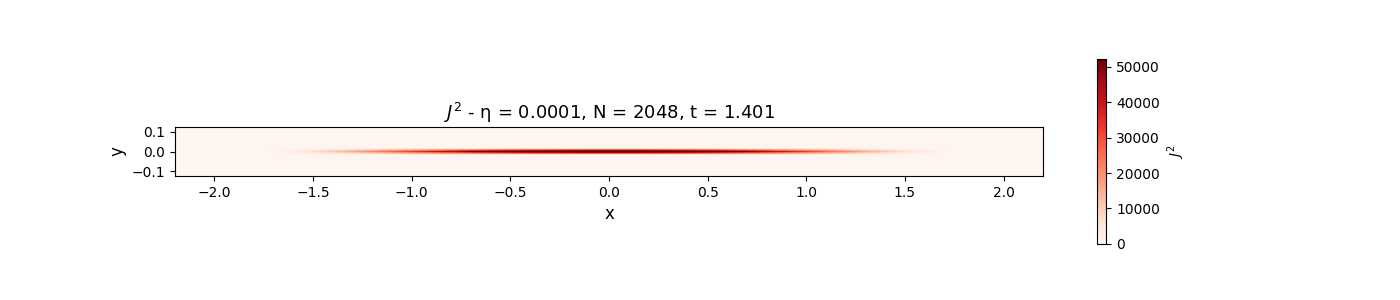
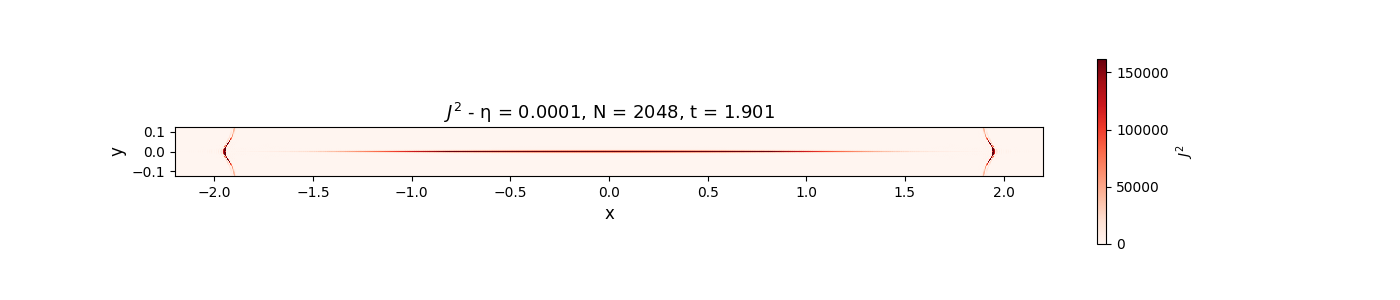
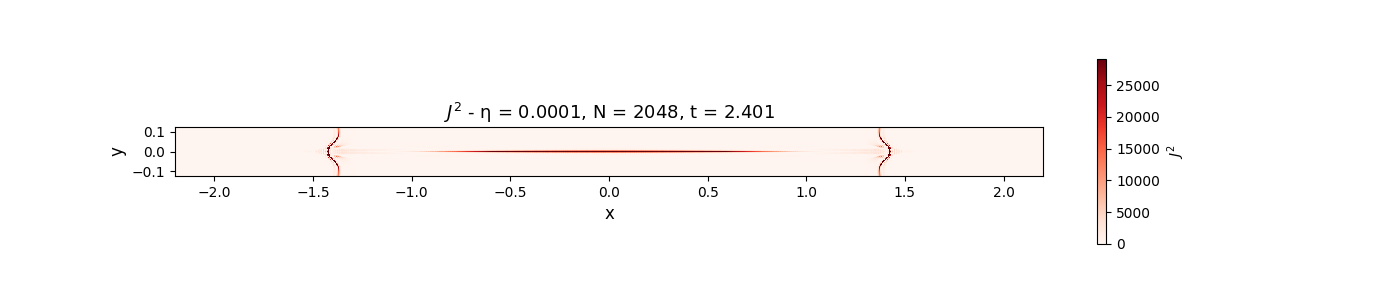
Figure 2: Evolution of the squared current density S2 in the current sheet zone as it thins to peak and then relaxes upon velocity field weakening.
Transverse profiles at the current maximum provide quantitative diagnostics for local geometric and physical parameters.
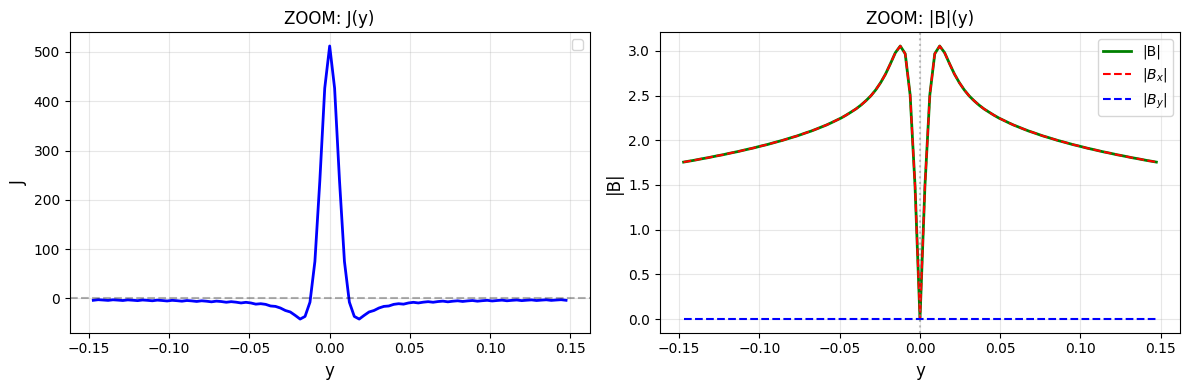
Figure 3: Current density and magnetic field profiles at the sheet midpoint at peak intensity, enabling extraction of sheet thickness and upstream Alfvén speed.
Numerical Resolution and Discrimination of Physical/Spurious Plasmoids
A central technical advance is the use of the power spectrum of S3 (S4) and S5 as convergence diagnostics; simulations are only deemed resolved if the spectrum's peak exceeds its high-S6 value by a defined margin (factor S7). Under-resolved spectral simulations at S8 grid points exhibit artificial plasmoid generation due to numerical noise and incomplete dissipation at high S9, whereas resolved runs (∼1040) remain free of such artifacts unless physical instability is triggered.



Figure 4: ∼1041 at ∼1042 showing spurious plasmoid generation post-peak, highlighting the impact of under-resolution relative to converged simulations.
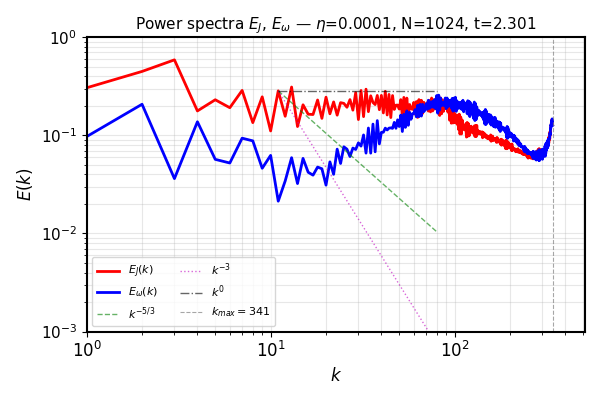
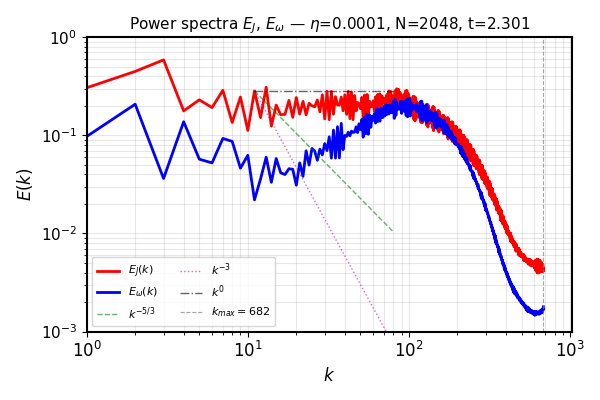
Figure 5: ∼1043 and ∼1044 at ∼1045 (left, non-converged) and ∼1046 (right, converged): only the latter satisfies the spectral diagnostic, paralleling the absence of spurious plasmoids.
Systematic Investigation of Physical Plasmoid Triggering
Physical plasmoid nucleation—in contrast to their spurious counterparts—requires the coincident satisfaction of three criteria:
- Temporal Proximity: Perturbations must be applied close to the time of current density maximum (∼1047 near peak), when the sheet is thinnest and susceptible to instability.
- Threshold Amplitude: The seed amplitude ∼1048 must exceed a critical value ∼1049 (for the present pseudo-spectral numerics), below which amplification during the finite-lived unstable phase is inadequate.
- Spectral Content: The perturbation must include the unstable wavenumber band (i.e., t≃1.90 should be at least the dominant mode of the plasmoid instability).
For single randomized perturbations, plasmoid number and growth rates (t≃1.91) sharply increase with later t≃1.92 and larger t≃1.93, saturating at high-enough t≃1.94. Crucially, when perturbations are applied too early (t≃1.95) as in previous works, no physical plasmoid formation is observed, matching prior findings and resolving apparent paradoxes.


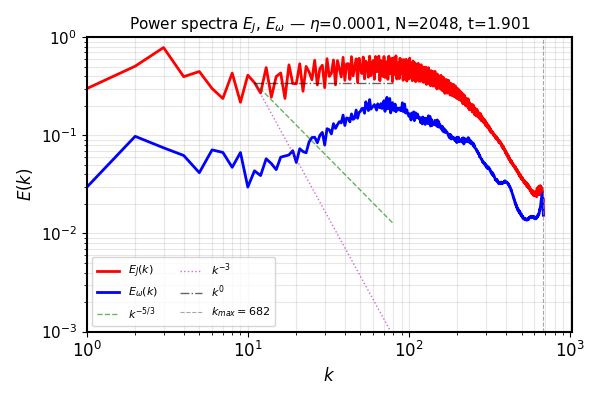
Figure 6: Plasmoid development at t≃1.96, t≃1.97, t≃1.98—onset and maturation reflected in t≃1.99 and τA0 spectra.


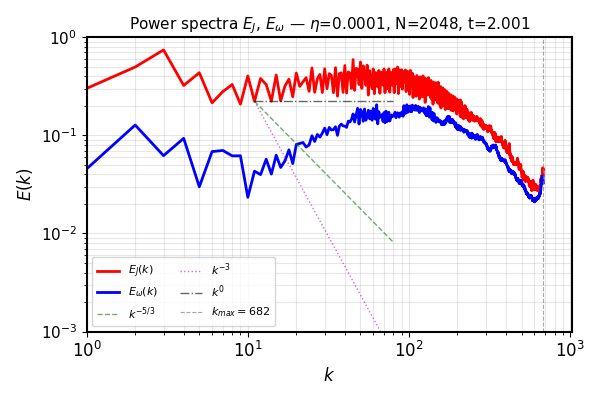
Figure 7: Increasing τA1 to 128 at fixed τA2 and τA3 yields denser plasmoid chains, consistent with dominant unstable wavelength predictions.
Convergence at high spectral resolution (τA4) is robust: plasmoid counts and power spectra are indistinguishable from τA5 at identical physical parameters.
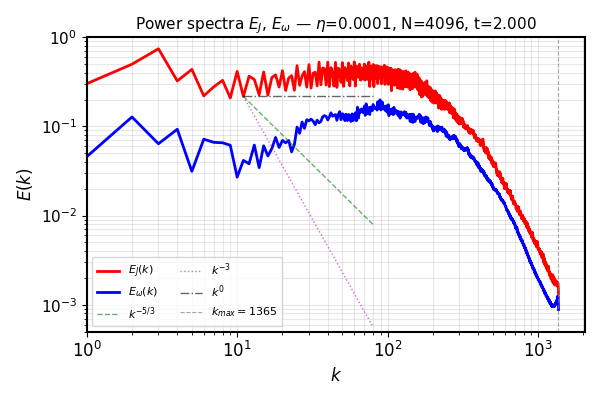
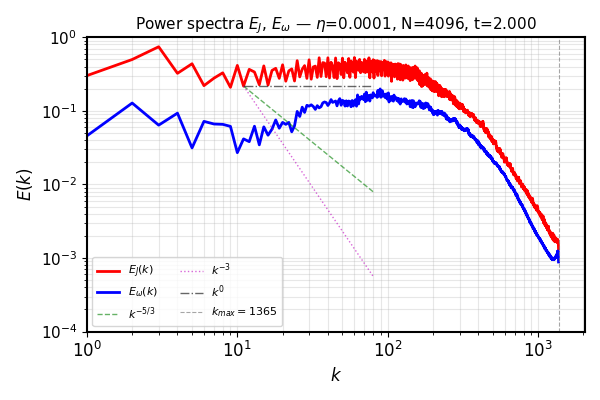
Figure 8: τA6 at τA7 for various perturbations—full resolution and dissipative spectral cascade confirm the physical nature of obtained plasmoids.
Theoretical Consistency and Impact of Noise Injection
Results are directly compared with least-time principle theory for forming sheets [Comisso et al., 2017] and coalescence-instability DNS [Huang et al., 2017]. For τA8, measured growth rates (τA9) and plasmoid numbers (Lcs≃30, Lcs≃31) are in quantitative agreement with theory and consistent with other numerical studies, subject to differences in the nature of their reconnection setups (transient versus quasi-steady-state).
The study further tests continuous noise injection, mimicking the persistent background noise of finite-difference codes and physical plasmas. In this protocol, the Lcs≃32 threshold for plasmoid triggering is lower (by 1–2 orders of magnitude) than in the single-shot case, while the largest Lcs≃33 and Lcs≃34 remain nearly unchanged.
Implications and Open Problems
This study demonstrates, with spectral fidelity, that the absence of plasmoids in prior high-Lcs≃35 Orszag-Tang vortex simulations was not due to a failure of instability theory but rather to the lack of temporally and spectrally appropriate perturbations. In pseudo-spectral algorithms, where numerical noise is orders of magnitude smaller than in finite-difference codes, explicit, correctly timed, and adequately strong perturbations are necessary for physical plasmoid manifestation. Continuous noise (as always present in nature and most codes) readily triggers the instability as soon as the physical threshold is breached.
This result clarifies the link between simulation methodologies and physical interpretation: in the absence of resurgent numerical noise, the mere linear instability criterion is insufficient for observing plasmoids unless the noise amplitude and timing are properly controlled.
Two pivotal open research questions remain:
- Quantitative effect of spurious versus physical plasmoids: Does the artificial triggering of fast reconnection via numerical artifacts lead to irreproducible or inaccurate reconnection rates? Systematic, Lcs≃36-dependent studies are needed.
- Extension to Quasi-Stationary Current Sheets: In forming sheets with longer lifetimes, does the finite-time constraint relax, allowing more ubiquitous plasmoid formation at lower noise thresholds?
Conclusion
This work establishes rigorous diagnostics and procedural guidance for physically robust identification and controlled triggering of the plasmoid instability in dynamically evolving current sheets. The approach provides converged numerical evidence for the requisite interplay between current sheet evolution, perturbation protocol, noise amplitude, and spectral bandwidth. These insights have direct implications for reconnection modeling in both astrophysical and laboratory contexts, particularly regarding the interpretation of plasmoid-dominated regimes in high-resolution numerical simulations and their relevance to observed fast energy dissipation events. Further exploration of noise effects, code architectures, and system parameters is warranted to generalize the control of plasmoid dynamics and reconnection rates across physical and computational regimes.

