- The paper introduces PRCCF, a framework that combines persona-guided retrieval with causality-aware cognitive filtering to enhance ESC response generation.
- It employs a dual-encoder Dense Passage Retrieval for personalized demonstration selection and multi-phase commonsense filtering to ensure cognitive relevance.
- Empirical evaluation on ESConv shows significant improvements in strategy prediction, BLEU-4, and human-preference metrics compared to baseline systems.
PRCCF: A Persona-Guided Retrieval and Causality-Aware Cognitive Filtering Framework for Emotional Support Conversation
Introduction
The PRCCF framework addresses two critical deficiencies in Emotional Support Conversation (ESC) systems: insufficient deep contextual understanding and limited personalization in response generation. Drawing on Hill’s helping skills theory, which posits the centrality of case-based reasoning, PRCCF structures response generation around two principal innovations: persona-guided retrieval of demonstrations and causality-aware cognitive filtering. With the incorporation of personalized retrieval and cognitive knowledge selection, PRCCF aims to surpass the inherent limitations of purely generative or coarse retrieval-based techniques, yielding greater coherence, empathy, and alignment with psychological support objectives.
PRCCF Framework Overview
PRCCF is organized into three interconnected modules: (1) Persona-guided Multi-View Retriever, (2) Causality-aware Cognitive Filtering, and (3) Multi-Source Fusion for Generation. The architecture is designed to integrate persona alignment with context-sensitive cognitive causality modeling, informed by external commonsense knowledge and causality detection.
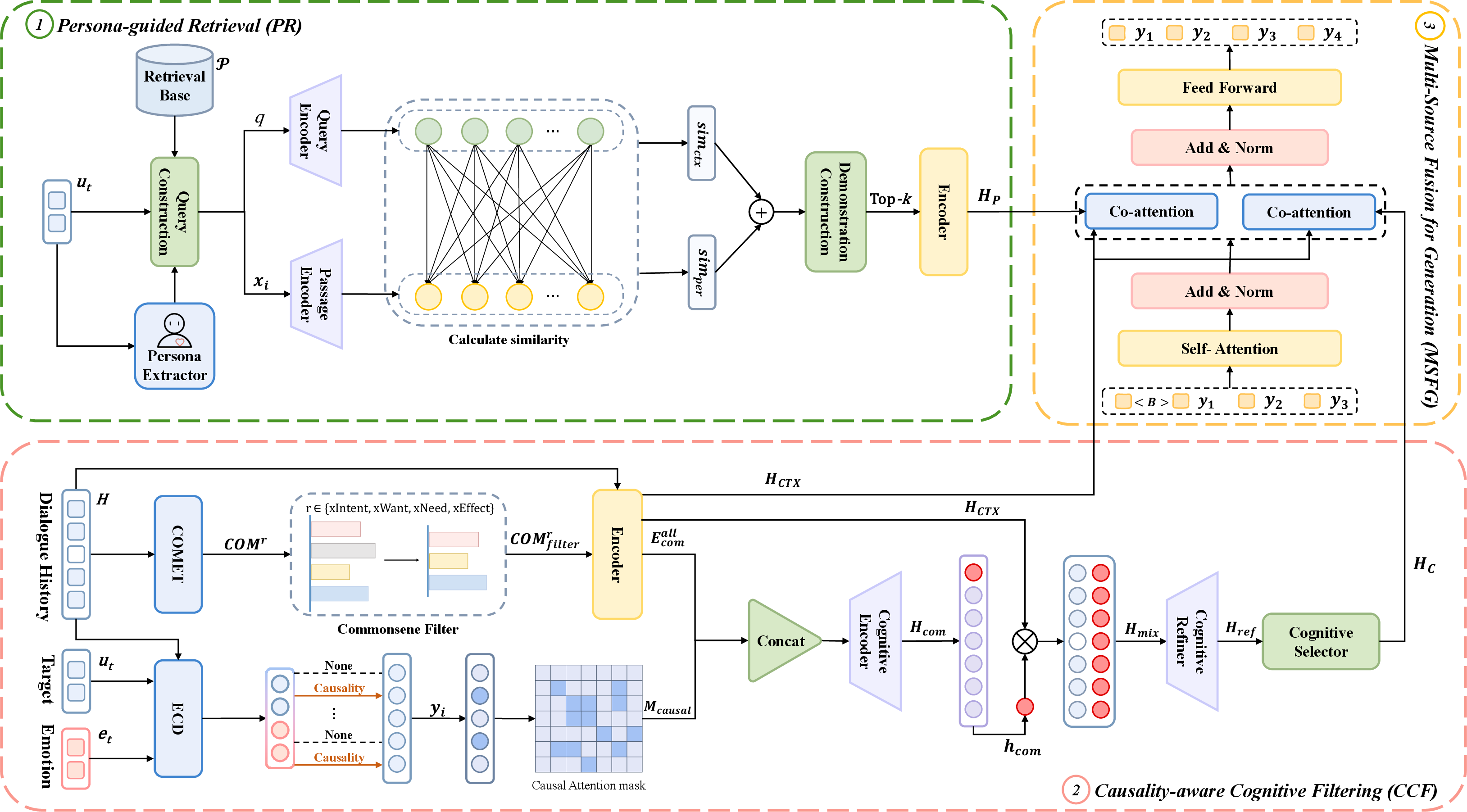
Figure 1: The PRCCF framework integrates a multi-view retriever, cognitive filtering, and multi-source fusion for generation.
Persona-Guided Retrieval Mechanism
The retrieval module is built on a dual-encoder Dense Passage Retrieval architecture, leveraging BERT-based encoders for both query and passage representations. Retrieval disambiguates candidates not only by semantic proximity but also by persona alignment, where user attributes and expressive style are explicitly factored into the similarity function:
sim(i)=α⋅simctx(q,xi)+β⋅simper(pt,pi)
This ensures demonstration selection reflects the seeker’s communicative norms, emotional tone, and strategic requirements, providing highly relevant, instruction-like guides for subsequent generation.
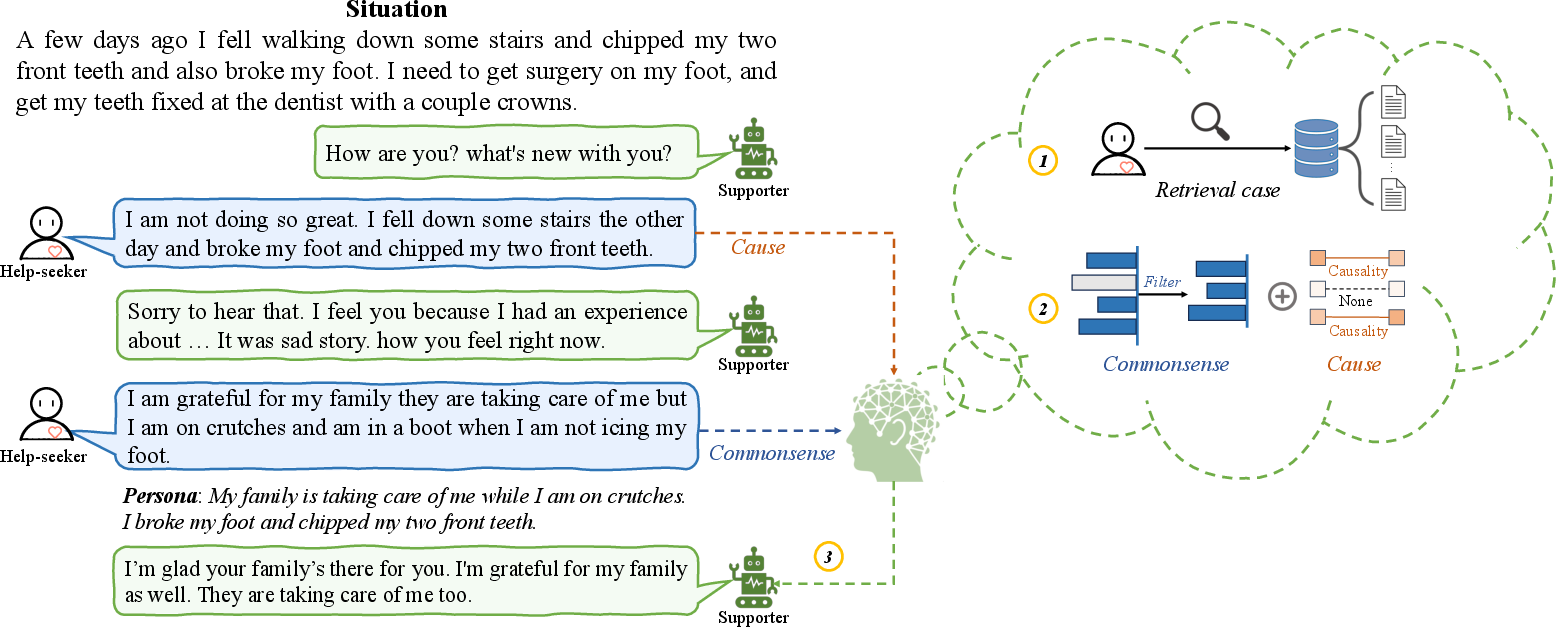
Figure 2: PRCCF employs persona-aligned retrieval and integrates causal and filtered commonsense knowledge to guide empathetic response generation.
Empirical analysis demonstrates that performance peaks at five retrieved candidate pairs, balancing semantic informativeness and demonstration noise (see Figure 3).
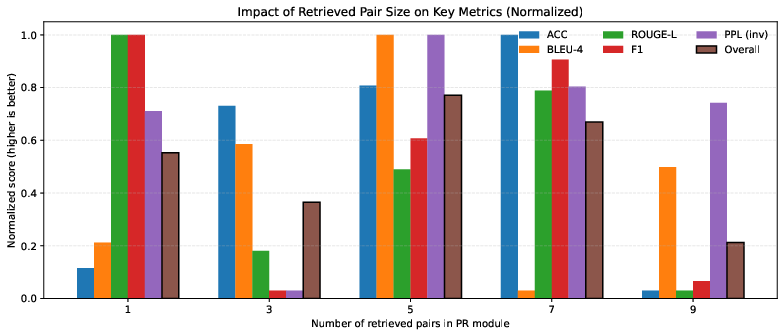
Figure 3: Generation and strategy performance peaks when retrieving five candidate demonstration pairs, indicating optimal semantic and persona diversity at this setting.
Causality-Aware Cognitive Filtering
The CCF module performs multi-phase filtering of external commonsense inferences. After COMET-based expansion (using xWant, xNeed, xIntent, xEffect relations), DeBERTa-v3-based classification is applied to retain only relevance-validated facts. An Emotion Cause Detector (trained on RECCON) highlights causative utterances, enforcing a causal attention mask that restricts knowledge conditioning to psychologically salient spans. Subsequent cognitive refinement fuses causal knowledge with context embeddings via a gated multi-layer selection, yielding cognitive representations that are maximally aligned with the inferred roots of user distress.
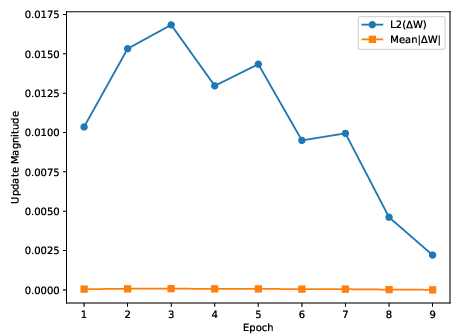
Figure 4: Parameter update dynamics in the cognitive refinement module indicate stable end-to-end adaptation and non-saturated learning.
Multi-Source Fusion for Generation
PRCCF fuses the dialogue context, retrieved demonstration representations, and causally filtered cognitive signals using adaptive, trainable weighted combination followed by residual normalization. Each source contributes complementary signal: context for turn-level grounding, retrieval for personalized patterns, and cognitive feature for deep causal alignment. Decoding is conditioned on this fusion, and the generator is trained to maximize the likelihood of strategy-aligned, contextually coherent, and emotionally supportive responses.
Experimental Evaluation
Automatic and Human Metrics
On the ESConv benchmark, PRCCF records significant gains over robust baselines. Notably, it achieves a strategy prediction accuracy (ACC) of 40.72% and the lowest perplexity (PPL=13.10). In generation metrics, PRCCF produces the highest BLEU-4 (B-4=3.55) and ROUGE-L (R-L=19.78) scores, outperforming both knowledge-enhanced and persona-augmented architectures (see Table 1 in the original paper).
Ablation Studies
Omission of the PR module substantially reduces generation coherence; excluding persona similarity in retrieval (w/o Persim) also lowers BLEU and ROUGE, substantiating the necessity of user alignment in demonstration guidance. The exclusion of the CCF module increases perplexity and reduces informativeness, confirming the value of causal knowledge filtering. Causal-aware selection and knowledge filtering both exhibit strong contributions; unfiltered commonsense leads to noise and degraded fluency.
LLM Baseline Comparison
PRCCF significantly exceeds ChatGPT and ChatGLM-6B variants across BLEU and ROUGE metrics. This empirically supports the paper’s position that general LLMs, even when prompt-augmented, fail to adequately model fine-grained emotional and strategic dependencies endemic to ESC.
Human Alignment
Human side-by-side evaluations on ESConv reveal PRCCF responses are preferred for identification (58%), comforting (60%), and overall experience (57%) over the best retriever and knowledge-filtering baselines, with statistical significance.
Case Study
Representative dialogue analysis demonstrates that, unlike prior systems producing generic or off-target suggestions, PRCCF’s responses are context-sensitive and maintain appropriate emotional distance and validation (see Table~4 in the original paper).
Analyses
Strategy Prediction
PRCCF demonstrates consistently superior top-n strategy prediction accuracy across all n, with performance gains most pronounced at low n. This implicates PRCCF’s joint retrieval-causal modeling pipeline in enhancing intent recognition and planning.
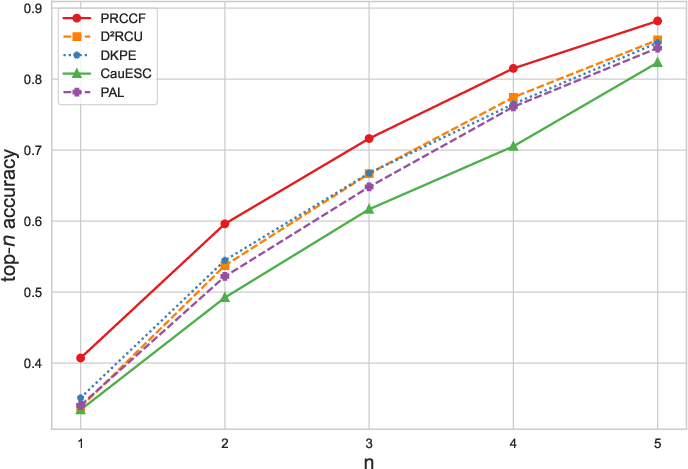
Figure 5: PRCCF outperforms state-of-the-art methods in top-n strategy prediction accuracy, especially noticeable for low n values.
Strategy Distribution over Dialogues
Strategy analysis confirms PRCCF’s alignment with established helping stages: Exploration, Comforting, and Action. Its predicted distributions transition smoothly from emotion reflection in early turns to actionable suggestions later, adhering more closely to expert counseling dynamics than competitors.
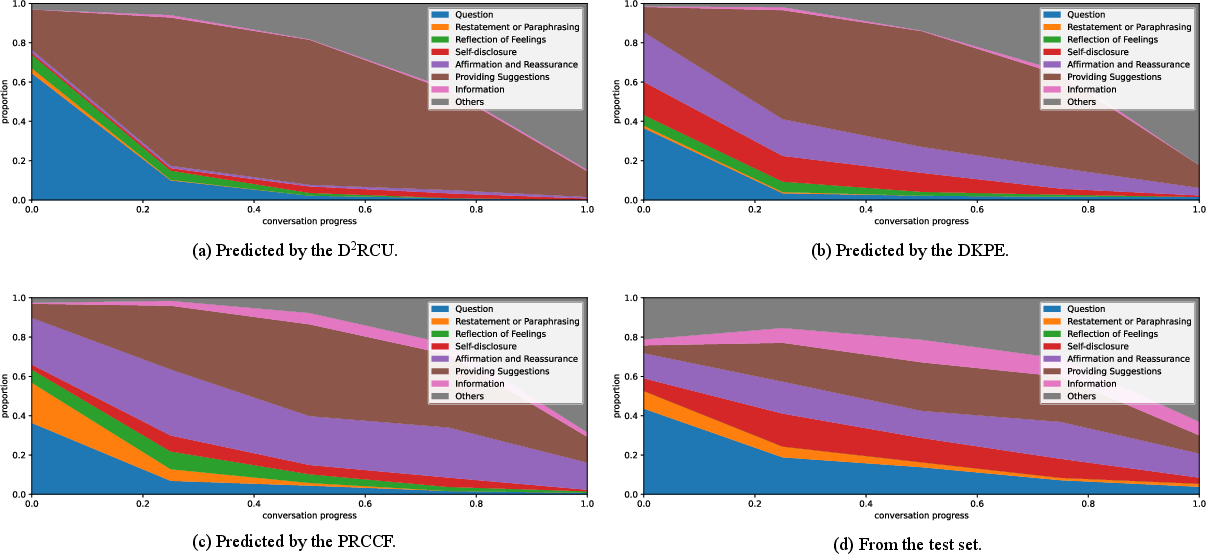
Figure 6: PRCCF’s predicted strategy distributions adaptively shift from exploration to action stages, closely mirroring ground-truth human strategy progression.
Dynamics of Cognitive Knowledge Refinement
Analysis of parameter updates in refinement modules throughout training reveals consistent, non-saturating adaptation, confirming that the causal-cognitive integration remains learnable and actively participates in optimization.
Implications and Future Directions
PRCCF demonstrates that explicit modeling of user persona and fine-grained causal filtering is essential for advancing ESC systems beyond generic empathetic dialogue. The strong human preference and automatic metric improvements solidify that persona-guided retrieval and causality-aware knowledge grounding are critical for robust, contextually-situated affective support.
Practically, PRCCF points to the future integration of even more granular user models (e.g., dynamically evolving persona vectors) and fine-tuned, situation-adaptive commonsense filtering, as well as potential synergy with constant adaptation via reinforcement learning. The modularity of the framework suggests applicability to other affect-centric dialogic tasks, including mental health triage and persuasive counseling.
Conclusion
PRCCF introduces a principled architecture for emotional support conversation that fuses persona-consistent retrieval with causally filtered cognitive modeling. It substantially surpasses previous ESC systems and LLMs on both automatic and human evaluations, setting a new state-of-the-art on ESConv. Theoretical and empirical analyses indicate that further gains are achievable via more granular personalization and continual cognitive grounding, opening avenues for robust, psychologically viable support agents.
(2604.01671)

