- The paper introduces a modular superconducting circuit that implements universal CV quantum gates with high fidelity (≈99%+).
- It details single-mode gate implementations (rotation, displacement, squeezing, Kerr) using tunable couplings and frequency detuning to suppress parasitic interactions.
- The architecture scales via a multilayer design that overcomes geometric constraints, paving the way for error-corrected, large-scale continuous-variable quantum processors.
Universal Continuous Variables Computation in Scalable Superconducting Architectures
Introduction
The paper "Building Block For Universal Continuous Variables Computation In Superconducting Devices" (2604.00212) proposes a modular, scalable architecture for continuous-variable (CV) quantum computing that achieves all required Gaussian and non-Gaussian gates with high fidelity using realistic superconducting circuit parameters. This work systematically addresses key limitations of previous superconducting CV approaches by leveraging a multilayer, tunable device geometry that natively supports the universal gate set—rotation, displacement, squeezing, Kerr nonlinearity, and beam splitter—required for CV computational universality.
Physical Architecture and Gate Synthesis
The building block comprises a two-layer superconducting circuit (Figure 1). The fundamental mode for CV encoding is realized by a DC-SQUID (denoted M), while three auxiliary qubits—two planar (rotation and beam splitter qubits, R and B) and one in a second layer (fluxonium F)—mediate the various interactions. The multilayer integration allows the realization of tunable quadratic couplings, essential for high-fidelity squeezing and Kerr gates, via an external parametric magnetic flux. Capacitive and inductive couplings are selectively activated for individual gate operations by frequency detuning.
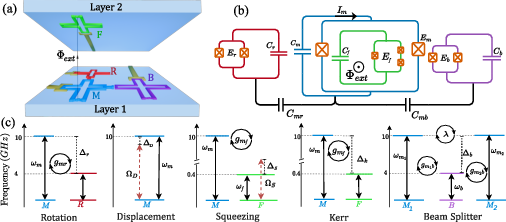
Figure 1: Schematic of the two-layer superconducting building block enabling universal CV quantum gates via tunable couplings and frequency controls.
The modularity enables direct extension to multinode devices, where additional DC-SQUID modes are connected via auxiliary qubits without introducing geometric constraints.
For each single-mode gate, the architecture permits selective activation of relevant interactions while suppressing parasitic couplings by large detuning and maintaining non-participating qubits in their ground states.
Rotation and Displacement
- The rotation gate R(θ) employs a dispersive interaction between M and R, allowing precise control over the rotation angle via detuning and interaction time (Figure 2a). High fidelities (>99.9%) are shown across a broad parameter range.
- Displacement D(α) is directly implemented via resonant drives, achieving nominal 100% fidelity with experimentally realistic pulse amplitudes and durations.
Squeezing and Kerr
- Squeezing S(ξ) is engineered using a parametric modulation of the external flux controlling the fluxonium–DC-SQUID coupling (Figure 2b). The scheme avoids the infeasibility of previous approaches requiring extreme detuning or parametric drive while achieving R0 fidelity for squeezing parameters relevant to near-term experiments.
- The Kerr operation R1 is selectively activated by tuning the coupling, enabling fourth-order nonlinear evolution (Figure 2c). The analysis reveals a trade-off: higher fidelity is accessible at the expense of longer gate times due to dispersive requirements, but operation durations remain well within coherence limits of contemporary superconducting platforms.
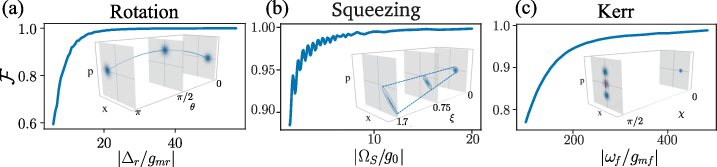
Figure 2: Gate fidelities for single-mode operations (rotation, squeezing, Kerr) as a function of key device parameters, illustrating attainable fidelity and Wigner function evolution.
Multi-Mode Interaction: Beam Splitter
The architecture implements the crucial multi-mode beam splitter R2 via a coupler (R3) dispersively mediating the hopping between adjacent DC-SQUID modes. By dynamically shifting the coupler's frequency, interactions can be switched on and off or tuned in amplitude (Figure 3). The fidelity analysis confirms that the beam splitter operation consistently achieves R4 fidelity for experimentally feasible detuning ratios and coupling strengths. Parasitic direct (nontunable) couplings are shown to be negligible and correctable within the control protocol.
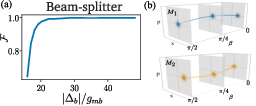
Figure 3: Simulation of beam splitter operation showing fidelity dependence on detuning and Wigner function evolution during coherent state transfer between modes.
Implications for Scalability and Superconducting CV Quantum Computing
This work establishes the device-level feasibility of universal continuous-variable quantum computation in superconducting platforms. The multilayer architecture overcomes the geometric and scaling bottlenecks that have historically limited CV quantum hardware. All gates are numerically demonstrated with fidelities R5 (typically R6 for Gaussian gates), matching or exceeding the best results in optical and trapped-ion CV systems, but in a format amenable to full integration, advanced error correction, and scaling strategies familiar to superconducting hardware engineers.
The explicit demonstration of flux-tunable, fast, high-fidelity realization of all universal gates—including the challenging non-Gaussian Kerr operation—is a marked advance over single-circuit and planar approaches. Furthermore, this architecture’s compatibility with recent 3D integration techniques and the negligible crosstalk between layers implies immediate applicability to scaling out high-connectivity CV processors.
Prospective Directions and Open Challenges
Improving the gate time for the Kerr interaction without fidelity degradation is a key avenue for future investigation, potentially via optimized parametric sequences or alternative nonlinear coupler designs. Extending this architecture to implement full quantum algorithms, error correction protocols for CV codes, or direct comparison against discrete-variable superconducting quantum computers in relevant workloads are promising future research directions. The practical realization of large-scale, universal, high-fidelity superconducting CV processors will have significant implications for quantum simulation, error correction codes in bosonic modes, and hybrid quantum information processing.
Conclusion
This work presents a modular, multilayer superconducting device architecture achieving universal continuous-variable gate sets with high fidelity and realistic parameters. The architecture directly addresses the scalability limitations of previous CV quantum hardware by leveraging flexible coupling schemes, robust dynamical detuning protocols, and advanced 3D integration. These results provide a robust foundation for scaling superconducting CV quantum computers and point towards practical realization of large-scale CV quantum information processing in the near term.

