- The paper introduces a multi-task DNN with an MMoE architecture that simultaneously predicts fission product yields and their experimental errors.
- Its innovative peak-weighted loss function and odd–even parity encoding enable precise capture of sharp yield peaks while reducing non-physical predictions.
- Empirical evaluations demonstrate significant improvements over BNNs, offering enhanced uncertainty quantification crucial for reactor safety analysis.
Multi-Task Deep Neural Networks for Predicting Fission Product Yields and Uncertainties in Nuclear Data
Introduction and Motivation
Accurate prediction of fission product yields (FPY) and associated experimental uncertainties is critical for reactor physics, fuel cycle analysis, and the design of nuclear facilities. FPY data exhibit pronounced peak-shaped structures and strong odd-even effects due to underlying nuclear shell and pairing phenomena. While phenomenological and microscopic models have realized significant advances, limitations in predicting unmeasured FPY at arbitrary neutron energies and for rare actinides persist due to data sparsity, computational costs, and challenges in extrapolating complex distributions. Bayesian and deep learning methods have made headway, but standard Bayesian Neural Networks (BNNs) using Gaussian posteriors struggle to capture jagged, non-smooth peak regions and do not address the covariance-driven experimental errors evaluated in modern data libraries.
The paper proposes a multi-task deep neural network (DNN) architecture adopting a Multi-gate Mixture-of-Experts (MMoE) framework to simultaneously predict both FPY values and their evaluated uncertainties, addressing the strong correlation between these targets. Moreover, the model incorporates a novel peak-weighted loss function and explicit odd–even parity encoding to improve fidelity in peak regions and capture fine local features, respectively.
Architecture and Methodological Innovations
The paper’s core methodological innovation is the application of multi-task learning via MMoE to the joint regression of FPY and FPY error, exploiting their mutual statistical and physical dependencies. The architecture, depicted below, consists of three shared "expert" subnetworks and dual gating networks for each target, enabling dynamic weighting of expert outputs conditioned on input features.
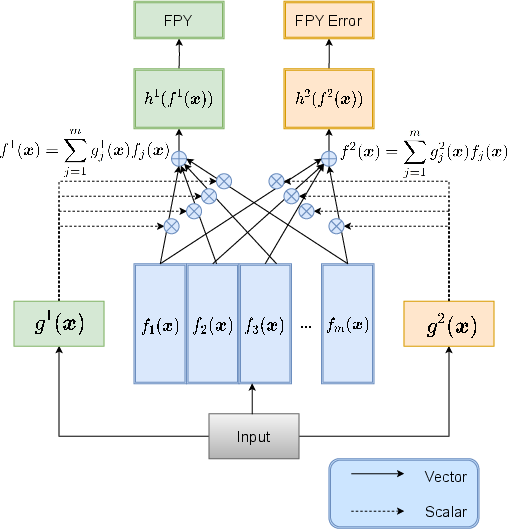
Figure 1: Network architecture of the proposed MMoE-based multi-task DNN for simultaneous prediction of FPY and FPY errors.
Key inputs include nuclear charge (Z), neutron number (N), mass number (A), excitation energy (E), and a parity indicator O representing the odd-even effect. This indicator is crucial for capturing the observed oscillatory behavior in yield distributions caused by nuclear pairing.
A central contribution is the introduction of a peak-sensitive weighted loss for the FPY regression task. This loss augments the objective function such that greater penalty is placed on errors in the peak regions of the yield curve (detected via standardized FPY values above a threshold r). For non-peak data, loss contribution is suppressed with a small multiplicative factor, whereas for peak data, the error is weighted by 1+normalize(y), further intensifying model focus on maxima. This construction is essential to counteract the inherent tendency of MSE loss to average out sharp features in the presence of highly imbalanced, peaked data.
The total training loss is a tunable convex combination of the (possibly weighted) FPY error and the FPY uncertainty error, with grid search to optimize α in favor of FPY accuracy.
Empirical Evaluation and Quantitative Results
Extensive ablation studies and head-to-head comparisons with both BNNs and conventional (single-task) DNNs are presented for major actinides 235U, 238U, (N)0Pu, and (N)1Pu at representative excitation energies (thermal, 0.5, 14 MeV). The model is validated using data from JENDL-5 with strictly non-overlapping test-versus-train splits. The effect of data augmentation using systematic Gaussian models at intermediate energies is assessed for improved generalization.
The results demonstrate significant improvements in peak and total (N)2 prediction error for both FPY and FPY error using the proposed multi-task DNN with the peak-weighted loss and odd-even encoding, across almost all actinides and energies. In peak regions—central to reactor safety and transient analyses—the reduction in (N)3 error is substantial compared to BNNs, which produce roughly double the error rates.
The model also achieves lower rates of non-physical, negative FPY predictions (8.3% versus >17% for BNNs), despite not implementing explicit physical constraints. The odd-even effect encoding delivers noticeable gains in accuracy for jagged distributions, though in cases with especially smooth peaks, such as (N)4Pu at 0.5 MeV and (N)5U at 14 MeV, parity indicators are shown to be less efficient, logically matching the data physics.
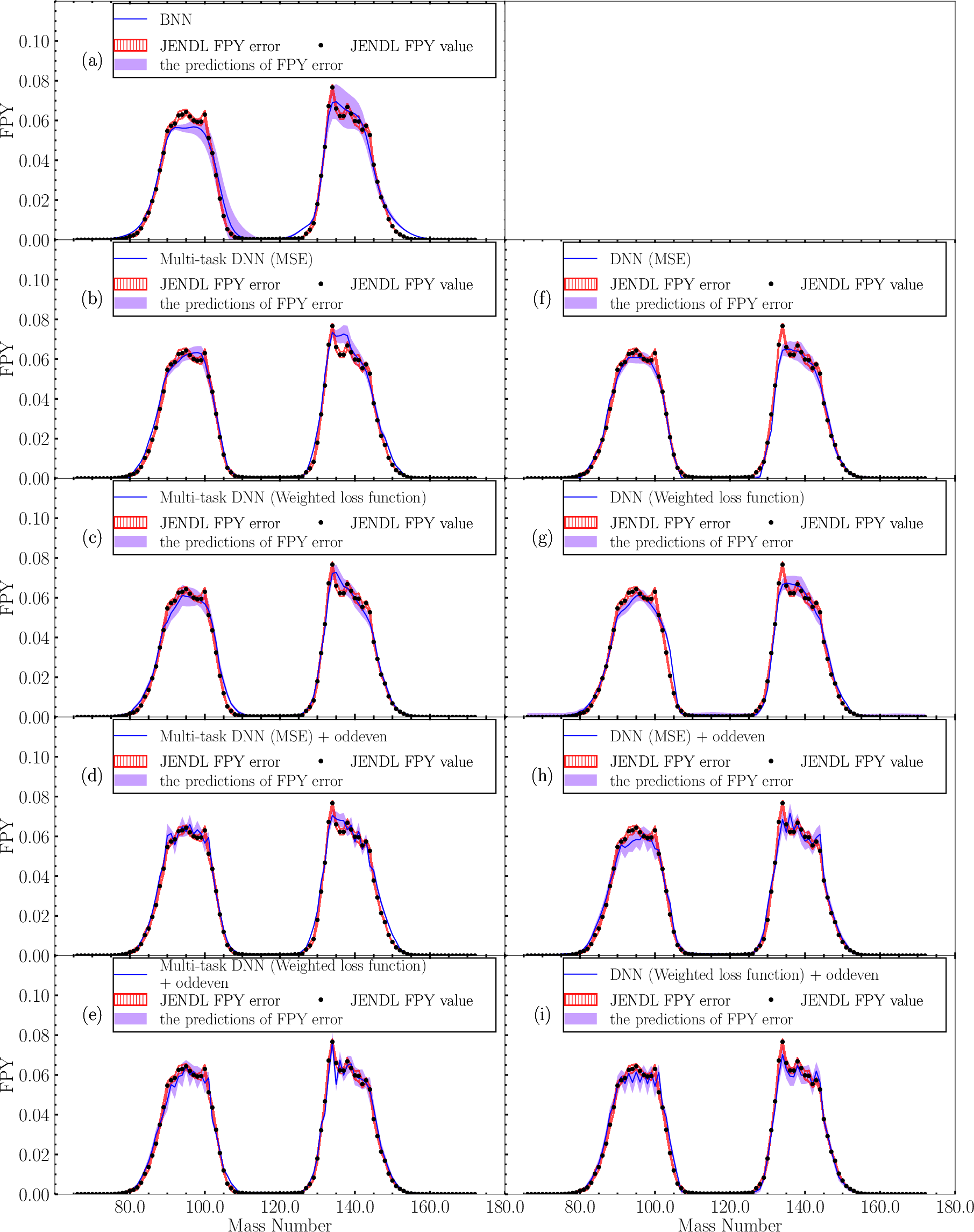
Figure 2: FPY prediction of (N)6U at 0.5 MeV: comparison across model classes, showing superior reproduction of experimental peaks and error bars via multi-task DNN + weighted loss + odd-even effect.
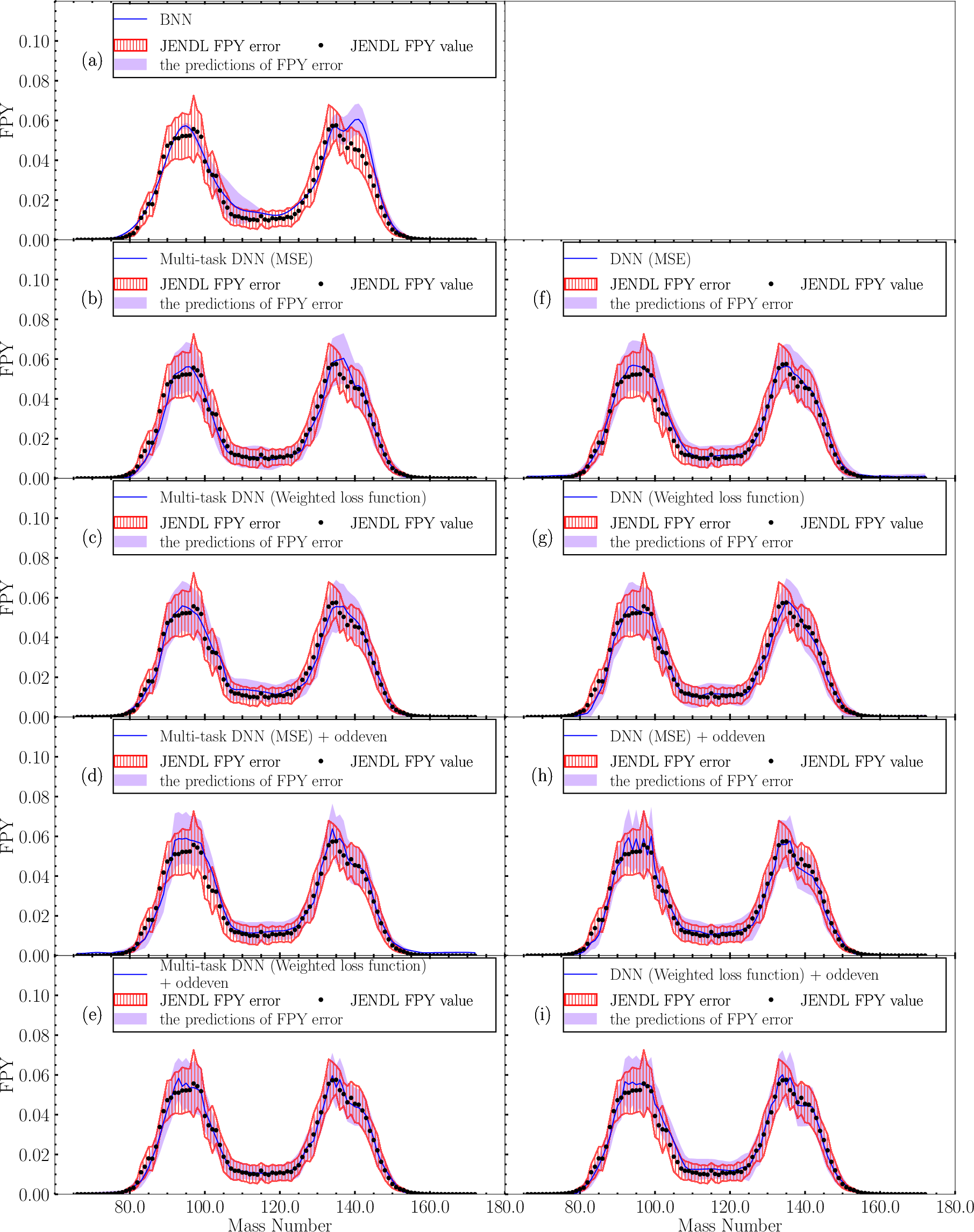
Figure 3: FPY prediction of (N)7U at 14 MeV, emphasizing accurate double-humped structure, broadening of peaks at higher energy, and associated uncertainty quantification.
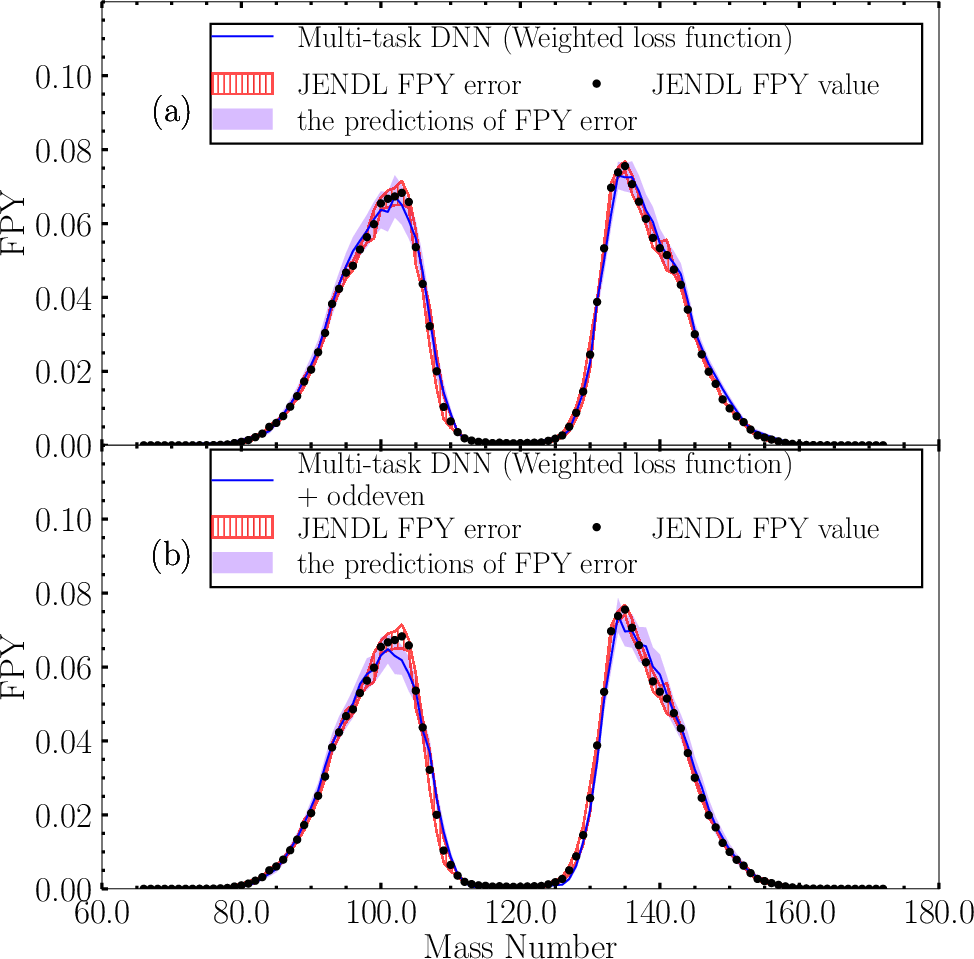
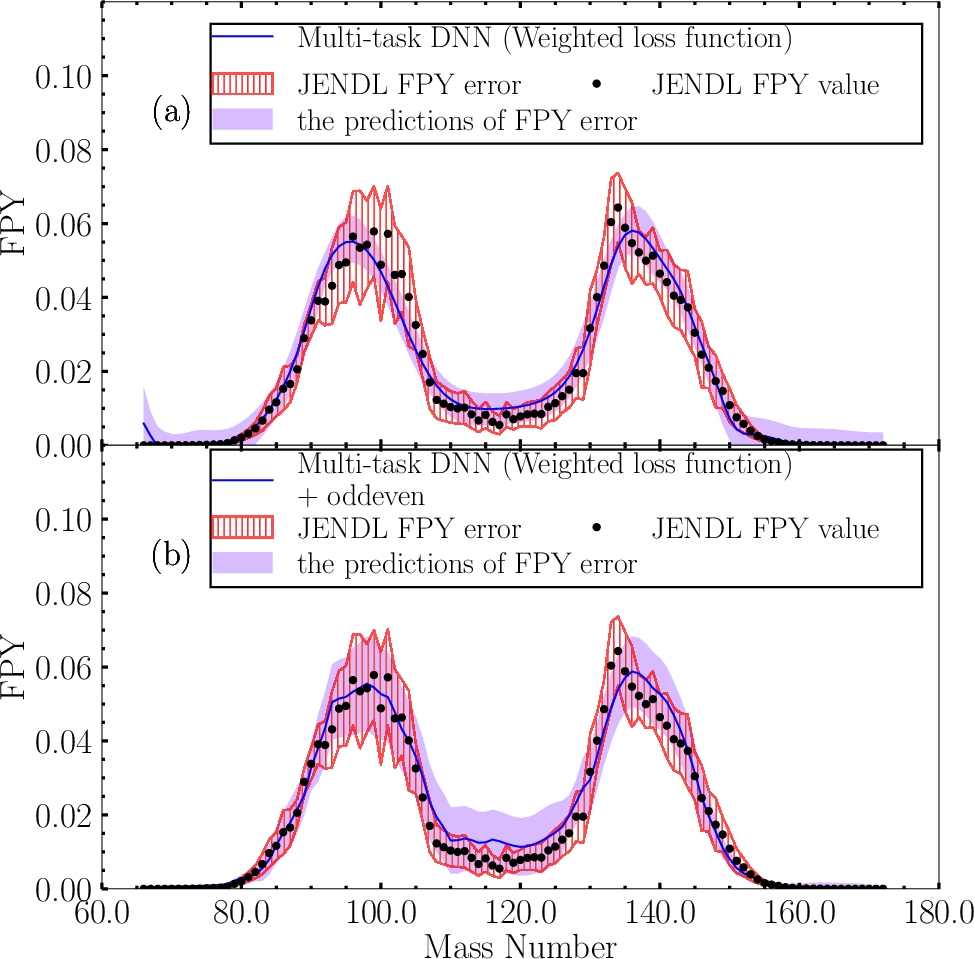
Figure 4: FPY prediction of (N)8Pu at 0.5 MeV with peak-weighted loss and parity encoding: high-fidelity jagged structure reproduction.
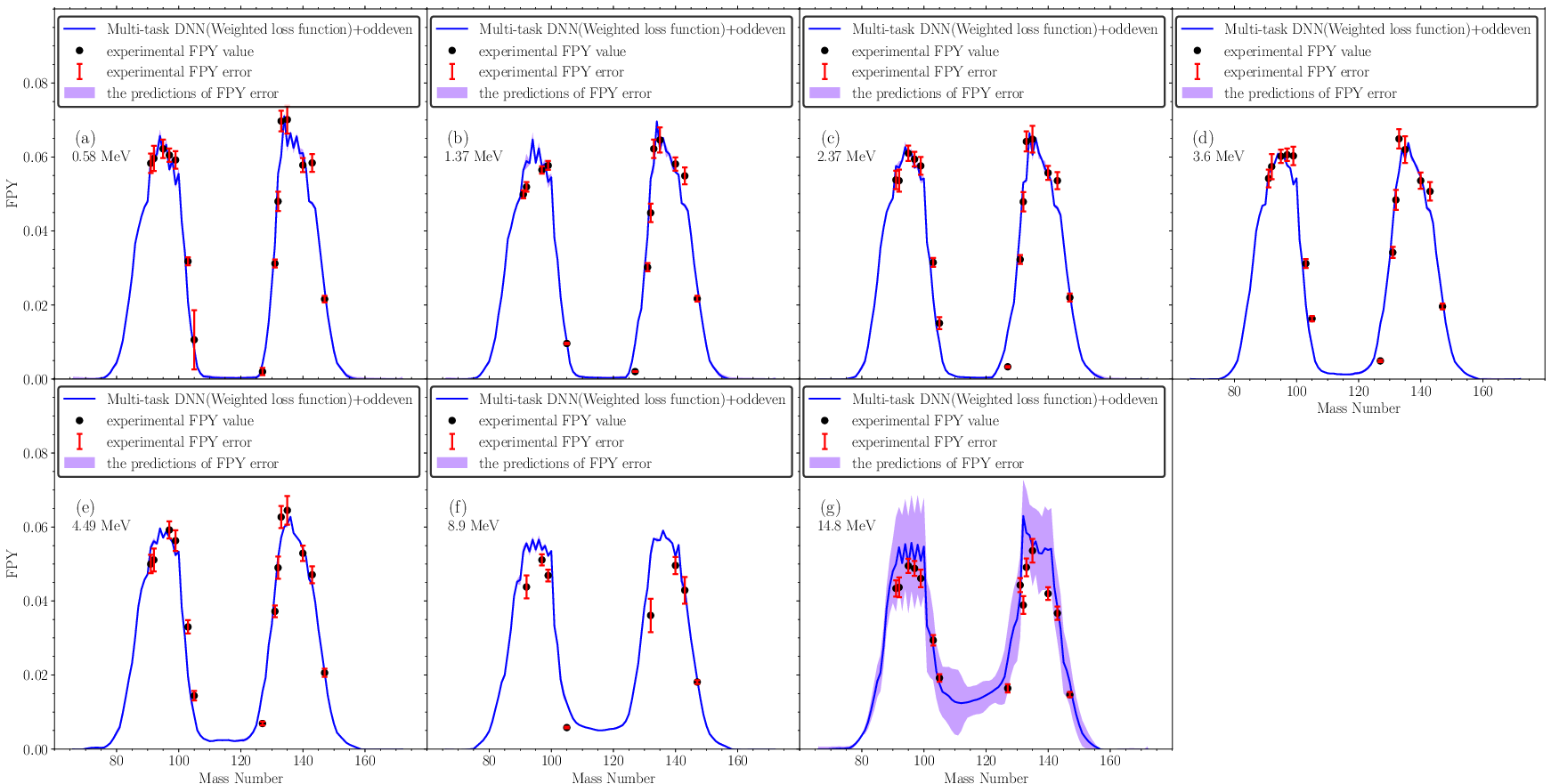
Figure 5: Compiled evaluations of FPY and FPY error for (N)9U over continuous neutron energy range, showcasing accurate energy-dependent evolution and error estimation.
The protocol for supplementary data generation and the effect on predictive robustness at unmeasured energies are also systematically addressed. As excitation energy increases, the predicted yield distribution appropriately broadens, peak-to-valley ratios decrease, and the uncertainties reflect the absence or presence of high-quality error covariance matrices, reproducing established nuclear phenomenology.
Implications for Nuclear Data Science and Future AI Development
This work provides a compelling case for the adoption of multi-task deep learning strategies in nuclear data evaluation and uncertainty propagation, particularly in domains where statistical dependencies among observables are enforced by physics-based constraints (mass/charge conservation, covariance structure, pairing). The MMoE paradigm, when combined with domain-adapted loss engineering and physicochemical feature encoding (e.g., parity), offers clear advantages for high-precision, non-smooth target regression—an area where standard Gaussian-process-inspired BNNs are less effective.
The simultaneous prediction of FPY and error has practical engineering implications: improved reliability in reactor inventory, radiological safety margin estimation, and regulatory assessment for fuel cycles and waste streams. The reduced rate of non-physical predictions and enhanced peak accuracy are critical for applications where safety analysis is sensitive to rare and extreme events.
Theoretically, these results demonstrate that deep architectures with dynamically shared experts and multi-task heads can flexibly accommodate data regimes with localized, physically motivated discontinuities and strong cross-observable coupling. Future AI developments in nuclear science will benefit from further systematic integration of physical constraints (conservation laws, sum rules), simulation-based augmentation for uncertainty estimation in data-poor regimes, and advanced calibration of multi-task objectives for other correlated observables (e.g., isomeric yields, delayed neutron fractions). Moreover, extending validation to minor actinides and rare isotopes remains a clear next step, contingent on future experimental campaigns.
Conclusion
The paper establishes that a multi-task DNN based on the MMoE architecture, enriched with a peak-sensitive loss and explicit odd-even input encoding, can quantitatively outperform BNNs and standard DNNs for the simultaneous prediction of fission product yields and their evaluated uncertainties in nuclear data libraries. This work provides a validated and scalable framework for joint regression of correlated nuclear observables in peak-shaped regimes and aligns with known physical mechanisms of fission. The methodology is broadly extensible to other fields involving correlated scientific data with structured uncertainties and strong physical constraints (2603.29100).