- The paper introduces the ω-Approximate Master Equation (ωAME) framework to reveal how dynamic group interactions drive multistable contagion transitions.
- It shows that temporal reshuffling leads to a non-monotonic invasion threshold, identifying an optimal mixing rate for enhanced spreading.
- Real-world data analysis demonstrates that ignoring dynamic group behavior underestimates critical contagion thresholds and misleads outbreak predictions.
Group Dynamics Shape Contagion Onset and Multistability under Collective Reinforcement
Introduction
This paper systematically investigates the coupling of group dynamics and higher-order contagion mechanisms, challenging the simplifying assumption of static or rapidly mixing group configurations often employed in complex contagion models. Through the introduction of a tractable analytical framework—the ω-Approximate Master Equation (ωAME)—that interpolates between the quenched and annealed limits, the authors uncover the profound impact of temporal group composition changes on macroscopic contagion transitions. The analysis is extended to both synthetic structures and real-world face-to-face interaction data, detailing how group switching, synergistic reinforcement, and underlying group-size/membership heterogeneity interact to qualitatively reshape the phase diagram, often inducing non-trivial multistability and novel critical phenomena.
The core model assumes a population partitioned into dynamically evolving groups, with individual group memberships described by a distribution {gk} and group sizes by {pn}. Infection dynamics are governed by a higher-order process where a susceptible in a group of size n with i adopters adopts at rate β(n,i)=λiν, introducing a synergy exponent ν that modulates nonlinear reinforcement strength. Individuals recover at rate μ, and, critically, groups are dynamically altered as individuals swap between them at rate ω.
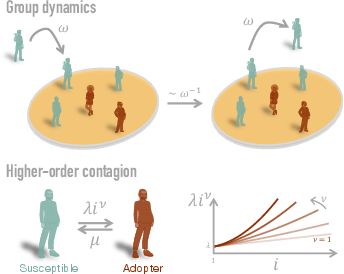
Figure 1: Schematic of the temporal higher-order contagion model, illustrating infection, recovery, and group switching processes parameterized by λ, ν, {pn}0, and {pn}1.
The ωAME formalism explicitly tracks the densities of susceptibles by membership degree and group configurations by the number of adopters, enabling self-consistent calculation of stationary prevalence {pn}2 which serves as the order parameter diagnosing macro-level system states and transitions.
Critical Behavior and Transition Phenomenology
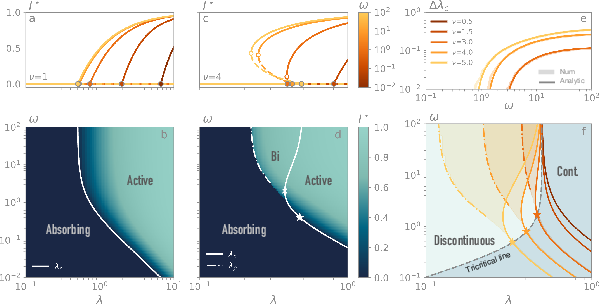
Through both analysis of the ωAMEs and stability/bifurcation theory, the paper demonstrates that temporal group reshuffling fundamentally rewires the critical behavior and stability structure of higher-order contagion:
Temporal reshuffling can thus both aid and inhibit spreading, depending on parameterization, which is in strong contrast to classical results for pairwise contagion on temporal networks.
Multistability and the Role of Structural Heterogeneity
Incorporating realistic group-size and membership heterogeneity, as measured in empirical datasets of human interaction, yields an even richer bifurcation landscape. The interplay between collective reinforcement, temporality, and mesoscopic structural localization induces:
- Multiple active states: Not only classical absorbing-active bistability, but also secondary bifurcations with coexisting delocalized and localized endemic branches.
- Hybrid transitions: Cases of continuous onset with concurrent bistability among active states, and regimes with triply-coexisting solutions (the absorbing state and two distinct active branches).
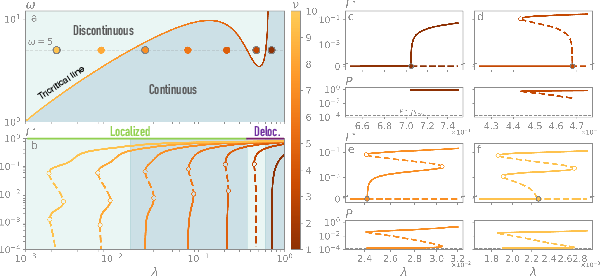
Figure 3: Bifurcation diagrams from empirical high school contact data illustrate tricritical lines, stationary prevalence curves, and localization (participation ratio) of activity across four dynamical regimes: continuous, discontinuous, hybrid with active bistability, and hybrid with discontinuous onset.
This multistability is absent in both the static/quenched and fully-annealed/mean-field limits, illustrating the crucial and non-perturbative effect of realistic group dynamics. The emergence and structure of these regimes depend systematically on measurable quantities such as group switching rate, group-size distribution, and membership distribution.
Empirical Systems and Dynamical Classification
By analyzing diverse real-world datasets—each characterized by empirical group switching rates and structural heterogeneity—the paper positions each system on a landscape of tricritical boundaries. The transition class for a given context is dictated not only by structure, but primarily by the ratio of group dynamical timescales (n6) to contagion timescale (n7).
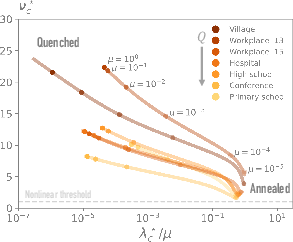
Figure 4: Tricritical points across a range of group switching and contagion timescales for multiple real-world datasets, demonstrating dependence of critical behavior on the effective structural coupling n8 and synergy exponent n9.
Empirically observed group switching rates often place real systems in regimes where discontinuous (potentially explosive) transitions are only accessible for very strong synergy exponents—much stronger than previously anticipated by static or mean-field analyses. This result demonstrates that static representations dramatically underestimate the reinforcement strength needed for bistability and explosion in realistic settings.
Mechanistic Insights and Contrasts
A key mechanistic result is the identification of a non-monotonic threshold minimum at a system-specific optimal i0, emphasizing that both too little and too much group reshuffling can suppress contagion. Furthermore, the work reconciles previously conflicting reports regarding the effect of temporality in higher-order contagion—demonstrating that the apparent suppression observed in prior studies is a result of model artifacts (e.g., temporal rewiring not preserving degree sequences) rather than a genuine effect of group dynamics itself.
Implications and Future Directions
The findings have direct implications for epidemic modeling, information diffusion, and any analysis of collective dynamics in group-structured systems:
- Theoretical: Temporality and structure are inseparable determinants of critical transitions in higher-order systems. Aggregate or static reductions fail to capture not only quantitative thresholds but the very nature (order and multiplicity) of macroscopic transitions.
- Methodological: Empirical studies must integrate temporal information to accurately infer system-level properties. Aggregated hypergraphs systematically misestimate both thresholds and phase structure.
- Practical: The possibility of multiple endemic states, contingent on group switching rate and heterogeneity, underscores the necessity of controlling both dynamical and structural aspects in interventions (e.g., social distancing, group partitioning).
The framework invites extensions incorporating adaptive group switching, memory, behavioral feedback, and other non-Markovian effects, likely revealing further novel critical phenomena. Its generality makes it applicable to an array of temporally evolving higher-order network processes beyond contagion, from consensus and cooperation to polarization.
Conclusion
This work rigorously demonstrates that group dynamics, when coupled with higher-order synergistic contagion, are first-order determinants of macroscopic transition classes and the emergence of multistability. Neglecting temporality in the analysis of higher-order processes leads to qualitatively and quantitatively erroneous predictions regarding both the onset of global contagion and the repertoire of attainable active phases. The presented ωAME framework establishes a benchmark for analyzing real-world group-structured systems, emphasizing temporality as an intrinsic axis, rather than a secondary correction, of complex social, biological, and technological contagion phenomena.