A connection between Gravitational Scalar-Tensor theories and Generalized Hybrid theories
Published 30 Mar 2026 in gr-qc | (2603.28497v1)
Abstract: We establish a correspondence between higher-derivative gravitational scalar-tensor theories of the form $Ψ(R,(\nabla R)2,\Box R)$ and generalized hybrid metric-Palatini models $f(R,\mathcal{R})$. Restricting to the physically relevant case of linear dependence on $\Box R$, we make explicit that both frameworks can be reformulated in the Einstein frame as General Relativity minimally coupled to two interacting scalar fields, thereby opening the possibility of finding theories that are dynamically equivalent. This correspondence provides an explicit dictionary relating the functions that define the higher-derivative theory to the hybrid function $f(R,\mathcal{R})$, allowing for reconstruction in both directions. We illustrate the usefulness of the procedure with explicit examples.
The paper presents an explicit correspondence between ghost-free GST theories and generalized hybrid models, ensuring equivalent Einstein frame representations.
It provides a constructive dictionary that maps Lagrangian functions and scalar field potentials via auxiliary fields and conformal transformations.
The work reinforces the applicability of these mappings to diverse cosmological backgrounds, opening avenues for observational tests in modified gravity.
Correspondence Between Gravitational Scalar-Tensor Theories and Generalized Hybrid Theories
Introduction
The paper "A connection between Gravitational Scalar-Tensor theories and Generalized Hybrid theories" (2603.28497) establishes an explicit mapping between ghost-free classes of gravitational scalar-tensor (GST) theories—those of the form Ψ(R,(∇R)2,□R) with linear dependence on □R—and the so-called generalized hybrid (GH) metric-Palatini models, characterized by a Lagrangian f(R,R) dependent on both the metric and Palatini curvature scalars. Both classes are shown to be dynamically equivalent, each admitting a reformulation in the Einstein frame as General Relativity (GR) minimally coupled to two real scalar fields with nontrivial kinetic couplings and potentials. The paper delivers a constructive "dictionary," providing a formal method to move between GST and GH representations and systematically translating physical results between these frameworks.
Formulation of Ghost-Free GST Theories
The class of ghost-free GST theories is defined by Lagrangians with linear dependence on □R, with the general form
Ψ(R,(∇R)2,□R)=K(R,(∇R)2)+G(R,(∇R)2)□R
where K and G are arbitrary functions as long as Ψ is linear in □R. Using standard reduction by auxiliary fields and conformal transformations, these theories admit an Einstein frame representation with two interacting scalar fields and a manifestly positive-definite kinetic matrix, thus eliminating Ostrogradski ghosts (see [Naruko et al. 2016]). After suitable field redefinitions (expressed via invertible maps), the resulting action takes the generic multi-scalar-tensor form: S=∫d4x−g^[2κ21R^−21(∇^χ)2−21e−32κχ(∇^σ)2−W~(χ,σ)]
where the explicit structure of the potential □R0 is determined by the choice of □R1 and □R2.
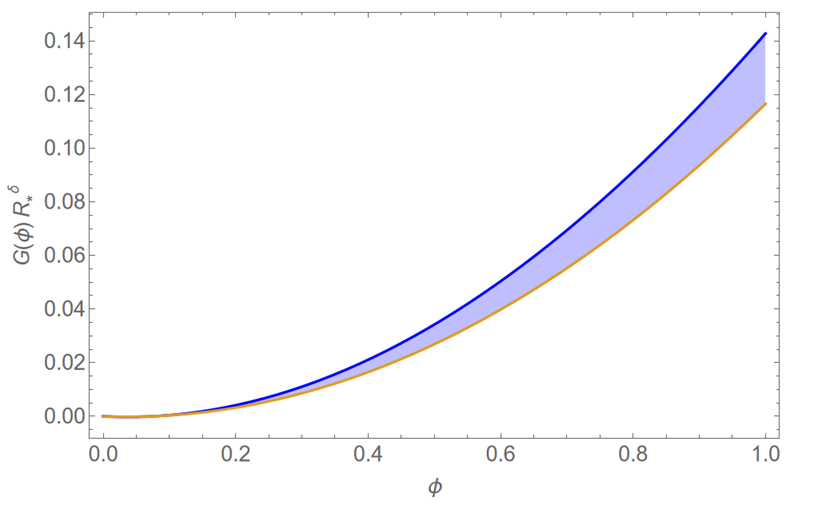
(Figure 1)
Figure 1: Rescaled deviation □R3, showing the stability of the first-order approximation for the scalar field map □R4; deviations are small over a broad parameter regime.
Generalized Hybrid Theories and Scalar-Tensor Representation
Generalized hybrid (GH) theories are based on an action driven by □R5, where □R6 is the usual metric Ricci scalar and □R7 is a Ricci scalar built from an independent (Palatini-type) connection. The Euler-Lagrange equations for the metric and independent connection reveal that, under reasonable (non-singular Hessian) conditions on □R8, these theories also propagate two extra dynamical scalar degrees of freedom. Upon introduction of auxiliary scalar fields and appropriate conformal transformation to the Einstein frame, the GH theory action reproduces the same canonical bi-scalar-tensor structure as the Einstein-frame GST models: □R9
where the only difference from the GST case arises in the details of the scalar potential, determined by f(R,R)0.
Explicit Mapping and Reconstruction Procedure
The core contribution of the paper is to build an explicit mapping, or "dictionary," between the two frameworks:
GST f(R,R)1 GH (Forward Path): Given a ghost-free GST theory specified by functions f(R,R)2, f(R,R)3, and f(R,R)4, one obtains the scalar-tensor representation in the Einstein frame. The fields f(R,R)5 and f(R,R)6 (via a logarithmic function of f(R,R)7-derivative terms) are related to the GH scalar field pair. The corresponding f(R,R)8 is reconstructed by equating the Einstein frame potentials and solving a Clairaut-type partial differential equation.
GH f(R,R)9 GST (Inverse Path): Given a GH model and an explicit cosmological or scalar field solution, one reconstructs the functions □R0, □R1, and □R2 such that the GST theory yields the required background evolution and scalar field dynamics. This typically involves inversion of auxiliary field maps and matching of kinetic sectors and potentials.
Figure 2: Schematic representation of the correspondence between the □R3 (GST) and □R4 (GH) formulations, illustrating forward and inverse reconstruction pathways.
The mapping shows that theories such as □R5 are dynamically equivalent to the hybrid form □R6, verifying the correspondence at the level of physical solutions and ghost-free kinetic structure. Similar correspondences are established for more general models with kinetic or higher-derivative couplings, and for classes with nontrivial cosmological backgrounds (e.g., quasi-de Sitter or matter-dominated expansion).
Selected Strong Results and Explicit Examples
The explicit reconstruction of a GH theory equivalent to the GST model □R7 results in an □R8 of cubic form with exact matching of scalar-tensor dynamics.
For quasi-de Sitter or matter-dominated expansion backgrounds, the paper demonstrates how to determine or reconstruct the functional degrees of freedom in GST or GH models to realize the desired cosmological dynamics while keeping the kinetic terms manifestly healthy.
A robust claim in the paper is that all physical solutions of ghost-free GST theories with linear □R9 dependence are also solutions to the corresponding GH theory under the established dictionary, and vice versa.
Reconstruction is demonstrated for non-trivial background evolution, with the estimation and control of errors (as shown in Figure 1), reinforcing the reliability of the dictionary in the applicable parameter regime.
Implications and Future Directions
The formal correspondence introduced between these two classes of modified gravity models provides not only a tool for theoretical investigation—allowing techniques and results from one context (e.g., solution techniques or stability criteria for GST models) to be ported to the GH framework—but also practical implications for cosmological model-building. In particular, exact background evolution or phenomenological constraints can be targeted through systematic reconstruction, and observables derived in either GST or GH language can be compared transparently.
From a theoretical perspective, these equivalences deepen the understanding of the landscape of scalar-tensor and higher-derivative gravities, clarifying the interrelations and redundancies among seemingly distinct model classes. The formalism may be extended to investigate strong gravity (black holes, wormholes), cosmological perturbations, and the weak-field/solar-system regime. Additionally, the approach could inform parameter constraints or model selection in gravitational wave astrophysics and cosmological data analyses.
Conclusion
The paper provides a comprehensive, technically rigorous correspondence between ghost-free gravitational scalar-tensor and generalized hybrid metric-Palatini theories, establishing explicit translation procedures between their Lagrangian functions and scalar-tensor representations. This mapping ensures that these two frameworks, though originating from distinct principles (higher-derivative metric theories and hybrid metric-affine constructions), can be considered dynamically equivalent under broad and physically relevant conditions. The constructed dictionary facilitates cross-fertilization of theoretical and phenomenological results and opens new opportunities for systematically exploring the consequences of extended gravity theories in both theoretical and observational settings.