Negative energies and the breakdown of bulk geometry
Published 26 Mar 2026 in hep-th, gr-qc, math-ph, and quant-ph | (2603.25782v1)
Abstract: One central question in quantum gravity is to understand how and why predictions from semiclassical gravity can break down in regimes with low spacetime curvature. One diagnostic of such a breakdown is that states which are orthonormal at the semiclassical level can receive large corrections to their inner products from quantum fluctuations. We study this effect by examining inner products in pure 2D JT gravity. Previous work showed that black hole states with long interiors exhibit a breakdown at length scales of order $e{S_0}$, where $S_0$ is a parameter analogous to $1/G_N$ in higher dimensions. This breakdown is caused by the discreteness of the spectrum of the dual boundary random matrix theory. We show that the full sum over quantum fluctuations indicates a more dramatic breakdown at parametrically shorter lengths of order $e{S_0/3}$. In the dual boundary description, these corrections arise from negative energy states appearing in rare members of the random matrix ensemble. These results demonstrate that non-perturbative effects can invalidate the semiclassical description at much smaller length scales than previously expected, providing a new mechanism for the breakdown of effective gravitational theories.
The paper identifies that rare negative energy states induce large corrections in semiclassical state overlaps, leading to a breakdown at scales ~e^(S0/3).
It uses a resummation of higher-genus contributions in the Euclidean path integral to reveal an exponential enhancement tied to the Airy regime in the spectrum.
The findings challenge conventional gravity models by demonstrating that semiclassical bulk geometry has a limited validity, requiring refined definitions of geometric observables.
Negative Energies and the Breakdown of Bulk Geometry in JT Gravity
Introduction and Context
The investigation of quantum corrections to semiclassical gravity has advanced substantially through the lens of the AdS/CFT correspondence, especially in lower dimensions where holographic dualities are under fine control. The paper "Negative energies and the breakdown of bulk geometry" (2603.25782) confronts the question of how and when the semiclassical picture of gravity fails, even in the absence of large curvatures, focusing specifically on pure JT gravity. Semiclassical intuition posits that Hilbert space pathologies—such as significant corrections to inner products between distinct semiclassical states—arise only at parametrically large scales, typically set by the entropy parameter S0. However, this work identifies a new, nonperturbative mechanism by which the effective description of bulk geometry becomes invalid at substantially shorter geodesic lengths than previously recognized.
Semiclassical State Overlaps and Quantum Corrections
The analysis centers around the inner products of ∣ℓ⟩ states—eigenstates of fixed geodesic length between the two asymptotic boundaries in JT gravity—within both the effective (semiclassical, continuous spectrum) description and the "fundamental" (random matrix, discrete spectrum) ensemble. The conventional expectation, based on Hilbert space dimension counting and the "null-state" argument, posits that significant deviations only appear for ℓ∼eS0. This intuition is rooted in the finite number of orthogonal boundary states available at finite S0.
Contrary to this, the paper establishes the existence of corrections to the inner products ⟨ℓ∣V†V∣ℓ′⟩ that become large at the parametrically smaller scale ℓ∼eS0/3. These corrections are sharply nonperturbative, dominating at length scales where the perturbative genus expansion remains controlled. The result relies on a detailed resummation over all topologies in the Euclidean gravitational path integral, combined with an exact calculation of ensemble-averaged quantities in the dual random matrix theory.
Figure 1: Bulk and boundary descriptions of the ∣ℓ⟩ states in JT gravity highlight the competing bases (length and energy) relevant in the analysis.
The Role of Negative Energy States
A key technical finding is that, in the random matrix realization of the dual, rare members of the ensemble possess negative energy states at E∼−e−2S0/3. Although these states are exponentially suppressed in the density, their overlaps with ∣ℓ⟩ scale as eℓ∣E∣, causing a nonperturbative enhancement for large ∣ℓ⟩0. The systematic inclusion of these rare, negative energy contributions in the ensemble average yields the explicit exponential growth
∣ℓ⟩1
valid for ∣ℓ⟩2. The variance is even more pronounced:
∣ℓ⟩3
reflecting the dominance of rare statistical fluctuations due to negative energies.
Figure 2: Different density of states realizations in JT gravity. The finite ∣ℓ⟩4 ensemble average (orange) shows "Airy regime" negative energies, which are responsible for the nonperturbative corrections at ∣ℓ⟩5, while typical discrete spectra (red) and large ∣ℓ⟩6 limits (blue) miss this effect.
Bulk-Path Integral and Genus Resummation
In the gravitational path integral, these corrections are not visible at any fixed genus but only emerge upon resumming the infinite series of higher-genus corrections. Formally, the calculation reduces to a weighted sum over Weil-Petersson volumes, with definite scaling in genus ∣ℓ⟩7 and boundary geodesic lengths. The proliferation of higher-genus "wormhole" topologies becomes competitive with their exponential suppression at ∣ℓ⟩8. This regime, controlled by the universal Airy behavior near the spectrum edge, dictates the breakdown of bulk geometry.
Boundary Perspective: Random Matrix Theory
On the boundary, the random matrix model dual yields a sharp interpretation. Most ensemble members possess a strictly positive spectrum; however, a non-negligible fraction have one or a few negative energy eigenvalues. The exponentially enhanced inner product response to these states is captured analytically using the Airy density of states and its kernel:
∣ℓ⟩9
which admits negative support. The saddle point of the crucial integrals, governing the behaviors above, indeed lies at negative energy.
At even larger geodesic lengths ℓ∼eS00, non-perturbative instanton effects manifest, modifying the spectral density in the complex plane. The authors derive, for ℓ∼eS01, an oscillatory, exponentially growing behavior in the inner product:
ℓ∼eS02
with potential for negative norms and null states at fine-tuned values.
Figure 3: The complex energy integration contour ℓ∼eS03 (blue) and associated saddle points (red) relevant for the instanton-dominated regime beyond the Airy scaling region.
Dynamical Implications: TFD Length Growth
A dynamical application is the length operator in the thermofield double (TFD) state, dual to the eternal AdSℓ∼eS04 black hole wormhole. Semiclassically, the geodesic length between boundaries grows linearly with time. In the fundamental Hilbert space, accounting for negative energies using the path integral prescription leads to a divergent expectation value of length for all times—there is no saturation at late times, and quantum corrections dominate over the classical result even at early times:
ℓ∼eS05
demonstrating that the geometric operator's definition is subtle in quantum gravity, especially in the presence of negative energy states.
Theoretical and Practical Implications
Theoretical implications:
The breakdown scale of the semiclassical Hilbert space is set nonperturbatively by the rare (but not exponentially suppressed) presence of negative energy states, reducing it from ℓ∼eS06 (expected from argument by null states) to ℓ∼eS07.
These effects are invisible at any fixed order in genus and only arise upon resumming the path integral, or equivalently, in the boundary by inclusion of the Airy regime’s tail.
The dominance of rare-in-ensemble events for certain observables illustrates that semiclassical gravity’s regime of validity is more restricted than previously argued from effective field theory or complexity bounds.
Practical implications:
For computations of physical observables in the dual, such as length or complexity in black hole geometries, care must be taken in operator definitions, as naive path integral insertions may yield divergent or unphysical results.
Nonperturbative completions of JT gravity that do not admit negative energies (e.g., double scaling limits with restricted spectra) would not manifest the exponential growth mechanism described, and exploring their bulk duals is an open avenue.
Future directions:
Extending the analysis to scenarios with matter, higher spin, or higher-dimensional analogs (such as the Schwarzian sector of 3D gravity) to probe the generality of the negative-energy-driven breakdown.
Developing a rigorous operational definition of geometric observables in the quantum theory, possibly based on Hilbert space orthonormalization procedures (e.g., Gram-Schmidt), which remain consistent with nonperturbative boundary effects.
Investigating the interplay between this mechanism and other known breakdowns such as complexity saturation and firewall paradoxes.
*Figure 4: The real part (a) and oscillatory structure (b) of the exponent for the instanton-dominated inner product integral, demonstrating the transition to the large amplitude, oscillatory regime at ℓ∼eS08. *
Conclusion
This work conclusively identifies a novel mechanism for the breakdown of bulk geometry in JT gravity, driven not by the finite size of the Hilbert space or complexity saturation but by nonperturbative quantum effects associated with negative energy states in the dual random matrix model. The onset of this breakdown at ℓ∼eS09 implies new care is needed in understanding the quantum-to-classical transition and the regime of validity for semiclassical geometric operators in quantum gravity. Given the universality of the Airy regime in matrix models, these phenomena are likely relevant broadly in low-dimensional holography and potentially in controlled subsectors of higher-dimensional gravity.
“Emergent Mind helps me see which AI papers have caught fire online.”
Philip
Creator, AI Explained on YouTube
Sign up for free to explore the frontiers of research
Discover trending papers, chat with arXiv, and track the latest research shaping the future of science and technology.Discover trending papers, chat with arXiv, and more.
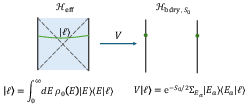
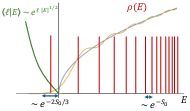
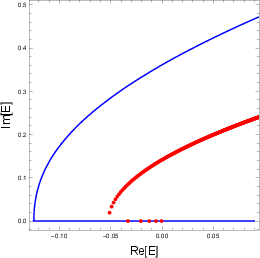
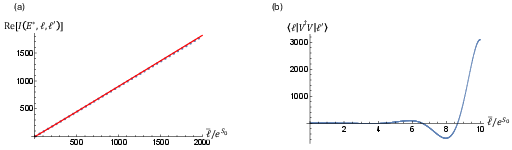 *Figure 4: The real part (a) and oscillatory structure (b) of the exponent for the instanton-dominated inner product integral, demonstrating the transition to the large amplitude, oscillatory regime at
