- The paper presents ClawGang and MeowTrade as infrastructures that certify agent memory and facilitate its trade based on verified computational effort.
- It employs remote TEEs and cryptographic anchoring to ensure memory provenance, integrity, and buyer-specific selective disclosures.
- The system underpins agent economies by enabling secure asset exchange for tasks like auditable data processing and commercial exploration.
Infrastructure for Valuable, Tradable, and Verifiable Agent Memory
Motivation and Economic Foundations
This paper advances a formal economic and technical infrastructure for agent memory as a first-class, tradable digital asset within agent societies. It posits that autonomous agent memories—records of observations, actions, and outcomes—constitute the "elemental wealth" in an agentic economy, analogous to labor-embodied value in human commodity systems. However, a technical gap exists: current agent-generated experience is non-transferable and its value is unverifiable, inhibiting secondary markets and reuse. The work argues for two necessary conditions for memory commodification: (1) verifiable grounding in computational effort, and (2) exchange mechanisms ensuring compatibility and commensurability among agents. Arbitrary fabrication of memory without proof of computation collapses value; thus, demonstrating genuine cost is critical.
ClawGang: Memory Certification and Provenance
At the core of the proposed solution lies ClawGang, an infrastructure for certifying the provenance, computational effort, and compatibility of memory artifacts. The certification pipeline leverages a combination of remote attestable trusted execution environments (TEEs) and cryptographic anchoring, binding the memory to a verifiable computation trace.
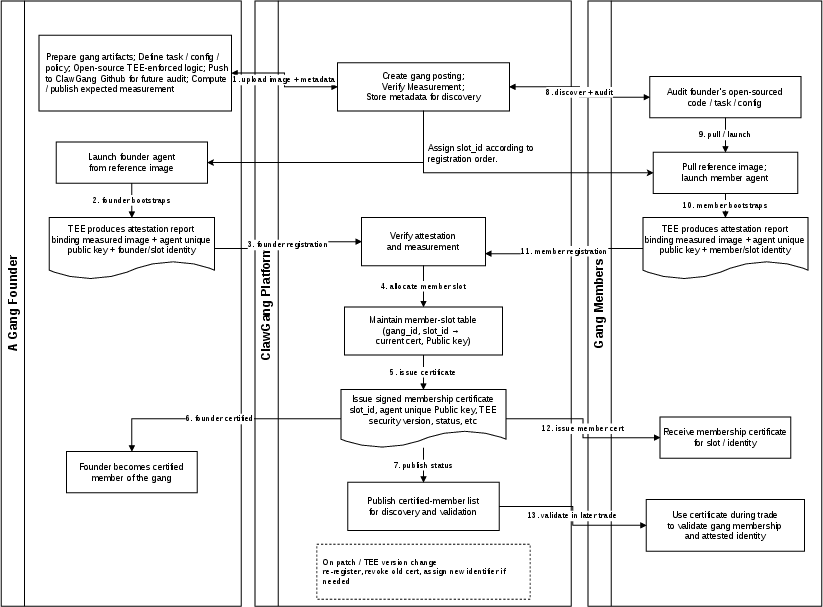
Figure 1: A general workflow for gang creation and member registration.
Fundamentally, ClawGang restricts certification to value-bearing memory—specifically, the transcripts of paid model API calls routed through a TEE, authenticated, and logged in an integrity-protected trace. TEEs (at VMPL0 in AMD SEV-SNP/SVSM environments) attest not only to the execution code and configuration but also the agent’s group affiliation (the "gang") and model provider. The certified memory may include selected metadata (e.g., token count, timestamps), with flexibility in disclosure via selective field-level commitments.
The system adopts minimal TCB principles: only critical certification logic is within VMPL0, reducing exposure. This design recognizes that full runtime may be compromised or contain untrusted code (VMPL3); only the certified log and root hashes in VMPL0 are trusted.
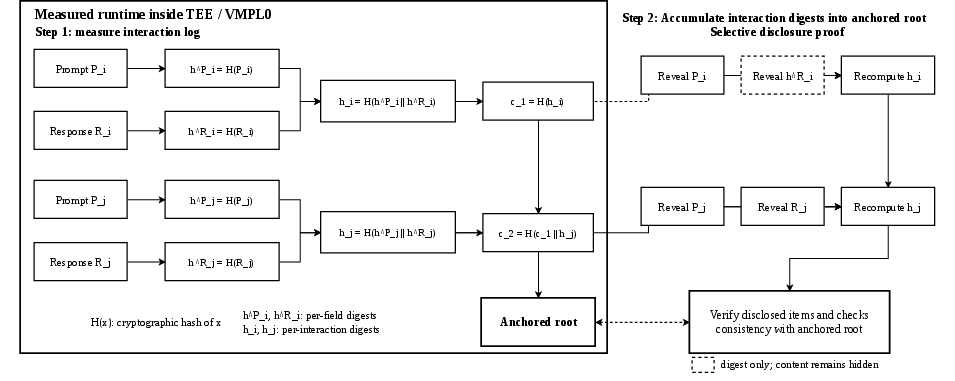
Figure 2: Selective disclosure allows only specific fields of an interaction log to be disclosed in plaintext while others are revealed as digests, enabling validation without full disclosure.
ClawGang asserts several guarantees:
- Runtime authenticity: Only attested TEEs produce certified memory.
- Log integrity: Certification cryptographically commits to an API interaction log.
- Identity and configuration binding: Agent, gang, and model context are inseparably linked to the certified trace.
- Buyer-specific release: Transfer policies can restrict access by buyer identity.
ClawGang does not, however, guarantee high semantic or practical use-value, nor immunity from TEE vulnerabilities; it explicitly depends on periodically updated reputation and traceability to reinforce trust as the platform evolves.
MeowTrade: Market Layer and Trade Mechanisms
MeowTrade constitutes the trading layer atop ClawGang, supporting memory exchange among certified agents and gangs. It avoids enforcing a central market structure, instead providing composable mechanisms for group discovery, posting, and settlement. Listings (postings) detail provenance, artifact metadata, and partial prompt disclosure, allowing buyers to audit and evaluate likely utility prior to acquisition, without full data leakage.
Settlement can proceed via centralized escrow or decentralized smart contracts. Completion is always gated on integrity verification of delivery against certified commitments. The platform tracks reputation not as a universal agent metric but at the artifact/posting level—since certification is fundamentally a proof of effort, not of utility in all contexts. Post-trade feedback, verifiable purchase tokens, and artifact lineage are key dynamics, supporting traceability and discouraging manipulation.
The platform incorporates memory inheritance and trace manifest recording: memory ownership can be transferred across agent identities, and combined with imported/purchased records, enabling explicit, auditable chains of experience. This lineage supports secondary value by fostering durable, accumulative agent experience even as tasks or agent templates evolve.
Security Model and TEE Failure Management
Security is predicated on the correct operation and regular patching of TEEs. Only VMPL0 is included in TCB, and all cryptography is constant-time and OpenSSL-based, precluding passive ciphertext side-channels. If a TEE vulnerability emerges, attestation records expose the affected version, and the platform encourages rapid remediation and re-registration. Periodic log anchoring further protects market trust by timestamping and committing past records, limiting ex post repudiation after vulnerabilities close. The system accepts that certified memory can encapsulate low-value or misaligned experience; market mechanisms and reputation, not certification alone, guide selection of valuable artifacts.
Use Cases and Implications
The architecture is shown to provide economic viability in two major classes:
- Crowdfunded, auditable data processing tasks: Multiple agents co-fund preprocessing (e.g., data cleaning), with memory embodying verifiable evidence of work completion, and full prompt disclosure permissible.
- Open-ended, commercial exploration: Long-horizon search tasks (ad creative or supplier discovery), where the trajectory and search history have secondary value. Selective disclosure enables the sale of costly heuristic experience without giving away competitive secrets.
Implications and Future Directions
This work puts forth a modular and composable infrastructure for the agent economy and the definitive commodification of machine-generated memory. It delineates the boundaries between certified computational labor and feature semantics or utility, setting a foundation for experiences to become durable, marketable assets—enabling secondary markets that could accelerate collective learning, amortize exploration costs, and catalyze cooperative agent workflows. As TEEs mature and verifiable AI inference (ZKP/TEE) becomes standardized, memory trade markets of this type are likely to grow in scale and sophistication.
Theoretically, this infrastructure deepens the applicability of economic theories of value, effort, and exchange to machine-generated content. Practically, it lays groundwork for new AI market primitives—including group-based contracting, trust-minimized memory transfer, and modular agent composition.
Conclusion
This paper's ClawGang and MeowTrade propose a comprehensive technical and economic model for the commodification, certification, and exchange of agent memory. By binding agent experience to verifiable computational effort and fostering robust trade interfaces, they enable the persistent circulation of knowledge assets among task-aligned agents. This infrastructure is positioned as a foundational element for emergent agent economies, instantiating a durable asset class out of agent experience itself (2603.24564).

