Geometric structures and deviations on James' symmetric positive-definite matrix bicone domain
Published 3 Mar 2026 in stat.ML, cs.CG, cs.CV, and cs.LG | (2603.02483v1)
Abstract: Symmetric positive-definite (SPD) matrix datasets play a central role across numerous scientific disciplines, including signal processing, statistics, finance, computer vision, information theory, and machine learning among others. The set of SPD matrices forms a cone which can be viewed as a global coordinate chart of the underlying SPD manifold. Rich differential-geometric structures may be defined on the SPD cone manifold. Among the most widely used geometric frameworks on this manifold are the affine-invariant Riemannian structure and the dual information-geometric log-determinant barrier structure, each associated with dissimilarity measures (distance and divergence, respectively). In this work, we introduce two new structures, a Finslerian structure and a dual information-geometric structure, both derived from James' bicone reparameterization of the SPD domain. Those structures ensure that geodesics correspond to straight lines in appropriate coordinate systems. The closed bicone domain includes the spectraplex (the set of positive semi-definite diagonal matrices with unit trace) as an affine subspace, and the Hilbert VPM distance is proven to generalize the Hilbert simplex distance which found many applications in machine learning. Finally, we discuss several applications of these Finsler/dual Hessian structures and provide various inequalities between the new and traditional dissimilarities.
The paper introduces a Finslerian structure and dual Hessian framework on James’ SPD bicone domain to facilitate geodesic computations.
It establishes tight analytical bounds comparing classical AIRM/logdet metrics with new Hilbert and bilogdet divergences.
The findings highlight significant implications for robust optimization, quantum information, and manifold learning.
Geometric Structures in James' Symmetric Positive-Definite Matrix Bicone Domain
Introduction
This paper develops novel geometric structures within the domain of symmetric positive-definite (SPD) matrices, focusing on the James' bicone parameterization of the SPD cone. SPD matrices underpin diverse applications across statistics, signal processing, finance, medical imaging, information theory, quantum theory, and machine learning. Traditionally, the SPD cone is endowed with the affine-invariant Riemannian metric (AIRM) and information-geometric log-determinant (logdet) divergence, both offering tractable dissimilarities and invariance properties.
The paper introduces two new geometric structures:
A Finslerian structure derived from the Hilbert geometry of James' VPM (variance-precision model) bicone domain.
A dual Hessian information-geometric structure based on the bilogdet (bilogarithmic determinant) barrier function.
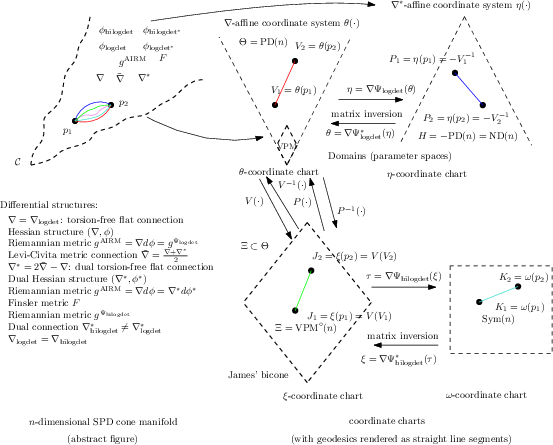
James' bicone parameterization yields a domain, VPM(n), which is bounded by extremal eigenvalues strictly in (0,1), facilitating geodesics via straight lines in suitable coordinate charts. The closure of the bicone includes the spectraplex—an affine subspace corresponding to positive semi-definite diagonal matrices with unit trace—and thus generalizes the probability simplex geometry.
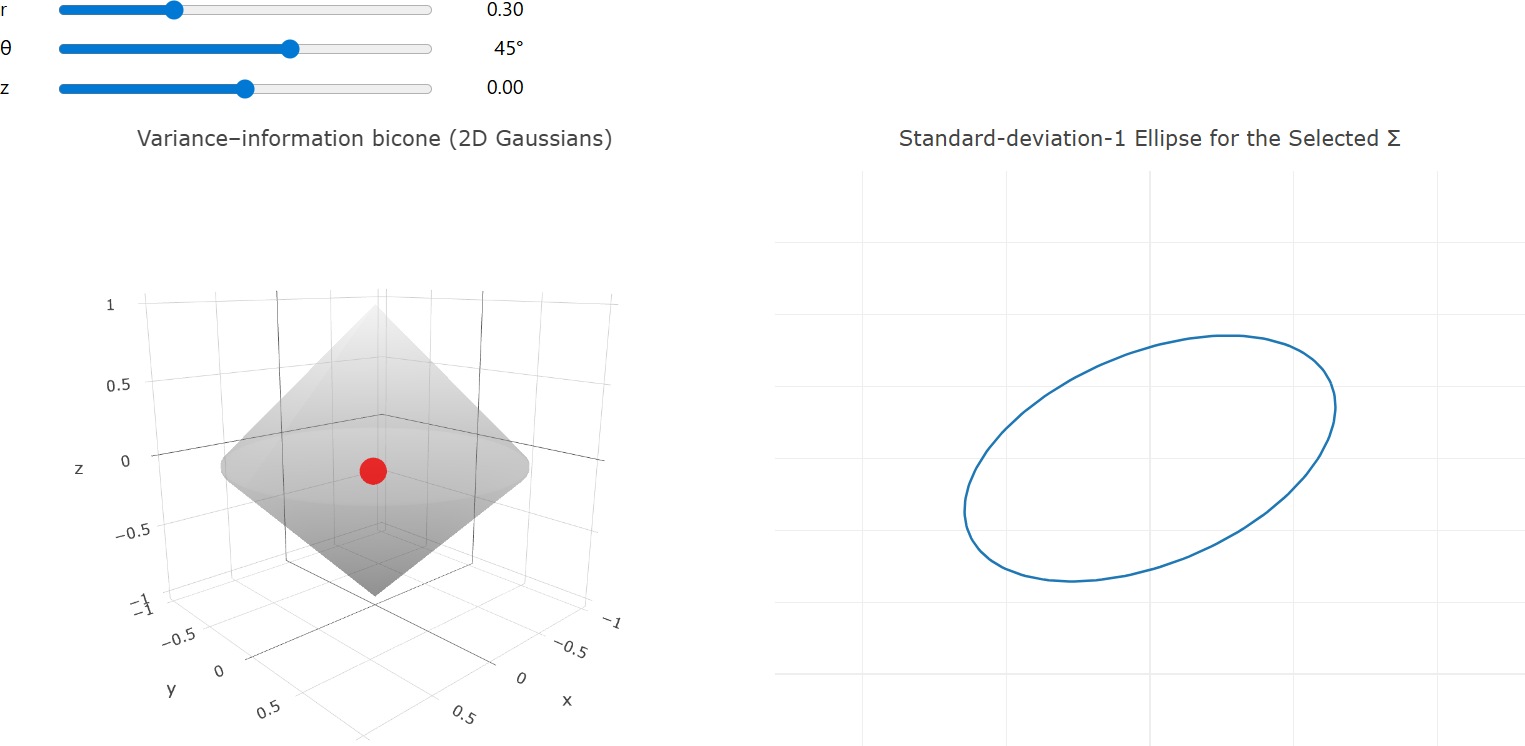
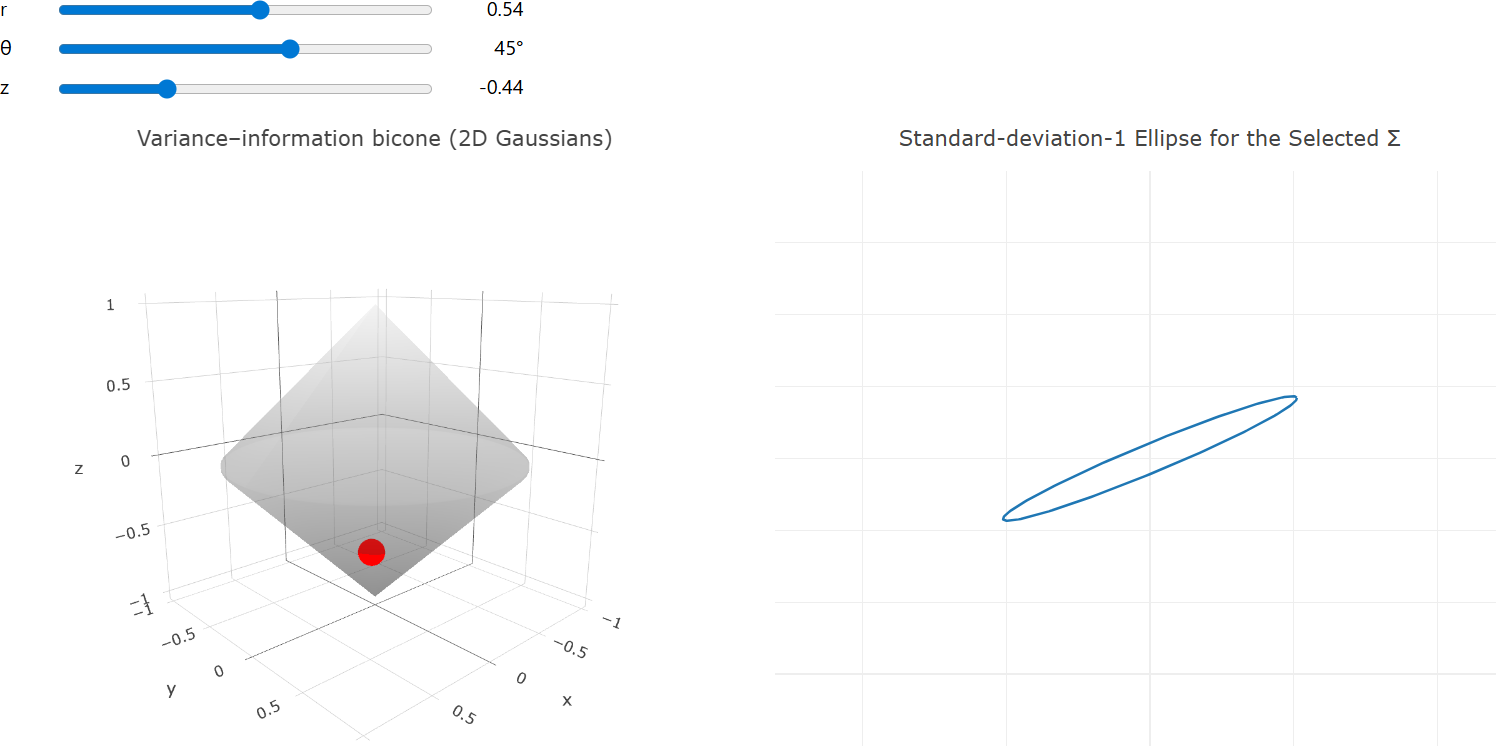
Figure 1: Screenshots of James' 3D bicone model with corresponding bivariance centered Gaussians.
Metric and Divergence Structures in SPD Geometry
Classical SPD Metrics
The affine-invariant Riemannian metric on the SPD cone PD(n) enables closed-form geodesics and distances, crucial for statistical inference and geometric learning. Its invariance under congruence and inversion aligns with covariance-based representations of Gaussian distributions. The dual information geometry rooted in the logdet function provides a Bregman divergence structure, with dually flat charts (coordinates: X and −X−1) grounded in Legendre duality.
James' Bicone Parameterization and VPM Domain
James' map realizes a diffeomorphism between PD(n) and the VPM bicone domain:
VPM(n)={X∈PD(n)∣0≺X≺I}
with mappings X↦X(I+X)−1 and X↦(I+X)−1 respectively for covariance and precision matrix normalization. Consequently, all eigenvalues λi are constrained to (0,1), facilitating bounded geometry and normalization.
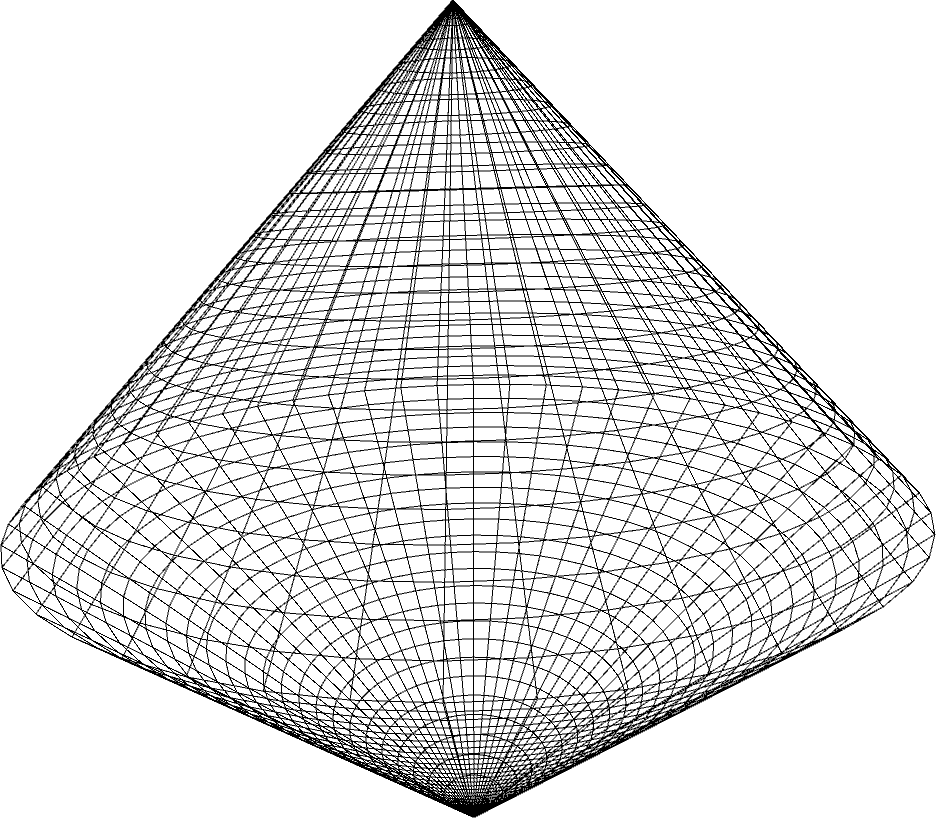
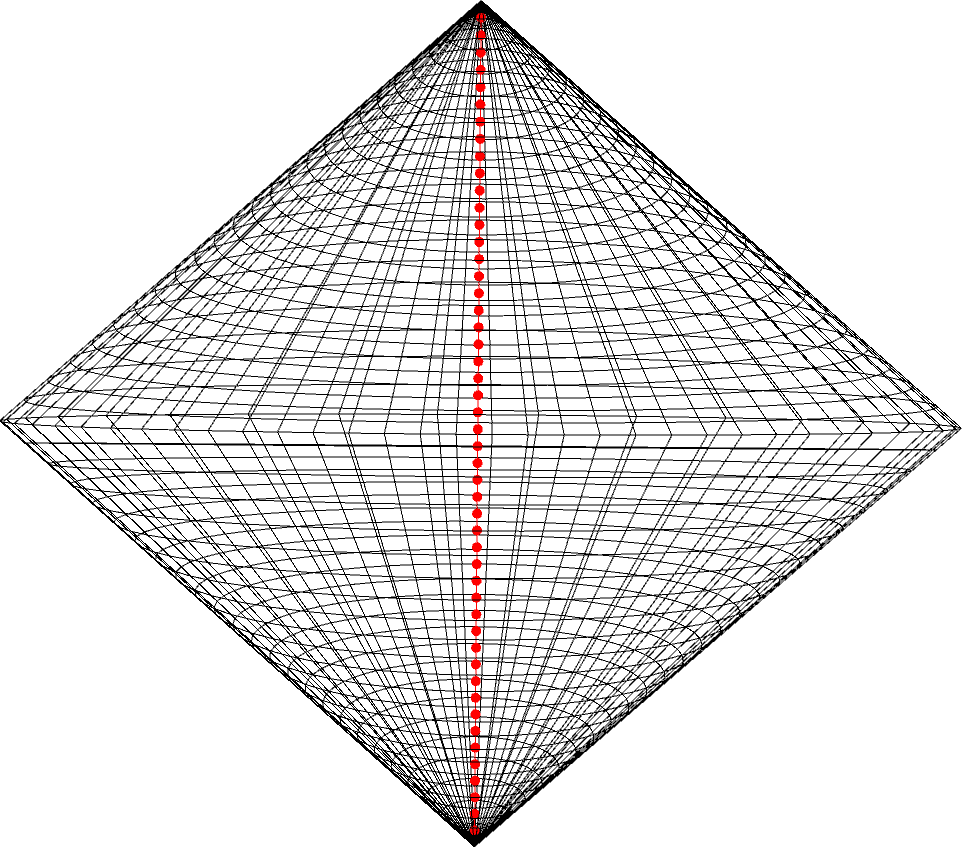
Figure 2: VPM(2) visualized as a 3D Lorentz bicone with open pregeodesic joining 0 to I.
This domain is highly relevant in quantum information theory (effect algebras for POVMs), robust control (Riccati equations), and extended Gaussian modeling (singular covariance/precision). The spectraplex arises as an affine slice of the closure, generalizing the probability simplex.
Figure 3: Dual SPD cones and their global coordinate charts via logdet and bilogdet potential functions.
Hilbert Geometry, Finsler Structure, and Bilogdet Divergence
Hilbert VPM Distance and Finsler Geometry
The Hilbert projective distance, a classical metric on bounded convex domains, is generalized to the VPM domain. For J1,J2∈VPM(n), the Hilbert distance is computed as:
with eigenvalue spreads yielding a matrix-norm representation.
This metric induces a Finsler structure, where geodesics are straight-line segments in the bicone parameterization—a crucial property for computational algorithms and robust geometric learning. The Hilbert VPM distance generalizes the Hilbert simplex distance, with the spectraplex (embedded standard simplex) forming a totally geodesic submanifold.
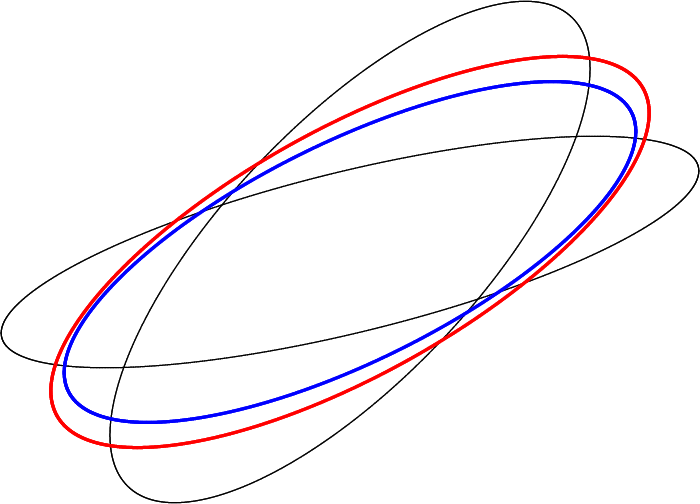
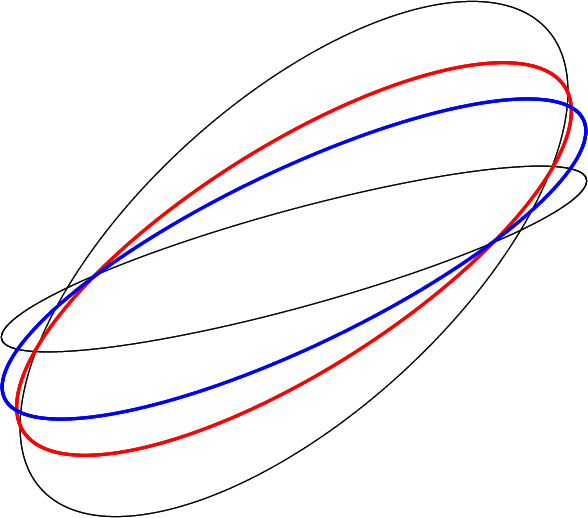
Figure 4: AIRM (blue) and Hilbert-Finsler (red) geodesic midpoints of two SPD matrices (black).
Dually Flat Structure via Bilogdet Function
The bilogdet barrier function,
Ψbild(X)=−logdetX−logdet(I−X)
is strictly convex and self-concordant on the VPM domain, yielding a Hessian Riemannian metric. Its gradient and Hessian supply dual coordinates and divergence measures, enabling an information-geometric structure adapted to the bicone boundary (potential diverging to infinity at the boundary).
combines logdet divergences on both the matrix and its complement—supporting optimization, control, and quantum theory applications.
Comparative Analysis: AIRM/Logdet vs. Hilbert/Bilogdet Dissimilarities
The manuscript rigorously establishes inequalities between standard (AIRM/logdet) and bicone-derived (Hilbert/bilogdet) dissimilarities:
Tight lower bounds showing that Hilbert VPM distance dominates the restricted AIRM distance by a factor 1/n.
Tight upper bounds for Hilbert VPM distance via the pushed-forward AIRM metric (2 factor).
Analogous bounds in the tangent space for the bilogdet Finsler norm, ∣∣V∣∣XH, and the bilogdet Riemannian norm, ∣∣V∣∣XΨ.
These relations are crucial for understanding the fundamental differences and potential tradeoffs between worst-direction distortion metrics (Hilbert) and information-geometric/averaged metrics (AIRM/logdet).
Implications and Future Directions
James' bicone VPM domain supplies novel geometric foundations for analyzing SPD matrices, particularly in settings where normalization and boundary-adapted structures are essential. The Hilbert VPM metric, relying solely on extremal eigenvalues, is inherently suited for robust analysis, maximum distortion modeling, and applications in quantum information and control theory. Its invariance and divergence behavior at the boundary render it promising for barrier-based optimization and learning.
The bilogdet structure provides an information-geometric framework, extending classical divergences and fostering applications in convex optimization, self-concordant barrier methods, and manifold learning.
The explicit bounds and geodesic constructions open up new computational strategies for geometric algorithms, medians/measures in Finsler geometry, and direct connections with the geometry of effects in quantum theory.
Speculatively, further developments may include:
Efficient algorithms for geometric clustering, mean/median computation, and robust parameter estimation using Hilbert geometry.
Expanded manifold learning for SPD domains using the VPM structure.
Applications to quantum computing, quantum granular computing, and optimal transport on the spectraplex.
Conclusion
This paper introduces and analyzes new geometric structures within the James' bicone domain of SPD matrices, establishing Finslerian and dually flat information-geometric frameworks and relating them to classical Riemannian/AIRM geometries. Strong analytical bounds, explicit geodesic formulations, and the identification of practical implications across quantum information theory, control, and optimization highlight the theoretical and computational potential of the VPM-based approach.
“Emergent Mind helps me see which AI papers have caught fire online.”
Philip
Creator, AI Explained on YouTube
Sign up for free to explore the frontiers of research
Discover trending papers, chat with arXiv, and track the latest research shaping the future of science and technology.Discover trending papers, chat with arXiv, and more.