A Path to an All-Sky Survey with Roman
Abstract: A deep, space-based, all-sky near-infrared survey carried out with the Nancy Grace Roman Space Telescope would constitute a foundational astronomical infrastructure for decades to come. In this white paper, we present a concrete and feasible path to imaging the entire sky at $\sim0.1''$ resolution, beginning with high-impact fields in Cycle 1 and scaling to ultra-wide coverage within the nominal mission. This first-epoch survey will reach $\mathrm{H}\sim25.5$ AB mag (5$σ$) and maximize synergies with contemporaneous observatories, while preserving substantial time for other ambitious Roman programs. We outline representative scheduling scenarios and an example Cycle 1 program that triples early Roman-LSST overlap and delivers high-value community data products such as LSST forced photometry, joint \textit{Gaia}-Roman astrometry, and catalogs of Galactic substructure, stong lenses, and other rare systems. The Cycle 1 program will lay the foundation for an eventual all-sky survey, while also delivering high-impact early science. We invite broad community participation in shaping and carrying out both the initial program and the long-term vision of an all-sky Roman survey.
Paper Prompts
Sign up for free to create and run prompts on this paper using GPT-5.
Top Community Prompts
Explain it Like I'm 14
Overview: What this paper is about
This paper lays out a clear, realistic plan to use NASA’s Nancy Grace Roman Space Telescope to take a super–high-resolution, near‑infrared picture of the entire sky. Think of it as building the sharpest, most detailed “Google Maps” of the universe in a kind of light our eyes can’t see (near‑infrared). The authors explain how to start small in the first two years, prove the idea works, and then scale up to cover almost everything during Roman’s 5‑year main mission—while teaming up with other major observatories to get the most science.
Key questions and goals, in simple terms
Here’s what the team wants to accomplish:
- Make a crisp, all-sky near‑infrared map with very fine detail (about 0.1 arcsecond resolution—extremely sharp), deep enough to see very faint objects.
- Start this mapping early so future pictures can be compared to the first ones to measure tiny motions of stars and other objects over time (like a “before and after”).
- Coordinate with other big projects happening at the same time—especially the Rubin Observatory’s LSST on the ground, and space telescopes like JWST, Euclid, and Gaia—so that combining their data gives much better science than any one could alone.
- Do it efficiently, without using up all of Roman’s observing time, and share high‑value data products with the whole community.
How they plan to do it (methods, explained simply)
The plan is a step‑by‑step survey strategy that balances speed, image quality, and teamwork with other telescopes:
- What Roman will look at:
- Use the H‑band filter (called F158) for most of the sky away from the crowded Milky Way plane. H‑band is near‑infrared light—glow beyond what our eyes can see—that’s great for seeing through dust and finding faint, red objects.
- Use a faster, broader filter (F146) for the crowded Milky Way plane to cover that busy region quickly.
- How deep and how sharp:
- Aim to reach “H ~ 25.5 AB mag (5σ).” In plain words: that’s very faint—much dimmer than what older surveys could see—and “5σ” means a solid, reliable detection.
- The sharpness is about 0.1 arcsecond, which helps separate overlapping objects that blur together in ground‑based images.
- How the camera takes the pictures:
- Short exposures (~85 seconds each), taken three times with tiny shifts between them (“dithers”) to fill in small gaps and sharpen the final image—like taking three carefully offset snapshots and combining them for a clearer result.
- How fast the survey goes:
- With this setup, Roman can map about 80 square degrees a day for the first pass, which is quick for space‑quality images.
- Smart scheduling and teamwork:
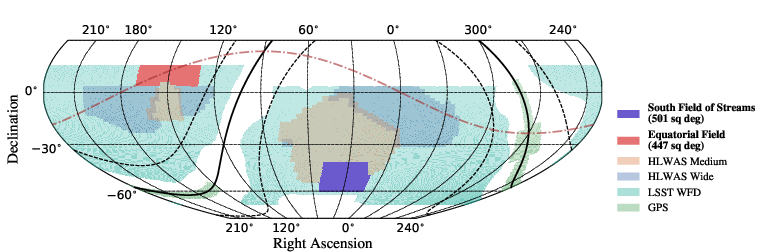
- Begin with high‑impact areas in “Cycle 1” (the first two years of science operations) that overlap with the Rubin Observatory (LSST) so the datasets can be used together right away.
- Keep options open to expand to wider areas during the rest of the mission.
- What “first epoch” means and why it matters:
- Take an early, high‑quality snapshot of the sky. Years later, take another. Comparing the two lets scientists measure tiny movements (“proper motions”) of stars that reveal how our galaxy and nearby systems are changing. Starting early makes these measurements much better.
Technical terms made simple:
- Near‑infrared: light just beyond red—good for seeing through dust and finding cool or distant objects.
- Arcsecond: a very small angle on the sky; 0.1 arcsecond is extremely fine detail.
- Dither: shifting the camera slightly between shots to cover gaps and sharpen the picture.
- Proper motion: how stars slowly drift across the sky over time.
- Weak lensing: gravity very slightly stretches the shapes of distant galaxies; measuring this helps map dark matter.
- Deblending: separating overlapping objects in an image so each one can be measured correctly.
Main findings and why they matter
This is a “white paper” (a plan), not a lab experiment, but it shows that an all‑sky Roman survey is practical and very powerful. Key takeaways:
- It’s feasible within Roman’s normal 5‑year mission. The authors show several realistic schedules: from a conservative plan focusing on the LSST area, to an ambitious plan that covers the whole sky.
- Even the early step delivers big science:
- Sharper, deeper reference images help LSST separate stars from galaxies and find faint, rare objects.
- Combining Roman with Gaia (and later Euclid and LSST) greatly improves measurements of star motions—even for stars too faint for Gaia alone—by factors of about 4–6 around Gaia’s faint limit.
- The survey can spot important stellar markers:
- In our galaxy’s halo, it can see main‑sequence turnoff stars out to ~200,000 light‑years, revealing streams and small galaxies shaped by dark matter.
- It can detect bright red giant stars out to several million light‑years, helping map the “Local Volume” of nearby galaxies.
- It’s a quasar machine: with H‑band plus LSST colors, a 10,000 square‑degree area could contain 10+ million quasars (active supermassive black holes), including many very distant ones. This helps study black hole growth and the early universe.
- The plan triples early overlap between Roman and LSST during Cycle 1, accelerating discoveries.
- Community data products (shared tools and catalogs) are baked in:
- LSST “forced photometry” at Roman’s sharp positions (measuring LSST light exactly where Roman sees sources).
- Combined Gaia–Roman motion solutions for fainter stars.
- Catalogs of Milky Way streams, dwarf galaxies, strong gravitational lenses, brown dwarfs, and other rare finds.
What this could change: big-picture impact
If carried out, this survey would become core infrastructure for astronomy—like roads and bridges for science:
- A lasting all-sky, high‑resolution near‑infrared map that future projects can rely on for decades.
- Stronger dark matter and cosmology studies by combining Roman’s sharp images with LSST’s deep, multi‑color, time‑lapse views and Euclid’s wide maps.
- A richer, clearer picture of our Milky Way’s structure, its small companion galaxies, star clusters, and the streams of stars pulled by gravity—key clues to how galaxies form and how dark matter is distributed.
- Faster discovery and follow‑up with JWST of the rarest, most interesting objects found by Roman across huge sky areas.
- A head start on measuring tiny motions in the sky by taking the first reference images early, so later images have a long time gap to compare against.
In short, the plan shows how Roman can quickly build a sharp, deep, near‑infrared “atlas of the sky,” team up with other world‑class observatories, and open the door to discoveries from our cosmic backyard to the edge of the visible universe.
Knowledge Gaps
Knowledge gaps, limitations, and open questions
The paper outlines a compelling path to an all-sky Roman first-epoch survey but leaves several concrete uncertainties and open questions that require further study and community planning:
- Survey depth uniformity and mitigation
- How to maintain or homogenize H-band depth given large spatial variations in zodiacal background (ecliptic/seasonal dependence) and the stated first-pass non-uniform coverage (55% with 3 exposures, 37% with 2, 4% with 1)?
- Whether exposure-time adjustments or revisit tiling will be used to equalize depth in high-zodi regions (e.g., equatorial strip) without compromising survey speed.
- Dither strategy validation and coverage gaps
- Whether a 2-point dither is sufficient for wide-area mapping (and under what conditions) versus the baseline LINEGAP3_3; quantitative impact on chip-gap coverage, PSF sampling, and cosmic-ray rejection.
- Risks of first-epoch coverage gaps in a 2-point strategy for downstream science (e.g., shear, deblending), and the plan to fill them.
- Roll-angle and orientation strategy
- Lack of a plan for multiple roll angles per field to control shear systematics and PSF anisotropy; requirements for the number and distribution of roll angles over the footprint.
- Weak-lensing systematics and shape measurement performance
- End-to-end forecasts for shear calibration biases with three 85 s F158 exposures: PSF modeling precision, detector systematics, chromatic PSF effects, and color-gradient biases in a single NIR band.
- How the assumed “near-constant number of usable galaxy shapes” across exposure times generalizes to all-sky conditions with varying backgrounds, stellar densities, and orientations.
- Chromatic PSF impacts (F146 and F158)
- Quantitative characterization of chromatic PSF in F146 (and to a lesser degree F158) on astrometry and shape measurements, and whether it precludes use of F146 outside the Galactic plane for any lensing-relevant applications.
- Calibration strategy and on-orbit measurements needed to control chromatic PSF for the stated science goals.
- Astrometric accuracy, cadence, and calibration
- A concrete plan to guarantee a second-epoch baseline across the footprint for proper motions (timing, filters, cadences), beyond reliance on opportunistic overlap with HLWAS and GAS programs.
- Absolute and relative astrometric calibration strategies across the WFI focal plane (distortion maps, temporal drift, thermal variations), especially in crowded fields and high-extinction regions.
- Expected proper-motion precision as a function of magnitude, color, crowding, and ecliptic latitude when combining Roman with Gaia/LSST/Euclid, including systematic floors and reference-frame ties.
- Star–galaxy separation and deblending
- Quantified completeness/purity of morphological star–galaxy separation at H≈25–26 with Roman’s PSF, including dependence on color, crowding, and PSF variations.
- Verified gains to LSST deblending and classification from Roman priors across different sky environments and surface brightness regimes.
- Photometric calibration and cross-mission color terms
- End-to-end photometric calibration plan for F158/F146 across the sky (zeropoints, spatial systematics, temporal stability).
- Treatment of Roman–LSST/Euclid color terms and bandpass mismatches for photometric-redshift improvement and quasar selection, including uncertainties and calibration data needs.
- Detector and image-level systematics
- Impact of WFI detector effects (persistence, IPC, nonlinearity, reciprocity failure), up-the-ramp sampling choice (IM_85_7), and cosmic-ray rejection efficacy on survey depth and uniformity.
- Bright-star artifacts, ghosts, saturation masks, and their sky-fraction losses; mitigation strategies for high-density bright-star regions.
- Scheduling, slews, and overhead realism
- Validation that the quoted 24% overhead and 81 deg²/day survey speed hold for an all-sky tiling with large slews, keep-out constraints, roll requirements, and downlink schedules.
- Seasonal scheduling constraints (Sun angle, Moon, SAA) and their effects on achievable depth and cadence in specific sky zones.
- Galactic plane and bulge strategy
- Robustness of using F146 with 2-point dither for the plane/bulge: confusion limits, extinction mapping, completeness for red sources, and the need for additional visits for proper motions.
- Quantified expectations for astrometric and photometric performance in the most crowded/extincted fields and how this informs cadence and exposure time choices.
- Time-domain opportunities and limitations
- A defined cadence strategy (if any) for enabling variability and transient science beyond population-averaged variability, and how templates will be constructed with single-epoch H-band imaging.
- Plans for multi-epoch revisit priorities if time-domain goals are to be pursued in the nominal mission.
- Strong-lens and rare-object discovery pipelines
- Algorithms, training sets, and expected purity/completeness for single-band H detection of strong lenses and other rare systems; resource and follow-up strategies (e.g., JWST, spectroscopy) to validate candidates.
- Selection-function characterization for rare-source populations to enable cosmological or astrophysical inference.
- High-redshift quasar selection
- Quantified completeness/purity of LSST+H selection for z>5 quasars, sensitivity to depth non-uniformity, and contamination from cool dwarfs; required spectroscopic resources and prioritization.
- Strategy to cover non-LSST regions (reliance on Euclid VIS+Roman H) and the expected degradation in selection performance.
- Resolved stellar populations and low-surface-brightness science
- Simulations quantifying detectability of MSTO stars and red giants in the presence of background variations and confusion across the Galaxy and Local Volume.
- Systematic limits for low-surface-brightness features (streams, galaxy outskirts) from sky subtraction and scattered light in wide-area H-band imaging.
- Solar System science and moving-object detection
- Assessment of moving-object identification efficiency with the proposed single-epoch strategy, and whether any cadence adjustments are warranted to exploit Solar System science.
- Data processing, pipelines, and QA
- Concrete commitments and compute plans for LSST forced photometry at Roman positions (e.g., S3DF resources), including pipeline versions, QA thresholds, and data release timelines.
- Standardization of cross-mission catalogs (Roman–LSST–Gaia–Euclid): schema, cross-match algorithms, handling of blending/conflicts, and uncertainty propagation.
- Data products and release policy
- Clear data release schedule for Roman first-epoch products and derived community data products, including versioning and reprocessing plans as calibrations improve.
- Provenance, reproducibility, and openness of pipelines to enable community validation and enhancement.
- Risk and scope management
- Contingency plans if GAS time allocations fall short of the conservative/intermediate/ambitious scenarios; prioritization rules for sky segments and science cases.
- Criteria to decide between area versus depth when confronted with schedule or performance shortfalls.
- Coordination with concurrent missions
- Firm plans to maximize contemporaneous overlap with HLWAS, LSST DR1–DR2, and JWST follow-up windows, given uncertainties in Roman and LSST schedules.
- Strategy for non-LSST regions (e.g., northern extragalactic sky outside Euclid VIS) where color information may be limited, and how that affects key science goals.
Addressing these gaps will require targeted simulations, calibration plans, observing-strategy optimizations, explicit performance budgets (for shear and astrometry), and resourcing commitments for community data products and cross-survey integration.
Practical Applications
Practical, Real-World Applications from “A Path to an All-Sky Survey with Roman”
Below, we distill actionable use cases derived from the paper’s proposed survey design, methods, and community data products. Each item notes sectors, potential tools/products/workflows, and key assumptions or dependencies.
Immediate Applications
These can be initiated or deployed now using existing infrastructure, software frameworks, and pre-Roman datasets (and/or during Roman Cycle 1), with modest additional development.
- LSST forced photometry at Roman source positions
- Sectors: Academia, Software
- What: Perform catalog-level LSST forced photometry at Roman detections over early Cycle 1 fields (~1,000 deg² + HLWAS H-band), producing cross-mission optical–NIR catalogs that improve deblending, colors, and photometric redshifts.
- Tools/workflows: Rubin pipelines; S3DF compute; data-release APIs; reproducible notebooks; QC dashboards.
- Assumptions/dependencies: Timely access to LSST DR1; Roman Cycle 1 coverage; bandwidth/storage at S3DF; cross-survey astrometric alignment.
- Joint Gaia–Roman astrometric solutions for improved proper motions
- Sectors: Academia, Software
- What: Derive joint astrometric fits to extend Gaia proper motions to fainter magnitudes and reduce uncertainties for G ~ 20–21 by factors of 4–6 (using frameworks like BP3M).
- Tools/workflows: BP3M; cross-survey calibration pipelines; error modeling; public catalogs.
- Assumptions/dependencies: Roman first-epoch depth (H ~ 25.5), cadence, reliable cross-match; Gaia DR4 availability; PSF and distortion calibration.
- Roman-enabled deblending and star–galaxy separation for ground surveys
- Sectors: Academia, Software
- What: Use Roman H-band space-based imaging (0.135″ PSF) to resolve blends in crowded/low-latitude regions and to clean LSST catalogs—especially for red sources.
- Tools/workflows: PSF modeling; morphology-driven classification; cross-survey joint likelihood deblenders.
- Assumptions/dependencies: Robust Roman PSF characterization; stable photometric calibration; consistent sky tiling/dithers.
- Rare-object discovery lists for follow-up (e.g., strong lenses, brown dwarfs, high-z quasar candidates)
- Sectors: Academia, Education (citizen science), Software
- What: Curate early candidate catalogs in Cycle 1 fields for JWST, 8–10m spectroscopy, and community follow-up; enable Zooniverse-style classification to scale triage.
- Tools/workflows: ML candidate selection; anomaly detection; citizen-science platforms; cutout services.
- Assumptions/dependencies: Spectroscopic resources; classification QC; early public data releases; coordination with observatory time allocation.
- Near-IR reference images for transient host identification and change detection
- Sectors: Academia, Software
- What: Use Roman first-epoch images as “gold-standard” reference for LSST time-domain discovery, improving host assignment in dusty/crowded fields and enabling multi-year variability studies vs. 2MASS/VISTA/UKIDSS.
- Tools/workflows: Difference-imaging alignment; cross-survey host-linking pipelines; variability statistics.
- Assumptions/dependencies: Data access policies; sky coverage; zodiacal background impacts on depth.
- Survey operations optimization as reusable templates for satellite scheduling
- Sectors: Industry (space operations), Software
- What: Translate Roman tiling/dither/exposure optimization (e.g., 3-point LINEGAP3_3, MA tables) into generalized scheduling approaches for Earth-observation constellations and other satellite assets.
- Tools/workflows: Operations research models; slewing/overhead minimization toolkits; survey simulators.
- Assumptions/dependencies: Mission-agnostic abstractions; access to platform constraints; validation on different instruments.
- Cross-domain transfer of deblending and shape-measure algorithms
- Sectors: Healthcare (medical imaging), Software
- What: Adapt PSF-informed deblending and weak-lensing shape estimation to segmentation and morphology analysis in radiology/microscopy (low-light denoising, multi-sensor data fusion).
- Tools/workflows: Domain-adapted models; synthetic benchmarks using Roman-like image properties; reproducible pipelines.
- Assumptions/dependencies: Successful transfer learning; annotated medical datasets; regulatory/clinical validation.
- Education and public engagement with high-resolution NIR sky maps
- Sectors: Education, Daily life
- What: Develop curricula, planetarium content, and citizen-science campaigns around Roman’s early fields (e.g., “field of streams”), introducing big-data tools and modern survey science.
- Tools/workflows: Interactive viewers; Jupyter/Colab lesson modules; Zooniverse projects; educator guides.
- Assumptions/dependencies: Accessible data portals; collaboration with outreach networks; inclusive design and translation.
Long-Term Applications
These depend on additional mission time, extended baselines, broader sky coverage, scaling, or further R&D before full deployment.
- All-sky H-band catalog to H ~ 25.5 (0.135″ resolution) as shared infrastructure
- Sectors: Academia, Policy, Software
- What: A definitive, uniform near-IR map of the entire sky, enabling weak lensing, photometric-redshift calibration, star–galaxy separation, and resolved stellar populations across the Local Volume.
- Tools/workflows: FAIR-compliant archives; cutout/VO services; queryable catalogs; long-term curation plan.
- Assumptions/dependencies: GAS allocation (~30–87% scenarios); Roman mission execution; HLWAS alignment; sustained funding for data stewardship.
- Global proper-motion map beyond Gaia’s limit
- Sectors: Academia, Robotics (navigation), Software
- What: Long-baseline Roman + Gaia/LSST/Euclid proper motions for faint red sources (giants, brown dwarfs), improving member selection for MW satellites/streams and navigation-grade star catalogs.
- Tools/workflows: Cross-mission astrometric framework; systematic error control; time-baseline planning.
- Assumptions/dependencies: >5-year baselines; repeated Roman epochs; cross-calibration stability.
- Cosmology advances via improved weak-lensing source shapes and photometric redshifts
- Sectors: Academia, Policy
- What: Increase usable source densities and reduce systematics by combining Roman H-band shapes with LSST optical colors, enhancing constraints on dark energy and structure growth.
- Tools/workflows: Joint analysis pipelines; shear calibration; hierarchical photo-z models; end-to-end simulators.
- Assumptions/dependencies: PSF chromatic control (F158); survey geometry optimization; multi-experiment MOUs and data access.
- High-redshift quasar census (0 < z < 5 to tens of millions; z > 5 candidates at scale)
- Sectors: Academia, Industry (AI/ML), Software
- What: Robust selection feeding large spectroscopic programs; ML toolchains for prioritizing rare, high-impact targets; improved understanding of SMBH growth and reionization-era structure.
- Tools/workflows: Candidate-ranking ML; spectroscopic scheduling; follow-up coordination platforms.
- Assumptions/dependencies: Accurate luminosity functions; spectroscopy throughput; contamination control; deep optical–NIR colors.
- Community standards and platforms for cross-survey data fusion
- Sectors: Software, Policy, Academia
- What: Establish interoperable schemas, provenance, astrometric/photometric calibration standards, and APIs for Roman–LSST–Euclid–JWST integration (FAIR-by-design).
- Tools/workflows: Open standards bodies; reference implementations; validation datasets.
- Assumptions/dependencies: Governance buy-in; sustained cross-agency funding; long-term maintenance.
- Scalable cloud/HPC workflows for petabyte-scale public archives
- Sectors: Industry (cloud/data platforms), Policy, Software
- What: Production-grade infrastructure for compute-near-data analysis, replication, and sustainability; commercializable patterns for scientific big-data platforms.
- Tools/workflows: Cost-aware storage tiers; serverless pipelines; ML-at-archive; containerized reproducibility.
- Assumptions/dependencies: Funding commitments; egress policies; global mirror sites; carbon-aware computing.
- Long-baseline variability science for faint red sources
- Sectors: Academia
- What: Population-level variability studies across years-to-decades for brown dwarfs, compact red systems, and obscured AGN (Roman vs. historical NIR surveys).
- Tools/workflows: Time-series pipelines; variability metrics; cross-mission light-curve harmonization.
- Assumptions/dependencies: Consistent photometric systems; cadence planning; crowding/sky-background models.
- Advanced deblending and PSF-shape algorithms transferred to clinical imaging
- Sectors: Healthcare, Software
- What: Mature Roman/LSST/EUCLID shape/deblend tools adapted to low-light/noisy modalities (e.g., fluorescence microscopy), potentially improving diagnostic reliability.
- Tools/workflows: Regulatory-grade pipelines; synthetic-to-real validation; clinician-in-the-loop interfaces.
- Assumptions/dependencies: Clinical data partnerships; explainability; accreditation.
- Workforce development and open-science policy models
- Sectors: Policy, Education, Academia
- What: Templates for inclusive, large-scale collaboration (NANCY WG), open data releases, and cross-agency coordination (NASA–NSF–DOE), strengthening national leadership in astrophysics.
- Tools/workflows: Community roadmaps; DEI-focused training; open peer-review pilots; shared compute credits.
- Assumptions/dependencies: Policy alignment; sustained programmatic support; incentive structures.
- Consumer imaging: smartphone and astrophotography improvements
- Sectors: Software, Daily life
- What: Dithering/stacking strategies and PSF-aware reconstruction techniques inform low-light mobile camera pipelines and prosumer astrophotography software.
- Tools/workflows: On-device stacking algorithms; denoising models; calibration targets.
- Assumptions/dependencies: OEM adoption; model compression; user education.
Notes on Cross-Cutting Assumptions and Dependencies
- Mission execution and scheduling: Roman launch (Fall 2026), CCS timelines, GAS allocations (Cycle 1 ~50 days; full mission ~389 GAS days).
- Survey configuration: Filter choices (F158 high-latitude; F146 low-latitude), exposure (IM_85_7), 3-point dither (LINEGAP3_3), PSF stability, zodiacal background variations.
- Multi-mission synergies: Timely overlap and data releases from LSST, Gaia, Euclid, JWST; MOUs for calibration/data sharing; spectroscopic follow-up capacity.
- Technical infrastructure: S3DF and comparable compute; scalable archives; bandwidth/storage; provenance; validation and QA.
- Community engagement: NANCY WG participation; citizen-science platforms; education/outreach partnerships; sustained funding and governance for long-term maintenance.
- Scientific dependencies: Proper motion baselines (>5 years for best leverage); photometric calibration consistency across surveys; robust luminosity-function priors for target selection.
These applications collectively position the proposed Roman all-sky survey as shared scientific infrastructure with broad spillover benefits—from advancing cosmology and Galactic science to catalyzing innovations in data platforms, imaging algorithms, education, and cross-domain analytics.
Glossary
- 2MASS: A near-infrared all-sky astronomical survey (Two Micron All Sky Survey) widely used as a reference dataset. Example: "2MASS, VHS, VVV/X, UKIDSS"
- AB mag: A photometric magnitude system where a constant flux density per unit frequency corresponds to a fixed magnitude. Example: " AB mag (5)"
- astrometric leverage: The gain in precision for measuring positions and motions due to longer time baselines or complementary datasets. Example: "irreversibly weaken Romanâs astrometric leverage"
- astrometry: The precise measurement of positions and motions of celestial objects on the sky. Example: "joint GaiaâRoman astrometry"
- cadence: The timing pattern or schedule of repeated observations. Example: "depending on cadence and depth."
- chromatic PSF: Wavelength-dependent changes in the point-spread function that can bias measurements, especially shapes. Example: "chromatic PSF effects"
- chip gaps: Small regions of missing coverage between detector segments in a focal plane. Example: "fully eliminate chip gaps in the first epoch."
- coronagraph: An instrument that suppresses starlight to enable imaging of faint nearby objects like exoplanets. Example: "coronagraph demonstrations"
- deblending: The process of separating overlapping astronomical sources in images. Example: "precise source identification and deblending"
- dither: Small, planned telescope offsets between exposures to improve sampling and fill detector gaps. Example: "3-point dither (LINEGAP3_3)"
- ecliptic plane: The plane of Earth’s orbit around the Sun, important for survey planning and background light. Example: "the ecliptic plane."
- Euclid: An ESA space telescope designed for cosmology, focusing on weak lensing and galaxy clustering. Example: "Euclid does not cover this portion of the equatorial strip"
- Euclid VIS imaging: Optical (visible) imaging from Euclid’s VIS instrument used for high-resolution, deep wide-area surveys. Example: "Euclid VIS imaging ($25.5$\,mag)"
- F146 filter: A very wide Roman near-infrared filter that combines Y+J+H sensitivity for fast survey speed. Example: "F146 filter"
- F158 filter: Roman’s H-band (∼1.58 μm) filter used for high-latitude weak lensing–quality imaging. Example: "F158 (H band)"
- forced photometry: Measuring flux at predetermined source positions (from another catalog) to improve cross-survey consistency. Example: "LSST forced photometry"
- Gaia: An ESA astrometry mission delivering all-sky positions, parallaxes, and proper motions. Example: "Gaia DR4"
- Galactic bulge: The dense, central stellar component of the Milky Way. Example: "Galactic plane and bulge"
- Galactic plane: The midplane of the Milky Way disk, a crowded region rich in stars and dust. Example: "Galactic plane"
- galaxy shape measurements: Quantitative estimates of galaxy ellipticities and orientations used for weak lensing and morphology studies. Example: "galaxy shape measurements"
- H band: A near-infrared band around 1.6 μm commonly used for deep imaging of stars and galaxies. Example: "H-band imaging"
- halo occupation: The statistical relation between dark matter halos and the galaxies (or quasars) they host. Example: "quasar clustering and halo occupation"
- High Galactic latitude: Sky regions far from the Milky Way’s plane, typically with less dust and crowding. Example: "high Galactic latitude ()"
- HLWAS: Roman’s High Latitude Wide Area Survey, a core cosmology imaging program. Example: "High Latitude Wide Area Survey (HLWAS)"
- JWST: NASA’s James Webb Space Telescope, optimized for high-sensitivity, high-resolution infrared observations. Example: "JWST"
- kpc: Kiloparsec, an astronomical distance unit equal to 1,000 parsecs (about 3,262 light-years). Example: "\,kpc"
- LMC: Large Magellanic Cloud, a nearby satellite galaxy of the Milky Way. Example: "LMC"
- LSST: The Legacy Survey of Space and Time at the Rubin Observatory, a 10-year optical imaging survey. Example: "Legacy Survey of Space and Time (LSST)"
- luminosity function: The distribution of objects by luminosity; used to model populations like galaxies or quasars. Example: "luminosity function"
- main-sequence turnoff (MSTO): The point on a color–magnitude diagram where stars exhaust core hydrogen and leave the main sequence, sensitive to age. Example: "main-sequence turnoff stars (MSTO)"
- Mpc: Megaparsec, a distance unit equal to one million parsecs (about 3.26 million light-years). Example: "--$15$\,Mpc"
- MultiAccum (MA) table: Predefined detector readout patterns for infrared imaging that set exposure sampling. Example: "MultiAccum (MA) table"
- near-infrared: The infrared wavelength range just beyond visible light, valuable for dust-penetrating astronomy. Example: "near-infrared"
- photometric redshift: A redshift estimate derived from multi-band colors rather than spectroscopy. Example: "photometric-redshift constraints"
- point-spread function (PSF): The image of a point source; characterizes optical and detector blurring. Example: "point-spread functions"
- proper motion: The apparent angular motion of a star across the sky over time. Example: "proper motions"
- quasar clustering: The spatial clustering of quasars, used to infer large-scale structure and halo properties. Example: "quasar clustering"
- red giant branch (RGB): An evolutionary phase of low/intermediate-mass stars ascending in luminosity and cooling. Example: "red giant branch"
- Rubin Observatory: The facility hosting LSST, designed for wide, deep, and fast optical surveys. Example: "the Rubin Observatory will be conducting the Legacy Survey of Space and Time (LSST)"
- slew-and-settle: Telescope operations to repoint (slew) and stabilize (settle) before imaging. Example: "rapid slew-and-settle"
- star–galaxy separation: Classifying sources as stars or galaxies using morphology, colors, or combined methods. Example: "starâgalaxy separation"
- stellar streams: Elongated structures of stars stripped from satellites or clusters by tidal forces. Example: "stellar streams"
- strong gravitational lenses: Systems where mass concentrations produce multiple images, arcs, or high magnification of background sources. Example: "strong gravitational lenses"
- time-domain: The study of astrophysical variability and transients over time. Example: "time-domain science"
- tip of the red giant branch (TRGB): The brightest point of the RGB; a standard candle for distance measurements. Example: "tip of the red giant branch"
- virial radius: The characteristic radius enclosing a gravitationally bound halo in equilibrium. Example: "virial radius"
- weak lensing: Small, coherent distortions of galaxy shapes by large-scale structure, used to probe matter distribution. Example: "weak lensing capabilities"
- Wide-Fast-Deep (WFD): LSST’s main survey strategy balancing area, depth, and cadence. Example: "wide-fast-deep (WFD) survey"
- zodiacal background: Diffuse sky brightness from sunlight scattered by interplanetary dust, affecting infrared sensitivity. Example: "zodiacal background"
Collections
Sign up for free to add this paper to one or more collections.

