- The paper demonstrates that using a 25-m spiral Mach-Zehnder interferometer with amplitude locking significantly suppresses laser frequency noise to record levels.
- It achieves a 12 Hz linewidth at 1348 nm by omitting resonant elements and leveraging balanced detection to reduce noise by up to 50 dB.
- Optical frequency division yields a 10 GHz microwave output with phase noise 15 dB lower than conventional crystal oscillator references.
Introduction
The manuscript "An Integrated Ultralow Noise Spiral Interferometric Laser" (2602.16461) details the design, fabrication, and experimental characterization of a novel on-chip ultranarrow-linewidth laser stabilized to a spiral Mach-Zehnder (MZ) interferometer with a 25-m integrated delay line. By departing from conventional cavity-based stabilization architectures, the work introduces a sinusoidal-fringe interferometric approach, leveraging balanced photodetection and amplitude locking to surpass frequency noise limits of state-of-the-art integrated resonant cavity lasers. Notably, the laser achieves a record on-chip fractional frequency noise of 5.6×10⁻¹⁴ and a linewidth of 12 Hz at 1348 nm. Optical frequency division to the microwave domain enables a 10 GHz output with phase noise 15 dB lower than the best oven-controlled crystal oscillator references. The paper delineates the practical and fundamental advantages of interferometric stabilization and sets the stage for next-generation compact frequency references relevant for precision metrology, communication, and quantum technologies.
Spiral MZ Interferometer Design and Operation
The spiral MZ interferometer is integrated onto a 2.6 cm × 2.6 cm Si3N4/SiO2 chip, exploiting ultra-low-loss waveguides (0.15 dB/m) and a minimum bending radius of 3.4 mm to achieve a 25-m delay length within single reticle constraints. The input and output couplers utilize asymmetric and symmetric splitting, respectively, to compensate for propagation loss and maximize fringe visibility. Operationally, the interferometer generates a broadband sinusoidal transfer function with an 8 MHz period and extinction ratio of 19.5 dB. The optical mode is loosely confined, enabling a large mode volume and single-mode operation at 1348 nm.
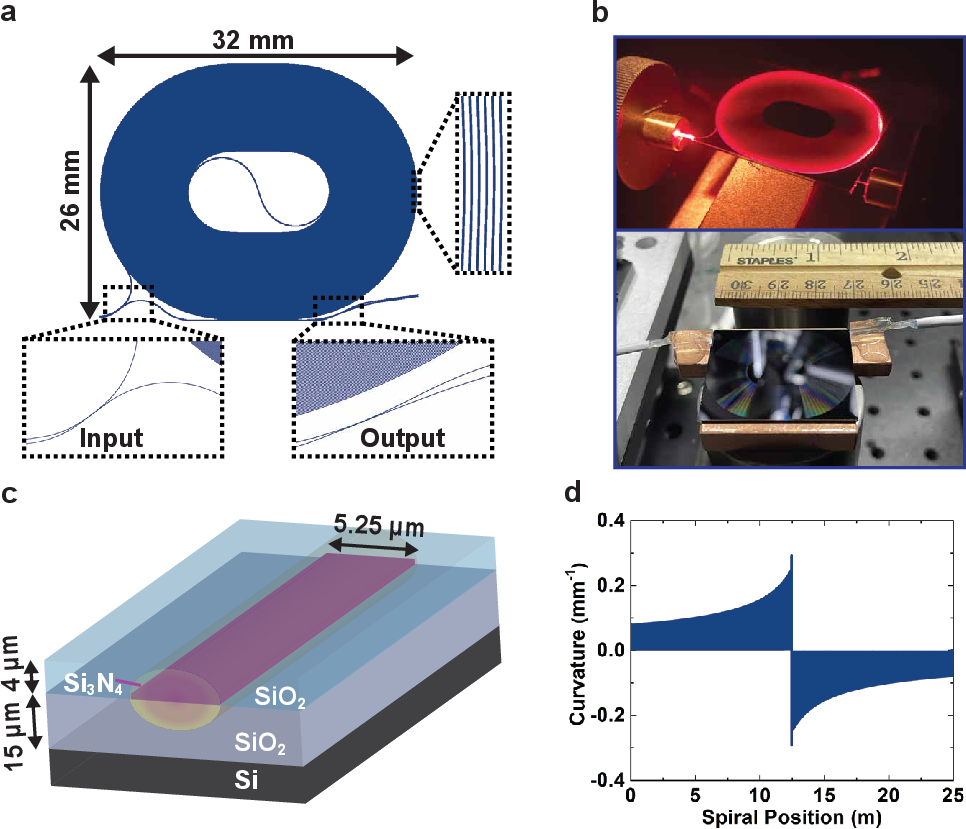
Figure 1: Spiral MZ interferometer layout and structural details, including chip photographs and waveguide cross-section.
Balanced detection fundamentally enhances noise suppression by doubling the fringe slope and attenuating common-mode laser RIN by up to 50 dB. The amplitude locking scheme stabilizes long-term frequency drift by tracking waveguide power directly correlated with fringe depth. Importantly, the architecture omits resonant elements to avoid cavity-induced noise limitations and is inherently tolerant to waveguide loss, enabling further scaling of spiral length via stitching.
Characterization and Frequency Noise Suppression
Comprehensive interferometer characterization demonstrates sinusoidal interference and robust extinction across 1290–1365 nm and 1454–1530 nm, evidencing broadband operability. The effective linewidth (4 MHz, Q=5.56×10⁷) is not directly comparable to high-Q cavities due to the interferometric sinusoid's 50% duty cycle. However, the corresponding SNR in frequency stabilization is orders of magnitude higher, attributed to balanced detection and broadband operation.
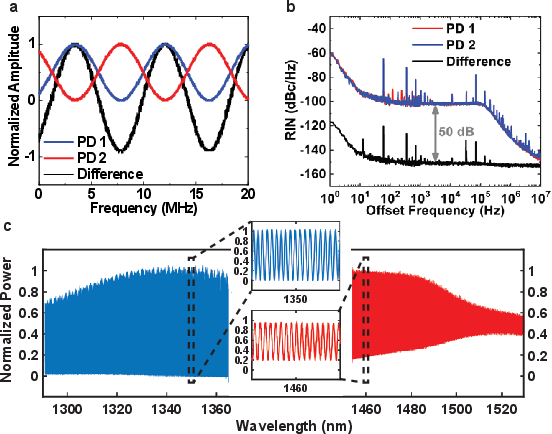
Figure 2: Sinusoidal fringe measurements, RIN suppression via balanced detection, and broadband fringe extinction characterization.
The spiral interferometric laser uses a 1348 nm seed laser amplified by an SOA and locked to the interferometer's fringe via difference photocurrent feedback. Amplitude locking stabilizes the spiral waveguide power, ensuring effective fringe tracking. The system achieves a measured frequency noise spectrum closely approaching the theoretical thermorefractive noise limit for the 25-m spiral, largely limited by vibration at low offsets. Critically, noise is 6 dB lower than the previous best integrated resonator, and SNR analysis reveals substantial headroom for future improvements.
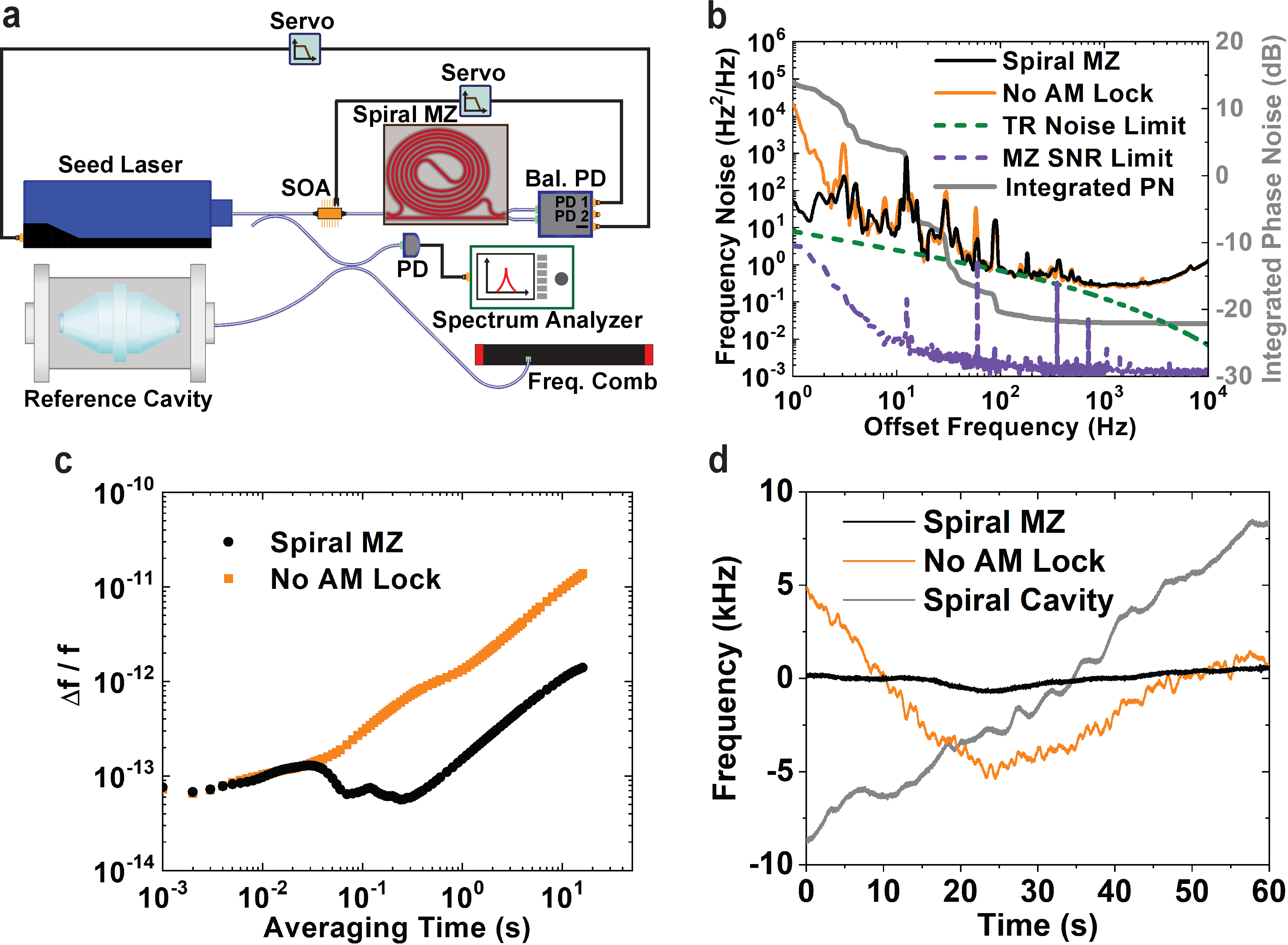
Figure 3: Spiral interferometric laser stabilization schematic, frequency noise spectra, fractional frequency noise improvement with amplitude lock, and long-term frequency drift comparison.
Quantitative metrics include:
- Fractional frequency noise: 7.6×10⁻¹⁴ at 1 ms, decreasing to 5.6×10⁻¹⁴ at 240 ms (record for integrated devices).
- Laser linewidth: 12 Hz (integrated phase noise and Allan deviation, outperforming prior 16.7 Hz record).
- Long-term drift: 24 Hz/s (with amplitude lock, >10x improvement).
- Frequency excursions: ±600 Hz over 1 minute (prior resonant cavity laser drifted by 17 kHz).
Contradictorily, the effective linewidth of the sinusoidal fringe surpasses high-Q cavities in frequency stabilization utility due to large SNR and noise suppression, challenging previous assumptions equating fringe sharpness with stabilization efficacy.
To demonstrate practical applicability, the stabilized optical carrier is coherently divided down to a 10 GHz microwave signal using an Er-fiber frequency comb, achieving an 87 dB reduction in phase noise spectral density. The resulting divided-down microwave phase noise remains well below crystal oscillator references across most of the offset frequency range, with -76 dBc/Hz at 1 Hz and -99 dBc/Hz at 10 Hz, representing the lowest phase noise achieved from chip-integrated optical references.
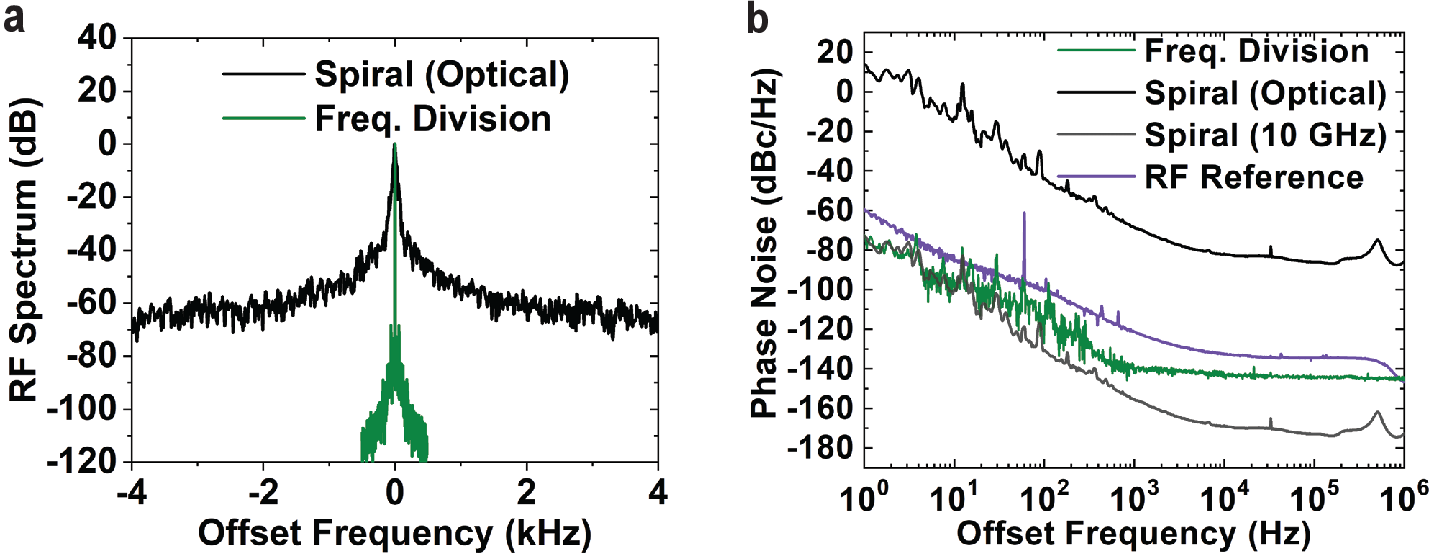
Figure 4: Comparison of optical and divided-down microwave spectra and phase noise, demonstrating substantial improvements over crystal oscillator references.
Implications and Future Developments
This study demonstrates that stabilization to a broadband spiral interferometer fringe, augmented by balanced detection and amplitude lock, enables frequency noise suppression and drift control exceeding all previously published integrated resonator-based lasers. The amplitude lock scheme is unique to the interferometric approach, providing robust long-term stability. The architecture's insensitivity to waveguide loss, lack of resonance-induced noise, and broadband operability offer new design pathways for compact ultralow-noise lasers.
The practical implications are profound for portable optical atomic clocks, high-precision spectroscopy, quantum computing, geodesy, and coherent communications—domains requiring narrow-linewidth lasers and stable microwave outputs. The architecture is amenable to further scaling, e.g., by integrating longer delay lines, leveraging multiple reticle stitching, or full integration of seed lasers and detectors.
Theoretically, the results indicate that interferometric stabilization breaks the conventional dependence of laser stability on cavity Q and loss. Future research could optimize spiral layouts for specific spectral regions (including visible wavelengths), explore materials for further reduction of thermorefractive noise, and enhance environmental robustness toward field-deployable frequency references.
Conclusion
The integrated spiral MZ interferometric laser achieves fractional frequency noise and linewidth metrics unprecedented among chip-scale lasers, as well as microwave phase noise beyond state-of-the-art crystal oscillators. The interferometric stabilization approach, especially when combined with balanced detection and amplitude locking, addresses limitations inherent to resonator-based architectures and unlocks broadband operability with tolerance to waveguide losses. These advances foresee transformative impacts in precision measurement, quantum systems, and mobile frequency synthesis, with future scaling and integration poised to extend performance and applicability even further.

