- The paper demonstrates that coherent superposition of fractional OAM modes creates tunable optical skyrmions with nonlinear, abrupt topological transitions.
- Experimental setups employing SLM and Sagnac interferometry validate the non-orthogonality effects and azimuthal discontinuities in polarization fields.
- The study reveals that manipulating initial OAM configurations allows for high-sensitivity topological control, with implications for optical metrology.
Fractional Optical Skyrmions: Theory, Generation, and Topological Evolution
Introduction
The topology of light fields, particularly in the context of optical skyrmions, has emerged as a central theme in modern photonic research. Skyrmions—originally conceived in particle physics—are characterized in optics by nontrivial mapping of polarization (spin) textures onto the Poincaré sphere, yielding integer-valued topological invariants robust to perturbations. The work "Fractional optical skyrmions" (2602.15464) extends this paradigm by formulating and demonstrating fractional optical skyrmions through the coherent superposition of non-integer orbital angular momentum (OAM) modes in orthogonal polarization channels. In contrast to integer skyrmion numbers, the fractional regime uncovers unique nonlinear evolutionary pathways, abrupt topological transitions, and partial wrapping of the Poincaré sphere, challenging the discretization inherent to prior optical topological studies.
Optical skyrmions are constructed from vectorial light fields where spatial OAM modes are entangled with polarization DoFs. Integer skyrmion textures arise from the superposition of orthogonal (integer m) OAM Laguerre-Gaussian (LG) modes bearing distinct polarizations, producing integer topological invariants (skyrmion number N). The extension to fractional OAM (m∈/Z) leverages the non-orthogonality of constituent LG modes, giving rise to fractional skyrmions whose topological number varies continuously.
A generic fractional skyrmion field is synthesized as:
∣ψ(r,ϕ)⟩=α∣m1⟩∣H⟩+β∣m2⟩∣V⟩
where ∣mi⟩ are scalar LG modes with OAM mi, and ∣H⟩,∣V⟩ denote linear polarization bases. Crucially, the non-orthogonality of fractional OAM modes ∣m⟩ disrupts the possibility of decomposing fractional skyrmions as sums or averages of integer skyrmions. As a result, the evolution between integer skyrmion states via fractional states exhibits abrupt changes, particularly at half-integer detuning of OAM difference Δm=m2−m1.
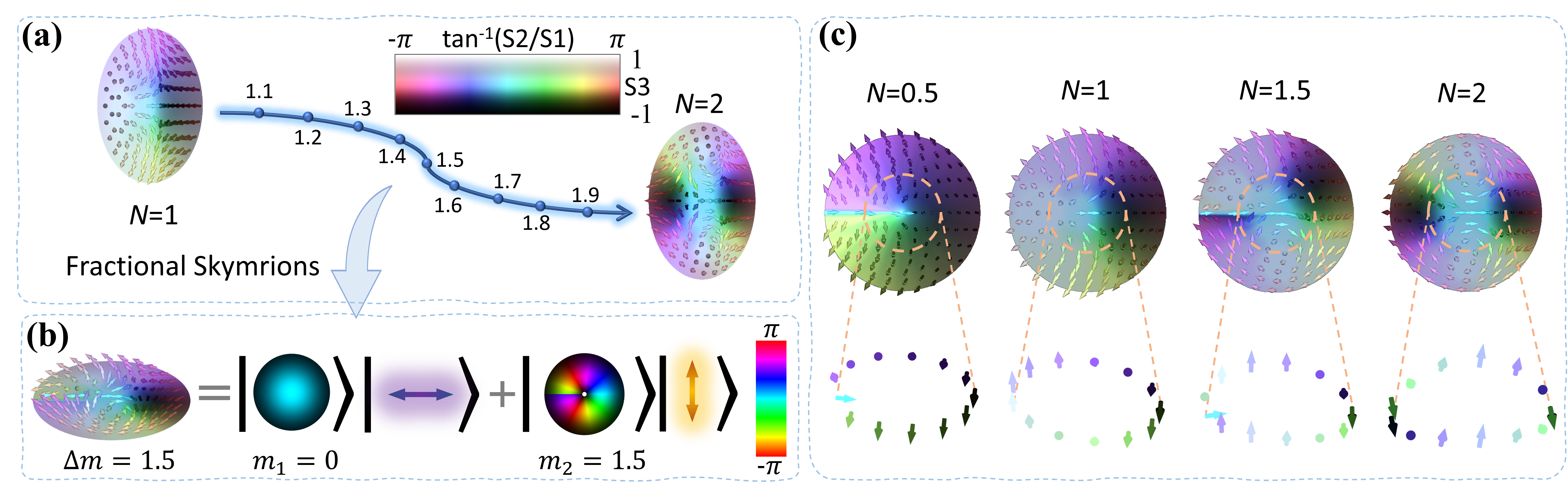
Figure 1: (a) Schematic for fractional skyrmions bridging integer topologies; (b) Method for generating arbitrary topologies by superposing fractional LG beams in orthogonal polarizations; (c) Polarization mappings—integer skyrmions cover the Poincaré sphere completely, but fractional skyrmions exhibit incomplete coverage due to abrupt transitions.
Experimental Realization
The experimental architecture (Figure 2) utilizes a spatial light modulator (SLM) for multiplexed generation of two spatially separated LG modes (integer or fractional m), which are subsequently combined via a Sagnac interferometer—enabling robust synthesis of the desired vector field superpositions in orthogonal polarizations. Full Stokes polarimetric analysis is then performed to quantitate the state of polarization (SOP) and reconstruct the topological field.
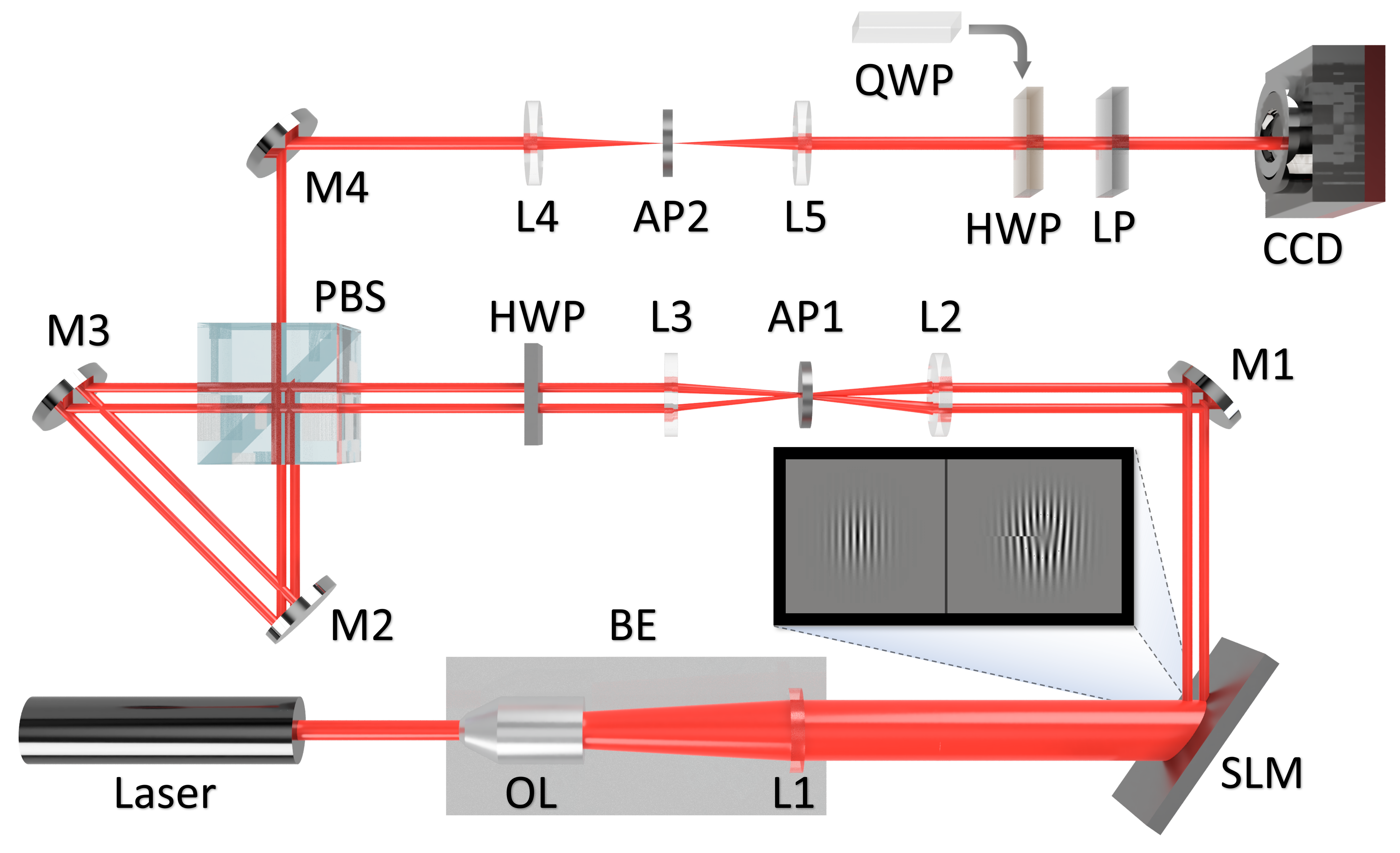
Figure 2: Experimental setup for creation and measurement of fractional skyrmions, featuring SLM generation of LG modes, polarization control, Sagnac vector synthesis, and Stokes polarimetry.
Stokes Field Structure and Polarization Analysis
Through combined theoretical and experimental Stokes polarimetry, the study reveals pronounced azimuthal discontinuities in the Stokes parameters S1 and S2 for fractional OAM combinations, manifesting as abrupt phase and polarization jumps at specific azimuthal angles—a direct result of branch cuts inherent to fractional OAM. In contrast, integer skyrmion fields exhibit analytic, continuous polarization evolution.
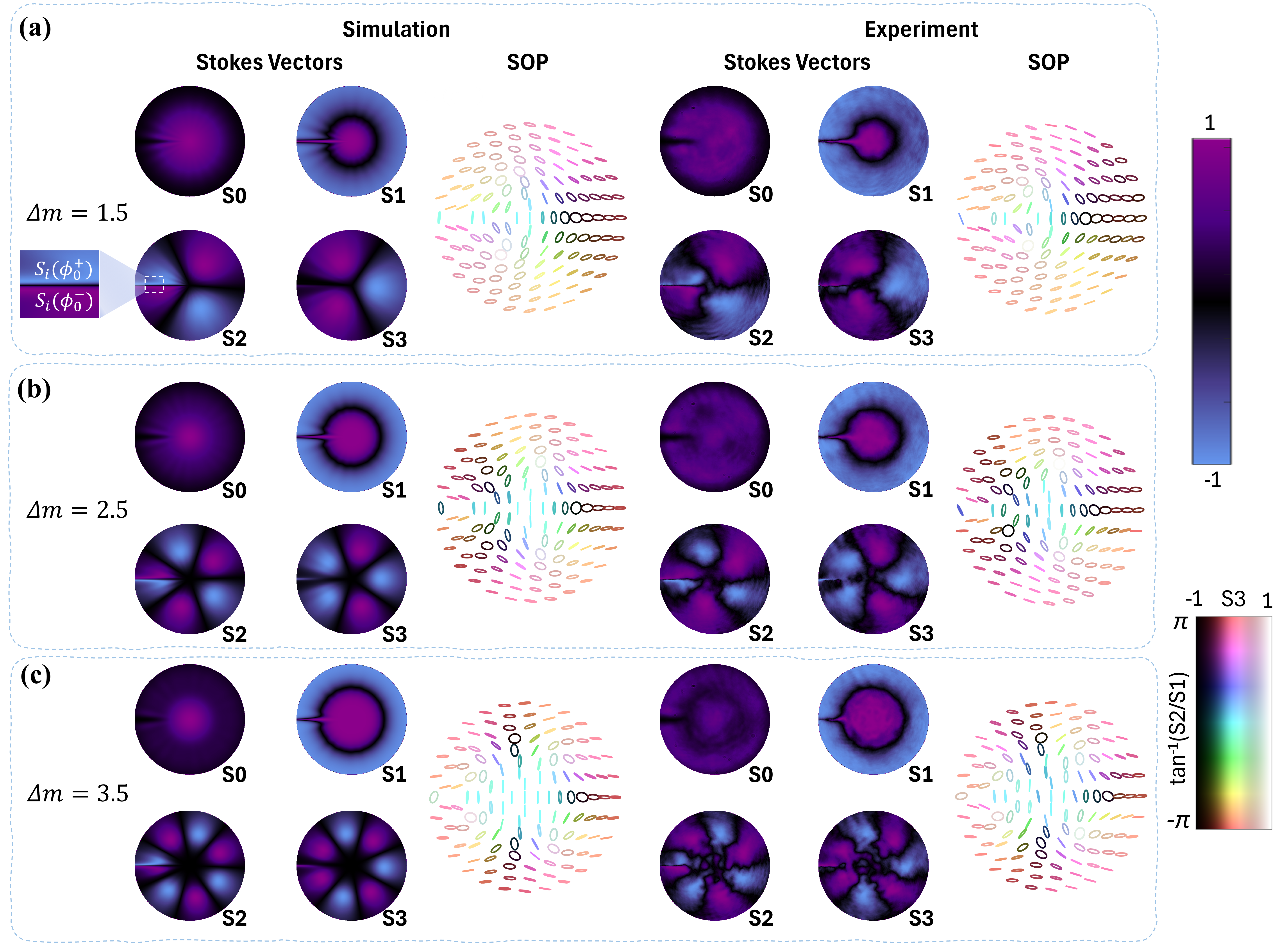
Figure 3: Stokes parameters and SOP for (a) Δm=1.5, (b) $2.5$, and (c) $3.5$. Both numerical and empirical data illustrate abrupt polarization transitions induced by fractional OAM, breaking azimuthal symmetry in the Stokes fields.
Nonlinear Evolution of Fractional Skyrmion Topology
Numerically evaluating the skyrmion number N(m) as a function of Δm uncovers nonlinear and discontinuous behavior as fractional OAM bridges neighboring integer topologies. Notably, the skyrmion number experiences rapid shifts in the vicinity of half-integer Δm, corresponding to the topological transition points where polarization texture bifurcations and azimuthal discontinuities in the SOP are most prominent.
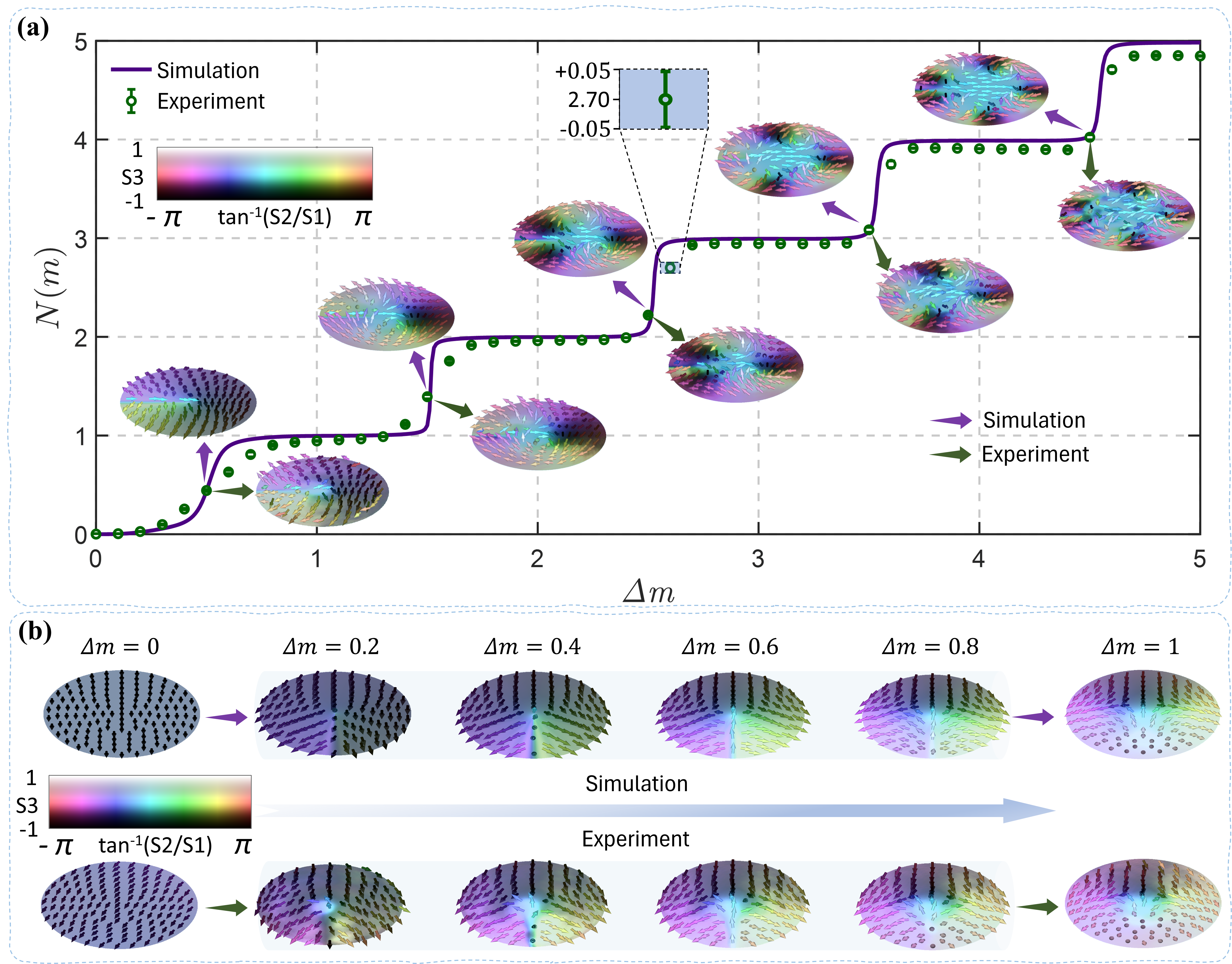
Figure 4: (a) Evolution of measured and simulated skyrmion number N(m) versus Δm, exhibiting a nonlinear profile with sharp transitions near half-integers. (b) Continuous but nonlinear evolution of topological texture for Δm from $0$ to $1$, highlighting the bifurcation and wrapping dynamics.
Dependence on OAM Configuration
The transition dynamics of fractional skyrmions were further probed for multiple OAM base configurations. Higher starting OAM indices (m1) shift the inflection point for the abrupt change in N(m) to higher Δm, and systematically reduce the observed skyrmion number during intermediate stages. This is attributed to the reduced spatial overlap and increased phase singularity content in higher-order modes, which in turn inhibits efficient spin-orbit coupling and topological texture formation.
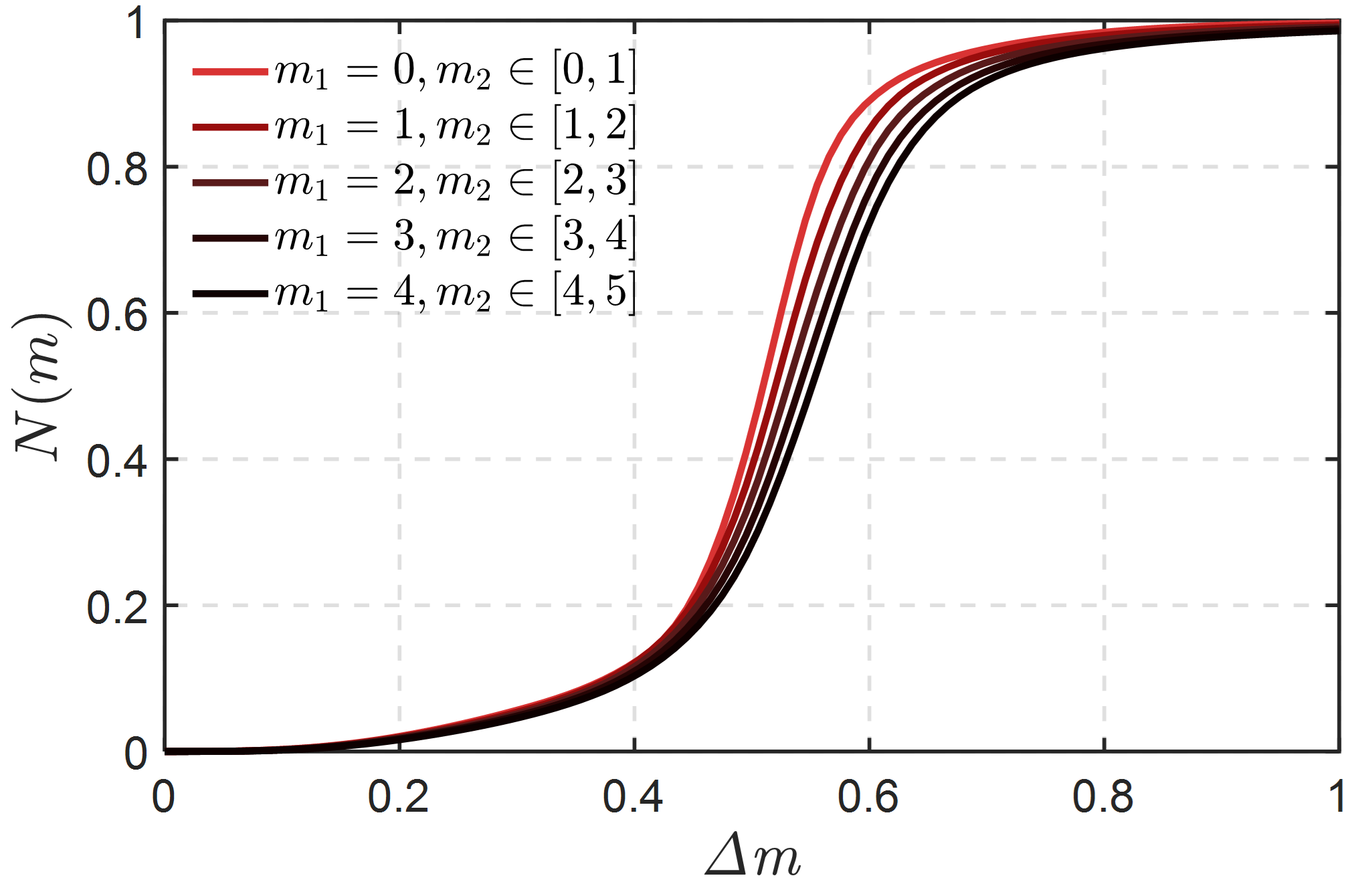
Figure 5: Evolutionary trajectories of fractional skyrmions for distinct OAM initial conditions, revealing systematic mode-dependent nonlinear dynamics and shifting transition curves.
Implications and Future Directions
The demonstrated existence of continuous, tunable fractional optical skyrmions—and their abrupt, nonlinear transitions—has decisive implications for both the fundamental theory of optical topology and emergent photonic technologies. The contention that fractional skyrmion numbers cannot be trivially constructed as linear interpolants between integer topologies—contrary to the case for fractional OAM eigenstates—reinforces the robustness of topological quantization in polarization-mapped systems.
On a practical front, the inherent sensitivity of the fractional skyrmion number near critical slopes (steep changes at half-integer Δm) implies potential utility for high-sensitivity topological metrology, high-density information encoding across non-integer DoFs, and advanced structured light communication using continuous topological modulation. The nonlinear response to OAM detuning and the dependence on the initial OAM configuration provide unprecedented control levers for tailoring spin-orbit coupled photonic fields.
Future theoretical work is warranted to extend analytic models for fractional skyrmion number evolution and to generalize these results to nonparaxial, evanescent, or quantum field regimes. Experimentally, the principles of fractional skyrmion generation may be adapted for on-chip integrated photonics, reconfigurable optical lattices, and topological quantum state engineering.
Conclusion
This work rigorously elucidates the generation, measurement, and theoretical underpinnings of fractional optical skyrmions, a class of vectorial light fields that bridges discrete integer topological orders through nonlinear and abrupt transitions in skyrmion number. Robust coherence of experimental observations with simulation confirms the existence and properties of these topological states. The findings challenge the simplistic linear intuition derived from OAM superpositions and establish a platform for controlled, continuous manipulation of optical topology. Such advances are poised to inform next-generation optical information processing, topological sensing, and the theoretical exploration of emergent topological matter in structured photonic systems.

