Talagrand's convolution conjecture up to loglog via perturbed reverse heat
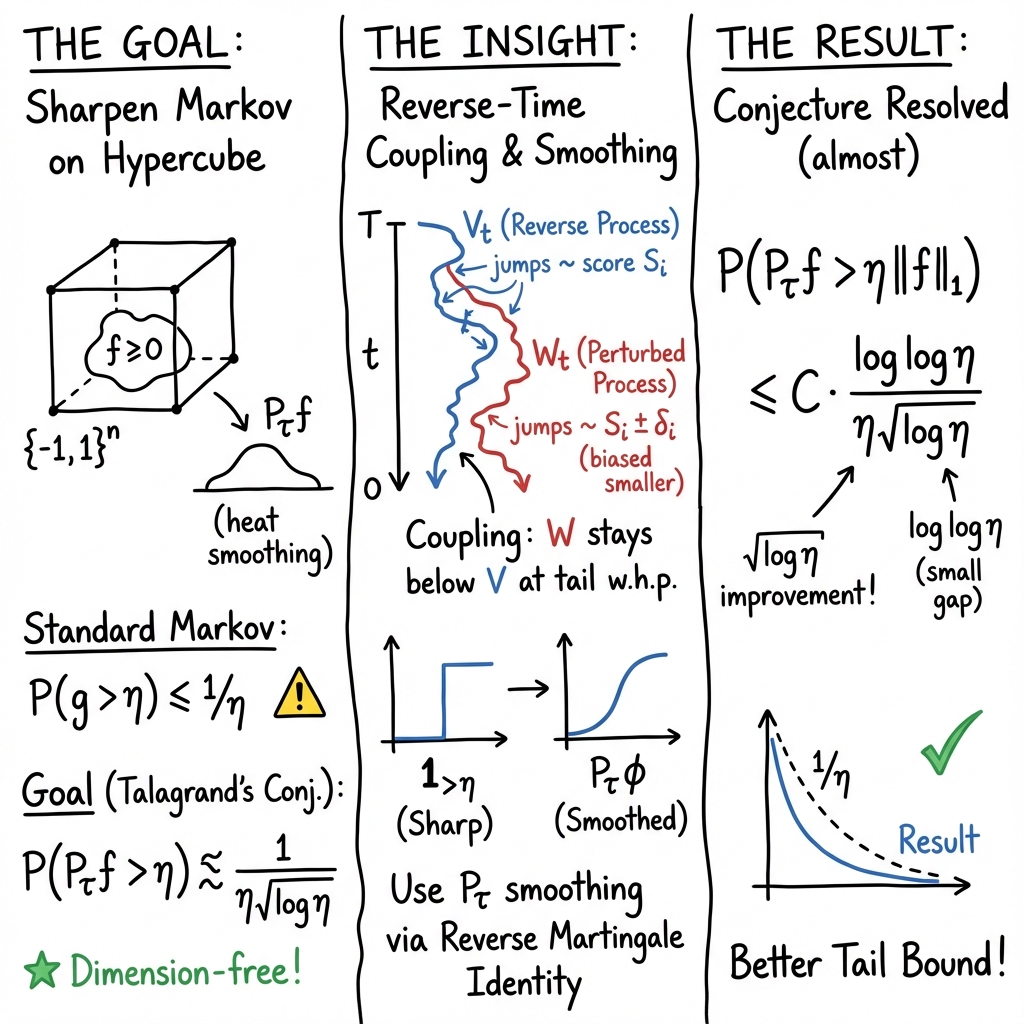
Abstract: We prove that under the heat semigroup $(P_τ)$ on the Boolean hypercube, any nonnegative function $f: {-1,1}n \to \mathbb{R}+$ exhibits a uniform tail bound that is better than that by Markov's inequality. Specifically, for any $η> e3$ and $τ> 0$, \begin{align*} \mathbb{P}{X \sim μ}\left( P_τf(X) > η\int f dμ\right) \leq c_τ\frac{ \log \log η}{η\sqrt{\log η}}, \end{align*} where $μ$ is the uniform measure on the Boolean hypercube ${-1,1}n$ and $c_τ$ is a constant that only depends on $τ$. This resolves Talagrand's convolution conjecture up to a dimension-free $\log\log η$ factor. Its proof relies on properties of the reverse heat process on the Boolean hypercube and a coupling construction based on carefully engineered perturbations of this reverse heat process.
Paper Prompts
Sign up for free to create and run prompts on this paper using GPT-5.
Top Community Prompts
Explain it Like I'm 14
A teen-friendly guide to “Talagrand’s convolution conjecture up to log log via perturbed reverse heat”
What is this paper about?
This paper studies what happens to a function when you “blur” it a little with random noise. The function lives on a big grid of corners called the Boolean hypercube, which is just all -long lists of and (like all possible true/false answer sheets of length ). The main question: after you blur a function, how rare are very large values? The paper proves a strong, nearly best-possible rule for how rare those large values become—confirming a famous conjecture (by Talagrand) up to a tiny extra factor.
1) Big picture: the paper’s purpose
When you add a bit of random noise to the input of a function (think: gently shaking an object to smooth out sharp spikes), the function typically becomes “nicer” and large spikes become rarer. Talagrand’s conjecture predicted a precise, dimension-free way to measure this effect on the Boolean hypercube. This paper almost fully proves that prediction: it shows that after blurring, the chance of seeing a very large value is much smaller than what the most basic rule (Markov’s inequality) would suggest, and this improvement does not depend on how many dimensions there are.
2) The key questions, in simple terms
- If we take any nonnegative function on the hypercube and “blur” it by randomly flipping each coordinate a little (this blurring is called the heat semigroup and written ), how likely is it that is much bigger than the average of ?
- Can we prove a dimension-free improvement over the basic 1-over- tail bound (Markov’s inequality)?
- Specifically, can we show something like
with a constant that does not depend on ?
Talagrand’s conjecture says “yes” with exactly the extra factor. This paper proves the same statement up to a very slowly growing “” factor in the numerator.
3) How do they approach the problem?
Think in analogies:
- The Boolean hypercube is like all exam answer sheets with true/false questions.
- A function assigns a nonnegative score to each answer sheet.
- The “heat semigroup” is like this: before reading the answer sheet, we flip each answer independently with a small chance and then evaluate . This is a way of “blurring” or “smoothing” .
Key ideas used:
- Blurring forward and then running backward:
- Forward process: imagine each coordinate randomly flips at a steady rate (like a Poisson clock). This matches the usual “blurring” operation .
- Reverse process: now “rewind the movie.” The paper writes down a reverse-time random process that reconstructs how the function behaves backward in time. The reverse process has jump rates that depend on how sensitive is to flips. This sensitivity is summarized by a “score” for each coordinate .
- Coupling:
- They run two related random processes side-by-side using the same randomness (like two runners with the same wind and weather). One is the ordinary reverse process, and the other is a carefully perturbed version (its jump rates are slightly tweaked before a stopping time).
- By comparing these two processes, they control how different the outcomes can be. This is measured by total variation distance (think: the maximum possible percentage difference between the probabilities of events under two distributions).
- Multi-stage comparison:
- To keep estimates sharp and dimension-free, they compare the two processes in many small time slices (a “multi-stage Duhamel” argument). This avoids an unwanted square-root-of-time penalty that would spoil dimension-free bounds.
- Anti-concentration:
- The authors show it is rare for to land in a narrow multiplicative window . This “anti-concentration” is the engine behind the final tail bound.
Along the way, they use:
- A “level-1” inequality from Boolean Fourier analysis (bounding gradients of smoothed indicator functions).
- A reverse-time martingale identity that lets them replace a hard function by a smoothed one, making the analysis easier.
- Bounds on the total “score energy” accumulated along the reverse process.
In short: start with the forward blurring, build a reverse-time description, perturb it carefully, and compare the original and perturbed versions in many small steps to get a tight, dimension-free estimate.
4) Main findings and why they matter
- Main theorem (informal): For any blurring amount , and any large threshold ,
where depends on but not on the dimension .
This is almost exactly what Talagrand’s conjecture predicts, except for an extra in the numerator. Since grows extremely slowly (much slower than ), the result is very close to optimal.
- Dimension-free: The constant does not depend on how big the hypercube is (how many coordinates there are). That’s a major achievement, because many inequalities get worse as grows.
- First confirmation that the worst-case tail probability goes to zero uniformly in dimension: The paper proves a long-standing open point: if you look at the worst possible function and dimension, the tail probability still shrinks to 0 as grows. This was not known before with a dimension-free bound.
Why it matters:
- It shows a universal “regularizing” effect: simple noise makes functions nicer in a precise, sharp way, even in huge dimensions.
- It connects discrete probability (hypercube flips) to advanced tools like time reversal, coupling, and smoothing identities.
- It nearly closes a conjecture guiding research for decades.
5) What are the implications?
- For theory:
- The result essentially solves Talagrand’s conjecture up to a tiny factor, showing the right form of improvement beyond basic Markov’s inequality.
- The techniques—reverse-time jump processes with state-dependent perturbations, multi-stage comparison, and anti-concentration—are new tools that could be useful for other problems on discrete spaces.
- Cross-connections:
- There’s an analogy with “score-based diffusion models” in machine learning (used for generating images), which also run a noisy process backward in time. Here, the “noise” is coordinate flips instead of Gaussian blur, but the reverse-time idea is similar.
- The work relates to isoperimetric inequalities and the geometry of small sets, areas that study how structure in high dimensions behaves under noise.
- Future directions:
- Removing the extra factor is a natural next step to fully match Talagrand’s original prediction.
- The methods might extend to other types of random processes or to new settings in discrete probability and theoretical computer science.
Final takeaway
Add a little random noise to a function on the hypercube, and big spikes become much rarer—much rarer than the simplest rule predicts—and this improvement holds no matter how many dimensions there are. This paper proves a nearly best-possible version of that statement, opening new pathways for understanding how randomness smooths complex high-dimensional objects.
Knowledge Gaps
Knowledge gaps, limitations, and open questions
Below is a single, focused list of unresolved issues and concrete directions suggested by the paper’s results and methods.
- Removing the extra factor: The main bound resolves Talagrand’s conjecture up to a dimension-free factor. Can one eliminate and prove the exact conjectured tail for all ?
- Small- regime: The proof assumes . Is it possible to extend the result (with the same asymptotics) to all , harmonizing with the original conjecture?
- Dependence on : The bound carries an explicit multiplicative dependence on via . Can one optimize or characterize the sharp -dependence (especially as and ), and is the current dependence optimal?
- Positivity of : The reverse process and coupling require strictly positive and then pass to limits for . Can one develop an intrinsic construction that handles zeros of directly (e.g., via absorbing states, mollification, or a generalized reverse jump process), removing the positivity workaround?
- Dimension assumptions in the analysis: Several technical lemmas assume and require to control scores. Can these -dependent choices be eliminated or replaced with dimension-free arguments that work uniformly for small ?
- Optimality and lower bounds on the cube: Known lower bounds show optimal up to constants; do there exist functions on the cube that force a (or larger) term, indicating the extra factor might be necessary in the discrete setting, or is it purely an artifact of the proof?
- Discrete semi-log-convexity: The approach hints at a “semi-log-convexity” for the Boolean heat semigroup analogous to the OU case. Can one prove a sharp, general second-order inequality (e.g., Hessian bounds for on the inner cube) with constants matching the conjectured rate, and use it to streamline the coupling?
- Alternative divergence-based controls: The paper notes difficulties using KL divergence and Pinsker (due to distance issues for jump processes). Is there a Poissonian Girsanov framework or other divergence control (e.g., pathwise relative entropy for pure jump SDEs) that can bypass closeness and yield tighter TV bounds?
- Multi-stage Duhamel refinement: The multi-stage Duhamel argument is essential to avoid a loss. Can one find a single-stage or alternative interpolation scheme (e.g., semigroup interpolation, Stein-type method) that achieves the same dimension-free control without the stage-wise construction?
- Stopping time and threshold optimization: The stopping time uses a threshold of the form . Can these thresholds be tuned or replaced (e.g., via adaptive stopping or barrier methods) to reduce or eliminate the term?
- Stronger couplings: The paper constructs an “approximate monotone coupling at tail” with an additive error. Is it possible to build an exact monotone or stochastic domination coupling for that directly yields the conjectured tail without error terms?
- Extensions to other discrete semigroups and measures: The result is for the heat semigroup on the unbiased hypercube with uniform measure . Can the methods extend to:
- biased base measures (non-uniform on the cube),
- other product/discrete structures (e.g., Hamming graphs, other finite groups),
- different semigroups (e.g., random transpositions, birth–death chains, on ) beyond dimension $1$?
- Bridging to the Gaussian counterpart via CLT: Since the Gaussian counterpart follows from Talagrand’s conjecture via CLT, what does the present “up to ” result imply for Gaussian tails when pushed through a quantitative CLT? Can one recover the exact Gaussian result (Lehec’s bound) from a sharpened discrete proof?
- Score process properties: The score is shown to be a martingale; can one derive stronger pathwise or concentration properties (e.g., high-probability bounds on ) to replace expectations in Lemma “Expected total squared score bound,” potentially tightening the tail analysis?
- Level-1 inequality tightness: The proof uses a “level-1” inequality (biased Parseval) pointwise on the inner cube. Are there stronger Fourier/influence inequalities available for (e.g., level- or influence-based bounds) that could reduce the loss?
- Explicit constants: While a universal constant is discussed (e.g., ), can one compute sharp constants in the final bound and in intermediary inequalities (e.g., edge ratio, score bounds), and match them to known lower bounds?
- Algorithmic implications of the reverse jump SDE: The reverse process (Boolean analogue of score-based diffusion with Poisson jumps) suggests sampling interpretations. Can one use it to design efficient samplers or concentration-testing algorithms for functions on the cube, and does algorithmic control (e.g., mixing time, acceptance probability) align with the theoretical tail bounds?
- Robustness to function classes: The analysis treats general , but does not exploit structure (e.g., monotone, log-submodular, product-form). Are there classes of where the tail can be sharpened (removing ) using structural properties?
- Formal completeness of appended results: Some key smoothness claims (e.g., a discrete Hessian/semi-log-convexity lemma) are deferred to the appendix. A fully explicit, self-contained statement with proof and constants would help verify whether second-order control alone could close the remaining gap.
Practical Applications
Overview
This paper proves a dimension-free tail bound for the heat semigroup on the Boolean hypercube, resolving Talagrand’s convolution conjecture up to a factor. Methodologically, it introduces a reverse-time pure-jump process (Boolean analogue of OU time-reversal), a state-dependent perturbation of jump rates (instead of drift), and a multi-stage Duhamel coupling to control total variation. These results and techniques yield actionable applications wherever binary data, Boolean functions, or discrete stochastic processes arise.
Below are practical applications derived from the findings and methods, categorized by deployment horizon.
Immediate Applications
These applications can be implemented now with existing tools and modest integration effort.
- Binary-model regularization via “biased coin” convolution (software/ML)
- Use case: Improve robustness of binary-feature classifiers and scoring systems by inserting a noise-smoothing layer
P_τ(random bit flips with rate determined by τ) before thresholding. - Tools/workflows: Add a “hyper-cube noise operator” layer in model pipelines; calibrate τ to meet target tail-risk using the dimension-free bound.
- Assumptions/dependencies: Inputs or intermediate representations are binary; outputs are nonnegative or can be shifted to nonnegative; η ≥ e³; τ > 0.
- Use case: Improve robustness of binary-feature classifiers and scoring systems by inserting a noise-smoothing layer
- Calibration of randomized response–style binary mechanisms (privacy/analytics)
- Use case: Design and tune bit-flip mechanisms (akin to differential privacy on binary data) with guaranteed dimension-free control of large deviations in aggregated statistics.
- Tools/workflows: Mechanism design using
P_τto flip bits; use the tail bound to set τ for acceptable risk while preserving mean. - Assumptions/dependencies: Mapping to L1 functions with nonnegative outcomes; careful choice of τ to satisfy utility/privacy constraints; bound applies to tail probabilities of smoothed outputs.
- Heavy-tail mitigation in online metric aggregation (product analytics/experimentation)
- Use case: Reduce false positives from heavy-tailed binary engagement metrics by applying
P_τsmoothing to aggregators prior to alerting/decision thresholds. - Tools/workflows: A “convolution regularizer” for dashboards/streaming analytics; automatic τ selection using the bound.
- Assumptions/dependencies: Binary event streams; nonnegative aggregators; acceptance of small bias introduced by smoothing.
- Use case: Reduce false positives from heavy-tailed binary engagement metrics by applying
- Reliability assessment under bit-flip noise (hardware/embedded systems)
- Use case: Model stochastic bit flips (Poisson jumps) and bound the probability of extreme states after noise smoothing; inform watchdog thresholds and scrubbing schedules.
- Tools/workflows: Simulators using the forward jump process; tail bounds to set safe operating parameters.
- Assumptions/dependencies: Independent flips per bit approximate hardware faults; mapping from system state to nonnegative risk functions; η ≥ e³.
- Analytical toolkit for discrete Markov processes (academia/theoretical CS/probability)
- Use case: Apply the reverse-time jump process, coupling via state-dependent perturbations, and multi-stage Duhamel technique to study tail/TV bounds in other discrete semigroups.
- Tools/workflows: Proof templates and analytical routines for time-inhomogeneous jump processes; use of level-1 inequalities on biased Fourier expansions.
- Assumptions/dependencies: Finite state spaces; access to generators or transition kernels; validity of score-like quantities or edge ratios.
Long-Term Applications
These require additional research, scaling, algorithmic development, or engineering.
- Discrete score-based diffusion models on the Boolean hypercube (ML/generative modeling)
- Use case: Build generative models for binary/discrete data (e.g., text tokens, binary images, tabular indicators, molecular graphs) using the reverse jump process and the “score” as the discrete analogue of Gaussian score.
- Potential tools/products: “Boolean diffusion” frameworks trained to approximate discrete scores; samplers based on time-reversal with Poisson jumps; libraries for generative synthesis of binary structures.
- Assumptions/dependencies: Need to estimate or learn discrete scores; stability and scalability of training; bridging from theoretical f to parameterized models.
- Certified robustness to Hamming-adversarial perturbations via randomized smoothing (ML/security)
- Use case: Extend randomized smoothing certifications (common with Gaussian noise) to L0/Hamming perturbations on binary inputs using
P_τ, with dimension-free tail guarantees guiding certificate tightness. - Potential tools/products: Certification toolkits for bit-flip robustness of binary networks and rule-based systems.
- Assumptions/dependencies: Translate tail bounds into certified radii; derive tight decision rules for discrete smoothing; empirical validation.
- Use case: Extend randomized smoothing certifications (common with Gaussian noise) to L0/Hamming perturbations on binary inputs using
- New MCMC and coupling schemes for discrete spaces (software/optimization/probability)
- Use case: Design samplers on hypercubes leveraging perturbed reverse heat dynamics and multi-stage Duhamel bounds to control TV distance between chains; potential for faster mixing or controlled bias.
- Potential tools/products: Samplers for high-dimensional binary optimization, probabilistic inference in graphical models, and approximate counting.
- Assumptions/dependencies: Generalize coupling beyond uniform measure; adapt perturbations to target distributions; guarantee convergence properties.
- Isoperimetric/small-set expansion consequences in discrete structures (academia/theoretical CS)
- Use case: Use dimension-free anti-concentration to refine bounds in small-set expansion, property testing, and hardness reductions on graphs/cubes.
- Potential workflows: New bounds and proof techniques for noise stability, influences, and expansion; transferring cube results to other product measures.
- Assumptions/dependencies: Formal translation to non-cube domains; development of matching lower bounds; integration with existing testing frameworks.
- Privacy-preserving federated analytics with bit-level noise calibration (policy/data governance)
- Use case: Deploy bit-flip noise mechanisms at the edge (e.g., IoT or mobile devices) with analytically controlled tail risk to meet regulatory thresholds while preserving utility in federated aggregates.
- Potential tools/products: Edge libraries implementing
P_τ-style randomized response; compliance dashboards using tail bounds for risk reporting. - Assumptions/dependencies: Regulatory alignment and privacy accounting; robustness under correlated bits; empirical calibration of τ beyond asymptotic regimes.
- Probabilistic/stochastic digital circuit design (hardware/energy-efficient computing)
- Use case: Exploit Poisson-jump modeling to inform design of stochastic or approximate computing circuits; use tail bounds to ensure system-level reliability under probabilistic components.
- Potential tools/products: Design guidelines for probabilistic logic; verification tools using reverse-time analyses to bound failure probabilities.
- Assumptions/dependencies: Hardware platform support for probabilistic operations; mapping logical error models to the heat semigroup; integration with EDA tools.
Cross-cutting assumptions and dependencies
- The core tail bound applies to nonnegative functions on the uniform hypercube; many practical adaptations will require shifting/normalizing outputs to be nonnegative.
- Bounds currently hold for η ≥ e³ and depend on τ; selecting τ is a key design parameter balancing regularization and bias.
- Score-based constructions require either analytic access to and its partial derivatives or learned approximations (score networks) in practical systems.
- Independence of coordinates underlies the specific semigroup; extensions to correlated or structured binary spaces need additional development.
- Multi-stage Duhamel and coupling methods assume access to generators or controlled perturbations; engineering these in complex systems is non-trivial.
These applications highlight how a purely theoretical advance on the discrete heat semigroup translates to robust smoothing, sampling, certification, and analysis tools in modern binary-data ecosystems.
Glossary
- Anti-concentration: A property or bound showing that a function's values do not concentrate too heavily in a small interval. "begin{lemma}[Anti-concentration]"
- Boolean hypercube: The discrete space of dimension n with coordinates in {−1,1}. "where is the uniform measure on the Boolean hypercube "
- Central limit theorem: A classical result that sums of independent random variables converge in distribution to a Gaussian; used to relate discrete and Gaussian settings. "It is a well-known fact that the Gaussian counterpart of the conjecture follows from Talagrand's Conjecture~\ref{conj:talagrand} by the central limit theorem."
- Compensated Poisson random measure: A Poisson random measure with its intensity subtracted to form a martingale integrator. " is its associated compensated Poisson random measure"
- Convolution: An operation integrating a function against a measure via group structure; here, smoothing by biased coin flips on the hypercube. "then can also be written as a convolution "
- Coupling: A joint construction of random processes or variables intended to compare their distributions or properties. "a coupling construction based on carefully engineered perturbations of this reverse heat process."
- Duhamel's formula: An integral representation comparing solutions of perturbed and unperturbed evolutions (semigroups/generators). "The main idea is to apply Duhamel's formula from $0$ to "
- Edge ratio: The ratio of a function’s values at two vertices connected by an edge in the hypercube (coordinate flip). "Additionally, for any , -th edge ratio is also bounded"
- Evolution system: A two-parameter family of operators describing time-inhomogeneous Markov evolutions. "two-parameter semigroup (also called evolution system)"
- Föllmer process: The time-reparametrized, time-reversed Ornstein–Uhlenbeck process used to build couplings in Gaussian settings. "The F\"ollmer process~\cite{follmer2005entropy}, as the (time-reparametrized) time-reversed Ornstein-Ulhenbeck (OU) process, played an important role"
- Flux equation: The relation giving the generator of the time-reversed process from the forward generator and marginal laws. "Its reversed generator satisfies the flux equation"
- Fourier coefficient: The coefficient in the multilinear (Fourier-Walsh) expansion of a Boolean function with respect to monomial basis. " is called the Fourier coefficient of on "
- Generator: The infinitesimal operator governing a Markov semigroup’s evolution. "Its generator takes the form, for any test function $h: #1 {-1,1}^n \to$, "
- Girsanov's theorem: A change-of-measure result for stochastic processes; here referenced for jump processes to bound KL divergence. "The KL divergence can be bounded via Girsanov's theorem applied to jump processes"
- Heat semigroup: The averaging operator on the hypercube defined via random sign flips with bias, modeling discrete heat flow. "Consider the heat semigroup "
- Hypercontractivity: A property that semigroups contract Lp norms to stronger norms, implying regularization for p>1. "Specifically, hypercontractivity for the uniform measure on $#1 {-1,1}^n$"
- Invariant measure: A measure that remains unchanged under the evolution of a Markov semigroup. "Additionally, the uniform measure is the invariant measure for ."
- Isoperimetric inequalities: Geometric inequalities relating boundary size to volume; connected here to small-set geometry and logarithmic factors. "it is worth mentioning that Conjecture~\ref{conj:talagrand} is closely related to isoperimetric inequalities with extra logarithmic factors"
- Itô's formula: The stochastic chain rule used to compute dynamics of transformed processes. "Applying It^o's formula, for any function $h: #1 {-1, 1}^{2n} \to$, we have"
- Jump SDE: A stochastic differential equation driven by jump noise (e.g., Poisson random measures). "We introduce a Markov process which fulfills the one-time marginals via a jump stochastic differential equation (SDE)"
- Kullback-Leibler divergence: A measure of relative entropy between probability distributions. "A natural alternative idea to bound the TV distance is through a Kullback-Leibler (KL) divergence bound"
- Kolmogorov forward and backward equations: Differential equations describing the evolution of transition operators for time-inhomogeneous Markov processes. "Its time-dependent generator is defined via the Kolmogorov forward and backward equations"
- Markov semigroup: A family of operators describing the evolution of expectations under a Markov process. "we define the associated Markov semigroup as"
- Martingale: A stochastic process whose conditional expectation at future times equals its current value; often arises from compensated integrators. " is a local martingale."
- Mehler's representation: The integral formula describing the Ornstein–Uhlenbeck semigroup. "the OU semigroup is defined by Mehler's representation as"
- Ornstein–Uhlenbeck (OU) semigroup: The Gaussian Markov semigroup modeling continuous-time mean-reverting diffusion. "the OU semigroup is defined by Mehler's representation as"
- Parseval's inequality: An identity bounding the sum of squared Fourier coefficients, used in Boolean analysis. "This is a well-known consequence of Parseval's inequality for biased Fourier analysis"
- Pinsker's inequality: A bound relating total variation distance to the square root of KL divergence. "and Pinsker's inequality."
- Poisson random measure (PRM): A random counting measure representing jump arrivals over time and space. "Let be a Poisson random measure (PRM) on "
- Reverse-time martingale identity: An identity showing equality of expectations after smoothing when reversing time. "\begin{lemma}[Reverse-time martingale identity]"
- Score function: The normalized gradient-like quantity guiding the reverse jump rates in the time-reversed process. "where the score function for -th coordinate , considering multilinear expansion of , is defined as"
- Semi-log-convexity: A lower bound on the Hessian of the log of a smoothed function, indicating convexity up to a negative constant. "second-order smoothness (or semi-log-convexity) brought by the OU semigroup"
- Stochastic bridge: A process that interpolates between two distributions over time. "one may think the process as creating a stochastic bridge from the probability measure to the uniform measure ."
- Time reversal: Constructing a reversed Markov process with appropriately adjusted semigroup/generator relative to marginals. "Using the time reversal formula, we derive the time reversal of the heat process"
- Time-homogeneous: A process whose transition laws depend only on elapsed time, not the absolute time. "When is time-homogeneous (i.e., the law of stays the same as "
- Time-inhomogeneous: A process with time-dependent transition behavior, requiring two-parameter semigroups. "When is time-inhomogeneous, we work with a two-parameter semigroup (also called evolution system)"
- Total variation distance: A metric measuring the maximal difference in probabilities assigned by two distributions. "In this subsection, we upper-bound the TV distance"
Collections
Sign up for free to add this paper to one or more collections.

