Mind, Matter, and Freedom in Quantum Mechanics and the de Broglie-Bohm Theory
Abstract: There are several important philosophical problems to which quantum mechanics is often said to have made significant contributions: - Determinism: quantum theory has been taken to refute determinism; -Free Will: in turn, this is thought to open the door to free will; - The mind-body problem: relatedly, it is sometimes said to shed light on consciousness; - Idealism: more radically, quantum theory is assumed to have refuted realism and to have placed the observer at the center of the world; - Reductionism: even granting realism, it has been claimed that quantum theory undermines reductionism. Our main thesis in this paper is that none of this is either necessary or desirable. By adopting the de Broglie--Bohm theory (or Bohmian mechanics), one can straightforwardly account for quantum phenomena without endorsing any of these claims.
Paper Prompts
Sign up for free to create and run prompts on this paper using GPT-5.
Top Community Prompts
Explain it Like I'm 14
Overview
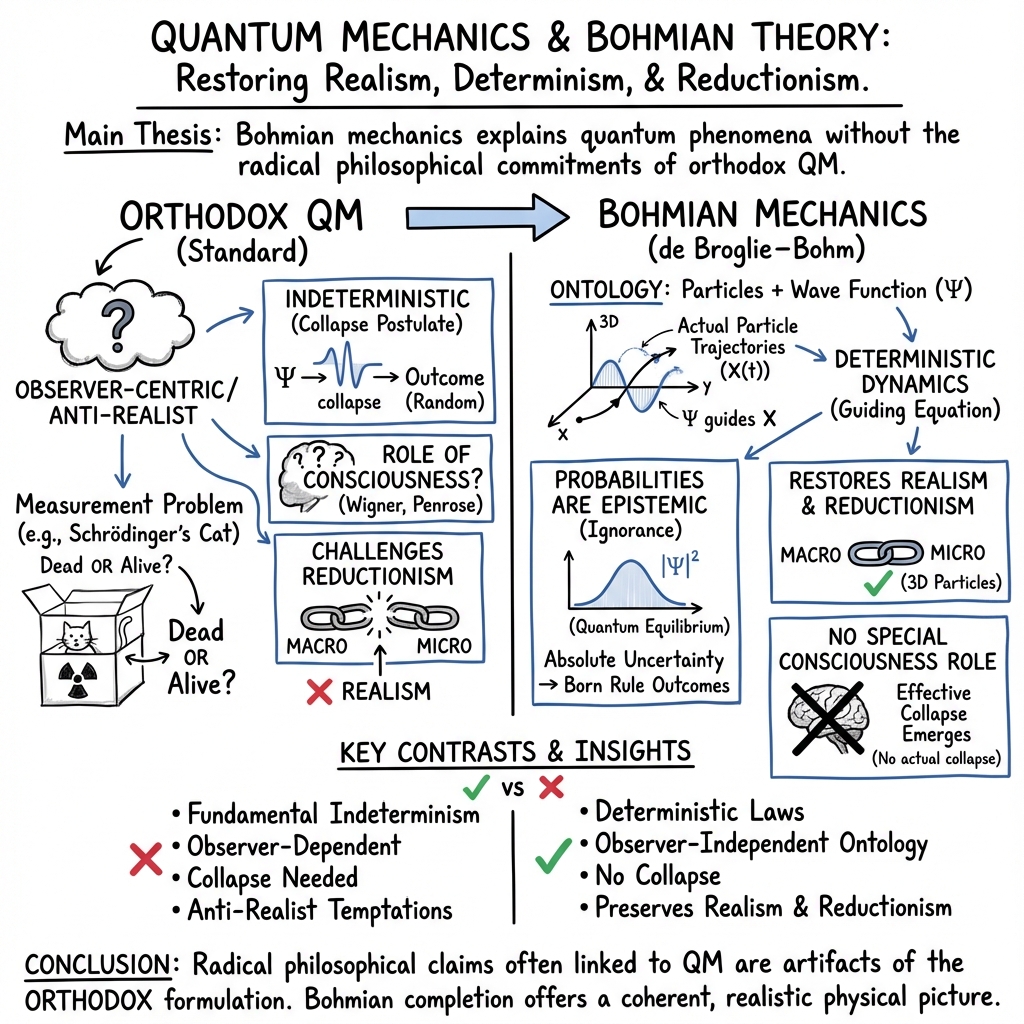
This paper talks about how we should understand quantum mechanics—the science of very tiny things like atoms and electrons. The authors compare the usual way quantum mechanics is taught (often called “orthodox” or “standard” quantum mechanics) with another approach called the de Broglie–Bohm theory (also known as Bohmian mechanics). They argue that Bohmian mechanics can explain all the same experiments while avoiding big, confusing claims—like “the world isn’t real unless we look at it,” “quantum physics proves free will,” or “mind changes matter.”
Key Questions the Paper Tries to Answer
Before getting into details, here are the main, simple questions the authors address:
- Does quantum mechanics really prove that the universe isn’t deterministic (i.e., that the future isn’t fixed by the present)?
- Does quantum randomness help explain free will or consciousness?
- Does quantum mechanics mean the world depends on observers (idealism), or can we keep believing in a mind-independent reality (realism)?
- Does quantum mechanics break reductionism—the idea that big things can be explained by smaller parts?
- Can a different version of quantum theory (de Broglie–Bohm) explain experiments without these controversial claims?
How the Paper Approaches These Questions
The paper doesn’t run lab experiments; instead, it compares ideas and models using logic, examples, and known results. Here’s the approach in everyday language:
- It explains two ways to think about quantum mechanics:
- Orthodox quantum mechanics: uses a “wave function” that sometimes evolves smoothly (like a calm wave) and sometimes “collapses” suddenly during measurements (like a wave snapping into a splash). The collapse is random.
- de Broglie–Bohm theory: says there are real particles with definite positions at all times, and a wave function guides them (like an invisible current guiding tiny boats). The wave never collapses; everything evolves continuously and deterministically.
- It shows both theories make the same testable predictions in the lab, but they tell different stories about what’s “really” happening.
- It uses simple analogies—like coin tosses, weather, and billiards—to explain the difference between determinism (how the world behaves) and predictability (what we can actually figure out).
- It clarifies tricky terms:
- Wave function: a math “map” that tells particles how to move.
- Born rule: a rule for calculating chances of different outcomes; in Bohmian mechanics, probabilities come from our ignorance about exact positions, not from true randomness.
- Measurement problem: in standard quantum mechanics, if you don’t add a special collapse rule, big objects (like a cat) would end up in weird “both alive and dead” superpositions, which we never see.
Main Findings and Why They’re Important
Here’s what the authors conclude, in plain terms:
- Determinism vs. predictability: Even if the world is deterministic (like a perfectly wound clock), we might still be unable to predict everything because tiny differences in starting conditions can lead to huge changes (think “butterfly effect”). So unpredictability doesn’t prove the world is non-deterministic.
- Quantum mechanics and randomness: In the orthodox view, randomness is fundamental—nature truly “rolls dice” when you measure. In Bohmian mechanics, the randomness comes from not knowing the exact starting positions of particles. The laws themselves are deterministic; the uncertainty is about our knowledge.
- Free will: Quantum randomness doesn’t give you control. A random outcome isn’t the same as a free choice. So quantum mechanics does not solve the free will puzzle.
- Consciousness: You don’t need consciousness to make quantum measurements work. Bohmian mechanics explains measurements as normal physical interactions, not mind-triggered events. Quantum theory, by itself, doesn’t solve the “mind-body problem” (how thoughts and feelings relate to the brain).
- Realism (is there a mind-independent world?): You can keep realism. Bohmian mechanics describes a world of particles moving along real paths, guided by a wave function. No need to say “the moon isn’t there unless we look.”
- Reductionism (explaining big stuff from small stuff): Quantum theory doesn’t break this idea. With a clear picture of particles and their dynamics, you can still explain everyday objects and their properties from the behavior of tiny parts.
These findings matter because they clear up common misunderstandings. They show you can seriously do quantum physics without saying that reality depends on observers, or that quantum theory magically gives humans free will, or that consciousness causes physical changes.
A Bit More on the Two Theories (in simple terms)
To keep things concrete, here are their different “stories” about measurements:
- Orthodox quantum mechanics:
- Between measurements: the wave function follows Schrödinger’s equation (smooth evolution).
- During measurements: the wave function “collapses” randomly to one outcome. The Born rule gives the probabilities.
- Problem: Why and how does “measurement” get special status? What counts as an observer? This leads to puzzles like Schrödinger’s cat.
- de Broglie–Bohm theory:
- Always: particles have exact positions and move along paths.
- The wave function always follows Schrödinger’s equation (no collapse).
- During measurements: the interaction between the system and the measuring device sorts particle positions into definite outcomes. We get the same experimental statistics (Born rule) because initial positions are distributed in a special way called “quantum equilibrium” (like starting all boats with a certain spread in a current).
- No special role for “observers”; measurements are just physical processes.
Implications and Potential Impact
- For physics: Bohmian mechanics offers a clear, realistic picture of the quantum world—particles and trajectories—while matching standard predictions. That can guide teaching, research, and how we talk about quantum foundations.
- For philosophy: It cautions against using quantum mechanics to “prove” big claims about free will, consciousness, or that reality depends on observers. Instead, it supports realism and reductionism.
- For everyday understanding: It helps people avoid overhyping quantum mysteries. Quantum physics is amazing, but it doesn’t force us to throw out common sense about an external world or think our minds magically change reality.
In short: the paper claims that we don’t need to adopt strange philosophical conclusions to make sense of quantum experiments. By using the de Broglie–Bohm theory, we can keep a clear, realistic, and deterministic picture of the world—without pretending quantum mechanics solves free will or the mystery of consciousness.
Knowledge Gaps
Knowledge gaps, limitations, and open questions
Below is a single, focused list of what remains missing, uncertain, or unexplored in the paper, formulated to be concrete and actionable for future research.
- Dynamical origin of quantum equilibrium: Provide a rigorous derivation (or clear conditions) under which generic initial distributions relax to the Born distribution ρ=|Ψ|² in de Broglie–Bohm (DBB) mechanics; quantify relaxation rates, identify classes of non-relaxing states, and assess cosmological constraints. Benchmark and extend Valentini’s “subquantum H-theorem” and relaxation scenarios.
- Scope and formalization of “absolute uncertainty”: Precisely state and prove the limits of epistemic access to particle positions in DBB; analyze whether weak/protective measurements, sequential measurements, or engineered ancillas can ever outperform |Ψ|² constraints without triggering disruptive back-action.
- Measurement theory in realistic settings: Develop explicit, experimentally faithful DBB models of measurement devices (with decoherence, noise, dissipation) that derive effective collapse and pointer basis selection; quantify when effective collapse breaks down, and identify signatures (if any) accessible in mesoscopic experiments.
- Spin and identical particles: Provide a clear, systematic DBB treatment of spin and exchange symmetry (e.g., spinor-valued guiding equations, absence/presence of “spin beables”); detail implications for Stern–Gerlach–type measurements and for ontology in many-fermion systems.
- Relativistic and QFT extensions: Construct fully interacting, Lorentz-invariant DBB models of quantum field theory (with particle creation/annihilation) or clarify the necessity and empirical invisibility of a preferred foliation; compare “particle-beable” vs “field-beable” approaches and catalogue open technical obstacles.
- Gauge fields and photons: Resolve the photon/beable problem by committing to and analyzing a DBB ontology for gauge fields (particle vs field beables, or hybrid); derive consequences for quantum optics, including spontaneous emission, antibunching, and Bell tests with photonic platforms.
- Nonlocality and causal structure: Make explicit how DBB accommodates Bell nonlocality while preserving operational no-signaling in relativistic space–time; test DBB in advanced network scenarios (e.g., bilocality, entanglement swapping, indefinite causal order) to probe for novel constraints.
- Classical limit with error bounds: Derive conditions and rigorous bounds under which Bohmian trajectories approximate classical (Newtonian or Hamilton–Jacobi) dynamics; quantify decoherence-assisted classicality and identify experimentally accessible mesoscopic regimes where deviations might be detectable.
- Empirical distinguishability and nonequilibrium: Propose concrete laboratory or cosmological probes for quantum nonequilibrium (ρ≠|Ψ|²), including sensitivity estimates, null tests, and reanalyses of existing data (e.g., cosmic microwave background, relic neutrinos, early-universe relics).
- Gravity and cosmology: Develop and test semiclassical couplings (Bohmian matter + classical gravity), assess energy–momentum conservation and back-reaction consistency, and explore Bohmian quantum cosmology (Wheeler–DeWitt/mini-superspace) for structure formation, initial conditions, and observational imprints.
- Status of the wave function in DBB: Go beyond a brief mention to evaluate competing stances (nomological, ontic field on configuration space, multi-field in 3D space), specify decision criteria (empirical neutrality, explanatory depth, simplicity), and examine whether any stance yields novel testable consequences or explanatory dividends.
- Reductionism via case studies: Work through detailed micro-to-macro derivations in a Bohmian framework (e.g., hydrodynamics, thermodynamics, solidity, transparency, chemical bonding), clarifying the role of emergent variables, effective theories, and coarse-graining.
- Time asymmetry and statistical mechanics: Clarify how low-entropy initial conditions, typicality measures, and coarse-graining produce irreversibility in a deterministic Bohmian universe; compare with Boltzmannian accounts and analyze whether DBB imposes distinctive constraints.
- Comparative assessment of realist alternatives: Provide a balanced, criteria-driven comparison of DBB, GRW, and Everett (ontology, dynamics, empirical reach, simplicity, explanatory power); map parameter spaces (e.g., GRW collapse rates) against current and prospective experimental bounds.
- Integration with neuroscience and consciousness: If consciousness supervenes on particle positions, develop explicit coarse-grained mappings from neural microstates to cognitive/phenomenal states; formulate consistency checks or indirect empirical constraints within a Bohmian physicalist picture.
- Agency and responsibility in a deterministic DBB world: Move beyond critique to articulate a positive, testable or at least formally precise model of agency compatible with DBB (e.g., compatibilist accounts grounded in neurodynamics, decision theory, and control-theoretic notions).
- Engagement with contemporary antirealist views: Systematically analyze QBism, relational QM, and related positions using precise points of disagreement, shared predictions, and potential discriminators (conceptual or empirical), rather than high-level critiques.
- Configuration-space vs 3D explanations: Evaluate explanatory trade-offs between configuration-space realism and 3D particle ontology in DBB by showing how the 3D macroworld emerges in each and by proposing metrics of explanatory economy and unification.
- Energy–momentum and conservation laws: Clarify definitions of local conserved quantities (including the role of the quantum potential) in DBB, especially in curved space–time or semiclassical gravity; examine consistency with stress–energy conservation and gravitational coupling.
- Pedagogical and methodological implementation: Translate the paper’s philosophical stance into concrete curricular materials (problems, simulations, lab modules) that teach standard calculational skills alongside DBB foundations; evaluate learning outcomes empirically.
Collections
Sign up for free to add this paper to one or more collections.

