- The paper identifies that embedding neural activity in hyperbolic space reveals hierarchical sensitivities in network behavior.
- It employs a nonlinear Hawkes process and Gaussian approximation to simplify complex spiking dynamics for analysis.
- Empirical simulations confirm that variations in excitation-inhibition balance notably shift the network's effective dimensionality.
Understanding the vast behavioral space of neural circuits is essential for advancing in computational neuroscience. This paper applies tools from information geometry to explore the high-dimensional complexities of spiking neural networks, aiming to quantify the effects of parameter changes on network behavior. By embedding probabilistic models of neural activity into a hyperbolic space, researchers can glean insights into the structure of these behaviors and their sensitivity to certain parameters.
Model Overview
Nonlinear Hawkes Process
The research begins with modeling spiking dynamics using a nonlinear Hawkes process. Each neuron's membrane potential evolves according to input currents and the history of interactions with other neurons, leading to a Poisson-like spike train. The membrane dynamics follow:
dtdVi=−τm−1(Vi−εi)+Ii+τs−1(μext−Jselfn˙i(t)+j=1∑nwijn˙j(t))
This complex model is simplified under a Gaussian approximation, reducing the computation to a population-level description.
Population-Averaged Model
The Gaussian approximation leads to reduced dynamics:
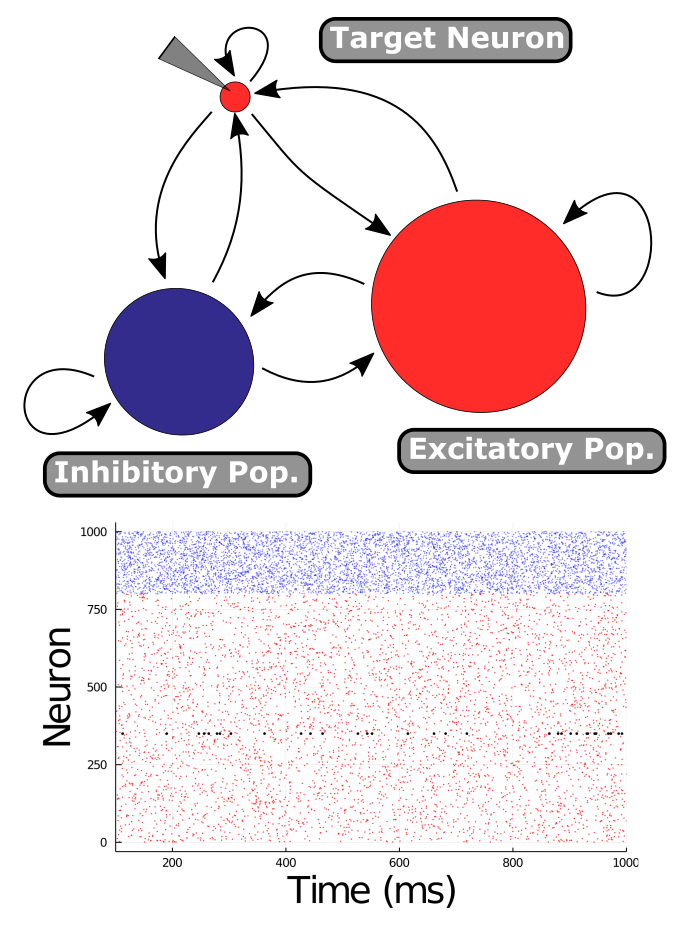
Figure 1: Network model (A) A graphical representation of the network architecture being studied. (B) An example raster plot generated from an extended network of spiking neurons.
In this approximation, the membrane potentials of neuron populations evolve according to:
dV=A(Vmf−V)dt+ΣdWt
where A reflects the drift dynamics, and Σ captures the stochastic influences.
isKL Embedding
The intrinsic dimensional structure of neural activity is explored using the isKL embedding technique, mapping probabilistic models onto a Minkowski-like space. This method leverages the symmetric KL-divergence as an effective distance between models with different parameter settings:
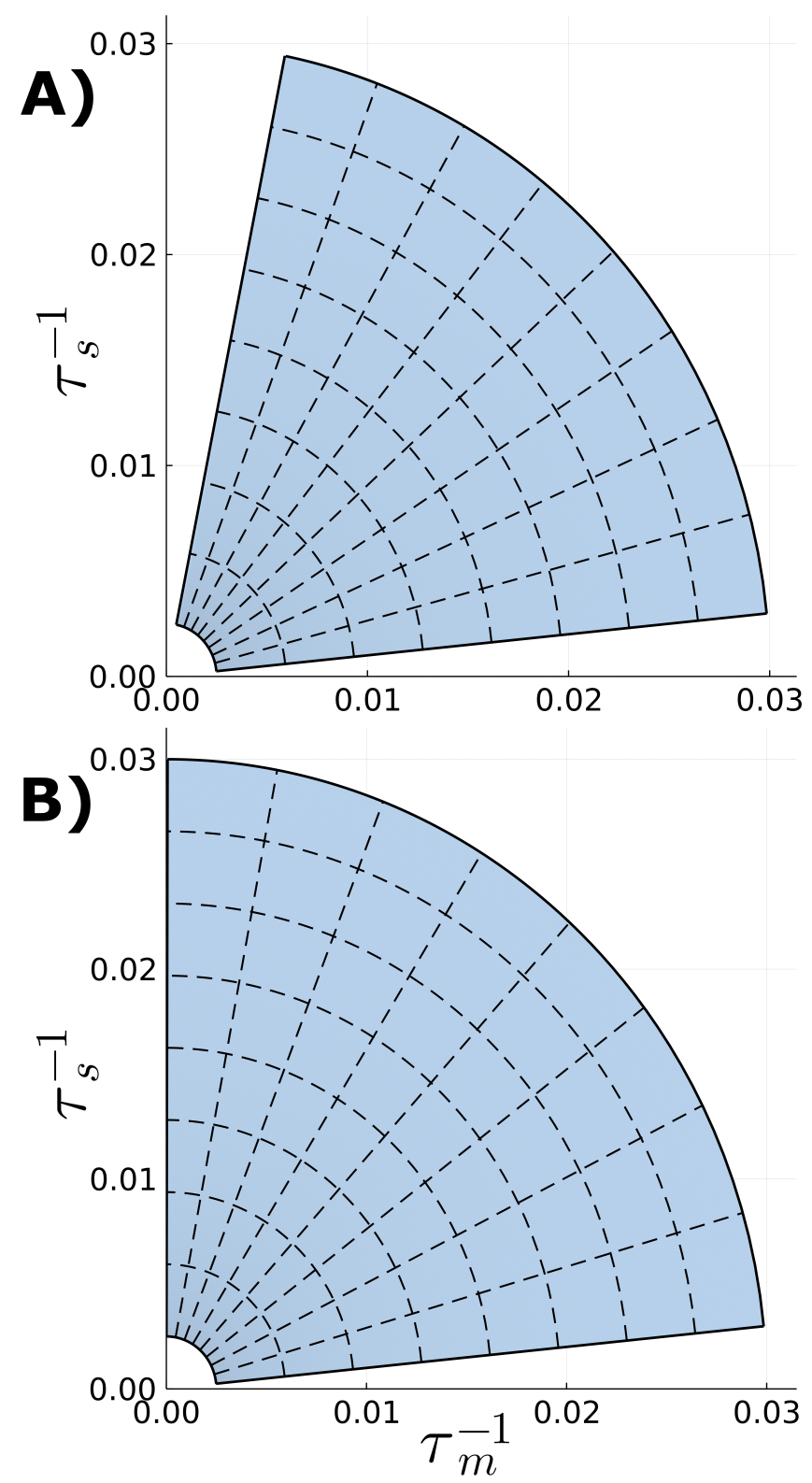
Figure 2: Visualizations of the isKL embedding coordinate functions.
Embedding coordinates are derived from exponential family models, allowing analysis of network sensitivity to parameter changes.
Hierarchical Sensitivities
The resulting behavioral manifolds exhibit hierarchical sensitivities. In such structures, certain parameter combinations significantly alter network output, while others contribute to minor adjustments.
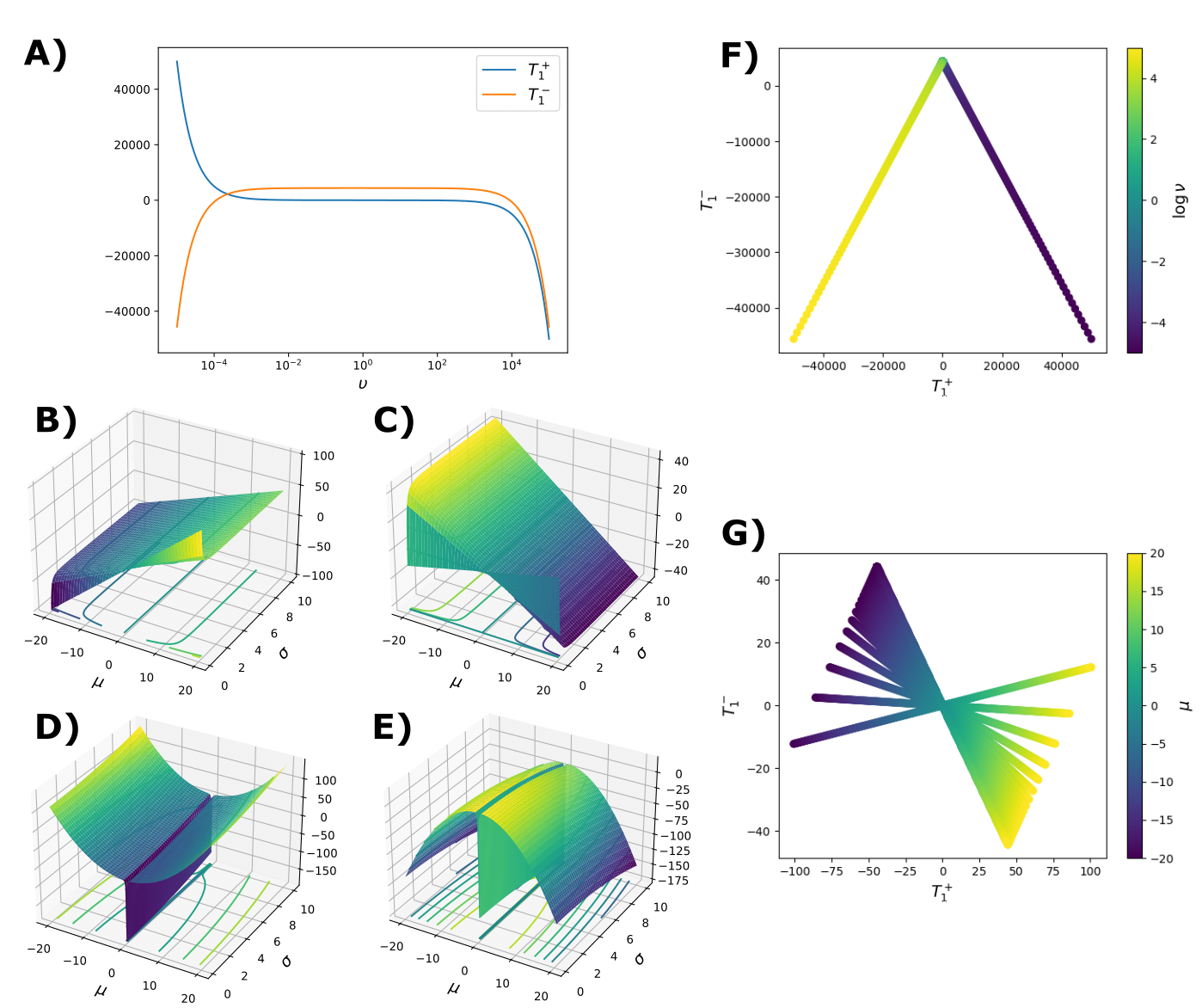
Figure 3: Largest manifold projections indicating stiff directions dominating network behavior.
These hierarchical structures are found to shift with excitation-inhibition (E/I) balance, underscoring the dynamic nature of neural configurations.
Empirical Verification
(Later sections detail how these theoretical predictions were verified against full-network simulations. Spiking dynamics were simulated across various timescale settings, confirming the Gaussian approximations.)

Figure 4: Membrane potential dynamics of spiking network models.
Behavioral Space Projections
As E/I ratios change, the manifold's projection hierarchy adapts, revealing how structural properties emerge from the embedded dimensions:
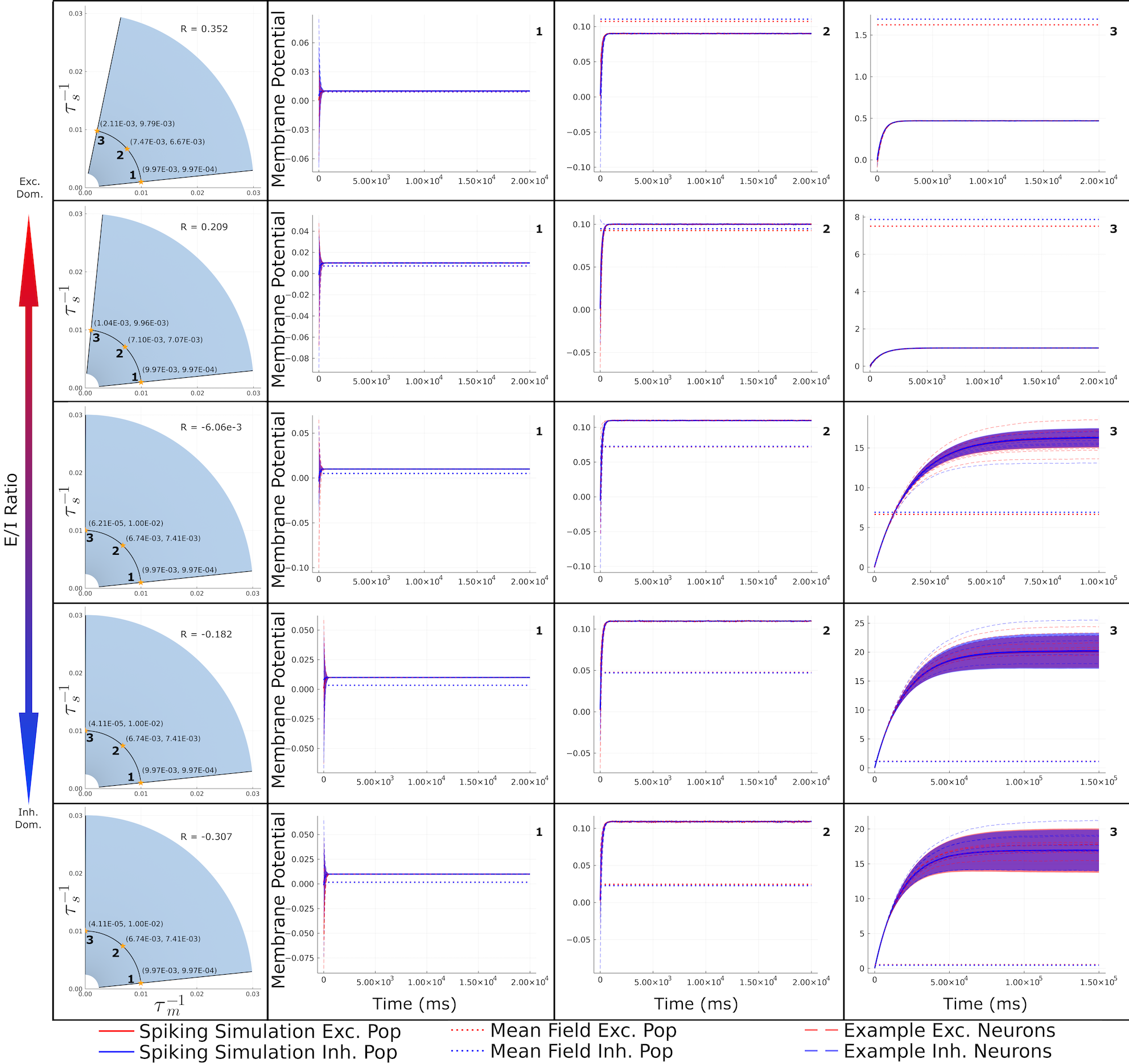
Figure 5: Coordinate evolution as E/I balance is tuned.
Understanding these embeddings helps pinpoint which structural parameters chiefly influence network behavior, aiding in the design of targeted interventions for neurological applications.
Conclusion
The paper systematically applies information geometry to unpack the complex dynamics of spiking neural networks, revealing hierarchical sensitivities in parameter spaces. This approach provides a novel lens for viewing neural function, opening pathways for deeper insights into both normal and pathological states. The embedded analyses serve as robust predictors of network behavior, potentially guiding the development of therapies for neurodisorders by manipulating cardinal features of network structure. Future work should extend these models to dynamic tasks, assessing temporal evolutions in neural coding.
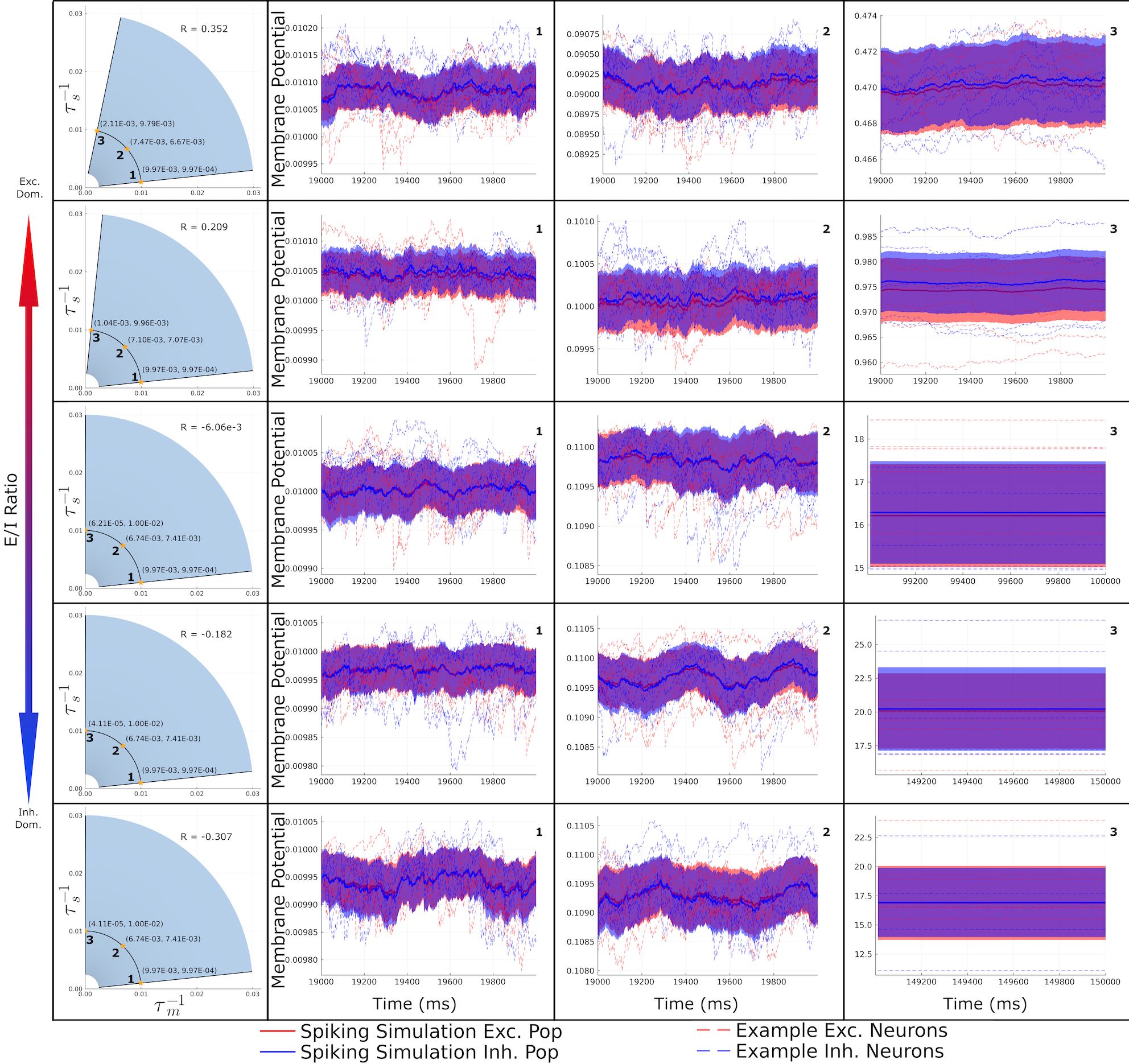
Figure 6: Effective dimensionality of model manifolds across E/I conditions.

