Chern insulator in a hyperbolic lattice
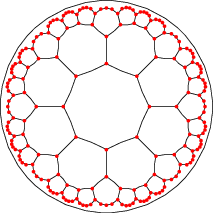
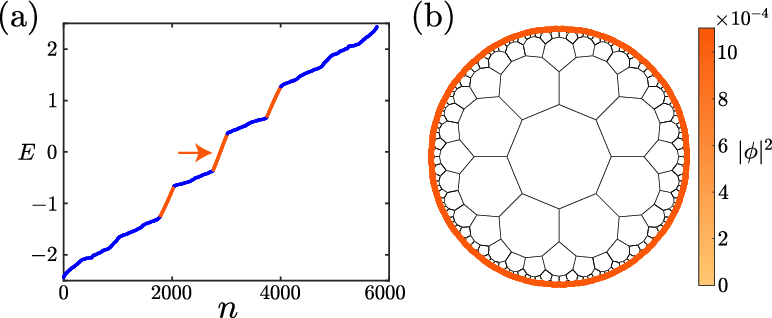
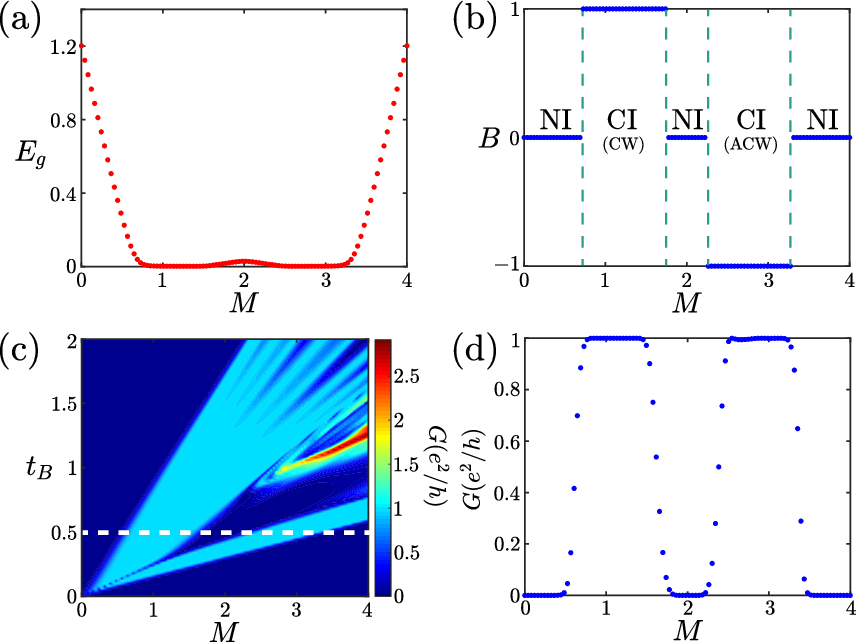
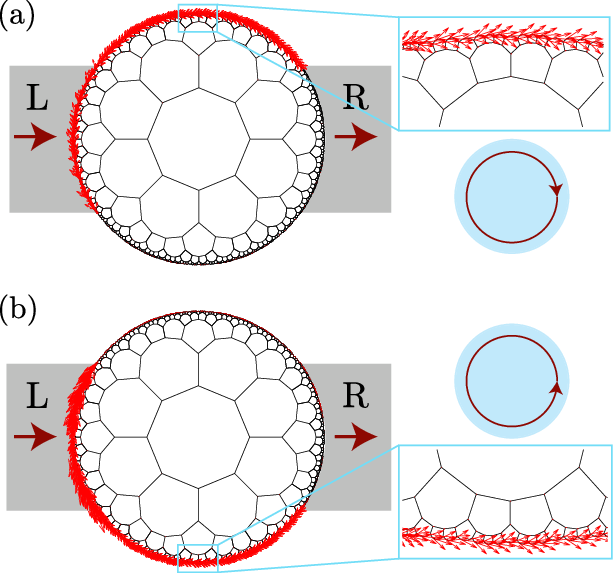
Abstract: Motivated by the recent experimental realizations of hyperbolic lattices in circuit quantum electrodynamics and the research interest in the non-Euclidean generalization of topological phenomena, we investigate the Chern insulator phases in a hyperbolic ${8,3}$ lattice, which is made from regular octagons ($8$-gons) such that the coordination number of each lattice site is $3$. Based on the conformal projection of the hyperbolic lattice into the Euclidean plane, i.e., the Poincar\'{e} disk model, by calculating the Bott index ($B$) and the two-terminal conductance, we reveal two Chern insulator phases (with $B=1$ and $B=-1$, respectively) accompanied with quantized conductance plateaus in the hyperbolic ${8,3}$ lattice. The numerical calculation results of the nonequilibrium local current distribution further confirm that the quantized conductance plateau originates from the chiral edge states and the two Chern insulator phases exhibit opposite chirality. Moreover, we explore the effect of disorder on topological phases in the hyperbolic lattice. It is demonstrated that the chiral edge states of Chern insulators are robust against weak disorder in the hyperbolic lattice. More fascinating is the discovery of disorder-induced topological non-trivial phases exhibiting chiral edge states in the hyperbolic lattice, realizing a non-Euclidean analog of topological Anderson insulator. Our work provides a route for the exploration of topological non-trivial states in hyperbolic geometric systems.
Paper Prompts
Sign up for free to create and run prompts on this paper using GPT-5.
Top Community Prompts
Collections
Sign up for free to add this paper to one or more collections.